
Does shop location or service area affect an electrician Maps ranking?
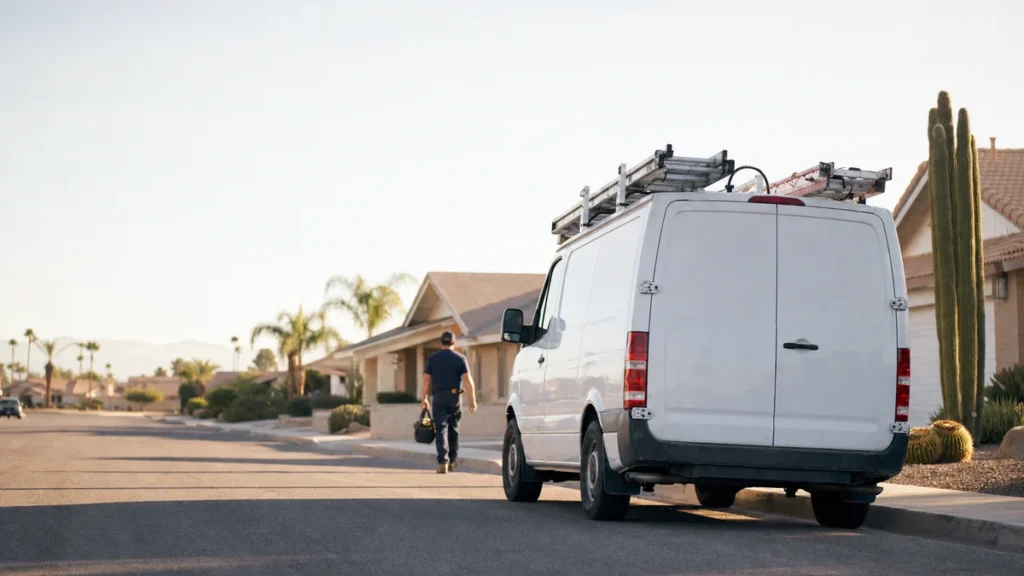
- How much does my shop location or service area affect my Google Maps rankings?
- How does Google use location to rank electricians on Maps?
- Why do I rank near my shop but not across town?
- Does my service area setting decide where I show up?
- Should my electrical company show its address or hide it?
- Can I use a virtual office to rank in a bigger city?
- What can I change to rank in towns farther from my shop?
- Should I open a second location to rank in another area?
- What happens to my ranking if I move the shop?
- How do I reach towns the map won't give me?
- What's different about location for electricians
- A worked example: one shop, three towns
- Frequently asked questions
- Key takeaways
- More in this section
- Sources
The short version
- Google says local results are mainly based on relevance, distance and popularity.
- Distance is measured from the searcher, so you usually rank best near your base.
- Your service area shows where you work; it doesn't erase the distance from your base.
- In farther towns, close the gap with relevance and reviews, or reach them with ads.
For electrical contractors who show up near the shop but disappear a few towns over, and want to know what their location and service area can and can’t change.
Get a free visibility audit · Book a growth call
How much does my shop location or service area affect my Google Maps rankings?
Yes, your location matters a lot, because distance is one of the three things Google says local results are mainly based on, along with relevance and how well known your business is. Distance is measured from the person searching, so an electrician usually ranks best in the towns closest to where the business is based. Your service area tells customers where you work and helps people find your profile, but Google doesn’t say it lets you rank equally across that whole area, so in farther towns you have to make up the gap with relevance and reviews, or use ads.
That’s how we plan local SEO for a service business: strongest in the towns closest to your base, built outward with real work, reviews and pages, and with ads covering the towns that are too far for the map to reach. Our local SEO service includes Google profile management and syncing your name, address and phone across 50+ directories, and our electrical contractor marketing page explains how it fits an electrical shop. More answers are in the electrical marketing questions library.
How does Google use location to rank electricians on Maps?
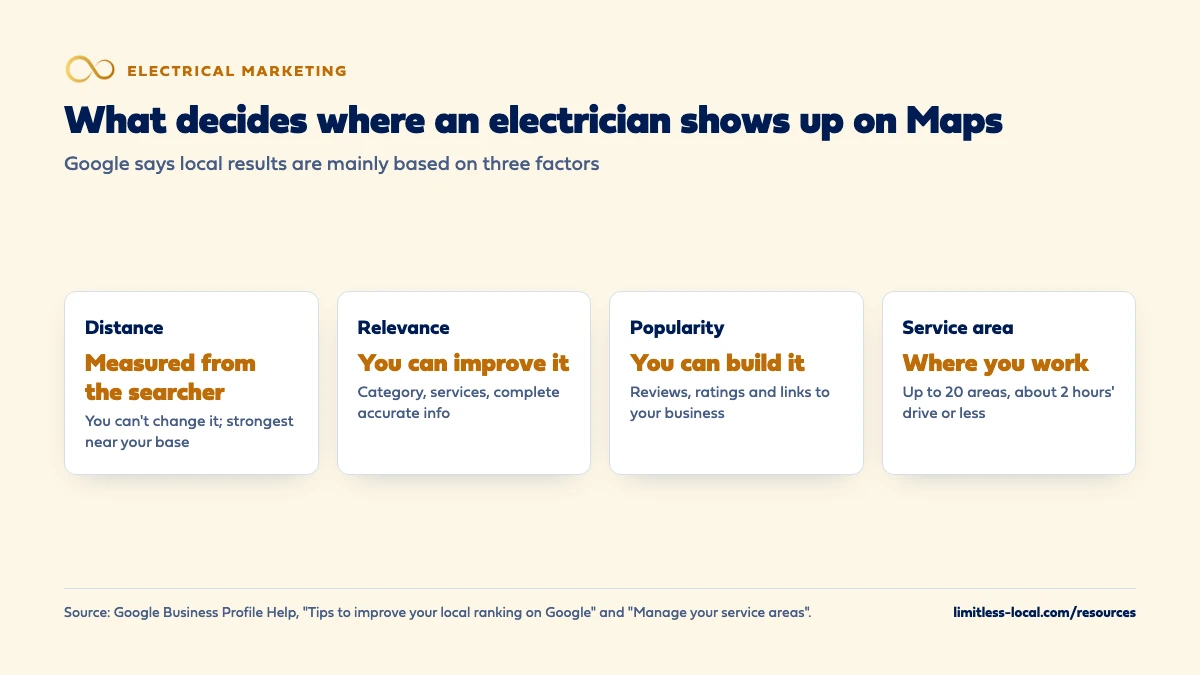
Google says local results are mainly based on three things: relevance, distance and popularity. Relevance is how well a Business Profile matches what someone searched. Distance is how far each business is from the customer who’s searching, and if the customer doesn’t share where they are, Google uses what it knows about their location. The third, which the same page also calls prominence, is how well known a business is, based partly on how many websites link to it and how many reviews it has.
Google also says there’s no way to request or pay for a better local ranking. So your location isn’t a setting you can tweak for a better spot; it’s a fact about your business that Google weighs against how relevant and well known you are. A strong profile can outrank a closer one, but a closer business starts with an edge.
Why do I rank near my shop but not across town?
Because distance is measured from the searcher, your ranking isn’t one number. A homeowner searching “electrician” from the street your shop is on and one searching from a suburb half an hour away can see two different lists, and you might be at the top of one and missing from the other.
In our judgement, this is the most common surprise for electricians who check their ranking from the office. Of course you look good from there: you’re as close as it gets. To see what customers see, check from the towns you actually want work in, or ask someone who lives there. Why a competitor electrician ranks above you on Google Maps covers how to compare your profile with theirs once you know where you’re losing.
Does my service area setting decide where I show up?
Not on its own. Google says setting a service area helps people find your Business Profile and shows customers where you can provide your services. It doesn’t say that listing a town lets you rank there the way you rank near your base, and distance from the searcher still counts.
Google’s rules for the setting:
- You can set up to 20 service areas, by city, postal code or another type of area.
- You can’t set it as a radius around your business.
- The boundaries of your overall area shouldn’t be more than about 2 hours of driving time from where your business is based, though Google notes larger areas may be appropriate for some businesses.
- Be as specific and accurate as possible.
- If approved, edits may take up to 48 hours to show on the profile.
In our judgement, the honest setting is the towns your trucks actually go to. Listing towns you won’t drive to doesn’t move you up there, and it can bring calls you’ll turn down.
Should my electrical company show its address or hide it?
It depends on whether customers come to you. Google sorts service businesses into two types:
- Service-area business: visits customers but doesn’t serve them at its address. Google uses plumbers as an example, and most residential electricians work the same way. Google says to remove the address from the profile and show only the service area, and that a business run from a home address should clear that address.
- Hybrid business: serves customers at its address and also travels to them. It can show the address and a service area, but Google says the location should be staffed and able to receive customers during its stated hours.
Google also says businesses that show their address should keep permanent signage with the business name there, and that a business without a storefront with clear signage that travels to customers is allowed one service-area profile. Hiding the address only changes what customers see: Google still asks for a business address it can find in order to verify the profile. Setup details are in how to optimize your electrician Google Business Profile.
Curious what your marketing is actually booking?
Get a free visibility audit — no obligation, no sales pitch.
Can I use a virtual office to rank in a bigger city?
No. Google’s guidelines say a rented mailing address that the business doesn’t operate out of, which Google calls a virtual office, isn’t eligible for a Business Profile, and that P.O. boxes or mailboxes at remote locations aren’t acceptable. Service-area businesses can’t list a virtual office unless it’s staffed during business hours, and an office in a co-working space only counts if it has clear signage, receives customers during business hours and is staffed by your own people.
Google also says that to keep a profile from being suspended, your address or service area has to be accurate and precise. A fake address can put the whole profile at risk, and with it the calls you already get near your real base. If you want work in a city you’re far from, the honest routes are below.
What can I change to rank in towns farther from my shop?
You can’t change the distance, but you can work on the other two factors Google names:
- Relevance. Pick the most specific category and list the services you want more of. Google says businesses with complete and accurate info are more likely to show up in local search results.
- Popularity. More genuine reviews and positive ratings can help your local ranking, Google says, and so can more websites that link to your business. Reviews from customers in the farther towns also give people there a reason to pick you; how many Google reviews an electrician needs covers the targets.
- Your website. In our judgement, pages about real work in those towns help the site rank in the regular results, which don’t lean on distance from your base the way the map does. How many city pages an electrician’s website should have covers how far to take that.
In our judgement, expect the map to stay strongest near your base even after this work. The goal is to widen the circle where you compete, not to rank everywhere.
Should I open a second location to rank in another area?
Only if it’s a real location. Google says that if you have different locations for your service business, with separate service areas and separate staff at each location, you’re allowed one profile for each location. A second profile without its own staff and service area breaks the guidelines and can get suspended.
In our judgement, a second location makes sense when you’re already sending trucks to that area regularly and the work there would justify a staffed base. Opening one only for the map listing tends to cost more than it brings.
What happens to my ranking if I move the shop?
Your location changes, so where you rank strongest moves with it. Google says edits to a verified profile are reviewed to make sure they follow its guidelines, which usually takes about ten minutes but sometimes up to 30 days, so plan the change ahead of the move date.
In our judgement, expect your strongest towns to shift toward the new base, and plan for some lost ground in the towns near the old one. Update the address, or the service area if you don’t show an address, everywhere your business is listed so the details match: your website, directories and the trucks. Which local citations and directories matter for electricians lists where to check.
How do I reach towns the map won't give me?
With paid ads, pointed at the towns you choose. Google says nobody can pay it for better treatment in how its search algorithms rank websites, and that there’s no way to pay for a better local ranking, so ads won’t lift your map position. What they can do is put you in front of searchers in towns where you don’t rank. Google Ads location targeting shows your ads in the locations you select, and depending on the country you can target regions, cities or postal codes. Google’s own service-area help page also points service businesses to Local Services Ads as a way to reach more people.
Draw those ad areas as carefully as the profile. How tight an electrician’s Google Ads service area should be walks through the settings, so you aren’t paying for calls from towns you’d turn down.
What's different about location for electricians
Most electricians are service-area businesses. Customers rarely visit an electrical shop, so the address is usually hidden, and many owners start from home. That’s allowed; Google says to clear a home address from the profile and show the service area.
Emergency calls are the most local of all. Someone with no power or a burning smell searches right now and calls one of the first electricians they see. In our judgement, that’s the work where being close to the searcher matters most.
Planned jobs travel farther. Homeowners planning a panel upgrade, an EV charger or a generator often compare a few estimates first, so a strong website and reviews can win work beyond the towns where you top the map.
Licensing has its own boundaries. If your service area crosses a state line, licensing and permit rules can differ. Check with each state’s licensing board before you list towns there.
Want to see where your company stands?
A free visibility audit shows where you show up on Google, Maps and AI answers, and what it's costing you in calls.
A worked example: one shop, three towns
The towns and numbers here are made up to show the thinking, not a benchmark for your market. Say your shop is in Town A, and you want more panel upgrades in Town B, 12 miles away, and Town C, 30 miles away. You check a search for “electrician” from each town:
- Town A: you’re in the top three map results. Keep the profile current and keep reviews coming.
- Town B: you’re 7th. That’s within reach. Add a page about your work there, ask customers there for reviews, and make sure panel upgrades are listed as a service.
- Town C: you don’t show up at all. The map is unlikely to give you this town while you’re based 30 miles away, so a tightly targeted ad for panel upgrades is the faster route if the jobs there are worth the drive.
The decision in each town comes down to the same question: what’s a booked job there worth after the drive time, and which route gets it for less?
Frequently asked questions
Does listing more cities in my service area help me rank in them?
Google doesn’t say it does. It says the service area helps people find your profile and shows where you work, while distance from the searcher still counts. List the towns you really serve.
Can I put my home address on my electrician Google profile?
Google asks for a business address it can find to verify the profile, but it says a service business run from a home address should clear that address from the profile and show a service area instead.
Do keywords in my business name help me rank in a city?
No. Google’s guidelines say to represent your business as it’s consistently known in the real world, across signage, stationery and other branding. Extra information in the name, such as service or location details that aren’t part of your real-world name, isn’t permitted and could get the profile suspended.
Why does my ranking change depending on where I search from?
Because Google measures distance from the person searching. Moving a few miles can change which businesses are closest, so the list changes too.
Can I have one Google profile per town I serve?
No. Google says a service-area business can only have one profile for the whole area it serves. A separate profile is allowed only for a separate location with its own staff and service area.
Will Local Services Ads cover towns where I don't rank on the map?
Ads are shown separately from the map results, so they can reach towns where you don’t rank, and Google’s service-area help page points service businesses to Local Services Ads to reach more people. Keep any ad area to towns you’ll actually drive to.
Key takeaways
- Google says local results are mainly based on relevance, distance and popularity, and you can’t pay for a better local ranking.
- Distance is measured from the searcher, so most electricians rank best in the towns nearest their base.
- The service area shows where you work; set it to towns your trucks really go, up to 20 areas.
- Virtual offices and extra profiles without real staff break Google’s guidelines and put the profile at risk.
- Widen your reach with relevance, reviews and town pages, and use ads for towns the map won’t give you.
Not sure what's working right now?
Start with a free visibility audit: rankings, Google profile, reviews and tracking, checked against your service area.
More in this section
- Why is a competitor electrician ranking above me on Google Maps?
- Which local citations and directories matter for electricians?
- Electrician Google Ads geotargeting: how tight a service area?
- Are Google Local Services Ads worth it for electricians?
- What website content helps electrician customers choose me?
Sources
- Tips to improve your local ranking on Google — Google Business Profile Help
- Manage your service areas for service-area & hybrid businesses — Google Business Profile Help
- Guidelines for representing your business on Google — Google Business Profile Help
- Manage your business address — Google Business Profile Help
- Understand what happens to your Business Profile edits — Google Business Profile Help
- How Does Google Determine Ranking Results — Google Search
- Target ads to geographic locations — Google Ads Help