
How do I fix inconsistent business info online as a plumber?
- How does a plumbing company clean up wrong names, numbers and hours across the web?
- What counts as inconsistent business info for a plumber?
- Why does inconsistent info hurt a plumbing company?
- Step 1: What's the one correct version of my info?
- Step 2: How do I find every listing for my plumbing company?
- Can AI tools help me find and fix the mismatches?
- Step 3: Which listings should I fix first?
- How do I fix Apple Maps and Bing listings?
- What do I do about duplicates and old addresses?
- How do tracking numbers fit with consistent info?
- How do I keep my plumbing info consistent after the cleanup?
- Should I fix my listings myself or pay someone?
- What's different about business info for plumbing companies
- A worked example: cleaning up after a move and a phone change
- Frequently asked questions
- Key takeaways
- More in this section
- Sources
The short version
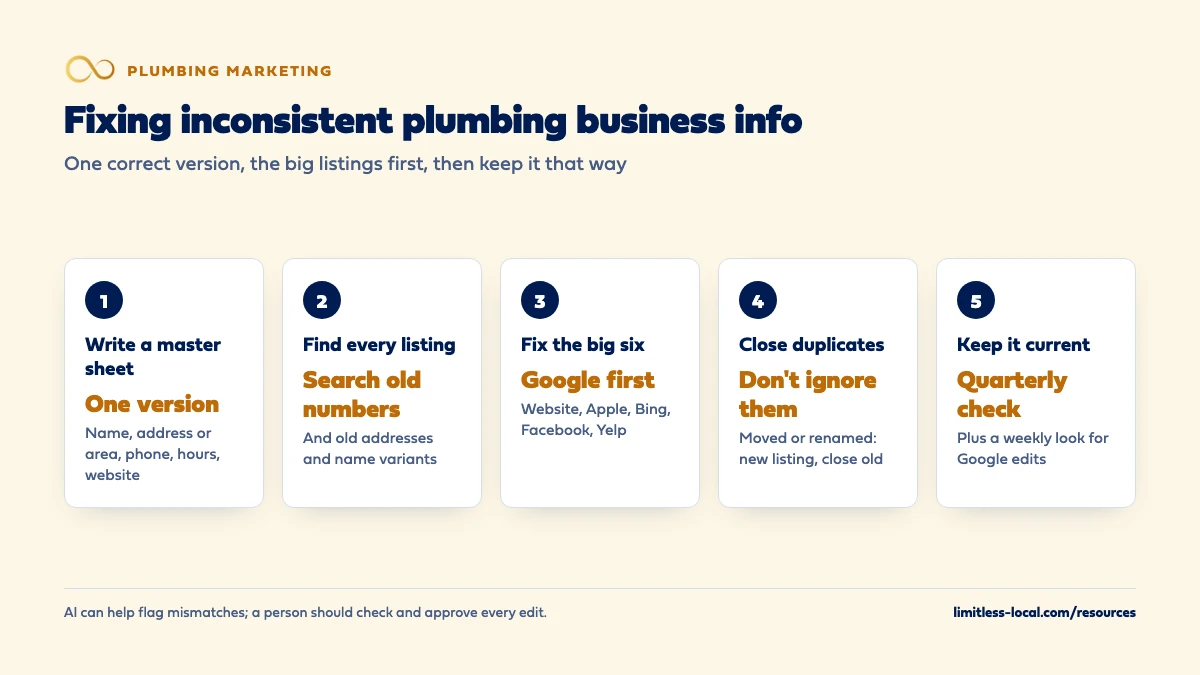
- Decide one master version of your name, address or service area, phone, hours and website.
- Fix Google, your website, Apple, Bing, Facebook and Yelp before anything else.
- Close duplicates and old addresses instead of leaving them to argue with your real listing.
- Use AI to find mismatches, not to log in and change listings for you.
For plumbing owners whose company name, phone number, address or hours show up differently across Google, Apple, Bing, Yelp and the rest.
Get a free visibility audit · Book a growth call
How does a plumbing company clean up wrong names, numbers and hours across the web?
Write down one correct version of your plumbing company’s name, address or service area, phone number, hours and website, then fix the listings that feed everything else first: your Google Business Profile, your own website, Apple Maps, Bing, Facebook and Yelp. After that, work through the smaller directories, merge or close duplicates and old addresses, and keep a simple checklist for every future change. AI tools can speed up the hunt for mismatches, but you or someone on your team should check and fix each listing by hand.
Listing cleanup is part of the first phase of every plumbing marketing package: we clean up and build out your listings and sync your name, address and phone across 50+ directories, then keep them that way. More on how that fits our local SEO work is on that page, and the rest of the plumbing marketing questions library goes question by question.
What counts as inconsistent business info for a plumber?
Anything that tells a homeowner, or Google, two different stories about the same company. For plumbing shops, the usual suspects are:
- The name. “Smith Plumbing” on Google, “Smith Plumbing & Drain LLC” on Yelp and “Smith Bros” on Facebook.
- The phone number. An old landline, a cell from the early days, an old tracking number or the answering service’s line.
- The address. The shop you moved out of, or your home address from before you set up as a service-area business.
- Hours. “Open 24 hours” on one listing, 8 to 5 on another.
- Service areas. Towns you stopped covering, or a radius that doesn’t match the one in your ads.
- The website. An old domain, a page that no longer exists, or a lead site’s page instead of yours.
None of these looks like a big deal on its own. Together, they cost calls.
Why does inconsistent info hurt a plumbing company?
The first cost is simple: a homeowner with a leak calls a dead number, sees the wrong hours, or drives to an empty building. That call goes to the next plumber.
The second is how listings feed each other. Google’s help on how it sources business information says profiles are compiled from crawled web content like your own website, licensed data from third parties, and users who suggest facts like addresses and phone numbers. So a wrong number sitting on an old directory can find its way back to the profile that matters most.
And Google’s tips to improve your local ranking say businesses with complete and accurate info are more likely to show up in local results, and that inaccurate info can keep your profile from showing up for relevant searches in your area.
Step 1: What's the one correct version of my info?
Write it down before you touch a single listing. A one-page master sheet with:
- Name exactly as it’s on your trucks, invoices and website.
- Address or service area. A real, staffed location, or the towns you cover with no address shown.
- Main phone number. One local number you control, that someone answers.
- Hours, including how you list emergency service.
- Website, exact URL, and the main categories and services.
Google’s guidelines for representing your business set some limits here. Your name should be your real-world name, as used consistently on your storefront, website and stationery, and adding extra keywords to it isn’t permitted and can lead to suspension. The phone number must be under your direct control, and a local number is preferred over a call center line. Service-area businesses can’t list a virtual office, and the overall service area shouldn’t extend farther than about two hours of driving from where you’re based. If a name with stuffed keywords has already got you in trouble, what to do when a plumbing Google profile is suspended covers the way back.
Step 2: How do I find every listing for my plumbing company?
Search for yourself the way a stranger would, and keep a spreadsheet as you go: site, what it shows, and whether it’s right.
- Search your business name, plus your town.
- Search every phone number you’ve ever used, in a few formats. Old numbers turn up listings you forgot existed.
- Search your old addresses if you’ve moved.
- Check the big ones by name: Google, Apple Maps, Bing, Facebook, Yelp, Nextdoor, the BBB, Angi and any lead sites you’ve used.
- Check the trade-specific ones: water heater and water softener brands’ find-a-pro pages, supply house directories, your local chamber and any licensing lookups.
- Don’t forget your own stuff: website footer and contact page, email signature, invoices, truck wraps and yard signs.
Most shops find more listings than they expected, and a surprising number they never created.
Can AI tools help me find and fix the mismatches?
Yes, for the tedious parts. Once your spreadsheet is filled in, paste it into an AI assistant along with your master sheet and ask it to flag every row where the name, phone, address, hours or website doesn’t match exactly, including small differences like “St” and “Street” or a missing suite number. It’s good at that kind of side-by-side checking.
It can also draft a short, consistent business description you can reuse, and write a checklist for each site’s edit steps from the help pages you paste in.
Where it falls down: it can be wrong or out of date about what a listing currently shows, so check each one with your own eyes. And don’t hand an AI tool your passwords or let it log in and make changes. You want a person who knows the business approving every edit.
One more use: ask an AI assistant what it knows about your company’s hours and phone number. If it gives you an old number, that’s a clue an old listing is still out there. Getting a plumbing company recommended by ChatGPT covers the AI side in more depth.
Curious what your marketing is actually booking?
Get a free visibility audit — no obligation, no sales pitch.
Step 3: Which listings should I fix first?
Fix the ones that feed the others, and the ones homeowners actually use:
- Your Google Business Profile. The one most calls come from.
- Your website. Google crawls it, so it should match your profile word for word.
- Apple Maps and Bing. They power maps and search on a lot of phones and computers.
- Facebook and Yelp. Widely used and often copied.
- Everything else, from the biggest directories down.
While you’re in your Google profile, look for edits Google made itself. Google’s help on Google updates to your profile says info changed by Google shows in blue in the profile editor. When a user suggests an edit that needs your review, you may get an email or a notice, and you have four days to accept or reject it before Google may publish it, if it’s backed by other public info such as your website. That’s one more reason to fix the website early. Optimizing your plumbing Google Business Profile covers the rest of the profile once the basics are right.
How do I fix Apple Maps and Bing listings?
Apple. Claim your location in Apple Business. Apple’s help on maintaining location accuracy says customers can report problems from your place card, and Apple may edit your location name, status or hours based on those reports and email you when it does. You can accept the change or contest it, and a name change goes to Apple for a review that can take up to five business days. Keep your hours current there so customers don’t report you as closed.
Bing. Claim or create your listing in Bing Places for Business. Bing says it pulls listing info from many sources, and other sources may take priority if your Bing Places data hasn’t been updated in more than six months or conflicts with what it’s getting elsewhere. If you’ve changed your name or moved, Bing recommends creating a new listing and marking the old one closed, instead of editing the old one, to avoid conflicting info.
What do I do about duplicates and old addresses?
Don’t leave them sitting there. A second listing with your old number or old shop address competes with your real one and confuses everyone who finds it.
- On sites you control, merge the duplicate or mark it closed or moved, depending on what the site offers.
- On sites you can’t claim, use the site’s report or suggest-an-edit option, and note it on your spreadsheet to check again in a month.
- If you used your home address before switching to a service area, check that the home address is gone everywhere, not just on Google.
If you’re not sure whether your plumbing company should show an address at all, whether a plumbing company should be set up as a service-area business walks through it.
How do tracking numbers fit with consistent info?
Carefully. Tracking numbers are how you learn which marketing books jobs, but scattering them across directories is one of the fastest ways to create the mismatch you’re trying to fix.
A simple rule: your main local number goes on your listings and in your website’s footer, everywhere a business’s contact details are copied. Tracking numbers go where you’re measuring something specific, like ads or one campaign landing page. Google’s guidelines say additional phone numbers can be used on Business Profile websites and other local surfaces, and that the number must be under your direct control, so keep every tracking number in an account you own.
If you ever drop a tracking provider, update or move those numbers before you cancel, or old listings will start ringing nowhere. Whether directory citations are worth paying for goes deeper on tracking numbers and listings.
How do I keep my plumbing info consistent after the cleanup?
Treat your master sheet like any other business record. Every time something on it changes, the change goes out to the top listings that same week.
The changes that usually cause trouble:
- A new phone system or answering service.
- A move, or switching to a service area.
- New or seasonal hours, and holiday hours.
- Adding or dropping towns.
- A rebrand or a new name on the trucks.
Then build in two habits. Glance at your Google profile weekly for blue Google edits and suggested changes. And once a quarter, re-run the searches from Step 2 to catch anything new. It’s an hour, and it saves you finding out from a customer who called the wrong number.
Should I fix my listings myself or pay someone?
If you’ve never moved, never changed numbers and only have a handful of listings, you can fix it yourself in an afternoon or two. Start with the big six and work down.
If you’ve moved, rebranded, changed phone systems or used several tracking numbers over the years, the hunt takes longer, and the long tail of directories is where paid help earns its keep. Either way, the master sheet and the first six listings are on you: nobody knows the right answers better than the owner.
Not sure which of these is costing you jobs?
A free visibility audit checks the Google profile, reviews, site and tracking, and shows what to fix first.
What's different about business info for plumbing companies
Emergency hours have to match everywhere. If your Google profile says open 24 hours but Yelp says 8 to 5, a homeowner with a burst pipe at night might skip you, or call and get nobody. Pick how you list emergency service and use it on every listing, and make sure the phone is answered when you say it is.
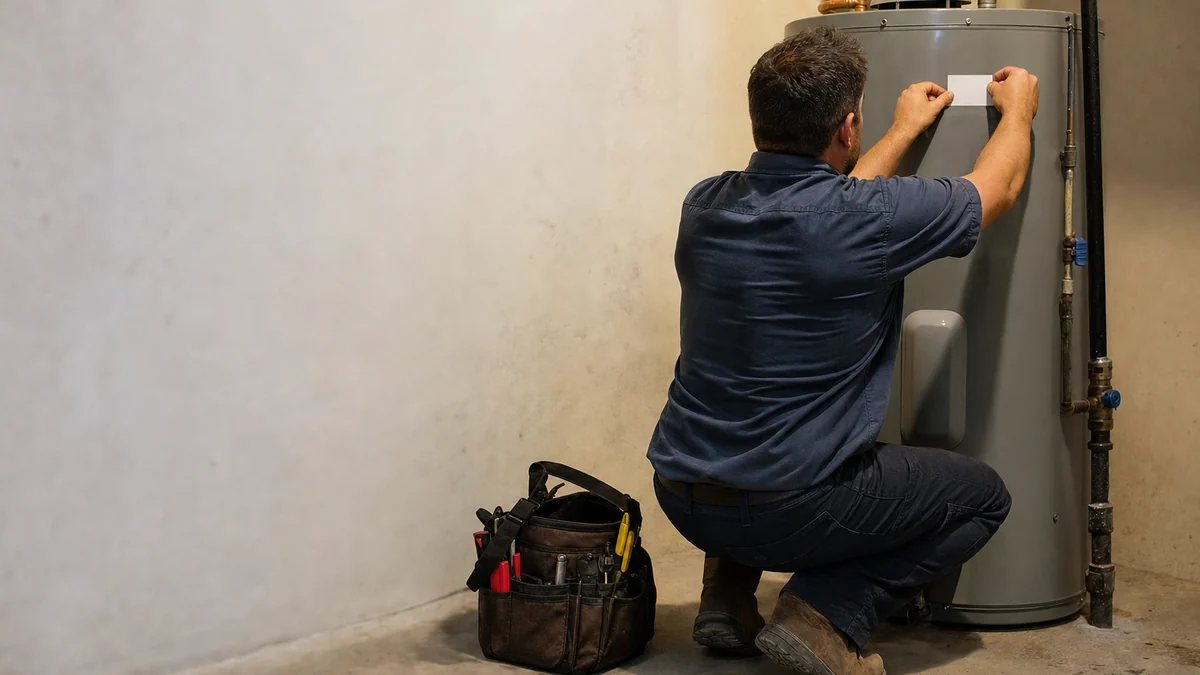
Old numbers live on trucks and stickers. Plumbers leave stickers on water heaters and under sinks for a reason: so customers call back years later. If the number on the sticker is dead, that repeat job goes elsewhere. Keep old numbers forwarding to your main line for as long as you can.
Brand dealer pages get forgotten. Water heater, tankless and water softener brands often list installers on their own sites. Those pages tend to keep whatever you sent them years ago.
A worked example: cleaning up after a move and a phone change
These numbers are made up to show the process, not a benchmark. Say a plumbing shop moved once and switched phone providers two years ago. The owner searches the name, both phone numbers and the old address, and finds 28 listings.
- 13 are correct.
- 9 show the old phone number.
- 4 show the old shop address.
- 2 are duplicates with the old name.
That’s 15 to fix. The owner does the big six first in one afternoon: Google, the website, Apple, Bing, Facebook and Yelp. Bing and one directory get a new listing with the old one marked closed, because the shop moved. The other listings get fixed over the next few weeks, a few at a time, and the old number stays forwarding to the new one in the meantime.
A quarterly check after that takes about an hour, because the master sheet now says exactly what every listing should show.
Frequently asked questions
Does my business name have to match my legal name?
Google asks for your real-world name, as customers know it and as it’s used on your trucks, website and stationery. Legal terms like LLC generally shouldn’t be added unless they’re consistently part of the name you use in the real world.
Can I put "plumber" or my town in my business name to rank better?
Not unless it’s genuinely part of your real-world name. Google doesn’t permit unnecessary information in business names, and it can lead to suspension.
How long until fixed listings update everywhere?
It varies by site. Some changes show within days; others wait for a review or the site’s next update cycle. Re-check the big listings a couple of weeks after you change them.
Should I delete listings on sites I don't use?
If you can claim them, correcting them is usually better than deleting, so an accurate listing exists if someone finds it. Close the ones that are true duplicates.
What if a listing site won't let me change my info?
Use its report or suggest-an-edit option, keep a note of when you asked and check back. If it still shows wrong info, focus on making every listing you control correct.
Do I need to list my license number everywhere too?
Where a listing has a field for it, adding it is a good trust signal for homeowners. Keep it identical everywhere, just like the rest of your info.
Key takeaways
- Write one master version of your name, address or service area, phone, hours and website first.
- Search every old phone number and address to find listings you forgot about.
- Fix Google, your website, Apple, Bing, Facebook and Yelp before the smaller directories.
- Check your Google profile weekly for Google’s own edits and suggested changes.
- Keep tracking numbers off directory listings, and old numbers forwarding to your main line.
- Let AI flag mismatches, but have a person check and approve every change.
Want a second set of eyes on your setup?
We'll look at how you show up locally and where calls are leaking, then send you a plain-English breakdown.
More in this section
- How do I make my plumbing company look trustworthy online?
- How do I manage my plumbing business digitally?
- How do I see what my plumbing competitors are doing online?
- How do I optimize my plumbing Google Business Profile?
- Can I dispute bad Local Services Ads leads as a plumber?
Sources
- Understand how Google sources & uses info in Business Profiles & local search results — Google Business Profile Help
- Tips to improve your local ranking on Google — Google Business Profile Help
- Guidelines for representing your business on Google — Google Business Profile Help
- Understand Google updates on your Business Profile — Google Business Profile Help
- Maintain location information accuracy with Apple Business — Apple Support
- Bing Places for Business — Bing Places for Business