
How does a pool builder scale past referrals and a single crew?
- What are the steps to grow a pool company beyond referrals and one crew?
- Why do referrals stop being enough when you want to grow?
- Step 1: Where are my signed pools coming from today?
- Step 2: How much more work can one crew and my subs really take?
- Step 3: How do I get found by homeowners who don't know anyone I've built for?
- Step 4: When should a pool builder add paid ads?
- Step 5: How do I keep referrals growing while I add new channels?
- Step 6: Who answers the phone and runs consultations while I'm on the job site?
- Step 7: When is it time to add a second crew?
- Step 8: How do I keep two crews busy all year?
- What usually goes wrong when a pool company grows too fast?
- How do I know the growth is actually working?
- What's different about scaling a pool construction company
- A worked example: how many leads does a second crew need?
- Frequently asked questions
- Key takeaways
- More in this section
- Sources
The short version
- Measure first: where each signed pool came from and how many your crew can build.
- Add demand from strangers: Google profile, reviews, a website with your builds, then ads.
- Fix the sales side before the leads arrive: fast answers, consultations, follow-up.
- Add crews after new demand holds up for a full season.
For pool builders whose work has always come from word of mouth and one crew, who want more signed contracts without the wheels coming off.
Get a free visibility audit · Book a growth call
What are the steps to grow a pool company beyond referrals and one crew?
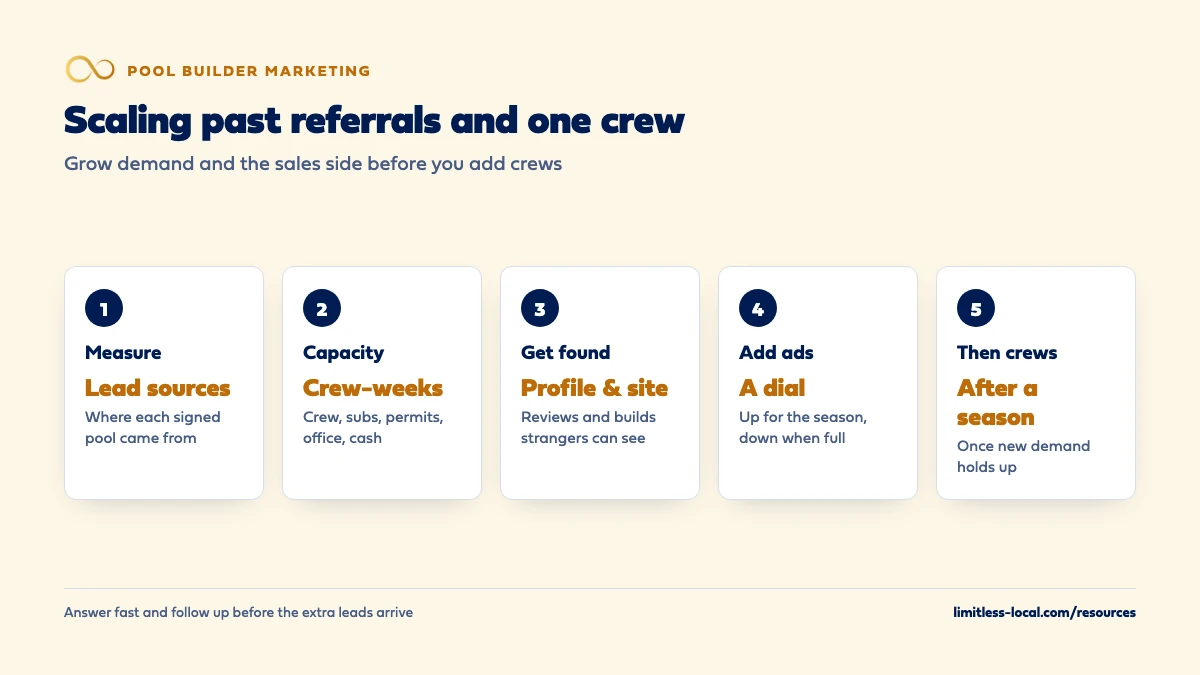
Scale in this order: find out where today’s signed pools come from and how much your crew and subs can really build, then add demand that doesn’t depend on who you know, starting with your Google Business Profile, reviews and a website that shows your builds, and adding search ads when you need calls sooner. Get the sales side ready before the extra leads arrive, because someone has to answer fast, run consultations and follow up while you’re on the job site. Add a second crew, or more subcontractor capacity, once the new demand has held up for a full season, not on the strength of one busy month.
Growing past referrals is exactly what our Limitless Engine packages are built for: the foundation first (tracking, follow-up and a clean online presence), then local SEO and ads around the towns and pools you want, then monthly improvements based on calls, leads and revenue. We’ve been on the owner’s side of this, too. Limitless Local was an equity partner in a pool construction company, where we streamlined back-office operations, built the lead-generation engine and ran sales and marketing, and that business did $2M+ in revenue in year one. Our pool builder marketing page covers how we work with pool companies, and the pool builder marketing questions library takes the rest one question at a time.
Why do referrals stop being enough when you want to grow?
Referrals are the best leads a pool builder gets. The homeowner already trusts you, they’ve usually seen a pool you built, and they don’t shop you as hard. The catch is that you can’t turn them up. Referrals grow with the number of happy customers you have, and those grow at the speed of one crew. If you build a handful of pools a year, you get a handful of neighbors and friends asking about you.
Referrals also arrive when they arrive. That’s fine when one crew is all you’re feeding. It gets scary when you’ve hired a second crew and promised your subs steady work.
So scaling isn’t about replacing referrals. It’s about adding a second stream of work from homeowners who’ve never heard of you, and building the sales and crew side so you can say yes to it.
Step 1: Where are my signed pools coming from today?
Before you spend a dollar on growth, write down where each pool you signed in the last year or two came from. Past customer, neighbor who saw the build, landscaper, pool supply store, a Google search, a home show.
A post on the U.S. Small Business Administration’s blog, How to Get the Most From Your Marketing Budget, points out that tracking can be as simple as reminding employees to ask new customers where they learned about your business. Ask on the first call, write it on the lead, and ask again at the contract signing, because the answer often changes once the homeowner thinks about it.
You’re looking for two things. First, which sources sign the pools you actually want, not just the most calls. Second, how much of your year depends on one or two referral sources that could dry up. That’s your baseline, and every channel you add later gets judged against it.
Step 2: How much more work can one crew and my subs really take?
It depends on your build process, and it’s worth figuring out honestly before you market for more. Count in crew-weeks, not pools. A simple fiberglass install and a custom gunite pool with a spa and outdoor kitchen don’t eat the same amount of your crew’s time.
Then look past your own crew, because often the real limit isn’t the crew at all:
- Subs. Your excavator, steel, gunite, tile and plaster subs have their own calendars. Two extra pools a month only works if they can take them.
- Permits and inspections. If your towns take weeks to issue a permit, more contracts just mean a longer line.
- The office. Designs, proposals, financing paperwork, change orders and scheduling. If all of that runs through you, you’re the bottleneck.
- Cash. More builds at once means more materials and payroll before the next draw comes in.
Write down the most pools you could build next season without cutting corners. That number decides how hard to push the marketing, and it keeps you from selling work you can’t deliver well.
Step 3: How do I get found by homeowners who don't know anyone I've built for?
Start with the free foundation, because every other channel leans on it. A homeowner who hears about you from an ad, a yard sign or a friend will usually look you up on Google before they call.
- Your Google Business Profile. Complete, verified, with the right categories, real photos of your builds and the towns you serve. Google’s help page Tips to improve your local ranking on Google says local results are mainly based on relevance, distance and popularity, and that more reviews and positive ratings can help your local ranking.
- Reviews from every finished pool. Ask at the moments homeowners are happiest, like the first swim. A pool builder doesn’t finish many jobs a year, so you can’t afford to skip any.
- A website that shows your work. A page for each kind of pool you build, with a real gallery and the towns you work in, so the site can be found for those searches over time.
This part is slow. SEO typically takes 3-6 months to show meaningful organic growth, so start it before you need it. Getting your pool company to rank in Google Maps goes through the profile work step by step.
Step 4: When should a pool builder add paid ads?
Add ads when you need calls sooner than SEO can deliver, or when you want a dial you can turn. Ads can generate leads within days of launch. Google says most ads are reviewed within one business day and start running once they’re approved, so the wait is mostly on your side: the landing page, call tracking and the towns you want to target.
For a builder growing past one crew, the dial is the big win. You can raise the budget ahead of the spring rush, pull it back when the calendar is full and point it at the pool types you want more of.
Two cautions. First, an ad budget will happily outrun your capacity, so cap it against the number you wrote down in Step 2. Second, judge ads on signed contracts over a season, not on the first few weeks of calls. Whether Google Ads are worth it for pool builders covers when the math works.
Curious what your marketing is actually booking?
Get a free visibility audit — no obligation, no sales pitch.
Step 5: How do I keep referrals growing while I add new channels?
Don’t let referrals slide just because the phone is ringing from Google. They’re still your cheapest, best-closing work, and they get easier to grow once you’re building more pools.
- Ask on purpose. Ask at the first swim and again at the one-year check-in, when the homeowner has had a summer to brag to the neighbors.
- Make it easy. A short text with a link to your gallery is easier to forward than a business card. Some field-service software makes this simple; Jobber’s referrals feature, for example, tracks how many referrals customers send, the jobs created from them and the revenue those jobs brought in.
- Work the trade side. Landscapers, outdoor-kitchen builders, fence companies and realtors meet your future customers before you do.
Getting referrals from landscapers and home builders covers the trade-partner side in more depth.
Step 6: Who answers the phone and runs consultations while I'm on the job site?
This is where most growth plans quietly break. When all your work came from referrals, a missed call got a callback that evening and the homeowner waited, because a friend had told them you were worth it. A stranger who found you on Google doesn’t wait. They call the next builder on the list.
Before the new leads arrive, decide:
- Who answers during the day. An office manager, a sales coordinator or a call-handling setup, but not voicemail while you’re in a hole with the excavator.
- Who runs design consultations. If it’s always you, your calendar caps your growth no matter how many leads come in.
- How follow-up happens. Pool buyers take time. A simple schedule of calls, texts and emails keeps you in the running for months.
How fast a pool builder should respond to a new lead is the place to start if you’re not sure how quick is quick enough.
Step 7: When is it time to add a second crew?
When new demand has held up long enough that you trust it, and the backlog is getting longer than your homeowners will accept. There isn’t one right answer, because it depends on your cash, your subs, your season and how much risk you’re willing to carry. A few signs that you’re close:
- Your signed backlog has stayed full through a whole season, not just one spring.
- The new channels are bringing signed contracts, not just calls, and you know roughly what each contract costs you.
- You’re turning down or pushing back pools you’d want to build.
- You have someone who could lead a crew to your standard without you standing over them.
Plenty of builders add sub capacity first, like a second gunite or tile sub, before hiring a full second crew. It costs more per pool, but it’s easier to scale back if a season comes in softer than you hoped.

Step 8: How do I keep two crews busy all year?
One crew can ride the seasons. Two crews need a fuller calendar, so plan for the slow months before they arrive.
- Sign next season’s builds in the off-season. Homeowners who are still planning in fall and winter can sign early if you stay in touch.
- Add work that fits the gaps. Renovations, resurfacing and equipment upgrades can fill weeks when new builds are thin, if they suit your crews.
- Keep the foundation running. Reviews, photos and website pages you add in winter are in place when searches pick back up.
What usually goes wrong when a pool company grows too fast?
The same few things show up again and again:
- Marketing outruns the sales side. Leads come in faster than anyone can call them back, and you pay for calls you never answer.
- Quality slips, then reviews slip. A rushed second crew leaves a bad review, and with a small number of reviews, one bad one shows.
- The wrong numbers get celebrated. More website visits and more calls feel like growth, but only signed contracts at a cost you can afford actually are.
How do I know the growth is actually working?
Track every lead from first contact to signed contract, by source, and look at it once a month and once a season. The numbers that matter: qualified leads, design consultations held, signed contracts and what each signed contract cost you in marketing. Compare that cost with what an average pool leaves you after materials, labor and overhead.
Give each channel the right amount of time. Ads show their early signal in weeks; SEO in months; and every channel takes as long as your sales cycle to turn into contracts. Tracking which marketing produces signed pool contracts walks through the setup.
Not sure which of these is costing you jobs?
A free visibility audit checks the Google profile, reviews, site and tracking, and shows what to fix first.
What's different about scaling a pool construction company
A booked job is a signed contract, not a call. A pool sale runs through a design consultation, a proposal, often financing and a permit. More leads only help if that whole path can handle them.
Crew time is the scarce thing. A new pool ties up a crew and a chain of subs for weeks. You can’t add capacity overnight in the middle of spring.
Few, big jobs. A pool builder signs far fewer jobs a year than a service trade, so each review, each referral and each lost lead matters more.
Every build is a billboard. Neighbors watch the excavation, the steel and the first fill. More builds in the right neighborhoods bring their own word of mouth, as long as the job site looks good.
A worked example: how many leads does a second crew need?
These numbers are made up to show the math, not a benchmark for your company. Say referrals bring you 8 signed pools a year and your one crew can build about 10. You want to build 20 next year, which means 12 more contracts from outside your referral circle, plus a second crew or more sub capacity to build them.
- If 1 in 4 design consultations signs, 12 contracts takes 48 consultations.
- If about half your qualified leads book a consultation, 48 consultations takes 96 qualified leads.
- Spread over a six-month selling season, that’s about 16 qualified leads a month, on top of your referrals.
Now every channel has a target to be measured against, and you can see the sales load: four consultations for every extra contract. If you run every consultation yourself today, plan for that before you hire a crew.
For a sense of the marketing cost, our Essentials package is $3,500 a month and includes Google Ads management for up to $2,500 a month in ad spend, which is paid to Google separately, along with SEO and Google Business Profile management for one location. Whether that pays depends on what an average pool leaves you.
Frequently asked questions
Should I hire a salesperson or a second crew first?
Usually the sales side first. If you’re running every consultation and answering every call yourself, more leads won’t turn into more pools, and a second crew with nothing signed is an expensive way to find that out.
Can I grow with more subcontractors instead of my own second crew?
Yes, and many builders do it that way first. It usually costs more per pool, but it’s easier to scale back if a season comes in slower than you planned.
Do I need a new website before I market beyond referrals?
Not always. You need a site that loads fast, shows your finished pools and makes it easy to call or request a consultation. If yours doesn’t, fix that before you pay for ads that send people to it.
Should I expand into more towns to grow?
Only where you’d happily build. Wider areas bring more leads, but also longer drives and more pools you’d rather not take. Win the towns closest to you first.
How long before new marketing can make up for a slow referral month?
Ads can generate leads within days of launch, while SEO typically takes 3-6 months to show meaningful organic growth. Either way, signed contracts follow your normal sales cycle, so plan ahead of the gap, not during it.
What if growth brings in smaller jobs I don't want?
Tighten what your marketing shows and says. Lead your website, profile and ads with the pools you want, and send small-job inquiries to a partner instead of squeezing them in.
Key takeaways
- Referrals can’t be turned up, so growth needs a second stream of work from homeowners who don’t know you.
- Measure where your signed pools come from and what your crew and subs can build before you market for more.
- Build the free foundation first (Google profile, reviews, a website with your builds), then add ads as a dial.
- Get calls answered, consultations covered and follow-up running before the extra leads arrive.
- Add a second crew once new demand has held up for a full season, and judge every channel on signed contracts.
Want a second set of eyes on your setup?
We'll look at how you show up locally and where calls are leaking, then send you a plain-English breakdown.
More in this section
- How can a pool builder turn reviews and referrals into more jobs?
- How can pool builders get referrals from landscapers and builders?
- Should pool builders build referral relationships with realtors?
- How do pool builders qualify leads before the design consultation?
- Is word-of-mouth and a basic website enough for a pool builder?
Sources
- How to Get the Most From Your Marketing Budget — U.S. Small Business Administration
- Tips to improve your local ranking on Google — Google Business Profile Help
- About the ad review process — Google Ads Help
- Referrals | Marketing Tools — Jobber Help Center