
How many booked jobs a month should a pool builder expect from ads?

- How many signed pool contracts a month can a modest ad budget bring?
- What counts as a booked job when a pool builder runs ads?
- Why is there no standard number of booked jobs from ads?
- How do I work out how many booked jobs to expect?
- What does a modest budget look like in a pricier market?
- Why do signed contracts lag behind the ad spend?
- How does the season change how many jobs ads bring?
- What changes the number of booked jobs the most?
- How many booked jobs a month make ads worth it?
- What should I expect in the first 90 days of ads?
- How do I count booked jobs from ads accurately?
- When should I worry that ads are booking too few jobs?
- What's different about ad results for pool builders
- A worked example: $2,500 a month in ad spend
- Frequently asked questions
- Key takeaways
- More in this section
- Sources
The short version
- A booked job for a pool builder is a signed contract, not a call or a consultation.
- Budget ÷ cost per click × lead rate × consultation rate × close rate = signed contracts.
- In a made-up example, $2,500 a month brings about two contracts a month in season, or one in a pricier market.
- Contracts lag the spend; judge a month of ads by what signs over the following months.
For pool builders setting expectations for ads: how to estimate signed contracts from your budget, and why the month you spend isn’t the month you sign.
Get a free visibility audit · Book a growth call
How many signed pool contracts a month can a modest ad budget bring?
There’s no standard number, because booked jobs from ads come from a chain: your budget, what a click costs in your towns, how many clicks become leads, how many leads book a design consultation, and how many consultations sign. Run that chain with your own figures; in a made-up example, $2,500 a month at $12.50 a click works out to about two signed contracts a month in season, and the same budget in a pricier market to about one. Expect contracts to trail the ad spend by weeks or months, because pool buyers take time to decide.
That chain is how we report ads to owners: what each signed job cost, not just each click or call. Google Ads management is part of our local ads work, covering up to $2,500 a month in ad spend in Essentials and up to $5,000 in Growth, with call, web and form tracking included. Ad spend is paid to Google directly. We don’t guarantee lead counts or booked jobs; nobody honestly can, because platforms change how they work. See how ads fit with SEO and follow-up on our pool builder marketing page, or browse the pool builder marketing questions library.
What counts as a booked job when a pool builder runs ads?
A signed contract. A call isn’t a booked job, a form isn’t, and a design consultation isn’t either, even though it’s the step that matters most along the way. For a pool builder, ads produce leads; your team turns some of those into consultations; and some consultations become signed pools, often weeks or months later.
Keep the three numbers separate: leads, booked consultations, signed contracts. When an owner says ads “aren’t working,” it often turns out the leads are fine and the drop-off is somewhere between the first call and the signature. You can only see that if you count each step.
Why is there no standard number of booked jobs from ads?
Because the answer is a chain of five numbers, and every one of them is different in your market:
- Your monthly ad budget.
- What a click costs for pool searches in your towns.
- How many clicks turn into a call or a form.
- How many of those leads book and keep a design consultation.
- How many consultations sign.
Change any one and the result changes. A builder in a crowded metro pays far more per click than one in a smaller market, and a builder who calls back in minutes books more consultations from the same leads than one who calls back tomorrow. Any article that hands you a single jobs-per-dollar figure for pool builders is quoting someone else’s chain. If you want a feel for where your close rate should sit, what close rate is good for pool construction leads covers how to measure it.
How do I work out how many booked jobs to expect?
Run the chain with your own numbers. Divide your budget by your cost per click to get clicks. Multiply by the share of clicks that become leads, then the share of leads that book a consultation, then the share of consultations that sign. What’s left is signed contracts per month, once the season is running.
If you haven’t run ads yet, you need a starting estimate for cost per click. Google’s Keyword Planner forecasts use historical search data to estimate clicks and average cost per click for a set of keywords at a given budget, taking bid, budget and seasonality into account. Treat them as a starting point, not a promise. For the other three numbers, use your own history: how many of last year’s calls and forms became consultations, and how many consultations signed. If you don’t know, the first two or three months of ads will tell you.
What does a modest budget look like in a pricier market?
The worked example below uses $2,500 a month at a made-up $12.50 per click and lands at two signed contracts. Here’s the same budget in a made-up crowded metro, where clicks cost $25:
- $2,500 ÷ $25 = 100 clicks.
- One click in ten becomes a lead: 10 leads.
- Two in five book and keep a consultation: 4 consultations.
- One in four signs: 1 signed contract.
Same budget, same sales process, half the result. That doesn’t make ads a bad bet in an expensive market, because one pool can carry a lot of ad spend. It does mean the budget that’s plenty in one town is thin in another. Whether $2,500 a month is enough ad spend for a pool builder looks at that question directly.
Why do signed contracts lag behind the ad spend?
Because pool homeowners don’t sign the week they click. They book a consultation, wait for a design and a price, talk about financing, maybe get a second quote, and then decide. Contracts from this month’s ads often land next month or the month after.
Google Ads has a name for the delay: the conversion cycle, the time it takes for a click to turn into a conversion. Its page on conversion windows explains that you can set how long after a click a conversion still counts, with a default of 30 days and options up to 90 days for Search campaigns depending on the conversion source. For a pool builder tracking signed contracts, the default can miss sales that take longer, so the longer window usually fits better. The practical point: judge a month of ads by the contracts it produces over the following months, not by the contracts that happen to sign in the same month.
Curious what your marketing is actually booking?
Get a free visibility audit — no obligation, no sales pitch.
How does the season change how many jobs ads bring?
A lot. In most markets, pool shopping bunches into the months before swimming season, when searches and clicks rise. The same budget buys more leads in a busy month, and more of those homeowners want to move quickly. In the off-season, fewer people search, but the ones who do are often planning carefully for next year.
So expect the monthly number to swing. A builder who signs two contracts a month from ads in spring might sign none in a winter month and still be on track for the year. Compare each month with the same month last year, and look at the year as a whole.
What changes the number of booked jobs the most?
Each link in the chain has its own fix:
- Cost per click: tighter keywords, negative keywords for jobs you don’t want, and ads aimed at the towns you really build in.
- Clicks to leads: a landing page about the pool work they searched for, with real builds, reviews and an easy way to call or ask for a consultation.
- Leads to consultations: speed and the first call. A lead who hears back fast and gets offered two specific consultation times books more often than one who waits a day. How fast a pool builder should call back gets into the detail.
- Consultations to contracts: your design, price, follow-up and financing options. This is sales, not marketing, but it’s where many lost jobs actually go.
Improving a weak middle step often adds more signed contracts than adding budget at the top.
How many booked jobs a month make ads worth it?
Fewer than most owners think, because a pool contract is large. Start from what one signed pool leaves you after the cost of building it. If your ads, plus whatever you pay someone to run them, cost less than that per signed contract, the ads are paying. Depending on your margin, one extra contract a month in season, or even one a quarter, can cover the whole spend.
Work out your own ceiling before you set a target. How much you can afford to spend to win one pool customer walks through the math, and it tells you what “enough” booked jobs means for your margins, not someone else’s.

What should I expect in the first 90 days of ads?
Leads quickly, contracts later. Ads can generate leads within days of launch, so the phone should start ringing in the first week or two. Consultations follow within a few weeks. Signed contracts from that first batch of leads may not show until the second or third month, depending on how long your design and quoting process runs.
Use those first months to learn your real numbers: cost per click, how many clicks become leads, how many leads book. By the end of the third month you’ll have enough to run the chain with your own figures instead of guesses, and to decide whether to raise, hold or redirect the budget.
How do I count booked jobs from ads accurately?
Connect each signed contract back to the lead that started it. That needs three things: call tracking, so you know which calls came from ads; a record of every lead’s source in your CRM or spreadsheet; and a habit of marking each lead as it books, signs or drops out.
Google Ads can help close the loop. Its help on measuring calls from ads says you can count a call as a conversion only when it lasts longer than a minimum duration you set, which filters out wrong numbers and hang-ups. And offline conversion imports let you send sales that happen later, over the phone or at your office, back into Google Ads, so you can see which ads led to signed pools, not just calls. What conversion tracking means for a pool builder covers the setup.
When should I worry that ads are booking too few jobs?
When a full season has passed and the chain shows a broken link. A few signs:
- Plenty of clicks but few calls or forms: the landing page or the ad’s promise is off.
- Plenty of leads but few consultations: response time, the first call, or junk leads from the wrong searches.
- Plenty of consultations but few contracts: price, design or follow-up, or leads who were never a fit.
- Few clicks at all: the budget is too small for your market, or the ads are aimed too narrowly.
Don’t judge on a single month, and don’t judge on contracts alone before the lag has played out. Judge on the whole chain over a season.
Not sure which of these is costing you jobs?
A free visibility audit checks the Google profile, reviews, site and tracking, and shows what to fix first.
What's different about ad results for pool builders
Few jobs, large tickets. A plumber might book dozens of jobs from a month of ads. A pool builder might book two, and still have the best return of any trade, because each contract is worth so much more.
A long gap between click and contract. Design, pricing, financing and permits all sit between the first call and the signature, so monthly ad reports always run ahead of signed work.
Seasonal swings. The same budget buys very different results in spring and in winter, so compare months year over year.
The consultation is the key step. For most trades the ad’s job is a booked service call. For pool builders it’s a booked, kept design consultation, and everything after that is your sales process.
A worked example: $2,500 a month in ad spend
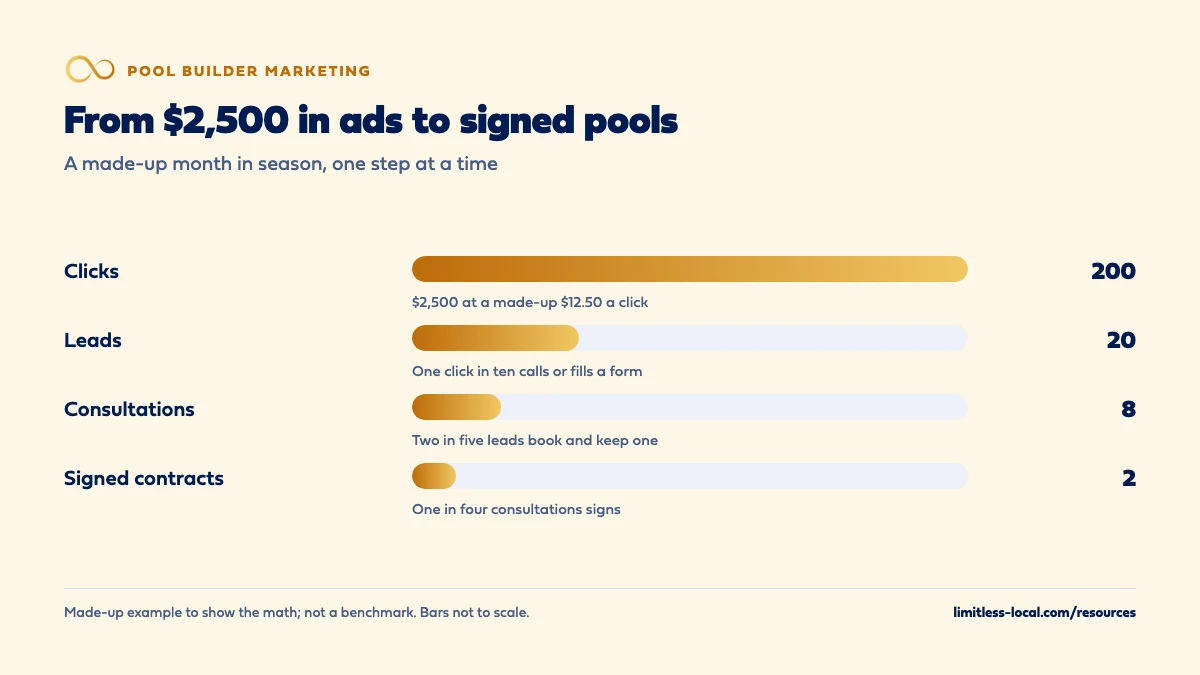
These numbers are made up to show the math, not a benchmark for your market. A builder spends $2,500 a month on Google search ads in season, about $82 a day, using Google’s method of dividing a monthly amount by 30.4, the average number of days in a month.
- Clicks: at $12.50 a click, $2,500 buys 200 clicks.
- Leads: one click in ten becomes a call or form: 20 leads.
- Consultations: two in five book and keep a design consultation: 8 consultations.
- Contracts: one in four signs: 2 signed contracts a month.
On ad spend alone, each signed pool cost $1,250. Add management, say our Essentials package at $3,500 a month, which covers up to $2,500 in ad spend, and the total is $6,000 a month, or $3,000 per signed contract. If a signed pool leaves the builder a made-up $15,000 after build costs, the ads are paying even in a month that signs one contract instead of two. Swap in your own click cost, rates and margin.
Frequently asked questions
Should I expect booked jobs in the first month of ads?
Expect leads and consultations in the first month. Signed contracts from those leads often arrive in the second or third month, because pool buyers take time to decide.
Will doubling my ad budget double my booked jobs?
Rarely exactly. Extra budget often buys more expensive clicks or reaches farther towns where fewer people sign. Raise it in steps and watch cost per signed contract as you go.
Do I count renovations as booked jobs?
Yes, but track them separately from new builds. They’re usually smaller and close faster, and mixing them in can make your new-build numbers look better or worse than they are.
How do I know my cost per click before I spend anything?
Use Keyword Planner’s forecasts for the searches you’d target in your towns. They’re estimates based on historical data, so check them against your real numbers after the first few weeks.
What if my ads bring leads but no booked jobs?
Look at the middle of the chain: how fast you respond, how many leads book a consultation, and whether the leads are from the right searches and towns. The ad may be doing its job while the follow-up isn’t.
Is cost per lead or cost per booked job the better number?
Cost per booked job. Cheap leads that never sign cost more in the end than pricier leads that do.
Key takeaways
- For a pool builder, a booked job is a signed contract; count leads, consultations and contracts separately.
- Expected contracts = budget ÷ cost per click × lead rate × consultation rate × close rate, with your own numbers.
- In a made-up example, $2,500 a month gives about two signed pools in season at $12.50 a click, and one at $25.
- Contracts lag the spend by weeks or months; set a long enough conversion window and judge over a season.
- The fastest gains often come from the middle steps, not a bigger budget.
Want a second set of eyes on your setup?
We'll look at how you show up locally and where calls are leaking, then send you a plain-English breakdown.
More in this section
- How long should a pool builder run ads before judging 1k a month?
- Is $2,500 a month enough ad spend for a pool builder?
- Is $1,000 a month enough for pool builder ads off-season?
- How many leads a month does a pool builder need to keep crews booked?
- What monthly ad spend gets a pool builder steady leads?
Sources
- About average daily budgets — Google Ads Help
- About Keyword Planner forecasts — Google Ads Help
- Conversion cycle: Definition — Google Ads Help
- About conversion windows — Google Ads Help
- Measure calls from ads — Google Ads Help
- About offline conversion imports — Google Ads Help