
What monthly ad spend gets a pool builder steady leads?

- How much ad spend a month keeps pool construction leads coming in?
- What does “steady leads” really mean for a pool builder?
- What decides how much ad spend your market needs?
- How do I estimate my number before I spend anything?
- What can $1,000 a month in ad spend do for a pool builder?
- What can $2,500 a month do?
- When does $5,000 a month make sense for pool construction?
- Why does the same budget feel steady one month and dry the next?
- How do I know if my budget is too small?
- What should I fix before I raise the ad budget?
- How should I judge whether my ad spend is working?
- What's different about ad spend for pool builders
- A worked example: pricing a month of steady pool consultations
- Frequently asked questions
- Key takeaways
- More in this section
- Sources
The short version
- Steady leads come from matching your budget to your market, not from a magic number.
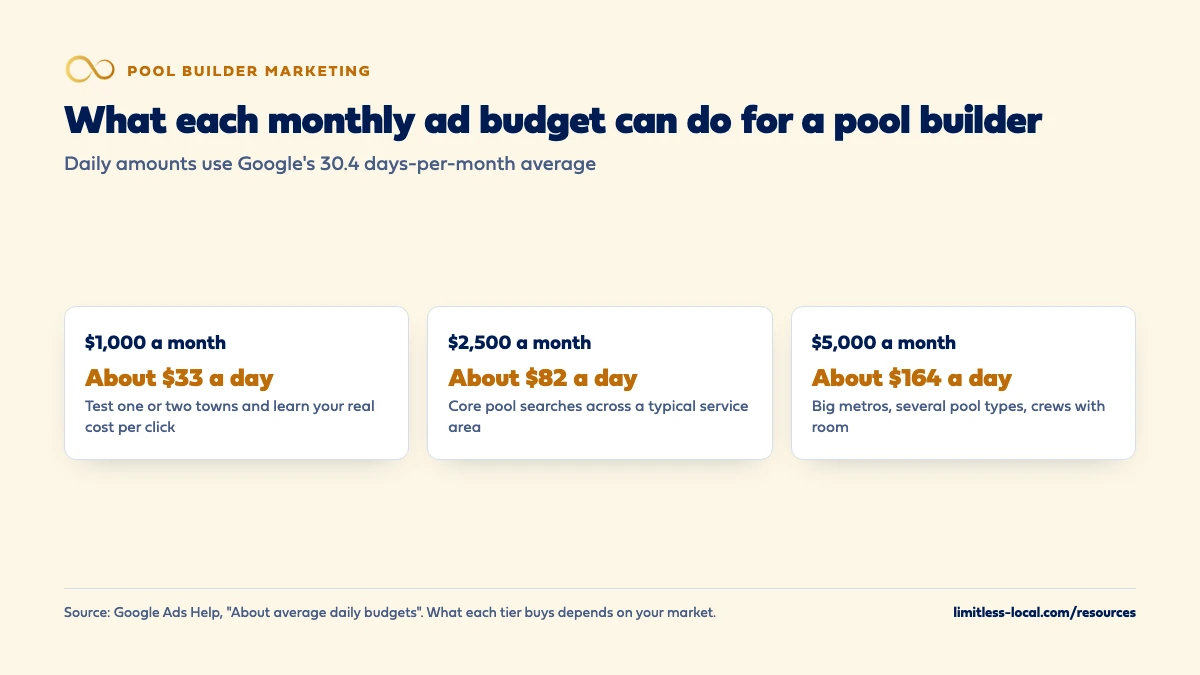
- $1,000 a month tests a small area; $2,500 covers core searches in a typical service area; $5,000 fits big metros and bigger calendars.
- Estimate it backward: consultations needed, leads, clicks, then cost per click from Keyword Planner.
- Fix the landing page, the phones and the wasted searches before you raise the budget.
For pool builders weighing $1,000, $2,500 or $5,000 a month in ad spend and wondering which one actually keeps consultations on the calendar.
Get a free visibility audit · Book a growth call
How much ad spend a month keeps pool construction leads coming in?
There’s no single number, because steady leads depend on how many homeowners search for pools in your towns, what clicks cost there, how many builders you’re bidding against and how well your site turns clicks into calls. Around $1,000 a month is usually enough to test a small market or a couple of towns, $2,500 can cover the core pool searches across a typical service area through the season, and $5,000 makes sense in a big, crowded metro or when you sell several pool types and have the crews to build more. Work your number backward from the consultations you need, check it against Google’s own forecasts for your area, and judge it by signed contracts over a full season.
Ad spend is paid directly to Google or Meta and isn’t included in any of our packages, and we recommend a budget after a quick audit of your market. Essentials ($3,500 a month) manages Google Ads up to $2,500 a month in spend; Growth ($4,500 a month) manages up to $5,000 and adds Meta remarketing. Our local ads page covers how we run campaigns, our pool builder marketing page covers the trade, and the pool builder marketing questions library goes question by question.
What does “steady leads” really mean for a pool builder?
It means your design consultation calendar has something on it every week of the selling season, not a flood one month and silence the next. For a pool builder, a lead isn’t a phone call about a green pool or a pump repair. It’s a homeowner in your area who wants the kind of pool you build and is ready to talk about it.
That changes what you’re buying with ad spend. You’re not paying for clicks or even calls. You’re paying for a steady trickle of the right conversations, at a cost your profit per pool can carry. So before you pick a number, decide two things: how many consultations a month you want in your busy months, and how many your quiet months need to keep crews booked. Steady looks different in March than it does in November, and your budget should too.
Write the number down. Every tier below is easier to judge once you know what “enough” looks like on your own calendar. For the whole marketing budget, not just ad spend, see how much a pool builder should spend on marketing.
What decides how much ad spend your market needs?
Five things, and most of them are about your market rather than your business:
- Search volume in your towns. A fast-growing suburb with big lots has more people searching for pool builders than a small rural county.
- What a click costs. Prices are set in an auction every time someone searches.
- How many builders are bidding. The more of them, the more each click costs and the more budget it takes to show up often.
- How wide your service area is. Covering six towns takes more money than covering two, even at the same click price.
- How well your site turns clicks into calls. A page that converts twice as well needs half the clicks for the same leads.
The auction point matters more than owners expect. Google’s page on the ad auction says your position is set by Ad Rank, a mix of your bid, the quality of your ads and landing page, the competitiveness of the auction and the context of the search, and that it runs again for every search. It also says a higher-quality ad can win a better position at a lower price than a competitor bidding more. That’s why two pool builders in the same town can spend very different amounts for the same results.
How do I estimate my number before I spend anything?
Work backward from the calendar, then let Google price it:
- Consultations you want a month in your busy months.
- Leads needed: divide by the share of leads that book a consultation, from your own records.
- Clicks needed: divide by the share of ad visitors who call or fill in a form.
- Spend: multiply clicks by the cost per click for your keywords and towns.
For that last step, Keyword Planner gives you a forecast. Google’s guide to Keyword Planner forecasts says they estimate clicks, cost, impressions and average cost per click for a set of keywords, and that forecasts take your bid, budget, seasonality and historical ad quality into account. Put in the pool searches you’d actually pay for, such as inground pool builders and pool installation in your towns, set your locations, and read the cost range.
Treat the forecast as a starting point, not a promise. If you don’t know how many homeowners search in your area yet, estimating how many people search for pool builders in your area walks through it first.
What can $1,000 a month in ad spend do for a pool builder?
It can tell you a lot, but it rarely keeps a busy metro calendar full. Google asks for an average daily budget, and its page on average daily budgets says to divide the monthly amount by 30.4, the average number of days in a month. So $1,000 a month is about $33 a day.
That works best when you keep it tight:
- One or two towns closest to your yard, or the neighborhoods where your best pools are.
- A short list of high-intent searches, like inground pool builder or custom pool construction, with the cleaning and repair searches blocked.
- One campaign sending people to one strong landing page.
In a small market with few competing builders, this can be enough for a steady trickle. In a big, crowded metro, expect quiet weeks: on a busy search day, the budget runs out early and your ad simply stops showing. Use this tier to learn your real cost per click and cost per consultation, then decide whether to grow it.
Curious what your marketing is actually booking?
Get a free visibility audit — no obligation, no sales pitch.
What can $2,500 a month do?
At $2,500 a month, or about $82 a day, most pool builders can cover their core pool searches across a typical service area for most of the day, through the selling season. That’s the level where ad spend usually stops being a test and starts being a channel you can plan around.
Here’s what that budget typically has room for:
- Separate campaigns or ad groups for new pool builds and for renovations, if you sell both.
- The towns you want most, without spreading so thin that every one gets a few clicks.
- A bit of testing: a new landing page, a financing message, or a different offer for the design consultation.
It still might not be enough in a big metro in spring, when more builders are bidding. If your ads show for only part of each day or stop early, that’s the sign to check before raising it. Pair this tier with tracking from day one, so after a season you know exactly what each consultation cost.
When does $5,000 a month make sense for pool construction?
At $5,000 a month, about $164 a day, you’re paying to show up for most of the pool searches in a large area. That makes sense when:
- Your market is big and crowded, and a smaller budget runs out before the day’s searches do.
- You sell several pool types, like custom gunite, fiberglass and renovations, each with its own searches and pages.
- You have capacity. Your crews, permits and calendar can take on more contracts in the season you’re selling into.
- Your numbers already work. At a smaller budget, your cost per signed pool came in under the ceiling your profit per pool allows.
If those aren’t true yet, $5,000 mostly buys more of the same problem. More leads into a slow follow-up process, or a calendar that’s already full, won’t turn into more signed pools. Raise the budget in steps, not in one jump, and give each step a few weeks of consultations before judging it.
Why does the same budget feel steady one month and dry the next?
Because neither Google’s spending nor homeowner demand is flat. Google spends more on days when you’re more likely to get clicks and conversions and less on others, with a daily cap of two times your average daily budget and a monthly cap of 30.4 times it for most campaigns. So a week can look busy and the next one quiet, even with no changes.
Season matters even more. When more homeowners start planning pools, more builders start bidding, and the same daily budget buys fewer clicks. In winter, searches drop, and a budget that felt thin in April can have money left over. Whether pool marketing costs more in spring and summer than winter covers how to budget across those swings.
One more reason: changes you make. Every time you add towns, switch bidding, or rebuild a campaign mid-season, results can wobble for a while. Make big changes before the busy months.

How do I know if my budget is too small?
Google will often tell you. Its help page on fixing “Limited by budget” says a campaign gets that status when it’s underperforming because of a limited budget, or when it uses Maximize Clicks bidding and could get more traffic with a bigger budget. It also offers a recommended budget, based on recent performance, your current budget, your keywords and your targeting settings, and says applying it will help you get more clicks and impressions.
More clicks isn’t the same as more signed pools, so read the recommendation against your own numbers. The other place to look is the auction insights report, which compares your impression share with other advertisers in the same auctions. It doesn’t show insights when your impression share is under 10%, which on its own tells you you’re barely showing up.
And check your calendar. If you’re getting good leads at a cost you’re happy with, but consultations dry up mid-week, a small budget is the likely reason.
What should I fix before I raise the ad budget?
Anything that wastes the money you’re already spending. Raising a budget on a leaky setup buys you a bigger leak. Check these first:
- Where the ad sends people. A page about one pool type, with real photos, your service towns and an easy way to book a consultation, beats your homepage. Whether pool builders need a landing page for Google Ads goes deeper.
- Searches you don’t want. Pool cleaning, above-ground pools, supplies and jobs can eat a small budget fast. Negative keywords for pool builders lists what to block.
- The phones. If ad calls go to voicemail during the day, the homeowner calls the next builder.
- Tracking. If you can’t see which calls and forms came from ads, you can’t tell whether more spend helps.
How should I judge whether my ad spend is working?
By signed contracts over a season, and by consultations month to month. A pool buyer can click in February, meet with you in March and sign in May. If you judge February’s spend by February’s contracts, it looks like it did nothing.
The fix is to record the source and date of every lead when it comes in, then credit each contract back to the month that lead arrived. After a season, divide what you spent by the pools it signed and you have your real cost per signed contract. Compare that to the most you’re willing to pay per pool, and the budget question mostly answers itself: if it’s well under, there’s room to spend more; if it’s over, fix the funnel before you add money. Tracking which marketing produces signed pool contracts shows how to set that up.
Until you have a season of data, watch the steps in between: leads from ads, consultations booked, and cost per consultation.
Want to see where your company stands?
A free visibility audit shows where you show up on Google, Maps and AI answers, and what it's costing you in calls.
What's different about ad spend for pool builders
A few contracts carry the whole year. A plumber needs dozens of jobs a month to justify ads. A pool builder can justify a budget on a handful of signed pools a season, so the question is cost per signed pool, not cost per lead.
The buyer takes months. Design consultations, revisions, financing and HOA approvals all happen after the click. Ad spend has to be judged on a delay that most ad reports don’t show.
Demand follows the calendar. Homeowners plan in late winter and spring for summer swimming, so the budget that keeps leads steady has to rise before the rush, not after it.
Plenty of pool searches aren’t buyers. Cleaning, repairs, chemicals and above-ground pools all share the word pool. A pool builder’s budget leaks faster than most trades’ if those aren’t blocked.
A worked example: pricing a month of steady pool consultations
These numbers are made up to show the math. They aren’t a benchmark for your market. Say you want 8 design consultations a month in spring. From your records, about one in three leads books a consultation, so you need 24 leads. Your landing page turns about one in ten ad visitors into a call or form, so you need 240 clicks.
Keyword Planner shows an average cost per click of about $9 for your pool searches and towns. That’s 240 × $9 = $2,160 a month in ad spend, or about $71 a day.
Now check it against the tiers. At $1,000 a month you’d get about 111 clicks, about 11 leads and three or four consultations: useful for learning, but not the 8 you wanted. At $2,160 the math says you’d hit your goal, and if about one in four consultations signs, that’s two pools a month at about $1,080 each in ad spend before management. Run the same steps with your own close rates and Keyword Planner numbers and you’ll have a budget you can defend.
Frequently asked questions
Can a pool builder run Google Ads on $500 a month?
You can, but in most markets it will only show your ads for a small slice of each day. Keep it to your closest town and your most specific searches, and treat it as a test of what clicks cost.
Is ad spend included in an agency's monthly fee?
Not with us. Ad spend is paid directly to Google or Meta and isn’t included in any package. Ask any agency the same question, and get the answer in writing.
How fast do ads bring pool leads after launch?
Ads can generate leads within days of launch. Signed contracts take longer, because the homeowner still has to meet with you, review a design and sort out financing.
Should I match what a competitor is spending?
No. You can’t see their close rate, their profit per pool or how well their site converts. Set your budget from your own cost per signed pool.
Should I cut ad spend when my build calendar is full?
Lower it rather than switch it off, and point what’s left at next season. Homeowners who start planning now are the ones who sign for the next open slots.
Do I need a separate budget for Facebook and Instagram?
Usually only after search is working. Search reaches people already looking for a builder; social and remarketing reach people earlier or remind past visitors, so give them their own line once your search numbers are clear.
Key takeaways
- There’s no universal number; your market’s searches, click prices and competition set it.
- $1,000 a month is a test, $2,500 covers core searches in a typical area, $5,000 fits big metros with capacity.
- Estimate it backward from consultations, then price the clicks in Keyword Planner.
- Fix the landing page, wasted searches, phones and tracking before raising the budget.
- Judge by cost per signed pool over a season, crediting each contract to the month its lead came in.
Not sure what's working right now?
Start with a free visibility audit: rankings, Google profile, reviews and tracking, checked against your service area.
More in this section
- What does cost per lead mean for a pool builder's ad budget?
- What does a pool builder budget beyond ad spend?
- What tracking shows a pool builder cost per qualified lead?
- How many leads are needed for a pool builder to hit its revenue goal?
- Are Google Ads worth it for pool builders?
Sources
- About average daily budgets — Google Ads Help
- Fix “Limited by budget” status — Google Ads Help
- About Keyword Planner forecasts — Google Ads Help
- The ad auction — Google Ads Help
- Use auction insights to compare performance — Google Ads Help