
What does a pool builder budget beyond ad spend?

- Besides ad spend, what marketing costs should a pool builder plan for each year?
- What costs come with marketing a pool company besides the ads?
- Which of these costs are one-time and which are monthly?
- What does a pool builder's website cost?
- Do I need to pay for landing pages on top of the website?
- How much should I set aside for call and form tracking?
- What should I budget for a CRM or job software?
- How much should go to photos, video and drone footage?
- What sales tools belong in the budget?
- Which marketing costs are free?
- What about yard signs, home shows and print?
- How do I keep these costs from eating the ad budget?
- Which of these are included if I hire an agency?
- What's different about these costs for pool builders
- A worked example: one year of costs beyond the ads
- Frequently asked questions
- Key takeaways
- More in this section
- Sources
The short version
- Ad spend buys the clicks; the website, tracking, CRM, photos and sales materials turn them into contracts.
- Split the list into one-time costs (website build, photo shoots) and monthly ones (tracking, CRM, hosting).
- Some of the most useful pieces, like your Google Business Profile and review link, cost nothing but time.
- Expect the first year to cost more than the second, because the website build lands in year one.
For pool builders setting next season’s budget who want every cost that sits next to the ad spend on paper: the website, tracking, CRM, photos, sales materials and the hours it all takes.
Get a free visibility audit · Book a growth call
Besides ad spend, what marketing costs should a pool builder plan for each year?
Beyond ad spend, a pool builder needs to budget for everything that turns a click into a signed contract: a website with a working way to request a design consultation, a landing page for the ads, call and form tracking, a CRM or job software that holds every lead through a months-long sale, photos and video of finished pools, and the materials you bring to the consultation. Some of these are one-time costs, like a website build, and most of the rest are steady monthly lines. Put each one on its own line so it doesn’t quietly eat into the ad budget, and judge it by whether it helps you see and sign more pools.
We measure budgets the same way: the number that matters is what each signed contract cost, with every line counted, not just the clicks. Ad spend is never included in our packages; it’s paid directly to Google or Meta, and we recommend a budget after a quick audit. The packages page shows which of the costs on this page each tier already covers, our pool builder marketing page shows how we work with pool companies, and the full pool builder marketing questions library takes the rest one question at a time.
What costs come with marketing a pool company besides the ads?
Picture the path a homeowner takes from seeing your ad to signing a contract, and you’ll find a cost at almost every step:
- Where they land: your website and any landing pages built for the ads.
- How they reach you: phone numbers, forms and the tracking that tells you which ad or listing they came from.
- Where the lead lives: a CRM or job software that holds the lead, its source and its next step for the months a pool sale takes.
- What convinces them: photos and video of real pools you’ve built, plus the design and proposal materials for the consultation.
- Who does the work: your own hours, a staff member’s or an agency’s.
- Offline extras: yard signs, home shows, printed pieces.
None of this is ad spend, and all of it decides whether ad spend pays off. If you’re still working out the total, how much a pool builder should spend on marketing covers that. This page is the list of everything that isn’t a click.
Which of these costs are one-time and which are monthly?
Sorting them this way keeps one big invoice from wrecking a month’s numbers:
- One-time or every few years: the website build or redesign, a logo refresh, a big photo and video shoot, printed design packets and sample boards.
- Monthly: call tracking, CRM or job software, website hosting and small updates, email tools, any management fee.
- Seasonal: home show booths, extra photo days when the landscaping on finished pools fills in, mailers timed before the spring rush.
Spread one-time costs across the months you’ll use them. A website you expect to keep for three years costs you a third of its price each year, not the whole thing in March. That keeps your cost per signed contract honest from month to month, and it keeps you from cutting ads in the month the website invoice lands.
What does a pool builder's website cost?
It depends on whether you start from a theme or build custom, and on how many pages you need for your pool types, project gallery and towns. On our side, a themed website is $3,750, or $3,000 with any Limitless Engine package, with up to 25 pages. A custom website starts at $5,000. There are 6- or 12-month payment plans, 10% off if you pay in full, and 30 days of support after launch. A themed site takes about 60 days from start to launch, and every site is done in 100 days or less.
Then come the smaller running costs: hosting, security updates, and the hours someone spends adding new projects to the gallery. Put those on the monthly list.
Not every pool builder needs a new site before spending on ads. If yours works on a phone, loads properly and has a clear way to request a consultation, it may only need fixing. Whether your website needs a redesign before marketing walks through how to tell.
Do I need to pay for landing pages on top of the website?
Often, yes, and it’s money well spent. A homeowner who clicks an ad for fiberglass pools should land on a page about fiberglass pools in your area, with your projects and a consultation form, not on your home page. Google’s definition of landing page experience describes it as a measure of how relevant and useful your landing page will be to people who click your ad, and says pages with higher ratings are usually well organized, with text that relates to what the person searched.
A landing page is usually a one-time build plus small updates when your offer or season changes. Most pool builders need only a few: one per main pool type or service you advertise, such as new in-ground pools and renovations.
How much should I set aside for call and form tracking?
Plan on a small monthly subscription plus usage. CallRail’s pricing page, for example, listed call and text tracking from $50 a month plus additional usage in November 2026, starting with 5 numbers and 250 minutes, and a plan that adds form tracking at $95 a month plus usage. Prices change, so check the current page before you budget.
Tracking is the line that tells you whether every other line is working. Without it, you’re guessing which ad, listing or home show produced the pool that signed. For a pool builder, where most first contacts are phone calls and a single contract is worth so much, that guess gets expensive fast.
Curious what your marketing is actually booking?
Get a free visibility audit — no obligation, no sales pitch.
What should I budget for a CRM or job software?
Most CRMs and field service tools charge a monthly fee that rises with the plan and, often, the number of users. Budget for three things, not just the subscription:
- The plan itself, at the level that includes lead stages, lead sources and reminders.
- Setup time: building your stages (inquiry, qualified, consultation, proposal, signed) and connecting your web forms so nobody retypes leads.
- Training: an hour or two for everyone who answers the phone, so they use it the same way.
If you already run your builds in Jobber, Housecall Pro or ServiceTitan, check what your current plan includes for leads before buying anything new. Many builders pay twice for the same job. And if you’re a small shop, a well-kept shared spreadsheet can carry you for a while. Whether a pool builder needs a CRM covers when the spreadsheet stops being enough.
How much should go to photos, video and drone footage?
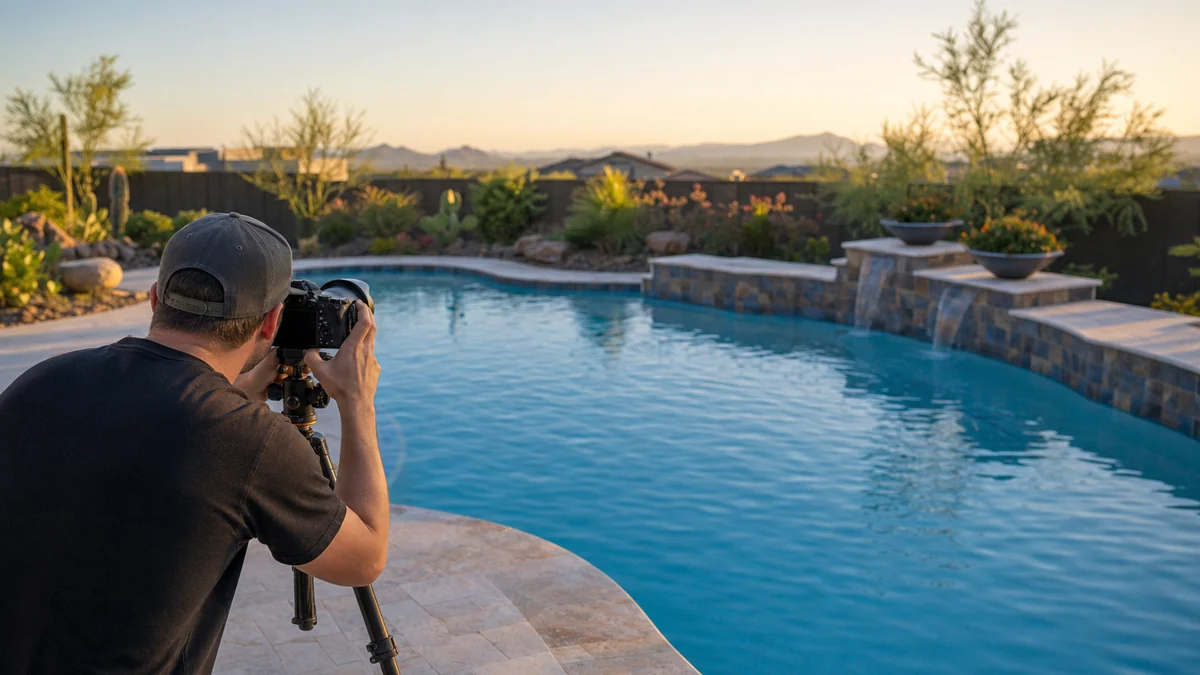
Budget it per shoot, and plan the shoots around your build calendar. Your work is what sells you, and the same set of photos feeds your website, your Google profile, your ads and your social posts for a full season.
Two kinds of shoots cover most needs:
- Finished-pool shoots, done once the landscaping has filled in and the light is right. These carry your gallery and ads.
- Progress shots during excavation, steel, shotcrete and tile, which your crew can take on a phone at no extra cost if someone asks them to.
One good finished-pool shoot a season, plus steady progress photos, beats a dozen phone snaps of the same angle. Where to use them is covered in how to use project photos and videos.
What sales tools belong in the budget?
The design consultation is where a pool sale is won, and it has its own costs:
- Design or 3D rendering software, if you show homeowners their backyard before they sign.
- Printed design packets and proposals that look as good as the pools you build.
- Sample boards for tile, coping and finishes.
- Financing information from your lender partners, if you offer financing.
These aren’t usually called marketing, but they belong next to it, because a consultation that doesn’t sign wastes the ad money that booked it. Put them on the list so you can see the whole cost of getting from a click to a contract.
Which marketing costs are free?
A few of the most useful ones cost only your time:
- Your Google Business Profile. Google says creating a Business Profile and listing your business on Google is free.
- Your Google review link. Google lets you create a link or QR code to request reviews from your profile and share it by text, email or a printed card. Google also says offering incentives such as free or discounted services in exchange for reviews is strictly prohibited, so the link should be the whole ask.
- Progress photos from the job site, taken by your crew.
- Listings on other free directories that homeowners actually use.
Free isn’t the same as costless, though. Each of these needs someone’s hours every week. How many hours a week in-house pool marketing takes puts numbers on that.
What about yard signs, home shows and print?
Budget them as their own seasonal lines, and track them like any other channel. A yard sign at a build site is cheap and works on exactly the neighbors who just watched a pool go in. A home show booth costs more once you add the booth fee, display, printed pieces and the staff days. Mailers cost per piece plus design.
The trick with offline costs is giving each one its own phone number or form, so you can see what they produce. If you can’t measure a line, you can’t defend it next year.
How do I keep these costs from eating the ad budget?
- Give every cost its own line, with one-time costs spread over the months you’ll use them.
- Set the ad budget first from the contracts you want, then add the rest. Don’t fund tools by quietly trimming the ads.
- Record every line by lead source where you can. Housecall Pro’s marketing ROI table, for example, says ROI and return on ad spend can only be calculated after you enter your spending for each lead source, so put the non-ad costs in too.
- Review the list each quarter. Cancel tools nobody opens, and move the money to what’s signing pools.
Which of these are included if I hire an agency?
It depends on the agency, so ask for the list in writing. On our side, Essentials is $3,500 a month and covers listing cleanup and buildout, Google Business Profile management, 1 landing page, a 3-email welcome flow, call, web and form tracking with basic attribution, and a real-time dashboard with a monthly report, along with SEO content, review work and Google Ads management up to $2,500 a month in ad spend. Growth is $4,500 a month and adds more on each of those. Automation add-ons, such as a lead tracking dashboard, unified messaging, calendar reminders, after-hours answering and AI website chat, plug into any tier and are priced on the discovery call. Websites are priced separately, and ad spend is always paid directly to Google or Meta.
When you compare quotes, line up what each covers against the list on this page. How much a pool marketing agency costs goes deeper on comparing fees.
Talk it through with someone who runs this every day
A 15-minute growth call: your market, your numbers, and what a realistic budget looks like. No pressure.
What's different about these costs for pool builders
The CRM carries a lead for months. A homeowner who calls in October might sign in February. Your lead system has to hold the source, the notes and the next step that whole time, which is why pool builders get more out of it than trades that close in a day.
Your work is the ad. Few trades depend on photos the way pool builders do. Finished-pool photography is one of the best-value lines on the list, because one shoot feeds every channel.
Timing matters for one-time costs. A website takes weeks to build, so start it in the slow months, not in March when homeowners are already searching. The same goes for shoots: book them in summer, when last season’s pools look their best.
The consultation is a real cost. Design time, renderings and printed proposals add up per lead, so the materials budget grows with your lead count.
A worked example: one year of costs beyond the ads
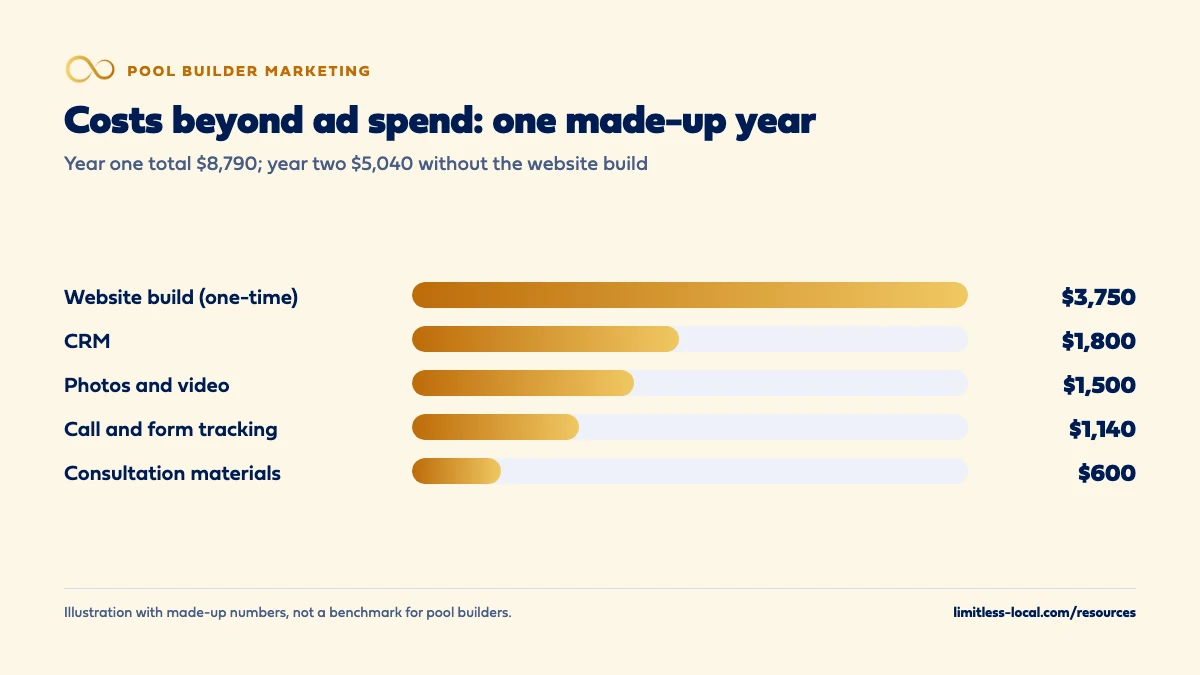
Apart from the themed website price and the CallRail plan above, these numbers are made up to show the math, not a benchmark for pool builders. Say a pool company plans its first year of non-ad costs like this:
- Themed website build: $3,750, one-time.
- Call and form tracking: $95 a month for the year = $1,140.
- CRM: $150 a month for the year = $1,800.
- Photos and video: two shoots at $750 each = $1,500.
- Consultation materials: $600 for printed packets and sample boards.
Year one adds up to $8,790, or about $733 a month on top of ad spend. If marketing produced 8 signed pools that year, those costs add about $1,099 to each contract. In year two, without the website build, the same list drops to $5,040, about $420 a month.
That’s why the first season can look expensive per pool and the second much less so. Judge these lines over two seasons, not one.
Frequently asked questions
Should the website cost count against my marketing budget?
Yes, but spread across the years you’ll use it. A site you plan to keep for three years counts as a third of its price each year.
Is call tracking worth paying for if most of my leads come from referrals?
Referrals still call you, and you’ll want to know how many calls came from referrals versus your ads or Google profile. Without tracking, every phone call gets credited to word of mouth by default.
Do I need separate software for leads if I already use Jobber or Housecall Pro?
Often not. Check what your current plan includes for lead stages, lead sources and follow-up reminders before buying a second tool.
Should my own time count as a marketing cost?
It should, at least on paper. Hours you spend on posts, reviews and ad checks are hours not spent on consultations or job sites, and that trade-off is real money.
When is the best time to pay for one-time costs like a website or a photo shoot?
Build the website in the slow months so it’s live before spring searches pick up. Book photo shoots in summer, once finished pools and landscaping look their best.
Can I cut these costs in the off-season?
Cut the seasonal lines, like shows and mailers, but keep tracking and the CRM running. Leads from the fall and winter are often the ones that sign in spring, and you’ll want their source on record.
Key takeaways
- Ad spend buys clicks; the website, landing pages, tracking, CRM, photos and sales materials turn them into signed contracts.
- Sort costs into one-time, monthly and seasonal, and spread one-time costs over the months you’ll use them.
- Your Google Business Profile and review link are free, but they still cost hours every week.
- Give offline costs their own phone number or form so you can see what they produce.
- The first year usually costs more than the second because the website build lands in year one.
Ready to compare options?
Book a short growth call and we'll walk through the math for your service area, including when we're not the right fit.
More in this section
- How much should a pool builder spend on marketing?
- How should a pool builder split its marketing budget?
- How do pool builders target high-income neighborhoods with ads?
- Are Google Ads worth it for pool builders?
- What should a pool builder ask before hiring a marketing agency?
Sources
- Get Listed on Google – Google Business Profile — Google Business Profile
- Create a Google link or QR code to request reviews — Google Business Profile Help
- Landing page experience: Definition — Google Ads Help
- Compare Pricing Plans — CallRail
- Marketing Dashboard: ROI Table — Housecall Pro Help Center