
How should a pool service company price its monthly routes?

- How do I set a monthly price for weekly pool service that still leaves a profit?
- What should a monthly pool service price cover?
- How do I work out my cost per stop?
- How much profit should each account carry?
- Should chemicals be included or billed separately?
- How do pool size, trees and equipment change the price?
- How does route density change what I can charge?
- Should I price per visit or a flat monthly rate?
- Should I list my pool service prices on my website?
- How do I raise prices on existing accounts?
- How do I compete with the cheapest pool guy in town?
- How does pricing connect to my marketing budget?
- What's different about pricing pool service routes
- A worked example: pricing one weekly account
- Frequently asked questions
- Key takeaways
- More in this section
- Sources
The short version
- Start from cost per stop: labor and drive time, chemicals, truck, billing, overhead.
- Add the profit you want per account, then check the price against what a pool needs.
- Price harder pools higher, and decide clearly whether chemicals are included.
- Density is the cheapest profit: same price, shorter drives, more left over.
For pool service owners setting or resetting their monthly rates, and deciding how price, route density and what’s included shape the customers they win.
Get a free visibility audit · Book a growth call
How do I set a monthly price for weekly pool service that still leaves a profit?
Price monthly pool service from your own cost per stop, not from the cheapest company in town: the tech’s time on site and driving between stops, chemicals, the truck, billing fees and a share of overhead, plus the profit you want from each account. Then adjust for what makes a pool harder, such as size, trees, screens and equipment, and decide whether chemicals are included or billed separately. Dense routes lower your cost per stop, so the same price earns more on a tight street than across town. Publish a clear starting rate and what it covers, and review prices every year.
Your price decides which customers you can afford to win, and your marketing decides where they come from. Our part is the second half: local SEO, your Google Business Profile, ads aimed at the streets you already serve, and call and form tracking that shows what each new account cost. The packages page lays out what each tier includes, the pool marketing page covers the trade, and the pool builder marketing questions library has more on service routes.
What should a monthly pool service price cover?
Every account has to pay for five things before it earns you anything:
- Labor. The tech’s time at the pool and the drive to it, at what that tech really costs you per hour once payroll taxes, workers’ comp and any benefits are added.
- Chemicals. Chlorine, acid, stabilizer and the rest, unless you bill them separately.
- The truck. Fuel, maintenance, insurance and wear, per mile driven.
- Billing. Card and bank fees, software and the time it takes to chase late payers.
- Overhead. Insurance, office, phones, licensing, and the marketing it takes to replace the accounts you lose each year.
Then comes profit. If a price doesn’t cover all five with room left over, more accounts at that price just means more work for the same thin result.
How do I work out my cost per stop?
Time a normal week on your route. For each stop, note the minutes on site and the minutes driving from the last stop, then average them. Multiply that by your loaded hourly labor cost. Add the average chemical cost per visit from your purchase records.
For the truck, the cleanest number is your own: a year of fuel, repairs, insurance and payments, divided by the miles driven. If you don’t have it yet, the IRS standard mileage rate for business use, 76 cents a mile for the second half of 2026, is a simple placeholder until you do. Multiply your cost per mile by the average miles between stops.
Billing fees depend on how customers pay. Skimmer’s billing FAQ, for example, lists card processing at 2.9% plus 25 cents a transaction, with an extra 0.5% on recurring or keyed transactions, and bank payments at 1% plus 25 cents. Bank autopay on a monthly invoice is usually the cheapest to collect. Spread your yearly overhead across your accounts and you have a full cost per account.
How much profit should each account carry?
Decide it on purpose instead of letting it be whatever is left. A useful check is the break-even math the U.S. Small Business Administration uses in its break-even point calculator: fixed costs divided by price minus variable costs gives the number of units you need to sell to break even. For a pool service company, the units are accounts, the price is your monthly rate, and the variable costs are labor, chemicals and driving per account.
Run it with your real numbers. If your fixed costs need 140 accounts to break even and you have 90, the problem isn’t volume you can market your way out of quickly; it’s the price, the costs, or both. If you break even at 40 and have 90, you have room to invest in growth or in better pay to keep good techs.
Should chemicals be included or billed separately?
Both models work, and pool billing software handles both: recurring service billed per stop or as a flat monthly fee, with or without chemicals.
- Chemicals included. One simple price homeowners can compare and budget for. You carry the risk of a heavy chemical month, a big pool or a stormy summer, so the price needs room for it.
- Chemicals billed separately. A lower base price and no chemical risk, but invoices change every month, and some customers will question each line.
Whichever you pick, write it down in the service agreement and on your website. Most billing arguments in pool service start with a customer who thought something was included and an owner who thought it was obvious that it wasn’t.
How do pool size, trees and equipment change the price?
A small screened pool with a cartridge filter and a big open pool under oak trees are different jobs. Build a short list of price adjustments so the office quotes the same way every time:
- Size. Larger pools take more chemicals and more time to brush and vacuum.
- Debris. Trees, no screen enclosure or a nearby field mean more skimming and more filter cleans.
- Extras. An attached spa, water features or a saltwater system each add time or a check.
- Access. Locked gates, dogs and long walks from the street add minutes every week.
Keep the list short enough to explain on a phone call. Three tiers plus a few add-ons is easier to sell and defend than a custom price for every backyard.
Curious what your marketing is actually booking?
Get a free visibility audit — no obligation, no sales pitch.
How does route density change what I can charge?
Density doesn’t change what a homeowner will pay; it changes what you keep. A stop three minutes from the last one costs far less to serve than one fifteen minutes away, so the same monthly price earns more on a tight route. That’s why the best growth for a route business is usually the neighbors of the pools you already serve.
It also tells you how to price outliers. A pool well outside your route can carry a higher rate to cover the drive, or you can decline it politely and refer it to someone closer. Taking every account at the same price, wherever it is, quietly makes your whole route less profitable. Whether a pool service business is profitable goes deeper on why density and retention decide the margin.
Should I price per visit or a flat monthly rate?
Most route businesses bill a flat monthly rate for weekly service. It’s simpler for the homeowner, it pairs well with autopay, and it evens out the months with four visits and the months with five. Price it off the yearly number of visits, roughly 52 a year, divided across twelve monthly payments, rather than off four visits a month.
Per-visit pricing fits customers who want every other week, seasonal openings and closings, or one-off green-pool cleanups. Keep those as separate services with their own prices, so the monthly rate stays clean. If you use Housecall Pro, its service plan templates let you set the number of included visits and bill monthly, quarterly, every six months or yearly.
Should I list my pool service prices on my website?
A clear “starting at” monthly rate, with a plain list of what’s included and what changes the price, does two jobs. It filters out callers who only want the lowest number, and it tells the right customers you run a real business with clear terms. Homeowners who call after seeing your price have already accepted the range.
What you leave off matters too. Avoid “cheapest in town” or deep first-month discounts in your headlines; they attract the customers most likely to leave for the next discount. If you’d rather not publish a number, at least say what’s included and how pricing works, so the first call isn’t spent explaining it.

How do I raise prices on existing accounts?
Pick one time a year, often before peak season, and review every rate against your current costs. Chemical prices, wages and fuel all move, and an account priced four years ago may now be losing money. Give customers written notice ahead of the change, say what it is, and keep the explanation short.
Most good customers stay. Canada’s Business Development Bank (BDC), in its definition of customer retention rate, lists loyal customers as tending to be more price insensitive and costing less to market to than new ones. The accounts that leave over a modest increase were often your least profitable ones. If your lowest-priced accounts are also your hardest, the increase sorts that out for you; how a pool service owner deals with difficult customers covers the rest.
How do I compete with the cheapest pool guy in town?
Not on price. Someone is always willing to go lower, often without insurance, without a schedule they keep, or without a business that will be around next year. Compete on what a homeowner notices: the same day every week, a short service note with a photo after each visit, quick replies, clean water after storms, and clear invoices.
Then say so in your marketing. Your website, your Google Business Profile and your reviews should show that reliability, because that’s what justifies a higher rate. Homeowners comparing two companies at different prices will read the reviews before they read the price.
How does pricing connect to my marketing budget?
Your price sets what you can afford to spend to win an account. Take the monthly profit an account leaves you, multiply it by how many months a typical account stays, and you have its worth over its lifetime. Spending a fraction of that to win a new account is a good trade; spending more than it will ever earn isn’t.
Point that spend at the streets you already serve, so every new account makes your route denser. How much a pool company should spend on ads to grow a route runs the budget math, and what a pool route business is covers the model if you also build pools.
Talk it through with someone who runs this every day
A 15-minute growth call: your market, your numbers, and what a realistic budget looks like. No pressure.
What's different about pricing pool service routes
Small payments, many times. A route lives on modest monthly rates repeated for years, so a few dollars on every account adds up to a large share of profit, in either direction.
The calendar moves your costs. Summer heat and storms raise chemical use and visit time, while the monthly price stays flat. Price for the hard months, not the easy ones.
Drive time is hidden labor. Minutes between stops are paid hours that no customer sees, so where your accounts are matters as much as how many you have.
Churn resets the math. Every lost account has to be replaced with marketing spend, so a price that keeps good customers happy is worth more than one that wins the most new ones.
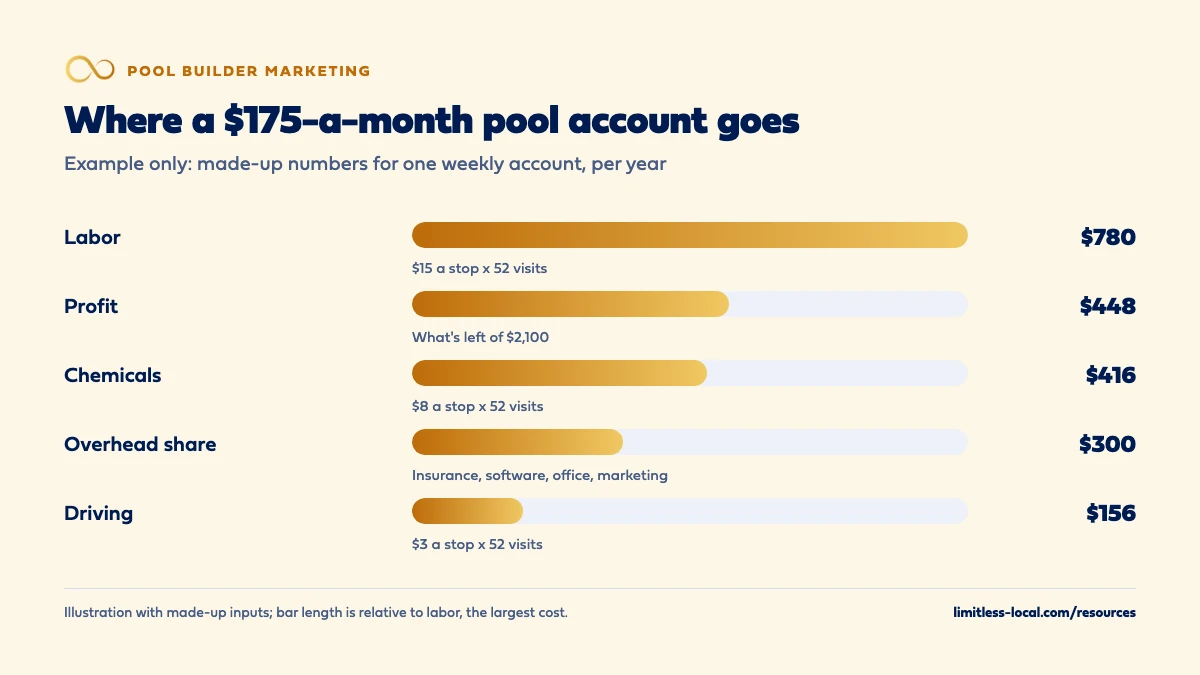
A worked example: pricing one weekly account
These numbers are made up to show the math, not a benchmark for your market. Say a tech costs you $30 an hour fully loaded, and an average stop takes 20 minutes at the pool plus 10 minutes of driving.
- Labor: 30 minutes at $30 an hour = $15 a stop.
- Chemicals: $8 a stop on average.
- Driving: 4 miles between stops at about 76 cents a mile, call it $3.
- Cost per stop: $26, or $1,352 a year at 52 visits.
- Overhead share: $300 a year for insurance, software, office and marketing.
That’s $1,652 a year, about $138 a month, before profit. At $175 a month ($2,100 a year), the account leaves $448 a year.
Now tighten the route. If the same stop sits 5 minutes and 2 miles from the last one, labor drops to $12.50 and driving to about $1.50, so the stop costs $22. That’s $1,144 a year plus the same $300 overhead, or $1,444, and the account at the same $175 now leaves $656 a year. Same customer, same price, nearly half again as much profit.
Frequently asked questions
Should I charge new customers a startup fee?
Charge separately for the first visit when a pool is green or neglected, because it takes far longer than a weekly stop. Price it as its own job, not by raising the monthly rate.
Do I lower the price in winter?
Only if you also reduce the service, such as visiting every other week. Otherwise keep the flat rate and let the slower months balance out the heavy summer ones.
Should I match a competitor's quote to win an account?
Only if your cost per stop says it still leaves a profit. If it doesn’t, the account costs you money every week you keep it.
How do I price an account I'd buy with an existing route?
Run each account through the same cost-per-stop math. Bought accounts priced below your cost need a planned increase or a plan to let them go.
Should repairs and equipment be priced into the monthly rate?
No. Keep repairs, parts and equipment as separate quoted work, and say in your agreement that they aren’t part of the monthly service.
Key takeaways
- Build your price from cost per stop: labor and drive time, chemicals, truck, billing and overhead.
- Decide the profit each account should carry, and check it with break-even math.
- Say clearly whether chemicals are included, and price harder pools higher with a short, fixed list.
- Density raises profit without raising price, so grow on the streets you already serve.
- Review every rate once a year, and compete on reliability, not on being cheapest.
Ready to compare options?
Book a short growth call and we'll walk through the math for your service area, including when we're not the right fit.
More in this section
- How much should a pool company spend on ads to grow its route?
- What is a pool route business, and should a builder add one?
- Is $2,500 a month enough ad spend for a pool builder?
- When should a pool builder raise its monthly marketing budget?
- Should a pool builder offer pool service as a side business?
Sources
- Standard mileage rates — Internal Revenue Service
- Billing FAQ – General — Skimmer
- Break-even point calculator — U.S. Small Business Administration
- Create Service Plan Templates — Housecall Pro Help Center
- What is customer retention rate? — BDC (Business Development Bank of Canada)