
When should a pool builder raise its monthly marketing budget?

- What are the signs a pool builder is ready to spend more on marketing each month?
- Is my marketing working well enough to deserve more money?
- Can my crews and subs build the extra pools?
- Is my sales process keeping up with the leads I already get?
- How do I tell if my Google Ads are being held back by budget?
- When is raising the budget the wrong move?
- How much should I raise it by at a time?
- How long should I wait before judging a raise?
- When in the year should a pool builder raise spend?
- Should the extra money go to ads, SEO or something else?
- When should I bring the budget back down?
- What's different about raising a budget for pool builders
- A worked example: deciding on a raise with real math
- Frequently asked questions
- Key takeaways
- More in this section
- Sources
The short version
- Raise when the numbers say each signed pool costs well under what it leaves you.
- Make sure crews and subs can build the extra pools before you buy the leads.
- Fix slow callbacks and weak consultations first; more spend won't fix them.
- Raise in steps, ahead of the season, and judge each step by signed contracts.
For pool builders whose marketing is working and who are wondering whether to step it up, and how to tell more spend will buy more signed pools, not just more leads.
Get a free visibility audit · Book a growth call
What are the signs a pool builder is ready to spend more on marketing each month?
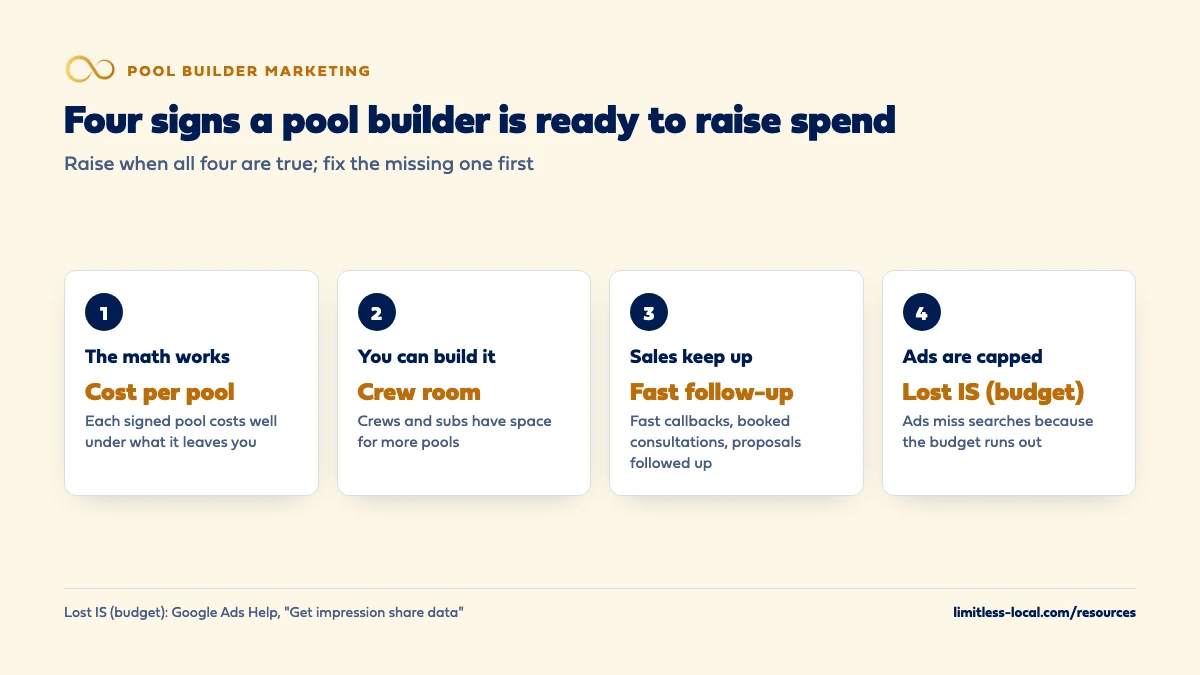
Raise your monthly marketing budget when four things are true at once: you can trace signed contracts to your marketing at a cost per contract well under what a pool leaves you, your crews and subs have room for more builds, your sales process is keeping up with the leads you already get, and your ads are missing searches because the budget runs out. If any one of those is missing, more money mostly buys more of the same problem. Raise in steps ahead of your busy season, and judge each step by signed contracts, not by a single month of leads.
This is how we decide when to raise spend too: we look at what each signed pool cost, by channel, before anyone talks about a bigger number. Our Limitless Engine packages start with Essentials at $3,500 a month, which manages Google Ads up to $2,500 a month in spend, and Growth at $4,500 a month raises that to $5,000. Ad spend isn’t included in any package and goes straight to Google or Meta, so a raise goes to the ad platform, not to us, until it takes you past what your package manages. See how it fits a builder’s year on our pool builder marketing page, or browse the rest of the pool builder marketing questions.
Is my marketing working well enough to deserve more money?
Start here, because raising the budget on marketing you can’t measure is a guess with a bigger price tag. Before you add a dollar, you should be able to answer three questions from your own records:
- Which channels signed pools last season? Not which ones sent leads, which ones turned into contracts.
- What did each signed pool cost in marketing? Everything you spent on that channel over the season, divided by the contracts it signed.
- How does that compare with what a pool leaves you? If your profit per pool can carry a much higher marketing cost than you’re paying now, there’s room to spend more.
If you can’t answer the first two, the next dollar goes to tracking, not to ads. Tracking which marketing produces signed pool contracts covers the setup, and working out what a lead is worth gives you the ceiling to compare against.
Can my crews and subs build the extra pools?
More marketing only pays if you can build what it sells. Count the pools your crews, your shotcrete and tile subs and your permit timelines can realistically finish next season, then compare that with the contracts you already expect from referrals, repeat customers and the marketing you run now. The gap is what a raise should aim to fill.
If the gap is small or zero, a bigger budget mostly creates a longer waiting list. Some homeowners will wait, but many won’t, and a lead you can’t schedule for months is one you paid for and may lose. In that case, keep the budget where it is, or shift it toward the higher-margin work you’d rather sell, and look at whether to pause marketing when the schedule is full before you spend more.
If you’re adding a crew or lining up more subcontractor capacity, that’s one of the clearest reasons to raise spend, as long as the new capacity is real before the leads arrive.
Is my sales process keeping up with the leads I already get?
This is the check most builders skip. A budget raise pours more leads into the same process, so any leak in that process gets bigger too. Look honestly at the last few months:
- Do new inquiries get a call back within minutes, or does it depend on whether you’re on a job site?
- Are design consultations being booked from the inquiries you get, or are a lot of them going quiet after the first call?
- Does every proposal get a planned follow-up, or do some sit until the homeowner calls you?
If the answers are shaky, fixing follow-up will usually sign more pools per dollar than buying more leads. Budgeting for follow-up, not just lead generation walks through that trade-off. Once the process is tight, a raise has a much better chance of showing up as contracts.
How do I tell if my Google Ads are being held back by budget?
Google tells you, if you know where to look. In your Google Ads account, add the impression share columns to your campaigns view. Google’s guide to getting impression share data explains that Search lost IS (budget) is the percentage of time your ads weren’t shown on the Search Network because of insufficient budget, while Search lost IS (rank) is the share lost to poor Ad Rank. Both are shown at the campaign level.
Those two numbers point in different directions:
- A high lost IS (budget) means homeowners are searching for pools in your area and your ads are sitting out because the money ran out. That’s the clearest sign a raise could buy more of the leads you already get.
- A high lost IS (rank) means more budget won’t help much on its own. The fix is in the ads, the landing page and the bids.
Google also marks campaigns Limited by budget when a campaign is underperforming because of a limited budget, and it may show a recommended budget. Treat that as a signal to check, not an instruction. The recommendation is about clicks and impressions; your test is whether the extra clicks sign pools at a cost you can carry.
Curious what your marketing is actually booking?
Get a free visibility audit — no obligation, no sales pitch.
When is raising the budget the wrong move?
Hold the budget, or even trim it, when any of these is true:
- You can’t connect leads to contracts. You’d be raising spend on faith.
- Your cost per signed pool is already near your ceiling. The next dollar usually buys leads that cost more, not less, so a raise would push you over.
- Leads are fine but contracts aren’t. That’s a sales or pricing problem, and more leads won’t fix it.
- The leads are mostly junk: wrong towns, service calls, people shopping for an above-ground pool. Tighten targeting first.
- Your schedule is full into next season.
- Cash is tight. Pool marketing pays back slowly, because homeowners take months to sign. Don’t raise spend you’d have to pull back in a panic before it has a chance to show results.
None of these means never. Each is something to fix before the next step up.
How much should I raise it by at a time?
In steps, not leaps. A step should be big enough that you’d notice the difference in leads within a few weeks, and small enough that, if it doesn’t work, you’ve lost a month or two of a modest increase, not a season’s worth of a big one.
Before you pick the number, Google’s Performance Planner can forecast what a bigger budget might do. It simulates relevant ad auctions over the last 7 to 10 days, adjusted for seasonality, and shows projected performance if you change campaign settings. Use it as a rough guide to how many more clicks and conversions are available in your area, not as a promise.
When you do raise, know how the spend limit moves. Google says that when you change your average daily budget, spend for the rest of the month won’t exceed the new average daily budget times the number of calendar days left, and that on any single day you can be charged up to twice your highest average daily budget for that day. A full month at a steady daily budget is capped at that budget times 30.4. That’s in Google’s guide to how budget changes take effect, and it means a mid-month raise won’t blow up the month.
How long should I wait before judging a raise?
Longer than a week, and longer than you’d like. Google’s guide to Smart Bidding learning says budget changes take effect in the next auction and don’t trigger a Learning status, but that performance typically settles over one to two conversion cycles, the time it takes a click to turn into a conversion. Google suggests evaluating over two conversion cycles or a two-week window, whichever is longer.
For a pool builder, the conversion Google sees is usually a call or a form, so that part settles fairly fast. The part that matters, signed contracts, takes much longer, because homeowners compare builders, designs and financing before they commit. Judge a raise in two stages:
- In the first month or so: more qualified leads from your towns, at a cost per lead that hasn’t jumped out of reach, and design consultations rising with them.
- Over the season: signed contracts, and the marketing cost of each one, compared with the season before.
If stage one looks wrong after a fair run, step back down. If it looks right, hold the new level long enough to see stage two before stepping up again.

When in the year should a pool builder raise spend?
Ahead of demand, not in the middle of it. Most builders feel the rush when the weather turns warm and homeowners start picturing summer, but the homeowners who sign in spring often started searching and comparing over the winter. Raising spend once your phone is already ringing means paying peak prices to catch people late in their decision.
A practical pattern: plan the year’s steps in the off-season, start the first step before your local busy period begins, and hold off on further steps until you’ve seen how the first one converted. Late in the season, when the build calendar fills and new contracts would wait until next year, it’s often right to step back down.
Should the extra money go to ads, SEO or something else?
It depends on where the gap is. Ads can bring leads within days of launch, so if you need contracts this season and your campaigns are losing searches to budget, ad spend is the fastest place for a raise. SEO typically takes 3-6 months to show meaningful organic growth, so money moved there is a bet on next season and the one after.
Often the best raise isn’t on the lead side at all:
- Tracking, if you can’t yet tell which channel signed which pool.
- Follow-up and sales time, if consultations aren’t turning into contracts.
- Photos and video of finished pools, if your ads and website don’t show the work that sells it.
- Reviews and your Google Business Profile, if you’re losing homeowners who compare builders on Maps.
For how the pieces fit in a budget, see how to split a pool builder’s marketing budget.
When should I bring the budget back down?
Raising isn’t a one-way door. Step spend down when the extra leads aren’t turning into consultations after a fair run, when your cost per signed pool climbs toward your ceiling, when the build schedule is full for the months ahead, or when the season turns and fewer homeowners are searching.
Step down the same way you stepped up: in measured amounts, one change at a time, so you can see what each one did. And keep the always-on basics running, such as your Google Business Profile, reviews and website, because those take months to build and are slow to win back. How much a pool builder should spend on marketing covers how to set the baseline you step up and down from.
Not sure which of these is costing you jobs?
A free visibility audit checks the Google profile, reviews, site and tracking, and shows what to fix first.
What's different about raising a budget for pool builders
The payback is slow. A pool contract can sign months after the first inquiry, so a raise in March may not show up as signed contracts until well into the season. Plan the cash for that gap before you raise.
Capacity is lumpy. You can’t add half a crew. A raise often makes sense in the season you add a crew or more sub capacity, and rarely makes sense when you can’t build more pools than you do now.
The calendar rules everything. Demand, cost per click and your build schedule all move with the seasons. A raise that’s right in late winter can be wrong in late summer.
Not every pool is worth the same. A custom gunite build, a fiberglass install and a remodel leave you very different amounts. Raise spend on the campaigns that sell the work you want more of, not across the board.
A worked example: deciding on a raise with real math
This builder is made up to show the math, not a benchmark for your market.
Last season, a builder spent $2,000 a month on Google Ads for six months, or $12,000. That brought in 48 leads ($250 each), 16 design consultations and 4 signed contracts. Marketing cost per signed pool: $12,000 divided by 4, or $3,000. The builder works out that each pool can carry up to $7,000 in marketing before it eats too far into profit, so there’s room.
Search lost IS (budget) shows the ads sat out of a lot of searches, the crew has room for a few more builds, and callbacks happen within minutes. All four signs say raise.
The builder steps up by $1,200 a month, to $3,200, for the same six months: $7,200 extra. The extra leads cost more, say $300 each, so the raise brings 24 more leads. At the same rates as last season (one in three books a consultation, one in four consultations signs), that’s 8 more consultations and 2 more contracts. The extra contracts cost $7,200 divided by 2, or $3,600 each: more than the first ones, but well under the $7,000 ceiling. Worth it, and worth checking again before the next step.
Frequently asked questions
Should I jump from $1,000 a month straight to a much bigger budget?
Usually not. Step up in amounts you can judge, check that the extra leads are booking consultations, and hold each level long enough to see contracts before the next step.
My agency says I need to spend more. How do I check?
Ask to see Search lost IS (budget) for each campaign, cost per signed contract by channel, and how many of last season’s leads booked a consultation. If ads aren’t losing searches to budget, or contracts aren’t keeping up with leads, more spend isn’t the fix.
Does raising my budget restart Google's learning?
No. Google says budget changes take effect in the next auction and don’t trigger a Learning status, though results still take one to two conversion cycles to settle.
Should I raise spend if I'm adding a second crew?
Yes, that’s one of the best reasons, as long as the crew is real before the leads arrive. Step up a season ahead of when you need the extra contracts, because pool buyers take months to sign.
Can I raise the budget for a few weeks and then drop it?
You can, but short bursts are hard to judge in a trade where contracts sign months later. If you test a raise, give it at least a full month of leads and follow those leads through to contracts before deciding.
Key takeaways
- Raise when the math works, crews can build more, sales keep up and ads are losing searches to budget.
- Search lost IS (budget) in Google Ads shows whether budget, not rank, is holding your ads back.
- Raise in steps, ahead of your busy season, and change one thing at a time.
- Judge leads in the first month or so, and signed contracts over the season.
- Often the best raise is in tracking or follow-up, not more leads.
Want a second set of eyes on your setup?
We'll look at how you show up locally and where calls are leaking, then send you a plain-English breakdown.
More in this section
- How much should a pool builder spend on marketing?
- How should a pool builder split its marketing budget?
- How should a pool builder prepare marketing before peak season?
- What does a pool builder budget beyond ad spend?
- Does pool marketing cost more in spring and summer than winter?
Sources
- Get impression share data — Google Ads Help
- Fix “Limited by budget” status — Google Ads Help
- About Performance Planner — Google Ads Help
- How budget changes take effect — Google Ads Help
- About Smart Bidding learning — Google Ads Help