
How does a pool builder work out what a lead is worth?

- How do I calculate what one pool lead is worth to my business?
- What does it mean for a pool lead to be worth something?
- Step 1: What does an average pool actually leave me?
- Step 2: What share of my leads turn into signed contracts?
- Step 3: How do I put the two numbers together?
- Should I use revenue or profit when I work out what a lead is worth?
- Is a referral lead worth more than an ad lead?
- Is a remodel lead worth the same as a new pool lead?
- Should I count the work a pool customer brings in later?
- How do I use the number once I have it?
- Can Google Ads see which leads became signed pools?
- What mistakes throw the number off?
- What's different about lead value for pool builders
- A worked example: what one pool lead is worth
- Frequently asked questions
- Key takeaways
- More in this section
- Sources
The short version
- Value of a lead = gross profit per pool x share of leads that sign.
- Use profit, not the contract price, and count a full season of leads.
- Work it out per lead source and per job type, not just one blended number.
- It's the starting point for what you can pay per lead, not the answer to it.
For pool builders who want one honest number for what a new inquiry is worth, before deciding what to pay for leads or how to judge a channel.
Get a free visibility audit · Book a growth call
How do I calculate what one pool lead is worth to my business?
A lead is worth the gross profit on an average pool multiplied by the share of leads that end up signing. Take your average contract price, subtract materials, labor, subcontractors and permits to get gross profit per pool, then divide the contracts you signed last season by the leads you got, and multiply the two. Work it out separately for each lead source and each kind of job, because a referral and a cold ad inquiry, or a new build and a remodel, are rarely worth the same.
This is the number our reporting is built around. Every package includes call, web and form tracking with source tagging and a monthly cost-per-lead breakdown, so you can put what each lead cost next to what each lead is worth. For pool builders that usually starts with our local ads work and the Essentials package at $3,500 a month. See how it fits the rest of the plan on our pool builder marketing page, or browse the rest of the pool builder marketing questions.
What does it mean for a pool lead to be worth something?
Most leads never become a pool. Some are tire-kickers, some are out of your area, some pick another builder, and some decide to wait a year. A lead’s worth is the average profit a single inquiry brings in once you account for all the ones that don’t sign.
That’s why it’s a smaller number than owners expect. If a pool leaves you a healthy profit but only a small share of inquiries sign, each inquiry is worth a slice of that profit, not the whole thing. Once you know the slice, you know the most a lead can cost before you’re paying more than it brings in, and you can compare channels on something better than gut feel.
This page is the first half of that job. The second half, turning a lead’s worth into what you can afford to spend, is covered in how much you can afford to spend to win one pool customer.
Step 1: What does an average pool actually leave me?
Start with gross profit per pool, not the contract price. Take your average contract over the last season, then subtract what it cost to build:
- Materials: steel, shotcrete or the fiberglass shell, plumbing, equipment, tile, coping and finish.
- Labor on the job, your crews and anyone you pay by the job.
- Subcontractors: excavation, electrical, decking, fencing.
- Permits, engineering, inspections and dumping.
What’s left is what each pool contributes toward overhead, marketing and profit. The SBA’s break-even point calculator draws the same line: fixed costs don’t change with sales or volume, while variable costs change with sales or volume. The costs that come with each build are the ones you subtract here. Rent, office staff and trucks stay on the overhead side.
Use real job costs from your last season if your software tracks them, not your estimate at bid time. Builds that ran over are part of the average.
Step 2: What share of my leads turn into signed contracts?
Count every lead you got over a full season, then count how many of them signed. Divide contracts by leads and you have your lead-to-contract rate.
Three things make this number honest:
- Decide what counts as a lead. A real homeowner asking about a pool in your area, by call, form, message or walk-in. Leave out spam, sales calls and service requests you don’t do. Write the rule down so it’s the same every season.
- Count a full season. Pool buyers take months to decide. A lead from March may sign in June, so counting one month undercounts contracts.
- Track the middle step too. Leads to booked design consultations, and consultations to contracts. If the overall rate is low, those two numbers tell you where it’s leaking.
For what those middle numbers tend to look like, see what lead-to-appointment rate a pool builder should expect and what a good close rate is for pool construction leads.
Step 3: How do I put the two numbers together?
Multiply them. Gross profit per pool times your lead-to-contract rate is what an average lead is worth.
You can do the same for a booked design consultation: gross profit per pool times the share of consultations that sign. A consultation is always worth more than a raw lead, because the homeowner has already shown up. That second number is useful when you’re judging a channel that sends fewer, better leads, or deciding how much sales time a consultation deserves.
Keep the result as a range, not a single figure set in stone. Run it on last season and the season before. If the two come out close, you can trust it. If they’re far apart, find out why before you build a budget on it.
Should I use revenue or profit when I work out what a lead is worth?
Profit. Revenue makes every lead look worth far more than it is, because most of the contract price goes straight back out to materials, crews and subs. Marketing is paid from what’s left, so that’s the number to measure it against.
Revenue-based numbers are also what get owners into trouble with lead buying. If you think a lead is worth a share of the contract price, you’ll happily pay prices for leads that quietly eat the whole margin on the pools they sign. Using gross profit keeps that from happening.
If you want to be stricter, subtract each pool’s share of overhead as well, which gets you closer to net profit per pool. That’s the more cautious number, and it’s the one to use when cash is tight or you’re testing a channel you haven’t proven yet.
Curious what your marketing is actually booking?
Get a free visibility audit — no obligation, no sales pitch.
Is a referral lead worth more than an ad lead?
Usually, yes, and it’s worth measuring rather than assuming. A homeowner referred by a past customer already trusts you, so they tend to book a consultation and sign more often than someone who clicked an ad while comparing five builders. Home show leads, Houzz inquiries and leads from a realtor or landscaper partner each behave differently again.
That’s why a single blended number can mislead you. If referrals sign at a high rate and ads at a lower one, the blended average makes ad leads look better than they are and referrals look worse.
Your job software can do most of this work. Jobber’s Lead Source Report, for example, shows how many leads each source brought, how many of them went on to a quote and a job, and the value of the first invoice tied to them. Whatever you use, the key is tagging the source on every lead the day it comes in, not guessing later. Tracking which marketing produces signed pool contracts covers how.
Is a remodel lead worth the same as a new pool lead?
No, so work them out separately. A remodel, a resurfacing job, a fiberglass install and a custom gunite build each have their own average price, their own margin and often their own close rate. A remodel lead may sign faster and more often, but leave less profit per job. A custom build lead may sign less often but leave far more when it does.
Mixing them gives you a number that’s right for none of them. If you sell several kinds of work, run the three steps for each: average gross profit for that job type, the share of those leads that signed, and the result. Then you’ll see which kind of lead your marketing should chase hardest, which ties into how to budget for new pools versus remodels.
Should I count the work a pool customer brings in later?
Only once your own records show it. A pool customer can come back for a remodel, an equipment upgrade or a spa years later, and many send referrals. BDC’s guide to calculating customer lifetime value works it out as the average value of a sale times the average number of repeat transactions times the average retention period, and says to include maintenance or after-sale service in the revenue.
For a pool builder, that follow-on value is real but uneven, and it arrives years after you paid for the lead. Work out the first-job number first and use it for decisions. Treat the later work as a cushion that makes a borderline channel acceptable, and count it in your math only when you can point to past customers who actually came back or referred someone.

How do I use the number once I have it?
Three ways:
- Set a ceiling on cost per lead. If a lead is worth a certain amount in gross profit, paying close to that leaves nothing for overhead or profit. Set your limit well below it. What cost per lead means for your ad budget shows how the two numbers work together.
- Compare channels. Put each channel’s cost per lead next to what its leads are worth. A channel with pricey leads that sign often can beat one with cheap leads that rarely do.
- Tell Google Ads. Google’s guide to conversion values explains that if you assign values to your conversions, you can see the total business value your ads generated, not just the number of conversions, and focus on the high-value ones. A remodel inquiry and a custom-build inquiry can carry different values.
Can Google Ads see which leads became signed pools?
It can, if you send that information back. Google’s guide to offline conversion imports describes saving the click ID that comes with each ad click along with the lead’s details, then, when that person converts offline, by signing a contract, for example, giving that click ID back to Google Ads. Google now recommends enhanced conversions for leads as the easier way to set this up.
For a pool builder, that closes the loop: instead of the ads chasing form fills, they learn which searches turned into signed pools. It works best once you have a steady flow of contracts to report, and it depends on your team marking each lead’s outcome in your software. That habit is also what keeps your lead-value math honest.
What mistakes throw the number off?
- Using the contract price instead of gross profit.
- Counting one month in a trade where contracts sign months after the inquiry.
- Counting junk as leads, which makes every lead look worth less, or leaving real leads out, which makes them look worth more.
- Blending every source and job type into one number.
- Crediting the wrong source. A homeowner who saw your truck, then searched your name and clicked an ad, isn’t really an ad lead. Ask every caller how they heard about you.
- Never updating it. Prices, costs and close rates move. Recalculate at the end of each season, and whenever your pricing or sales process changes.
Not sure which of these is costing you jobs?
A free visibility audit checks the Google profile, reviews, site and tracking, and shows what to fix first.
What's different about lead value for pool builders
Big tickets, few contracts. A pool builder signs far fewer jobs than a service business, so each contract moves the math a lot. Work from a full season, and from two if you can.
Long, multi-step sales. Leads become design consultations, then proposals, then contracts, often over months. Track every step, or you won’t know where value is being lost.
Very different job types. Custom builds, fiberglass, remodels and resurfacing can each be worth a different amount per lead. One blended number hides that.
Margins move with the build. Rock blasting, poor soil, permit delays and change orders all change what a pool leaves you. Use actual job costs, not bid-time estimates.
A worked example: what one pool lead is worth
This builder is made up to show the math, not a benchmark for your market.
Last season the average new-pool contract was $68,000. Materials, crew labor, subs and permits came to $47,600 per pool, so each pool left $20,400 in gross profit, or 30% of the price.
The builder got 80 real leads, booked 24 design consultations and signed 6 contracts. The lead-to-contract rate is 6 divided by 80, or 7.5%.
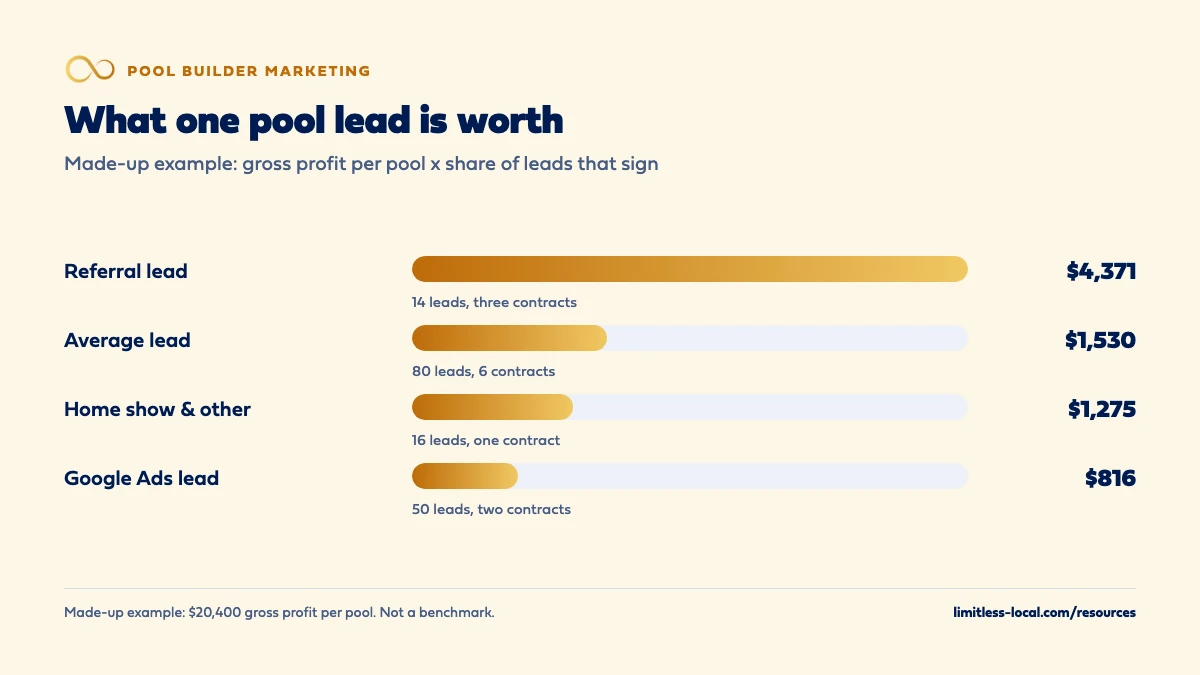
- Value of a lead: $20,400 x 7.5% = $1,530.
- Value of a booked consultation: $20,400 x 6 / 24 = $5,100.
Split by source, the picture changes. Google Ads sent 50 leads and two contracts: $20,400 x 2 / 50 = $816 a lead. Referrals sent 14 leads and three contracts: about $4,371 a lead. Home shows and everything else sent 16 leads and one contract: $1,275 a lead. Same builder, same pools, very different numbers, which is why the next step, setting what each channel can cost, should use these and not the blended $1,530.
Frequently asked questions
Is what a lead is worth the same as what I should pay for one?
No. What a lead is worth is the gross profit it brings on average; what you pay should sit well below that, so there’s room left for overhead and profit.
What if I don't have a full season of data yet?
Use what you have and treat the result as a rough range. Recalculate as soon as a full season of leads has had time to sign or say no.
Should I count leads that are still deciding?
Count them as leads, but don’t count them as lost yet. Run the numbers again once they’ve had time to decide, or they’ll drag your rate down for the wrong reason.
Does a phone lead count the same as a form lead?
Count both, but tag which is which. If calls book consultations more often than forms in your market, they’re worth more, and that’s worth knowing when you choose ads and landing pages.
Do I need special software to work this out?
No. A spreadsheet works. Software that tags the lead source and follows each lead through to an invoice makes it faster and harder to fudge.
Should I include my own time on consultations?
If you want the cautious number, yes. Add the cost of the time spent on design consultations and proposals to your costs, which lowers what each lead is worth but makes the number truer.
Key takeaways
- A lead is worth gross profit per pool times the share of leads that sign.
- Use actual job costs and a full season of leads, not one month.
- Work it out per lead source and per job type; blended numbers mislead.
- Count later work from a customer only once your records show it.
- Use the result to set a cost-per-lead ceiling well below it, and to give Google Ads real values.
Want a second set of eyes on your setup?
We'll look at how you show up locally and where calls are leaking, then send you a plain-English breakdown.
More in this section
- What tracking shows a pool builder cost per qualified lead?
- How do pool builders qualify leads before the design consultation?
- What does cost per lead mean for a pool builder's ad budget?
- How many leads are needed for a pool builder to hit its revenue goal?
- What is lead routing in a pool builder's sales process?
Sources
- Break-even point calculator — U.S. Small Business Administration
- Lead Source Report — Jobber Help Center
- Calculating customer lifetime value & cost of acquisition — BDC
- About conversion values — Google Ads Help
- About offline conversion imports — Google Ads Help