
What close rate is good for pool construction leads?

- What lead-to-contract close rate should a pool builder expect?
- What does close rate mean for a pool builder?
- Is there an industry benchmark for pool construction close rates?
- How do I calculate my own close rate?
- Should I measure from leads or from design consultations?
- Is a 10% or 25% close rate good for pool construction leads?
- What close rate do I need for my marketing to pay?
- Why does my close rate change so much by lead source?
- What drags down a pool builder's close rate?
- How long should I wait before judging a close rate?
- Can a close rate be too high?
- Why close rate works differently for pool builders
- A worked example: the same season as three different close rates
- Frequently asked questions
- Key takeaways
- More in this section
- Sources
The short version
- No trustworthy industry-wide close rate exists for pool builders; definitions vary too much.
- Split it in two: leads that book a design consultation, and consultations that sign.
- A close rate is good if your cost per signed contract stays under what a pool can carry.
- Compare by lead source and job type, counted over a full selling season.
- Fix the step that's weak: lead quality, response speed, the consultation or the follow-up.
For pool builders trying to decide whether their close rate is a problem, and which number to compare it against.
Get a free visibility audit · Book a growth call
What lead-to-contract close rate should a pool builder expect?
There’s no reliable published close rate for pool construction leads, so the benchmark that matters is your own: a close rate is good when, at your average contract and margin, it keeps what you spend to win each signed contract under what a pool can afford. Measure it in two steps, leads to design consultations and consultations to signed contracts, because a weak number at each step has a different fix. Track it by lead source over a full season, since a low rate on inexpensive web leads and a high rate on referrals can both be healthy.
Close rate is where marketing and sales meet, and it’s the number that turns cost per lead into cost per signed contract. Every one of our packages includes call tracking with recording and transcription, source tagging, and monthly reports with a cost-per-lead breakdown, so you can see which sources book consultations and which sign. The packages page lists what each tier includes, and the pool builder marketing page shows how we work with pool companies. More answers about leads, costs and contracts are in the pool builder marketing questions library.
What does close rate mean for a pool builder?
Close rate is the share of opportunities that turn into a sale, but the software you use may define it differently, which is the first thing to settle before you compare numbers:
- Housecall Pro calculates lead conversion rate as the share of leads moved to won, out of all leads, including those that are won, lost and still open. Source: Conversion Rate Reporting.
- Jobber calculates a quote conversion rate by comparing quotes sent in a calendar month with quotes converted in that month, and notes this can even come out above 100% because quotes converted without being sent aren’t counted as sent. Source: Quotes Report.
- ServiceTitan separates close rate, which is exclusive to sales and estimates, from conversion rate, which is about revenue and invoices. Source: Technician’s Close or Conversion Rate does not look correct.
In our judgement, a pool builder needs two clear numbers: the share of real leads that book a design consultation, and the share of consultations that sign a contract. Multiply them and you get the share of leads that sign. Write down which leads count, and use the same definition every season.
Is there an industry benchmark for pool construction close rates?
Not one we’d stand behind. We haven’t found a close-rate benchmark for pool builders from a government source or an independent study, and the figures you’ll see quoted online rarely say what counted as a lead, what period was measured, which markets were included or whether renovations were mixed in with new builds. A rate calculated from all inquiries and one calculated from completed design consultations can differ several times over for the same company.
In our judgement, comparing your number with someone else’s tells you very little. Comparing it with your own last season, by lead source and by job type, tells you a lot. That’s the benchmark this page uses.
How do I calculate my own close rate?
- Pick the period. In our judgement, a full selling season, so the long gap between first call and signed contract doesn’t distort it.
- Count real leads. Homeowners in your area asking about work you do. Log spam, job seekers and wrong-service calls, but leave them out of this count.
- Count booked design consultations from those leads, and the consultations that actually happened.
- Count signed contracts from those consultations, by the month the lead first came in, not the month it signed.
- Divide. Consultations ÷ leads, contracts ÷ consultations, and contracts ÷ leads.
- Split it by lead source and by new build versus renovation.
Grouping by the month the lead came in matters for pool builders. A lead from March that signs in June belongs to March’s marketing. Counting it in June makes June’s marketing look better than it was and March’s look worse. Tracking which marketing produces signed pool contracts covers how to keep the source attached to each lead for months.
Should I measure from leads or from design consultations?
Both, because they fail for different reasons.
Leads to consultations is mostly about lead quality and speed. If few inquiries book a consultation, in our judgement the usual causes are leads from outside your area or budget, slow first response, or a booking process that asks too much too soon. How pool builders qualify leads before the design consultation covers the screening side, and how fast a pool builder should respond to a new lead covers the speed side.
Consultations to contracts is mostly about the sale: how the consultation runs, how clear the proposal is, how financing is handled and whether follow-up continues after the meeting. A low rate here with plenty of booked consultations usually points at the sales process, not the marketing.
One combined number hides which of these is the problem. Two numbers tell you where to spend your effort.
Curious what your marketing is actually booking?
Get a free visibility audit — no obligation, no sales pitch.
Is a 10% or 25% close rate good for pool construction leads?
It depends on what’s in the bottom of the fraction and what each lead costs. In our judgement, 10% of all inquiries and 25% of design consultations can describe exactly the same company: if 40% of leads book a consultation and 25% of those sign, then 10% of leads sign. The worked example below shows that math.
So before judging a rate, ask three questions:
- Out of what? All inquiries, real leads, or completed consultations?
- From which source? Referral leads and paid search leads usually behave differently.
- At what cost? A low close rate on inexpensive leads can still produce an affordable contract; a high close rate on very expensive leads may not.
The rate is good if the resulting cost per signed contract fits your margin. Setting that ceiling is covered in what a good cost per signed pool contract is.
What close rate do I need for my marketing to pay?
Work it backward from what a contract can afford. The Business Development Bank of Canada describes cost of acquisition as sales costs plus marketing costs, divided by the number of new customers those efforts won. Source: Do you know the lifetime value and cost of acquisition of your customers?. Flip that around and you get the minimum close rate a channel needs:
Minimum close rate = cost per consultation ÷ the most you can spend to win one contract.
Say a channel costs you $500 per design consultation, and you’ve worked out that you can spend up to $3,000 in marketing to win one pool. You need at least 1 in 6 consultations from that channel to sign, about 17%. If it signs more than that, the channel pays; if it signs fewer, it doesn’t, however good the leads feel. These numbers are made up; use your own.
How to set the most you can spend per contract is covered in how much a pool builder can afford to spend to win one customer.
Why does my close rate change so much by lead source?
Because each source sends a different kind of homeowner. In our judgement, referrals from past customers and trade partners tend to arrive already trusting you, so they close at a higher rate. Paid search brings people who are comparing builders, so more of them shop around. Shared lead services may send the same homeowner to several builders at once. Home shows bring people early in their planning, who may take a season or more to decide.
None of that makes one source good and another bad. A lower-closing source can still be worth it if its leads cost little, and a high-closing one can be limited by how many leads it can send. Judge each source on its own close rate and its own cost per signed contract, not against the company average.
What drags down a pool builder's close rate?
In our judgement, the usual causes, roughly in the order to check them:
- Leads that were never a fit: outside your area, wanting work you don’t do, or far below your price range.
- Slow first response: the homeowner booked someone else’s consultation while waiting.
- A consultation that sells instead of designs: the homeowner doesn’t leave with a design they’re excited about.
- A proposal that’s hard to say yes to: unclear scope, no options, no explanation of payments or financing.
- Follow-up that stops after one email.
- A calendar problem: your next open build slot is later than the homeowner wants to swim.
The consultation and proposal side is covered in detail in how pool builders turn design consultations into signed contracts.
How long should I wait before judging a close rate?
Longer than a month. A pool lead can take weeks or months to move from first call to signed contract, so a rate measured too early counts leads that are still deciding as losses. Housecall Pro’s lead conversion rate, for example, counts open leads in the total, so a month full of open leads will show a low rate until they’re won or lost. Source: Conversion Rate Reporting.
Ad platforms have the same timing problem. Google Ads records a conversion only inside its conversion window, which defaults to 30 days after the ad click, and Google says the setting is particularly suited to businesses whose buying cycle doesn’t fit that default. Source: About conversion windows. Google also describes the conversion cycle as the time it takes for a click to result in a conversion. Source: Conversion cycle: Definition. To see contracts signed offline, Google lets you import offline conversions to measure what happens after your ad results in a click or call. Source: About offline conversion imports.
In our judgement, check the rate monthly for early warning signs, but only judge it at the end of a season, once most of that season’s leads have been won or lost.
Can a close rate be too high?
Sometimes. In our judgement, if you sign nearly every consultation, it’s worth asking whether you’re priced below what your market would pay, or whether you’re only meeting homeowners who were already sold before they called, which can mean you’re not generating enough new demand. A very high rate on a small number of consultations can also leave your crews short of work.
None of that means a high rate is a problem on its own. It’s a prompt to look at price, lead volume and how full next season’s calendar is. If the calendar is full and margins are healthy, a high close rate is simply good news.
Not sure which of these is costing you jobs?
A free visibility audit checks the Google profile, reviews, site and tracking, and shows what to fix first.
Why close rate works differently for pool builders
The sales cycle is long. Design, proposal, financing and permits can stretch a pool sale over weeks or months. A close rate measured in the same month the leads came in will look worse than it is.
A design consultation is expensive. In our judgement, a consultation with design work behind it costs a builder far more time than a typical service-trade estimate, which makes the leads-to-consultations step worth screening hard.
Financing is part of the close. A homeowner who wants the pool may still not sign until the money is lined up, so some lost deals are financing deals, not sales failures.
New builds and renovations are different sales. Track them as separate close rates; a single blended number hides both.
One contract moves the numbers. With a modest number of consultations in a season, a single extra contract can shift the rate noticeably, so look at trends over seasons, not single months.
A worked example: the same season as three different close rates
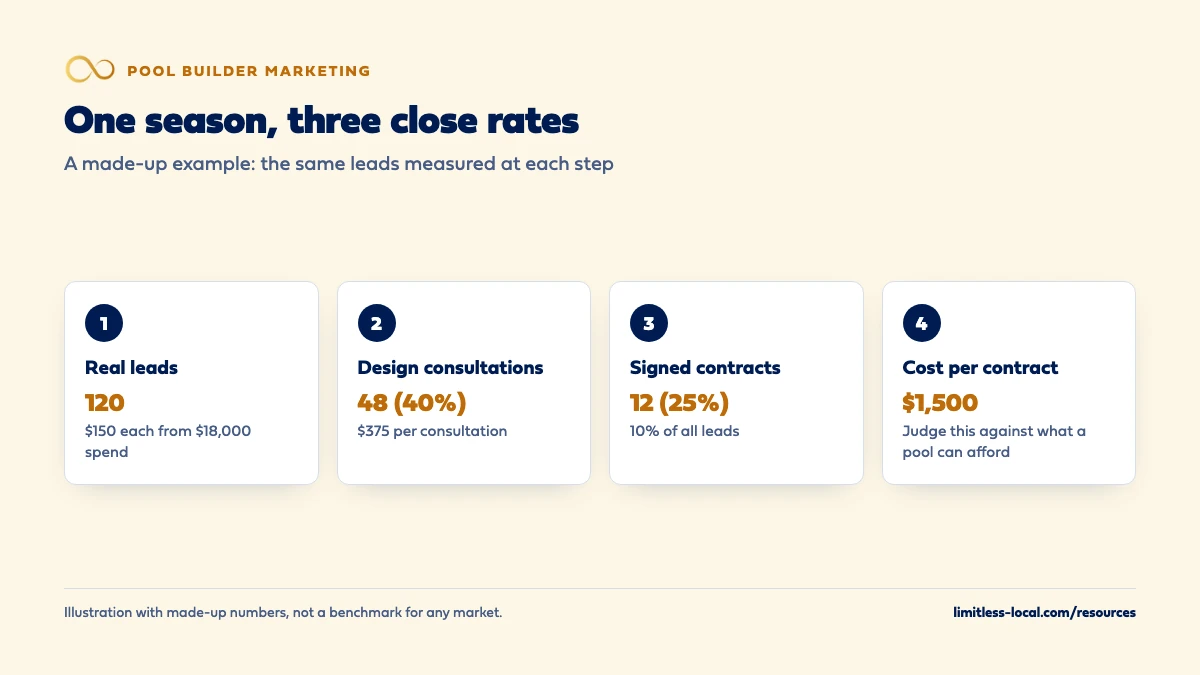
These numbers are made up to show the math, not a benchmark for your market. Say you spent $18,000 on marketing over a season and it brought 120 real leads. Of those, 48 booked and kept a design consultation, and 12 signed contracts.
- Leads to consultations: 48 ÷ 120 = 40%
- Consultations to contracts: 12 ÷ 48 = 25%
- Leads to contracts: 12 ÷ 120 = 10%
All three are the same season. Now the costs: $18,000 ÷ 120 = $150 per lead, ÷ 48 = $375 per consultation, ÷ 12 = $1,500 per signed contract.
Say better follow-up after consultations lifted the second rate from 25% to 1 in 3. The same 48 consultations would sign 16 contracts, and the cost per contract would fall to $1,125, without a dollar more in marketing. That’s why the consultation-to-contract step is often the cheapest place to improve.
One more piece of context. From our own record, not a client result: the agency was an equity partner in a pool construction company, where it streamlined back-office operations, built the lead-generation engine and ran sales and marketing. That business did $2M+ revenue in year one. It’s why we look at the sales numbers, not just the lead numbers.
Frequently asked questions
Should leads that haven't decided yet count against my close rate?
Report them separately. Some software, such as Housecall Pro’s lead conversion rate, counts open leads in the total, so the rate will rise as they’re won or lost. Recount at the end of the season.
What counts as a lead when I calculate close rate?
In our judgement, a homeowner in your area asking about work you do. Log spam, job seekers and wrong-service calls so you can see them, but keep them out of the close rate.
Should new pools and renovations have the same close rate?
No. They’re different sales with different prices and timelines. Track a separate rate for each so one doesn’t hide the other.
Can Google Ads tell me my close rate?
Not by itself. It counts the conversions you track, such as calls and form fills. To see signed contracts there, you’d import them as offline conversions.
Should I measure each salesperson's close rate?
Yes, but compare like with like. ServiceTitan, for one, reports close rate per technician on sales and estimates. Give each person a similar mix of lead sources before comparing them.
Will lowering my price raise my close rate?
It may, but it can raise the rate while lowering what each pool earns. In our judgement, fix lead fit, response speed and the proposal before touching price.
Key takeaways
- There’s no reliable published close rate for pool builders; your own seasons are the benchmark.
- Track two rates: leads that book a design consultation, and consultations that sign.
- A close rate is good if your cost per signed contract stays under what a pool can afford.
- Count contracts by the month the lead came in, and judge the rate at the end of a season.
- Compare by lead source and by new build versus renovation, not against a company-wide average.
Want a second set of eyes on your setup?
We'll look at how you show up locally and where calls are leaking, then send you a plain-English breakdown.
More in this section
- How many leads are needed for a pool builder to hit its revenue goal?
- How should pool builders follow up on leads during a long sales cycle?
- How fast should a pool builder respond to a new lead?
- How do pool builders qualify leads before the design consultation?
- How do pool builders keep leads coming in the off-season?
Sources
- Conversion Rate Reporting — Housecall Pro Help Center
- Quotes Report — Jobber Help Center
- Technician's Close or Conversion Rate does not look correct — ServiceTitan Help
- Do you know the lifetime value and cost of acquisition of your customers? — Business Development Bank of Canada
- About conversion windows — Google Ads Help
- Conversion cycle: Definition — Google Ads Help
- About offline conversion imports — Google Ads Help