
What is the map pack and how does a pool builder get into it?
- What is Google's map pack, and how does a pool company show up in it?
- What exactly is the map pack?
- What does a homeowner see about my pool company in the map pack?
- Why does the map pack matter so much for a pool builder?
- How does Google decide who gets into the map pack?
- What are the basic steps to get a pool builder into the map pack?
- Why do I show up in the map pack in one town and not the next?
- Can a pool builder without a showroom get into the map pack?
- Where does Google get the information it shows in the map pack?
- How long does it take a pool builder to get into the map pack?
- How do I know if the map pack is bringing me pool leads?
- What's different about the map pack for pool builders
- A worked example: two builders, one search
- Frequently asked questions
- Key takeaways
- More in this section
- Sources
The short version
- The map pack is the short list of local businesses with a map that Google shows for local searches.
- Listings come from Google Business Profiles; there's no way to pay for a spot.
- Google ranks them mainly on relevance, distance and popularity.
- Verify and complete your profile, pick the right category, and ask every customer for a review.
For pool builders who keep hearing about the map pack and want to know what it is, why it matters and where to start.
Get a free visibility audit · Book a growth call
What is Google's map pack, and how does a pool company show up in it?
The map pack is the block of local businesses, usually three, that Google shows with a map near the top of results when someone searches for something like “pool builder near me.” Each listing comes from a Google Business Profile, and Google says it picks them mainly on relevance, distance and popularity, with no way to pay for a spot. A pool builder gets in by verifying a complete profile with the right category and honest service areas, collecting genuine reviews from every build, and keeping its details consistent across the web.
The map pack is one of the three places our local SEO work targets, along with the regular Google results and AI answers. Google Business Profile management, listing cleanup and review generation are part of every package on our pool builder marketing page, and we don’t guarantee a map pack spot, because nobody honestly can; platforms change how they work. The pool builder marketing questions library goes deeper on each ranking signal.
What exactly is the map pack?
The map pack is the block of local businesses Google shows with a small map when someone searches for a type of business near them. It usually sits near the top of the results, above most of the regular website listings, and it’s often called the 3-pack because it shows three businesses before the homeowner taps to see more. Each listing comes from a Google Business Profile, not from your website.
Google shows it because it recognizes the search has local intent. Its explanation of how Search ranks results gives the example of someone searching “pizza” and getting nearby businesses that deliver. “Pool builder,” “pool companies near me” and “fiberglass pool installer” work the same way: Google assumes the person wants someone close by and answers with a map.
What does a homeowner see about my pool company in the map pack?
Usually your business name, your star rating and how many reviews you have, your category, whether you’re open, and buttons to call, visit your website or get directions. Tapping a listing opens your full profile: photos, more reviews, your services and your description.
The rating is worth understanding. Google’s page on review scores says the score is the average of all ratings published on Google, on a 1-to-5-star scale, and that a new review can take up to 2 weeks to show in the updated score. In a three-listing block, a homeowner is comparing star ratings and review counts side by side before reading a word you wrote.
Why does the map pack matter so much for a pool builder?
Because it’s where a lot of first impressions happen. A homeowner who has just decided they want a pool often starts with a search on their phone, and the three builders in that block get looked at first. Plenty of homeowners still scroll, ask neighbors or check Houzz, but being in the pack puts you on the shortlist before any of that.
It also carries trust you can’t buy with an ad. The map pack can’t be paid for, so a builder sitting there with strong reviews looks established. For a purchase this size, that matters.
How does Google decide who gets into the map pack?
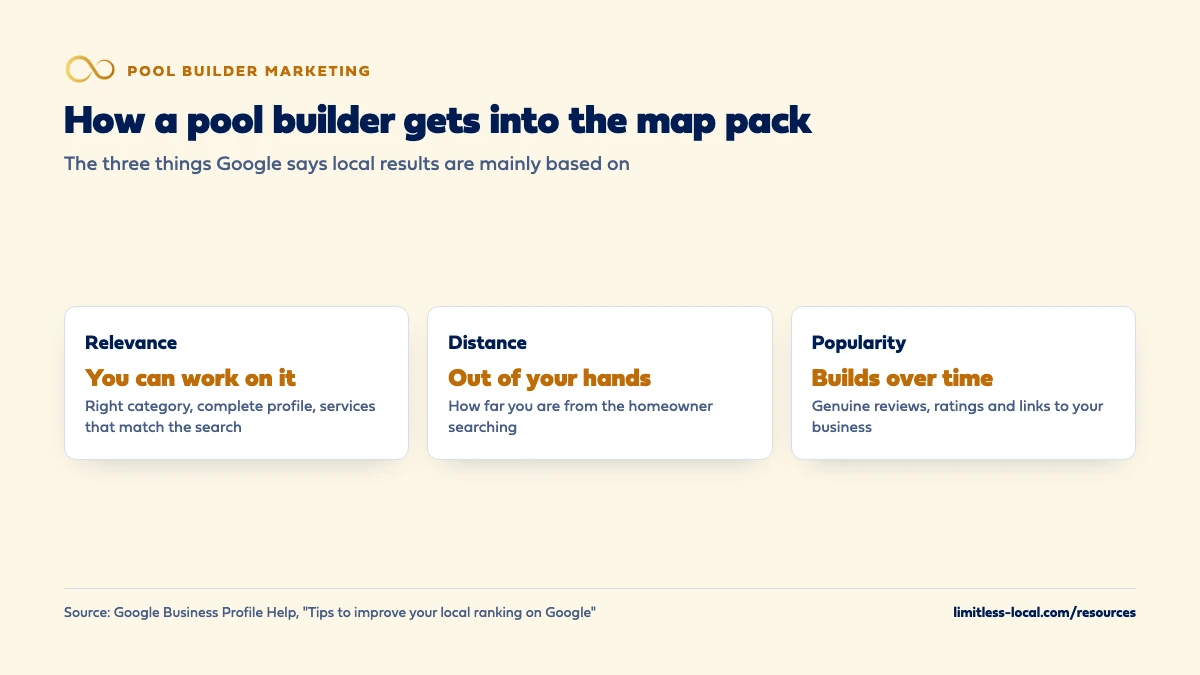
Google’s help page on local ranking says local results are mainly based on three things:
- Relevance: how well your profile matches what the homeowner searched for.
- Distance: how far your business is from the person searching. If they don’t share where they are, Google uses what it knows about their location.
- Popularity: how well known your business is, which draws on things like how many websites link to you and how many reviews you have. Google says more reviews and positive ratings can help.
It also says there’s no way to request or pay for a better local ranking, and it keeps the details of how it weighs these confidential. Anyone who promises you a guaranteed spot is promising something Google says it doesn’t sell. The signals that decide which pool builders show in Google Maps goes signal by signal.
Curious what your marketing is actually booking?
Get a free visibility audit — no obligation, no sales pitch.
What are the basic steps to get a pool builder into the map pack?
The basics, in the order that usually matters:
- Claim and verify your Google Business Profile. Verification makes your business more likely to show up.
- Pick the most specific pool construction category as your primary category. Categories affect your local ranking.
- Set your location honestly. If customers don’t visit you, hide the address and list the towns you serve.
- Fill in everything: hours, phone, website, services, description and real photos of your builds.
- Ask every customer for a Google review, at handover, and reply to each one.
- Make your website match. Your name, phone and service area should be the same on the site as on the profile, with pages about the pool work you do.
Each of those is a lever on relevance or popularity. The local SEO tactics that work best for a pool builder ranks them in more detail, including what to skip.
Why do I show up in the map pack in one town and not the next?
Distance. The map pack is built around the person searching, so a homeowner 10 minutes from your yard and one 45 minutes away can see completely different builders for the same search. That’s normal, and it’s the part of the ranking you can’t change.
Listing more towns in your profile doesn’t fix it. Google’s page on service areas lets you list up to 20 areas and says the whole area shouldn’t stretch more than about 2 hours of driving time from your base, but the areas you list tell homeowners where you work; they don’t move your business closer to them. Expect to show most in the towns nearest you, and reach the farther towns with ads and your website. How proximity affects a pool builder Google Maps ranking explains why.
Can a pool builder without a showroom get into the map pack?
Yes. Most pool builders run as service-area businesses: they go to the customer’s home and nobody visits their yard. Google treats that as a normal way to set up a profile. You hide your address, list the areas you serve, and you can still appear in local results.
What you can’t do is invent a location. Google’s guidelines for representing your business say a rented mailing address you don’t operate from, a virtual office, isn’t eligible for a profile, and P.O. boxes aren’t acceptable. A fake office in a bigger city to get into that city’s map pack is a fast way to a suspended profile.
Where does Google get the information it shows in the map pack?
Mostly from you, but not only. Google says it compiles profile information from several sources: crawled web content like your own website, licensed data from third parties, and contributions from users, which includes customer photos and reviews as well as what you add as the owner.
That’s why consistency matters. If an old directory still shows the phone number you had five years ago, or your website lists a different business name from your profile, Google has conflicting information about you. Fix your profile first, then your website, then the listings people actually see.
How long does it take a pool builder to get into the map pack?
It depends on where you’re starting and who you’re up against. A builder with a solid record who simply never verified a profile can show up fairly quickly once it’s verified and filled in. A newer builder in a town where the top three have years of reviews will take longer, because popularity builds one finished pool at a time.
SEO typically takes 3-6 months to show meaningful organic growth, and reviews follow your build calendar, so many pool builders see the biggest move after a full season of steady review asks. If you were in the pack and dropped out, start with what to do when a pool builder loses its Map Pack spot.
How do I know if the map pack is bringing me pool leads?
Your profile shows you. Google’s page on Business Profile performance says profile owners and managers can see the searches people used to find them, how many people viewed the profile, and how many tapped to call, clicked the website link or asked for directions. Those numbers include activity from both organic results and Google Ads.
Check them monthly against the same month last year, since pool searches rise and fall with the season. Then ask every new lead how they found you, and follow the ones who say “Google” or “Maps” through to a design consultation and a signed contract. A map pack spot that brings calls but never a signed pool is worth knowing about too.
Want to see where your company stands?
A free visibility audit shows where you show up on Google, Maps and AI answers, and what it's costing you in calls.
What's different about the map pack for pool builders
Slower review counts. Builders finish far fewer jobs than service companies, so map packs for pool searches often show builders with modest review counts. That makes the gap more reachable than it looks.
Several searches, several packs. “Pool builder,” “fiberglass pools” and “pool remodeling” can each bring up a different set of businesses. A profile that only says “pool construction” may miss the renovation searches.
Seasonal timing. Most pool shopping happens in a few months of the year. Work done on the profile in the off-season is what’s showing when homeowners start searching.
Service companies in the mix. Pool service and repair companies sometimes show for broad pool searches. A clear primary category and services list helps Google tell a builder from a route company.
A worked example: two builders, one search
These builders are made up to show how the signals play out. A homeowner in a suburb searches “pool builder” on her phone.
- Builder A is based 12 minutes away. Verified profile, a pool construction category, 26 reviews with a 4.8 average, and photos of recent builds.
- Builder B is based 40 minutes away. It has 85 reviews and a longer track record, but its profile uses a general contractor category and hasn’t had new photos in two years.
Builder A has the edge on distance and relevance; Builder B has more popularity. For this homeowner, Builder A has a good chance of showing in the pack. For a homeowner in Builder B’s own town, it likely flips. Neither builder can change where they’re based, but Builder B can fix its category and photos in an afternoon, and Builder A can keep closing the review gap with every handover.
Frequently asked questions
Is the map pack the same as Google Maps?
They draw on the same Business Profiles. The map pack is the short block in the regular search results; Google Maps is the separate app and site, where the homeowner sees a longer list.
Can I pay to be in the map pack?
No. There’s no way to request or pay for a better local ranking. Ads can appear on the same page, but they’re labelled as ads and don’t change your map pack position.
Why do my friends see me in the map pack when I don't?
Results change with the searcher’s location. Check from a few addresses around your service area, or ask customers in different towns to search and tell you what they see.
Does my website affect whether I get into the map pack?
Indirectly. Google uses crawled web content, including your site, as one source of information about your business, and a site with pages about your pool work supports the relevance of your profile.
Do I need a separate profile for each town I build in?
No. Service-area businesses can only have one profile for the whole area they serve. List the towns in your service area instead.
How many reviews do I need to get into the map pack?
There’s no set number. It depends on what the builders already in your local pack have and how close you are to the searcher. Compare your count, rating and newest review with the top three.
Key takeaways
- The map pack is the block of local businesses with a map that Google shows for searches like “pool builder near me.”
- Listings come from Google Business Profiles, ranked mainly on relevance, distance and popularity; you can’t pay for a spot.
- Verify the profile, use the most specific category, set an honest service area and fill in every field.
- Reviews from every finished pool build the popularity that keeps you in the pack.
- Expect to show most near your base, and use ads and your website to reach farther towns.
Not sure what's working right now?
Start with a free visibility audit: rankings, Google profile, reviews and tracking, checked against your service area.
More in this section
- What should a pool builder do if they lost their Map Pack spot?
- What is a pool route business, and should a builder add one?
- What questions do pool buyers ask builders before hiring?
- What marketing tools and software does a pool builder need to buy?
- What signals decide which pool builders show in Google Maps?
Sources
- Tips to improve your local ranking on Google — Google Business Profile Help
- How Does Google Determine Ranking Results — Google Search
- Understand review scores for local places & businesses — Google Business Profile Help
- Manage your service areas for service-area & hybrid businesses — Google Business Profile Help
- Guidelines for representing your business on Google — Google Business Profile Help
- Understand how Google sources & uses info in Business Profiles & local search results — Google Business Profile Help
- Understand your Business Profile performance & insights — Google Business Profile Help