
Is a pool service business profitable, and where does marketing fit?
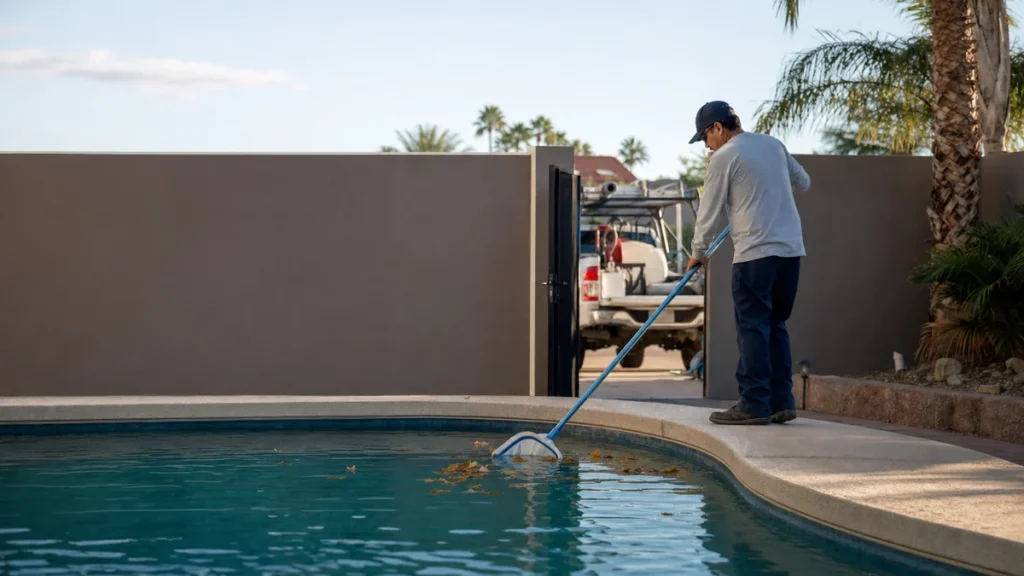
- What makes a pool cleaning route profitable, and how much should marketing cost?
- What makes a pool service business profitable?
- How do I work out the profit on one pool account?
- Why does route density matter so much?
- How much does customer churn eat into profit?
- What is one pool account worth over its lifetime?
- Where does marketing fit in a pool service business?
- How much can I afford to spend to win one account?
- Which marketing works best for a pool service route?
- Do repairs and equipment work change the math?
- When does a pool service business struggle to make money?
- How do I know if my marketing is paying for itself?
- What's different about pool service compared with pool construction
- A worked example: what one account is worth and what you can pay to win it
- Frequently asked questions
- Key takeaways
- More in this section
- Sources
The short version
- Profit comes from dense routes, long-staying customers and repair work on top.
- Work out profit per account first, including drive time and billing fees.
- Marketing is the cost of replacing and adding accounts, so measure cost per new account.
- Aim marketing at the streets you already drive, not the whole metro.
For owners of pool cleaning and service companies working out what each route really earns, and what they can afford to spend winning new accounts.
Get a free visibility audit · Book a growth call
What makes a pool cleaning route profitable, and how much should marketing cost?
A pool service business can be steadily profitable when its routes are dense, its customers stay for years and each new account costs less to win than it earns before it leaves. Profit per account is the monthly price minus chemicals, the tech’s time including drive time, the truck and billing costs, and it shrinks fast when stops are spread across town or customers cancel after one season. Marketing fits in as the cost of replacing lost accounts and adding new ones: aim it at the streets you already serve, and judge it by cost per new account against what an account earns over its lifetime.
That’s the cost-per-job thinking we use for every trade: what matters is what each new account cost and what it earned, not clicks or leads. Our local SEO work covers the Google profile, Maps rankings and reviews that bring in steady, nearby accounts, and our pool marketing page explains how we work with pool companies. If you’re running a route or two, you can do most of what’s on this page yourself; the rest of the pool marketing questions library goes question by question.
What makes a pool service business profitable?
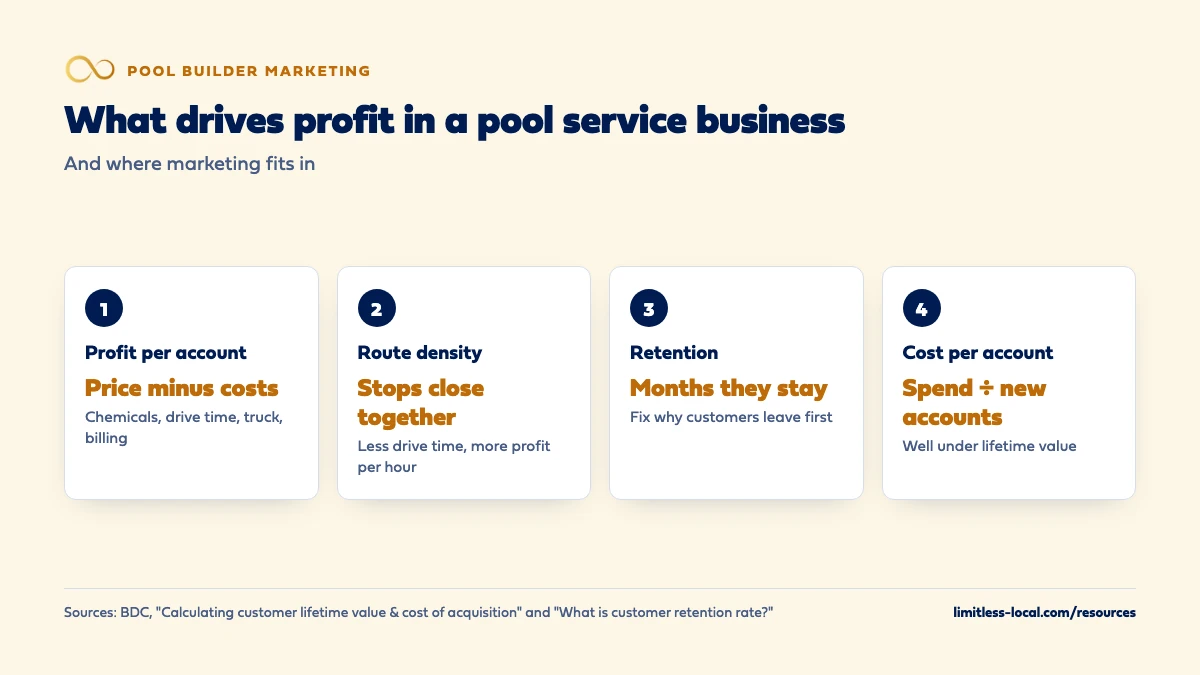
Four things, and most of them are about the route, not the price:
- Recurring revenue. A weekly or monthly account pays every month, so a full route is predictable income instead of a hunt for the next job.
- Route density. The more stops you have on the same streets, the more of your tech’s day is spent servicing pools instead of driving between them.
- Retention. An account that stays for years pays back what it cost to win many times over. One that cancels after a season may never pay it back.
- Work on top of the route. Filter cleans, equipment repairs, pump and heater replacements and green-pool cleanups often carry better margins than the weekly visit, and service customers usually call the company already at their pool.
Pricing matters too, but a fair price on a scattered route with high turnover still loses money. A tight route of loyal customers can make money even at a competitive price.
How do I work out the profit on one pool account?
Start with what the customer pays each month, then take off everything that account costs you to serve:
- Chemicals and supplies, unless you bill them separately.
- Tech time, including the drive to that stop, not just the minutes at the pool.
- Truck costs: fuel, maintenance and wear.
- Billing and software, including card processing fees. For example, the pool service software Skimmer lists card processing at 2.9% plus $0.25 per transaction, with an extra 0.5% for keyed or recurring transactions. Small per-invoice fees add up across a full route.
What’s left is your gross profit per account per month. Then account for the costs that don’t change with each stop, like insurance, office help, your phone and your own salary. The Small Business Administration’s break-even calculator separates fixed costs from variable costs the same way, and divides fixed costs by what each unit leaves you to find how many units you need to sell. For a pool route, a unit is an account: that’s how many accounts you need just to cover the business before it makes a profit.
Why does route density matter so much?
Because drive time is paid time that earns nothing. If a tech spends twenty minutes driving to a stop that takes twenty minutes to service, that account costs you twice the labor of one next door to the last stop.
Density changes how you should think about growth:
- A new account three streets from your existing stops is worth more than the same account across town, even at the same price.
- Accounts in a new area only make sense once there are enough of them to fill a route there.
- Losing one account in a dense cluster hurts less than losing a whole cluster.
This is where marketing comes in. Ads, door hangers and neighborhood posts aimed at the streets you already drive bring in accounts that improve the route. Marketing aimed at the whole metro brings in accounts that stretch it.
How much does customer churn eat into profit?
More than most owners track. Customers cancel because they move, sell the house, drain the pool for the winter, decide to do it themselves or find a cheaper option. Every cancelled account is a hole in the route that has to be refilled before the business grows at all.
Measure it with a customer retention rate. Canada’s Business Development Bank (BDC) explains the retention rate formula this way: take the customers you had at the end of a period, subtract the new customers you won during it, divide by the customers you had at the start and multiply by 100. Do it once a year, or once a season if you’re in a market where pools close for winter.
If your retention rate is low, more marketing is a leaky bucket. Fix the reasons people leave first: missed visits, unanswered texts, surprise charges or cloudy water after a storm. Then market.
What is one pool account worth over its lifetime?
Roughly, the profit it earns each month times the number of months it stays, plus the profit on repairs and equipment work along the way. A common way to estimate lifetime value is the average value of a sale, times the number of repeat transactions, times how long a customer stays, counting maintenance and after-sale service as part of it.
For a pool route, use your own numbers:
- Average monthly profit per account, from the section above.
- Average number of months an account stays, from your billing history.
- Average repair and equipment profit per account per year.
Work it out separately for accounts from different sources if you can. Customers who came through a neighbor’s referral often stay longer than ones who answered a discount offer, and that changes how much each source is worth paying for.
Curious what your marketing is actually booking?
Get a free visibility audit — no obligation, no sales pitch.
Where does marketing fit in a pool service business?
Marketing is the cost of winning accounts. It does two jobs:
- Replacing churn. Every account that cancels has to be replaced just to stay level.
- Growing the route. Anything above replacement adds to income and route density.
The number that tells you whether it’s working is cost per new account. The usual formula for cost of acquisition is sales costs plus marketing costs, divided by the number of new customers they brought in. For a small pool service company, that’s usually your ad spend, any lead fees, printing and the value of the time you or your office spend on sales, divided by new accounts.
Compare that number to lifetime value, not to the first month’s bill. An account that costs more to win than its first month pays can still be a great deal if it stays for years.
How much can I afford to spend to win one account?
Less than an account earns over its lifetime, with room to spare. One very general guideline, depending on the benchmark you look at, puts lifetime value at 2.5 to 3 times the cost of acquisition. Treat that as a rough check, not a target for your market: your own retention and repair numbers matter more.
Two practical limits on top:
- Cash flow. If a new account takes many months to pay back what it cost, a burst of growth can squeeze your cash even when the math works.
- Capacity. New accounts need a tech with room on the schedule. Marketing past what your crew can service just fills the voicemail.
For the step-by-step math from accounts wanted to a monthly ad budget, see how much a pool company should spend on ads to grow its route. The same thinking applies to construction in how a pool builder works out what a lead is worth.
Which marketing works best for a pool service route?
The channels that bring nearby homeowners who’ll stay, in roughly this order for most route owners:
- Your Google Business Profile and reviews. Homeowners looking for pool service search on Google and Maps, and they read reviews. A steady flow of reviews from regular customers is cheap and keeps working. How to get more Google reviews for a pool company covers how to ask.
- Referrals from current customers. Neighbors trust neighbors, and a referral on the same street is a dense account by default.
- Door hangers and neighborhood posts on your route streets. Cheap, local and aimed exactly where density helps most.
- Local Services Ads. Google’s Local Services Ads page lists pool cleaning among the home services eligible for the Google Verified badge, and you pay when a potential customer contacts you through the ad, not per click.
- Search ads on pool service searches in your route towns, for when you need accounts faster than referrals bring them.
- Partners: pool builders handing off new pools, realtors with buyers of homes with pools, and landscapers.
If you’re a builder thinking about adding service, whether a pool builder should offer pool service as a side business covers that decision.
Do repairs and equipment work change the math?
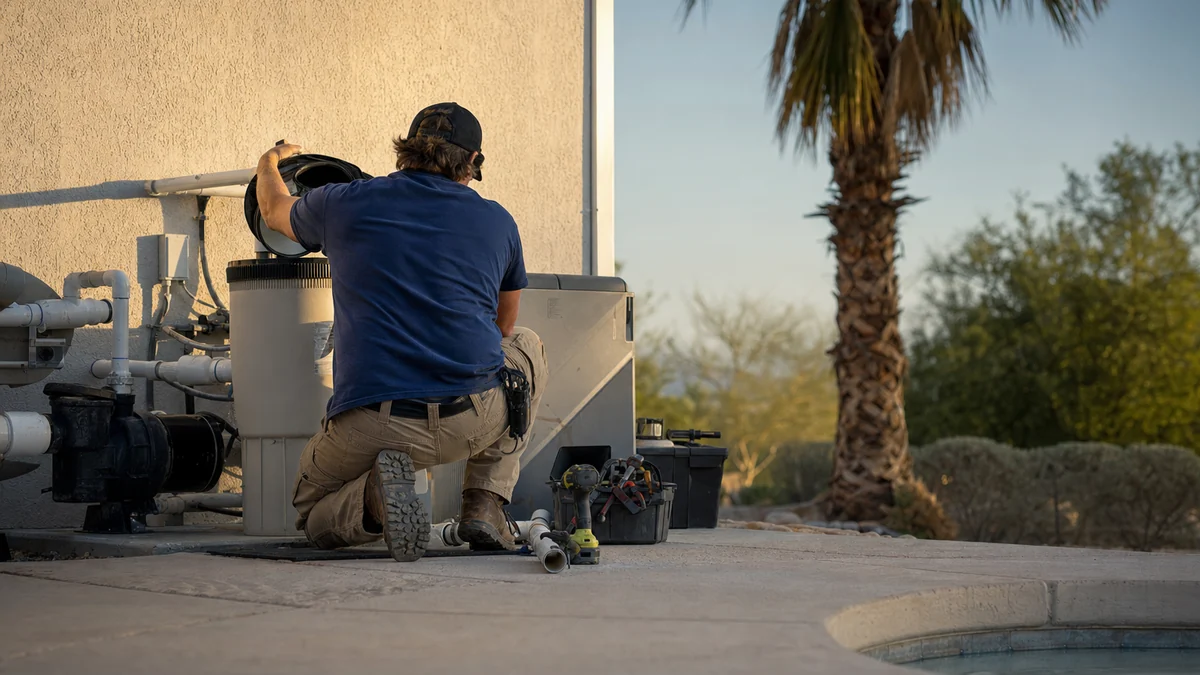
Often, yes. The weekly visit gets you in the backyard; the work around it, like pump, filter and heater replacements, leak fixes, green-pool cleanups and equipment upgrades, is often where the better margins are. A service customer with a failing pump usually asks the tech who’s already there.
That changes marketing in two ways. First, it raises what an account is worth, so you can justify spending a bit more to win the right ones. Second, it makes service customers your best source of bigger jobs, so the route itself becomes a marketing channel. Track repair revenue per account so you know how much it really adds.
When does a pool service business struggle to make money?
Usually when one or more of these is true:
- Scattered routes: accounts spread across a wide area, so drive time eats the margin.
- Underpricing: prices set to match the cheapest competitor without knowing your own cost per stop.
- High churn: customers leaving faster than marketing can replace them.
- Expensive accounts: paying more to win accounts than they earn before they cancel, often from broad ads or lead services that send far-away jobs.
- No add-on work: running the route but sending repairs elsewhere.
Each of these shows up in the numbers above, which is why working out profit per account, retention and cost per new account is worth an afternoon before you spend another dollar on marketing.
How do I know if my marketing is paying for itself?
Track three things for every new account: where it came from, what it cost to win, and how long it stays.
- Ask every new customer how they found you, and record it in your billing or scheduling software.
- Add up spend by source each month and divide by new accounts from that source.
- Check retention by source after six months and a year.
A source that brings cheap accounts who leave fast can be worse than one that brings fewer, pricier accounts who stay for years. Once you can see that, you can move money toward the sources that build a dense, loyal route.
Want to see where your company stands?
A free visibility audit shows where you show up on Google, Maps and AI answers, and what it's costing you in calls.
What's different about pool service compared with pool construction
Small tickets, every month. A builder wins a few big contracts a season; a route wins many small accounts that pay monthly. So the key number is lifetime value per account, not profit per job.
Geography is the margin. A builder can drive an hour for a big pool. A route can’t afford an hour between stops.
Reviews come from routine work. Every weekly visit is a chance to impress or disappoint, so reviews reflect consistency more than one big project.
Seasons depend on climate. In warm markets, routes run all year; where pools close for winter, accounts pause or cancel and spring is when routes refill.
A worked example: what one account is worth and what you can pay to win it
These numbers are made up to show the math, not a benchmark for your market. A route charges $160 a month. Chemicals cost $35, the tech’s time and truck for that stop come to $60, and billing and software add $10. That leaves $55 a month in gross profit per account.
If accounts stay an average of 30 months, each one earns about $1,650 in gross profit over its life, before any repair work. Say the owner spends $1,200 a month on ads and wins 6 new accounts: that’s $200 per account, and each account earns more than eight times what it cost.
Now say churn is high and accounts stay only 8 months. Each one earns $440, just 2.2 times what it cost to win, below the very general 2.5-to-3 guideline. Same price, same ad spend, very different business. Before raising the ad budget, that owner should fix why customers leave.
Frequently asked questions
Is a pool cleaning business profitable?
It can be, when routes are dense, customers stay and prices cover your real cost per stop, including drive time. The same business loses money on a scattered route with high turnover.
Should I buy an existing pool route instead of marketing for accounts?
The same math applies: compare what you’d pay per account with what those accounts earn over their lifetime, and check how many are on streets you already serve. Accounts that cancel after the sale are an expensive way to grow.
Should I charge chemicals separately?
It depends on your market and customers, but either way, know what chemicals cost you per account. If they’re included, they belong in your profit-per-account math.
Do online reviews matter for a pool service company?
Yes. Homeowners comparing pool services on Google read reviews, and a review from a customer you see every week reflects the consistency they’re buying.
Is it worth adding accounts outside my current route area?
Only if there are enough of them to build a route there. A single account far from your other stops can cost more in drive time than it earns.
What's the first marketing a new pool service owner should do?
Set up and verify a Google Business Profile, ask every customer for a review, and put door hangers on the streets around your existing stops.
Key takeaways
- A pool service business is profitable when routes are dense, customers stay and add-on repairs come to you.
- Work out profit per account including drive time and billing fees, then how many accounts cover your fixed costs.
- Marketing is the cost of replacing and adding accounts; measure cost per new account against lifetime value.
- Aim marketing at the streets you already serve, so each new account improves the route.
- If churn is high, fix why customers leave before spending more to win new ones.
Not sure what's working right now?
Start with a free visibility audit: rankings, Google profile, reviews and tracking, checked against your service area.
More in this section
- What share of revenue should a pool builder put into marketing?
- How do I grow a pool construction business with marketing?
- How should a pool builder split its marketing budget?
- How much should a pool builder spend on marketing?
- How do I know if my pool marketing agency is working?
Sources
- Calculating customer lifetime value & cost of acquisition — BDC
- What is customer retention rate? — BDC
- Break-even point calculator — U.S. Small Business Administration
- Billing FAQ – General — Skimmer Help Center
- Reach Local Customers with Local Service Ads — Google Ads