
Is $1,000 a month enough for pool builder ads off-season?

- Is $1,000 a month enough Google Ads spend for a pool construction company in the slow months?
- What does $1,000 a month buy in the off-season?
- Who's searching for a pool builder in the off-season?
- What should $1,000 a month fund off-season, and what shouldn't it?
- How do I check if $1,000 fits my market before I spend it?
- When is $1,000 a month off-season enough?
- When is $1,000 a month not enough off-season?
- How do I know if $1,000 is holding my ads back in winter?
- Should I pause my ads or keep $1,000 running in the slow months?
- How should I spread $1,000 a month across the off-season?
- How should I judge $1,000 a month in the off-season?
- What's different about off-season ads for pool builders
- A worked example: $1,000 a month over a four-month off-season
- Frequently asked questions
- Key takeaways
- More in this section
- Sources
The short version
- $1,000 a month is about $32.89 a day in Google Ads.
- Off-season, spend it only on high-intent searches in your best towns.
- Sell next season's build slots and renovations, not this month's pool.
- Trim it if next year is already booked; raise it if the campaign is tight and still limited by budget.
For pool builders deciding what to spend on ads between fall and spring, and whether $1,000 a month keeps the pipeline alive or just burns money.
Get a free visibility audit · Book a growth call
Is $1,000 a month enough Google Ads spend for a pool construction company in the slow months?
In many markets, $1,000 a month is enough to keep pool builder search ads running through the off-season, as long as it goes only to high-intent searches like “pool builder” plus your towns, and to next season’s design consultations. Fewer homeowners search in the cold months, so the same budget often reaches a bigger share of them, and in a small market you may not even spend it all. It isn’t enough to also fund broad keywords, display ads or social campaigns, and it’s too much if your build calendar for next season is already full.
Ad spend is paid directly to Google or Meta and isn’t part of any of our packages; we recommend a budget after a quick audit of your market. Running and tracking those campaigns is what our local ads work does, our pool builder marketing page covers the trade, and the pool builder marketing questions library has the other budget pages.
What does $1,000 a month buy in the off-season?
If it all goes to Google Ads, $1,000 a month is an average daily budget of about $32.89. Google’s average daily budget help divides a monthly amount by 30.4, the average number of days in a month, and says that for most campaigns you’ll never pay more than 30.4 times your average daily budget in a month, or more than two times it on any single day.
What changes in the off-season is what that money meets. Fewer homeowners search for pool builders between late fall and early spring in most of the country, and fewer builders are bidding hard for them. The same $32 a day can show your ads to a bigger share of the searches that do happen.
The flip side: in a small market there may not be enough searches to spend $1,000. Google Ads only charges you for clicks, so if few people search, the campaign spends less than its budget. That’s not a problem to fix with broader keywords. It’s the market telling you how big it is in winter.
Who's searching for a pool builder in the off-season?
A smaller, more deliberate group. Homeowners who search in November or January are rarely hoping to swim next week. They tend to be:
- Planners who want a pool by next summer and know good builders book up.
- Comparers gathering ideas, prices and builder names for a decision in spring.
- Renovation buyers who want resurfacing, new tile or equipment done before the pool opens again.
- New homeowners who just moved in and are planning the backyard.
None of them is likely to sign this week, and some won’t sign for months. That’s why off-season ads should ask for a design consultation for next season, not push a quick quote. It’s also why your follow-up matters more than in summer: nurturing leads who plan to build next year covers how to stay in touch without wearing them out.
What should $1,000 a month fund off-season, and what shouldn't it?
Spend it where intent is highest, and nowhere else:
- Fund: search ads on phrases homeowners use when they’re choosing a builder, like “pool builder”, “inground pool builder” or “custom pool” with your town names.
- Fund: a separate, smaller campaign for renovations or resurfacing, if you do that work, because those homeowners often want it done before spring.
- Fund: your best towns first, the ones with the jobs you want and short drives for your crew.
- Don’t fund: broad research phrases like “pool ideas” or “how much is a pool”, which eat a small budget fast.
- Don’t fund: display ads, video ads or cold social campaigns. They need more budget than $1,000 to show anything, and they reach people who weren’t looking.
Exclude searches for pool cleaning, chemicals, supplies, above-ground kits, pool covers and closing services, which pick up in fall. Negative keywords for pool builders has a starting list.
How do I check if $1,000 fits my market before I spend it?
Look at your own market’s numbers, not a national average. Two free tools do most of the work:
- Keyword Planner. Google’s Keyword Planner forecasts show average monthly searches for your keywords and locations, and you can change the month range to see how popular they are at different times of year. Its bid ranges show roughly what advertisers paid for a top-of-page spot over the last 30 days, with a low end near the 20th percentile and a high end near the 80th. Forecasts take your bid, budget and seasonality into account.
- Google Trends. It shows how interest in a search rises and falls through the year in your state or metro, on a scale of 0 to 100. Its FAQ notes that low-volume terms can show as zero and include random noise, so use broad phrases like “inground pool” rather than your exact keywords.
Then do the rough math. Divide $1,000 by a likely winter cost per click to get clicks, and compare that with how many searches there are. If $1,000 buys more clicks than your towns have searches, you’ll underspend. If it buys only a handful, it’s thin.
Curious what your marketing is actually booking?
Get a free visibility audit — no obligation, no sales pitch.
When is $1,000 a month off-season enough?
It’s usually enough when most of these are true:
- Your market is small to mid-sized, with a handful of builders bidding and winter clicks that cost less than in spring.
- The campaign is narrow: one or two pool types, your best towns, phrases that mean “I want a builder”.
- You’re selling next season, not trying to fill this month’s crew calendar.
- The basics run alongside it: a complete Google profile, fresh project photos and steady reviews, which cost time, not ad spend.
- You answer the phone and forms quickly, even in the slow months.
In that situation, $1,000 a month keeps you in front of the planners before the spring rush, when more builders start bidding and clicks can cost more. Keeping leads coming in the off-season covers the rest of the winter plan, from open proposals to past customers.
When is $1,000 a month not enough off-season?
These are the signs it’s too thin:
- You’re in a large, crowded metro where builders keep bidding through winter and clicks stay expensive.
- You need winter leads to fill a crew that would otherwise sit idle, not just to feed next season.
- You’re trying to cover new pools, renovations and several far-apart towns on one budget, so none of them gets enough.
- The campaign is tight and still limited by budget. More on that below.
- You’re launching in a new market and need enough data before spring to know which towns and keywords work.
In those cases, either narrow the campaign until $1,000 is enough for what’s left, or raise the budget. Narrowing comes first. Whether $2,500 a month is enough covers the next step up.
How do I know if $1,000 is holding my ads back in winter?
Check the campaign status in Google Ads. It marks a campaign “Limited by budget” in two cases: the campaign is underperforming because of a limited budget, or it uses Maximize Clicks and could get more traffic with a bigger budget. When it applies, Google suggests a recommended daily budget, though it won’t show one if you rarely hit your daily budget or the campaign has limited data.
In the off-season, “limited” should make you look twice. Before raising anything, check that the campaign isn’t paying for the wrong searches: look at the search terms report for cleaning, supplies and closing searches, and confirm the ads only run in towns you build in. A tidy campaign that’s still limited in January is a good sign there are more planners searching than $1,000 can reach. A messy one just needs cleaning up.

Should I pause my ads or keep $1,000 running in the slow months?
For most pool builders, trimming beats switching off. The homeowners who search in winter are planners, and the builder they talk to first has a head start in spring. Going dark for four months hands those conversations to whoever kept bidding.
If you do stop, pause rather than remove. Google’s campaign help says pausing is temporary and keeps all your settings and history, while a removed campaign can’t be resumed or restored. Resuming a campaign also won’t restart ad groups or keywords you paused separately, so each has to be switched back on.
Pausing makes sense when next season’s build slots are already sold, when you can’t answer calls for a stretch, or when the campaign is spending on the wrong searches and needs rebuilding. Otherwise, a lean budget on high-intent searches is cheaper than starting cold in March.
How should I spread $1,000 a month across the off-season?
Not evenly. Most pool builders get more from a winter budget by letting it build toward spring:
- Late fall: the lightest month. Many homeowners are closing pools, not planning new ones. Keep the core builder searches running and cut the rest.
- Early winter: steady. Planners start comparing builders. Push design consultations for next season.
- Late winter: the strongest. Raise the budget ahead of the spring rush, before more builders start bidding.
Keep the total for the season in mind: $1,000 a month for four months is $4,000. You can run $750 in a quiet month and $1,250 in a busy one and land in the same place.
Run the ads when someone can respond. Google’s ad schedule settings make ads eligible to show only during the times you choose. If your office keeps shorter winter hours, schedule around them, or make sure forms get a reply the same day.
How should I judge $1,000 a month in the off-season?
Over the whole season, and by what signed. Off-season leads take longer than summer ones: a homeowner who asks for a consultation in December may sign in March. Judge too early and a good winter campaign looks like a waste.
Track three things for every lead the ads produce: did it book a design consultation, did it get a proposal, and did it sign. Credit each signed contract back to the month its lead first came in. Then divide the season’s spend by the number of signed pools to get your cost per signed contract, and compare it with what a pool leaves you after costs.
If you’re judging a fresh campaign, how long to run $1,000 a month before judging it walks through what to check and when.
Not sure which of these is costing you jobs?
A free visibility audit checks the Google profile, reviews, site and tracking, and shows what to fix first.
What's different about off-season ads for pool builders
You’re selling a slot on next year’s calendar. Most trades sell this week’s job. A pool builder in winter is selling a spot on next season’s build schedule, so the ads and the follow-up should say that plainly.
Fall brings the wrong searches. Pool closing, covers and winter chemicals spike just as builder searches fall. A small budget without negative keywords will spend on them.
Renovations keep moving. Resurfacing, tile and equipment upgrades are often planned for before the pool reopens, which gives a winter budget a second job if you do that work.
Climate decides how deep the dip is. A builder in a warm state may barely see a slow season, while one in the Midwest may see searches all but stop. Your own market’s numbers decide what $1,000 can do. If you build in a warm-weather market, whether a Florida pool builder has a slow season looks at the shorter dip.
A worked example: $1,000 a month over a four-month off-season
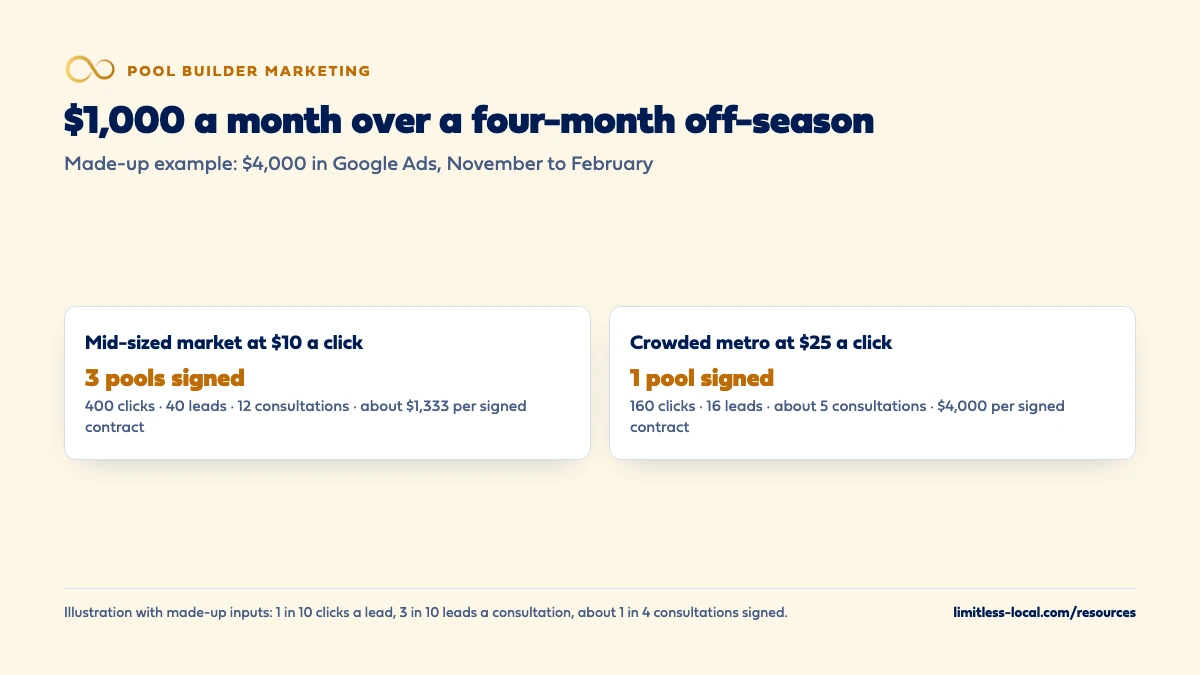
These numbers are made up to show the math, not a benchmark for your market. A builder spends $1,000 a month from November through February: $4,000 in total. Clicks cost $10 on average. 1 in 10 clicks becomes a lead, 3 in 10 leads book a design consultation, and about 1 in 4 consultations sign.
$4,000 at $10 a click buys 400 clicks, which bring 40 leads, 12 consultations and 3 signed pools. Cost per signed contract: $4,000 ÷ 3 = about $1,333. Most of those contracts won’t sign until March or April, so judging the campaign in January would have shown almost nothing.
Now the same builder in a crowded metro, at $25 a click: $4,000 buys 160 clicks, 16 leads, about 5 consultations and 1 signed pool, at $4,000 per signed contract. Whether that’s worth it depends on what a pool leaves after costs, and it’s the kind of question a free visibility audit answers for your towns.
Frequently asked questions
Should I use seasonality adjustments in Google Ads for the off-season?
No. Google describes seasonality adjustments as an advanced tool for short events, ideal for one to seven days, and says they may not work as well over longer periods. A whole off-season isn’t what they’re for.
Is $1,000 better spent on Facebook ads in winter?
Usually not on its own. Search ads reach homeowners already looking for a builder. Social ads reach people while they scroll, which takes more budget and more time to turn into a consultation.
Does $1,000 include the cost of someone managing the ads?
Keep them apart. Ad spend is what Google charges for clicks; management is what you pay someone to run the account. If $1,000 has to cover both, much less of it reaches the ads.
Can I bank unspent winter budget for spring?
Not inside Google Ads. Each month’s spend is capped by that month’s daily budget, so unspent money doesn’t roll over. Plan the year’s total yourself and raise the daily budget when spring arrives.
Should I lower my bids in winter instead of my budget?
If clicks are cheaper because fewer builders are bidding, you often don’t need to. Lowering the budget while keeping the campaign narrow is simpler and easier to judge.
What if I'm already booked for next season?
Trim the budget to the renovation work you can still fit, or pause new-pool ads until you have slots to sell. There’s no point paying for consultations you can’t build.
Key takeaways
- $1,000 a month is about $32.89 a day in Google Ads, and in a quiet winter market it may not all get spent.
- Off-season, spend it on high-intent builder searches in your best towns and on next season’s consultations.
- Don’t stretch it over broad keywords, display ads or cold social campaigns.
- Trim rather than switch off, and pause rather than remove if you do stop.
- Judge it over the whole season by cost per signed contract, crediting each pool to the month its lead came in.
Want a second set of eyes on your setup?
We'll look at how you show up locally and where calls are leaking, then send you a plain-English breakdown.
More in this section
- Is $2,500 a month enough ad spend for a pool builder?
- When is $500 a month not enough for pool builder marketing?
- Is 10k a month too much ad spend for a pool builder?
- Is 5k a month too much for pool builder marketing to grow?
- How long should a pool builder run ads before judging 1k a month?
Sources
- About average daily budgets — Google Ads Help
- About Keyword Planner forecasts — Google Ads Help
- FAQ about Google Trends data — Trends Help
- Fix "Limited by budget" status — Google Ads Help
- Enable, pause, or remove a campaign — Google Ads Help
- Set up an ad schedule — Google Ads Help
- About seasonality adjustments — Google Ads Help