
Is 5k a month too much for pool builder marketing to grow?

- Is $5,000 a month too much for pool construction marketing if I want to grow fast?
- What does $5,000 a month in pool marketing actually cover?
- How do I tell if $5,000 a month is too much for my pool company?
- When is $5,000 a month the right amount to grow?
- When is $5,000 a month too much?
- Is $5,000 enough if I want to grow fast?
- How should a pool builder split $5,000 a month?
- What if an agency fee comes out of the $5,000?
- Can my crews and sales process handle what $5,000 brings in?
- Should I spend $5,000 every month of the year?
- How long before I know if $5,000 a month is working?
- What's different about a $5,000 budget for pool builders
- A worked example: is $5,000 a month too much for this builder?
- Frequently asked questions
- Key takeaways
- More in this section
- Sources
The short version
- $5,000 a month is $60,000 a year; divide that by your gross profit per pool to see how many signed pools cover it.
- Whether it's too much depends on your profit per pool, close rate, market and crew capacity, not on the number itself.
- It's too much when leads leak, tracking is missing or the schedule is already full.
- If an agency fee comes out of the $5,000, check how much is left for ad spend.
For pool builders who want more signed contracts this year and are weighing whether a $5,000 monthly marketing budget is bold or reckless.
Get a free visibility audit · Book a growth call
Is $5,000 a month too much for pool construction marketing if I want to grow fast?
Not if the numbers work. $5,000 a month is $60,000 a year, so the test is whether it can bring enough extra signed contracts, at your close rate and profit per pool, to cover that and leave money over, and whether your crews can build them. It’s too much if your follow-up leaks, you can’t tell which marketing produced which contracts, or your schedule is already full; fix those first and ramp up to it.
That’s the math we run before recommending any budget: what a signed pool is worth to you, what the searches in your towns cost, and how many more pools your crews can build. We’ve done it on our own dime, too: we were an equity partner in a pool construction company, where we built the lead-generation engine and ran sales and marketing, and that business did $2M+ revenue in year one. Our packages start with Essentials at $3,500 a month, and ad spend is always paid directly to Google or Meta, never through us. See how it all fits on our pool builder marketing page, or browse the rest of the pool builder marketing questions.
What does $5,000 a month in pool marketing actually cover?
That depends on whether $5,000 is your ad budget or your whole marketing budget, and owners mix the two up all the time. As an ad budget, it’s money paid straight to Google or Meta for clicks and leads. As a whole budget, it has to cover everything: ad spend, any agency or freelancer fees, SEO and content, review tools, call tracking, and the occasional photo or video shoot of finished pools.
This page treats $5,000 as the whole monthly marketing number. If you’re asking about $5,000 in ad spend alone, that’s a bigger commitment, and the test in whether $10k a month is too much ad spend works the same way at any size.
Either way, write down what’s inside the $5,000 before you judge it. A builder spending $5,000 with $4,000 in ads and a builder spending $5,000 with $1,000 in ads are running very different experiments.
How do I tell if $5,000 a month is too much for my pool company?
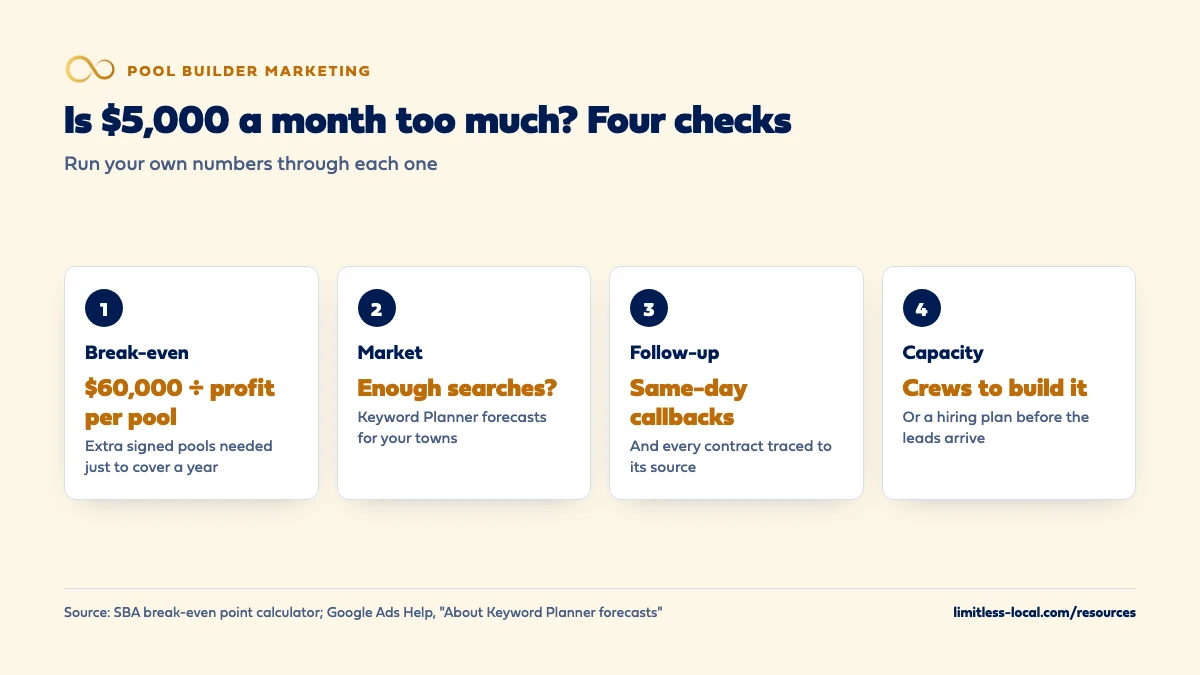
Work it backward from signed pools, not forward from the price tag. The SBA’s break-even point calculator uses a simple formula: fixed costs divided by price minus variable costs equals your break-even point in units. Swap in your marketing and your pools:
- Yearly marketing cost: $5,000 × 12 = $60,000.
- Gross profit per pool: the contract price minus what it costs you to build it.
- Break-even: $60,000 divided by your gross profit per pool = how many extra signed pools the marketing has to produce just to pay for itself.
Then ask the real follow-up: is that number realistic from your market, at your close rate, in a year? If your gross profit per pool is high, a handful of extra contracts covers it and the rest is growth. If your margin is thin, it takes many more, and $5,000 starts to look heavy. How much you can afford to spend to win one pool customer walks through that ceiling.
When is $5,000 a month the right amount to grow?
It tends to fit when most of these are true:
- Your margin per pool is healthy, so a few extra contracts a year cover the whole budget.
- Your market has enough searches for new pools to absorb the ad spend part without paying for junk clicks.
- Someone calls every lead back the same day, and design consultations are booked fast.
- You can tell which marketing produced each signed contract, not just each lead.
- You have room to build more, or a plan to add a crew before the extra pools arrive.
For a pool builder in that position, $5,000 a month is a growth budget, not a gamble. Growing usually takes a higher share of revenue than holding steady; the SBA’s 2019 post How to Get the Most From Your Marketing Budget says businesses need to budget more when they’re just starting out and still building awareness, and can reduce it once they have a steady customer base.
When is $5,000 a month too much?
The same list in reverse, and each one is a reason to fix something before spending more:
- Leads wait. If callbacks take days, more leads mostly means more homeowners who signed with whoever called first.
- You can’t trace contracts to sources. Without that, you can’t tell whether $5,000 is working or just busy.
- The schedule is already full. Extra leads you can’t build for next season are expensive leads.
- Your margin per pool is thin. If it takes a dozen extra pools just to break even, the risk is high.
- Your market is small. In a town with few searches for new pools, a big ad budget runs into a ceiling and starts buying weaker clicks.
“Too much” is rarely permanent. Usually it means “too much right now,” and the fix is a smaller start while you close the gaps.
Curious what your marketing is actually booking?
Get a free visibility audit — no obligation, no sales pitch.
Is $5,000 enough if I want to grow fast?
Sometimes it isn’t. In a large, crowded metro, in several markets at once, or when you’re building a second crew’s worth of work from scratch, $5,000 can be too little to move fast, especially if part of it goes to fees.
Two quick checks tell you. First, Google’s Keyword Planner forecasts estimate clicks and cost for your keywords and towns, taking your bid, budget and seasonality into account; put your ad-spend share in and see what it might buy. Second, once ads are running, look at how often your ads stop showing because the budget ran out. If they’re missing a lot of the searches you want in peak season, the budget, not the ads, is the limit.
Growing fast is still a reason to fix follow-up first, not a reason to skip it. A big budget on a leaky process grows the leak fastest.
How should a pool builder split $5,000 a month?
There’s no fixed split, but a sensible starting shape for a growing builder looks like this:
- Ads that bring leads now: Google search ads for new pool and renovation searches in your best towns, usually the biggest share in season.
- Things that keep paying later: your Google Business Profile, reviews, and website pages for your pool types and towns.
- Tracking: call tracking and a way to mark which leads signed, small in cost and big in what it tells you.
- Help: whoever runs it, if it isn’t you.
Google asks for an average daily budget, and its page on average daily budgets says to divide a monthly amount by 30.4. If you put the full $5,000 into ads, that’s about $164 a day; whatever share you choose, do the same math so you know what you’re actually bidding with. How a pool builder should split its marketing budget goes channel by channel.
What if an agency fee comes out of the $5,000?
Then do the subtraction before you sign anything, because what’s left for ad spend decides what the ads can do. Using our own prices as the example:
- Essentials is $3,500 a month. Out of a $5,000 total, that leaves $1,500 a month for ad spend.
- Growth is $4,500 a month. Out of a $5,000 total, that leaves $500, which isn’t enough to run ads well for a pool builder trying to grow.
Ad spend isn’t included in any of our packages; it’s paid directly to Google or Meta. So if $5,000 is your hard ceiling for everything, a managed package plus ad spend may not fit yet, and running a tight ad campaign yourself while you fix follow-up and tracking might be the better first step. If $5,000 is your ad budget and the fee sits on top, the picture changes completely. How much a pool marketing agency costs covers fees across the market.

Can my crews and sales process handle what $5,000 brings in?
Ask this before you spend, not after. More marketing brings more leads, which means more design consultations, more proposals and, if it works, more pools to dig. Every step needs someone’s time:
- Sales: who calls back every lead the same day, and who runs the extra consultations?
- Design and permits: can your office handle more drawings, HOA packets and permit submissions?
- Crews: how many more pools can you build next season, and when would you need another crew?
If the honest answer is “a couple more pools,” $5,000 a month may be more marketing than your business can turn into revenue right now. A smaller budget plus a hiring plan can be the faster path. Scaling past referrals and a single crew covers the order to do it in.
Should I spend $5,000 every month of the year?
Usually not the same $5,000. Pool buying has a season, and most builders get the best return from spending more in the months homeowners are planning and signing, and less when they aren’t. A flat budget overspends in the quiet months and can run short when searches peak.
A better habit is to set a yearly number, $60,000 in this case, and let the monthly amount move with demand. Keep the always-on pieces running all year: your profile, reviews, website and tracking. Shift ad spend toward the months your records show the most consultations booked. And remember the gap: the leads you buy in late winter may not sign until spring.
How long before I know if $5,000 a month is working?
Ads can generate leads within days of launch; SEO typically takes 3-6 months to show meaningful organic growth. Signed pools take longer still, because homeowners take weeks or months to decide.
So judge it in stages. In the first month, check that ads are showing in the right towns, calls and forms are tracked and real buyers are calling. By the end of the first quarter, you should know your cost per design consultation. Over a full selling season, count signed contracts by the month each lead came in and compare the total with your break-even number. How long a pool builder should run ads before judging them covers what to read at each stage.
Not sure which of these is costing you jobs?
A free visibility audit checks the Google profile, reviews, site and tracking, and shows what to fix first.
What's different about a $5,000 budget for pool builders
One job pays for months of marketing. A service company needs hundreds of jobs to cover $60,000 a year. A pool builder may need only a handful of extra signed pools, which is why a budget that looks big next to other trades can be modest for a pool company.
The payback is slow. A lead today can be a contract in a few months and a finished pool after that. Cash goes out long before the profit comes in, so plan for the gap.
Capacity is the real ceiling. Crews, permits and the build calendar cap how fast a pool builder can grow, often before the market does.
Every lead is expensive to waste. At pool-builder lead costs, a missed callback isn’t a lost service call; it’s a lost contract.
A worked example: is $5,000 a month too much for this builder?
These numbers are made up to show the math, not a benchmark for your market.
A builder signs 20 pools a year, mostly from referrals, and makes about $18,000 in gross profit per pool after building costs. The owner wants to grow and is considering $5,000 a month in marketing, or $60,000 a year.
Break-even: $60,000 ÷ $18,000 = 3.3, so the marketing needs to bring about 4 extra signed pools a year just to pay for itself.
The growth case: if it brings 10 extra signed pools, the marketing cost per signed pool is $6,000 ($60,000 ÷ 10), and the extra gross profit is $180,000 (10 × $18,000). After the $60,000, that’s $120,000 more than last year.
The catch: 30 pools is 50% more work than the 20 the crews built last year. If the builder can’t add a crew, the extra leads pile up, consultations get rushed and the cost per signed pool climbs. In that case, a smaller budget for the first half of the year while hiring, then stepping up to $5,000, is the better plan.
Run the same three lines with your own numbers. If break-even is a few pools and you can build the rest, $5,000 a month isn’t too much.
Frequently asked questions
Is $5,000 a month a lot compared with other trades?
In dollars it’s the same everywhere, but a pool builder needs far fewer extra jobs to cover it than a service company does. Judge it by how many signed pools it takes to break even, not by what another trade spends.
Should a brand-new pool company spend $5,000 a month?
Only if it can afford to wait for the payback. New builders often need more marketing than established ones, but with no track record of close rates, start smaller, track everything and step up once you know what a signed pool costs you.
Is it better to spend $5,000 on ads or on SEO?
Usually both, weighted by timing. Ads bring leads within days; SEO takes months but keeps paying. A growing builder typically leans on ads in season while the profile, reviews and website build up.
What if I spend $5,000 and nothing signs in the first month?
That’s normal for a pool builder. Check the early signs instead: are ads showing in the right towns, are calls tracked, are real buyers booking consultations? Contracts come later.
Can I lower the budget once I'm busy?
Yes, and many builders should in the months they can’t take more work. Keep the profile, reviews and tracking running so you’re not starting from zero when you turn ads back up.
Does a bigger budget mean I'll rank higher on Google Maps?
No. Google’s local ranking tips say there’s no way to request or pay for a better local ranking. Budget buys ad visibility, not your position in the free map results.
Key takeaways
- $5,000 a month is $60,000 a year; divide it by your gross profit per pool to find how many extra signed pools cover it.
- It’s a sensible growth budget when margins are healthy, follow-up is fast, tracking is in place and crews can build more.
- It’s too much right now if leads wait, contracts can’t be traced or the schedule is full.
- If a management fee comes out of the $5,000, check what’s left for ad spend before you commit.
- Judge it over a full selling season by signed contracts, not by the first month’s leads.
Want a second set of eyes on your setup?
We'll look at how you show up locally and where calls are leaking, then send you a plain-English breakdown.
More in this section
- Is 10k a month too much ad spend for a pool builder?
- When is $500 a month not enough for pool builder marketing?
- Is $2,500 a month enough ad spend for a pool builder?
- How much should a pool builder spend on marketing?
- When should a pool builder raise its monthly marketing budget?
Sources
- Break-even point calculator — U.S. Small Business Administration
- How to Get the Most From Your Marketing Budget — U.S. Small Business Administration
- About Keyword Planner forecasts — Google Ads Help
- About average daily budgets — Google Ads Help
- Tips to improve your local ranking on Google — Google Business Profile Help