
What makes a good HVAC lead different from a bad one?

- What is a qualified HVAC lead, and how does the office tell it from junk?
- What are the traits of a good HVAC lead?
- What makes an HVAC lead bad?
- Is a price shopper a bad lead?
- Is an emergency repair lead better than a tune-up or replacement lead?
- Does it matter who's calling: the owner, a renter or a family member?
- Which questions sort good leads from bad ones in the first minute?
- How should my office score leads the same way every time?
- Why do some lead sources send better leads than others?
- Can a good lead turn into a bad one?
- Should my agency and I define a good lead the same way?
- How do I use lead quality to improve my marketing?
- What's different about lead quality for HVAC companies
- A worked example: scoring a month of leads
- Frequently asked questions
- Key takeaways
- More in this section
- Sources
The short version
- Good lead: real person, in your area, work you do, reachable, ready to book.
- Bad lead: spam, wrong service, out of area, unreachable, or no plan to book.
- A good lead left waiting for a callback can turn into a bad one.
- Score every lead the same way and track the results by source.
For HVAC owners who want the office, the ads and the monthly report to mean the same thing when they say “a good lead.”
Get a free visibility audit · Book a growth call
What is a qualified HVAC lead, and how does the office tell it from junk?
A good HVAC lead is a real person in your service area, asking for work you actually do, who you can reach and who’s ready to book on a timeline you can meet. A bad lead fails at least one of those: spam or a wrong number, an address outside your area, a job you don’t do, someone who never picks up, or a caller with no real plan to book. Score every lead on the same few traits so your office, your ads and your reports all mean the same thing by “good.”
Scoring leads only works if every call, form and message lands in one place with its source attached. Every one of our HVAC marketing packages includes call tracking with recording and transcription, form and chat lead tracking and source tagging, and our automation add-ons, like the lead tracking dashboard, unified messaging and after-hours answering, plug into any tier. The HVAC lead generation guide covers where leads come from, and the HVAC marketing questions library goes question by question.
What are the traits of a good HVAC lead?
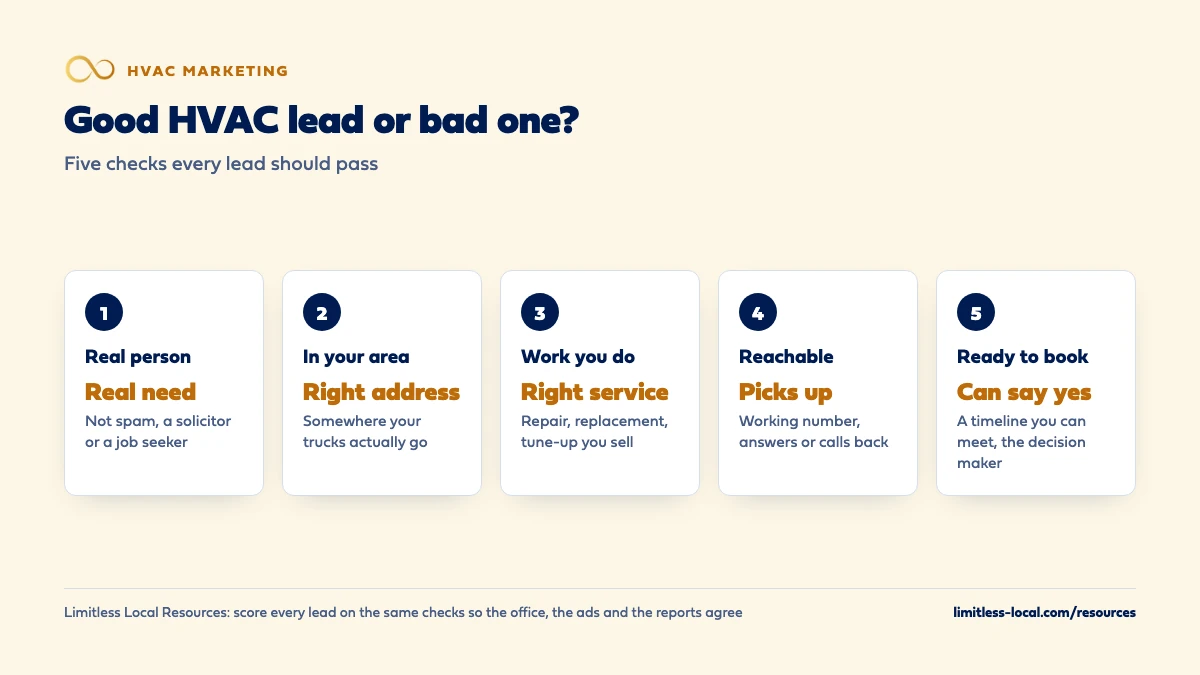
A good lead passes five simple checks:
- It’s a real person with a real need. Not a robocall, a vendor pitch or a job seeker.
- They’re in your service area. The address is somewhere your trucks go without losing half a day.
- They want work you do. AC repair, furnace repair, a replacement, a tune-up, ductwork, whatever you actually sell.
- You can reach them. A working phone number, and they pick up or call back.
- They’re ready to book. They have a timeline that fits your schedule, and they can say yes, or the person who can is on the call.
Notice what’s not on the list: “they booked.” A good lead is one worth your office’s best effort. Whether it turns into a booked job also depends on how fast and how well you handle it.
What makes an HVAC lead bad?
Bad leads usually fall into a few buckets:
- Not a lead at all: spam calls, robocalls, solicitors, wrong numbers, people applying for jobs.
- Wrong service: appliance repair, water heaters if you don’t do them, commercial rooftop units if you’re residential only.
- Wrong place: the address is outside your service area.
- Unreachable: a fake or mistyped number, no answer after several tries.
- No plan to book: someone collecting prices for a project they won’t do this year, or a renter who can’t approve work.
Write down your own buckets and use them every time. If most of your leads land in the same two or three, the fix is usually in your ad settings, not your office. What to fix when your HVAC leads are mostly junk covers that clean-up.
Is a price shopper a bad lead?
Not automatically. “How much do you charge?” is one of the most normal questions a homeowner asks, and plenty of people who open with it book when the answer is clear and friendly.
The difference is what happens next. A good lead asking about price will tell you what’s going on with the system and let you explain your diagnostic fee or schedule an estimate. A poor one only wants a number for a job nobody has seen, and hangs up to call the next company. Mark the first as a good lead and the second as “price only” in your notes, so you can see whether certain ads or sources attract more of them. How to attract fewer price shoppers covers the marketing side.
Is an emergency repair lead better than a tune-up or replacement lead?
They’re all good leads if they pass the five checks. They’re just worth different amounts and need different handling:
- Emergency repair: urgent and usually quick to book, if you answer. The value is the repair ticket, plus a chance at a replacement later if the system is old.
- Replacement or new system: the most valuable lead you get, with the longest decision. It needs an estimate visit and follow-up.
- Tune-up or maintenance: a smaller ticket, but it can turn into a maintenance plan member who calls you first for years.
Tag each lead by job type when it comes in. A month where most of your good leads were tune-ups is a different month from one full of replacement estimates, even if the lead count is the same.
Does it matter who's calling: the owner, a renter or a family member?
Yes, because it decides who can say yes. A homeowner can book on the spot. A renter usually can’t approve work on a system that isn’t theirs, so the real lead is the landlord or property manager. An adult child calling about a parent’s furnace may be the one deciding, or may need to check first.
Ask early and politely: “Are you the homeowner, or should we also talk to someone else?” A renter isn’t a bad lead if you can get the property manager’s number. And property managers who manage many homes can turn into some of your best repeat customers.
Curious what your marketing is actually booking?
Get a free visibility audit — no obligation, no sales pitch.
Which questions sort good leads from bad ones in the first minute?
Your call-takers can qualify most leads with a handful of questions that also help book the job:
- What’s the address or ZIP code?
- What’s going on with the system?
- Is it heating, cooling, or both, and roughly how old is it?
- Are you the homeowner?
- When would you like someone out?
- How did you hear about us?
Asked naturally, those questions don’t feel like a screening. They feel like a company that knows what it’s doing. How your HVAC office should handle incoming calls covers the rest of the call, from greeting to booking.
How should my office score leads the same way every time?
Keep it simple enough that a busy office actually does it. After every call, form or message, mark the lead as one of three things: good, bad (with a reason from your list), or not a lead. Then mark whether a good lead booked.
Most field and call tracking software has a place for this:
- ServiceTitan classifies calls by whether they were answered, how long they lasted and whether they booked. If you don’t set up call reasons first, any call longer than a minute is classified as a lead, which skews your booking rate and your marketing reports (Understand call classifications).
- CallRail lets you mark calls and forms as qualified or not, score them from the keypad right after a call, or set rules that qualify them automatically (How to qualify leads in CallRail).
- Housecall Pro has a lead source field on customers, jobs and estimates, so you can see which sources bring good jobs (How to Use Lead Sources).
Whatever you use, the rule is the same: one definition, written down, used by everyone who answers the phone.
Why do some lead sources send better leads than others?
Each source decides who gets to contact you, and that shapes lead quality:
- Local Services Ads: Google no longer gives credits for leads about a job type you don’t service or an area you don’t serve, and says to refine your service areas, job types and categories if you’re getting unwanted leads (About Automated Local Services Ads lead credits). Your settings are your quality filter.
- Google search ads: quality follows the searches you pay for and the areas you target.
- Facebook and Instagram lead forms: Meta’s default form is built for volume. Its “Higher intent” form type adds a review screen so people confirm their details, which helps screen out the barely interested (About instant form types).
- Shared lead sites: the same homeowner may be sold to several companies, so a good lead can still be a hard one to win.
Before you pay for any source, ask how it decides who reaches you. How to tell if an HVAC lead is exclusive and worth paying for goes through the questions.

Can a good lead turn into a bad one?
All the time. A homeowner with no cooling who calls three companies books the first one that answers. If your callback comes two hours later, the lead looks “bad” on your sheet (no answer, already booked) when it was a great lead you lost.
That’s why lead scoring should record when the lead came in and when someone first responded. If “unreachable” and “already booked elsewhere” pile up, look at response time before blaming the ads. An HVAC client of ours got 47% more booked estimates from speed to lead, automated reminders and better follow-up. How fast an HVAC company should respond to new leads covers the response side.
Should my agency and I define a good lead the same way?
Yes, and in writing. Marketing reports love big lead counts, and a report that counts every ring of the phone as a lead can look great while your schedule stays empty.
Agree on three things: what counts as a lead, what counts as a good lead, and what counts as booked. Then judge the marketing on good leads and booked jobs by source, not total leads. If you’re not sure where the lines between a click, a lead and a booked job sit, the difference between a click, a lead and a booked HVAC job lays them out.
How do I use lead quality to improve my marketing?
Once a month, pull every lead by source and reason. Then ask three questions:
- Which source sends the highest share of good leads? That’s where more money is likely to work.
- What’s the most common bad-lead reason for each source? Out-of-area points to location settings. Wrong service points to job types, keywords or ad wording. Unreachable points to forms or response time.
- Which good leads didn’t book, and why? That’s an office and follow-up question, not a marketing one.
Fix the biggest reason first, give it a month, and check again. Lead quality improves in steps, not overnight.
Want to see where your company stands?
A free visibility audit shows where you show up on Google, Maps and AI answers, and what it's costing you in calls.
What's different about lead quality for HVAC companies
The season changes what a good lead looks like. In a heat wave, almost every caller has a real, urgent need, and the problem is answering them all. In spring and fall, more callers are shopping for replacements or tune-ups and need more follow-up.
System age is a clue. A repair call on a system that’s near the end of its life is a good repair lead and a possible replacement lead. Note the age on every call.
Emergency calls test your phones, not your marketing. No-heat and no-cool calls at night are good leads that go bad fast if nobody answers. Track after-hours leads separately so you see what you’re missing.
Maintenance plan members are the best leads you have. They already trust you. Make sure your office spots them on the call and gives them priority.
A worked example: scoring a month of leads
These numbers are made up to show the math, not a benchmark for your market. Say your marketing brought in 100 leads last month, and you spent $3,000 on ads. Your office scored them:
- 14 were spam, solicitors or wrong service.
- 9 were outside your service area.
- 17 never picked up after several tries.
- 60 were good leads.
Of those 60 good leads, 39 booked. Your cost per lead looks like $30, but your cost per good lead is $50, and your cost per booked job is about $77. Your booking rate on good leads is 65%, while your booking rate on all leads is only 39%.
That split tells you where to work. Cut the 14 junk and 9 out-of-area leads with tighter ad settings, chase down why 17 people never picked up, and coach on the good leads that didn’t book.
Frequently asked questions
What is a qualified HVAC lead?
A qualified lead is one that passes your basic checks: a real person in your service area, asking for work you do, who you can reach and who’s ready to book. It’s a lead worth your office’s full effort.
Should I count a missed call as a lead?
Count it as a possible lead until someone calls back and finds out. Many missed calls are good leads, and the callback decides whether you keep them.
Are form leads worse than phone leads?
Not by nature, but forms make it easier to submit a fake number or a half-hearted request. A couple of required questions, like ZIP code and the problem, filter out a lot of noise.
Is a commercial lead good if I mostly do residential?
Only if you want and can handle that work. A lead for work you don’t do is a bad lead for you, however big the job.
How often should I review lead quality?
Once a month is enough for most HVAC companies, plus a quick check after you change ads or settings. In peak season, a weekly glance at bad-lead reasons catches problems sooner.
Key takeaways
- A good HVAC lead is a real person, in your area, wanting work you do, reachable and ready to book.
- Bad leads are spam, wrong service, out of area, unreachable or not planning to book.
- A price question or a renter isn’t automatically a bad lead; what happens next decides it.
- Slow responses turn good leads into lost ones, so record response time with each lead.
- Score every lead the same way, track it by source, and judge marketing on good leads and booked jobs.
Not sure what's working right now?
Start with a free visibility audit: rankings, Google profile, reviews and tracking, checked against your service area.
More in this section
- How can I tell if an HVAC lead is exclusive and worth paying for?
- What should an HVAC company fix when its leads are mostly junk?
- How do I avoid wasting money on shared HVAC leads?
- How can an HVAC company get more leads?
- How long does it take an HVAC lead to turn into a booked job?
Sources
- About Automated Local Services Ads lead credits — Google Local Services Help
- About instant form types — Meta Business Help Center
- Understand call classifications — ServiceTitan Help
- How to qualify leads in CallRail — CallRail Help Center
- How to Use Lead Sources — Housecall Pro Help Center