
How can I tell if an HVAC lead is exclusive and worth paying for?

- How do I check whether a paid HVAC lead is really exclusive, qualified and fairly priced?
- What does "exclusive" actually mean when someone sells HVAC leads?
- How do I check whether a lead was really exclusive?
- What should I ask a lead seller before I pay?
- How do platform lead types differ?
- How do I tell if a lead is qualified?
- What's a fair price for an HVAC lead?
- How do credits and refunds change what a lead really costs?
- How do I track whether a lead source is worth it?
- Are exclusive leads always better than shared ones?
- When should I stop buying leads and build my own?
- What's different about buying leads for an HVAC company
- A worked example: the expensive lead that's actually cheaper
- Frequently asked questions
- Key takeaways
- More in this section
- Sources
The short version
- Exclusive means sold to you only. It doesn't mean the homeowner won't call others.
- Ask where each lead comes from, how many companies get it, and how credits work.
- Qualified means your service, your area, a real number, and ready to book.
- Judge price by cost per booked job, not cost per lead.
For HVAC owners being pitched “exclusive leads,” who want a way to check the claim and the price before they pay for another month.
Get a free visibility audit · Book a growth call
How do I check whether a paid HVAC lead is really exclusive, qualified and fairly priced?
An HVAC lead is truly exclusive when the seller delivers it to your company only and the homeowner asked for you or your kind of service directly, not when a sales rep simply calls it exclusive. Check it by asking the seller where each lead comes from and how many companies receive it, then watch the leads themselves: homeowners who mention other companies or have already been called are a sign it was shared. A lead is worth paying for when it’s for work you do, in your area, from a reachable homeowner ready to book, and when the price per lead, divided by how many of those leads you book, comes out to a cost per booked job your margins can carry.
The leads that are hardest for anyone else to share are the ones homeowners send you directly: calls from your Google profile, your website and your own ads. That’s what our local ads work builds: Google Ads in every package, Local Services Ads management in Growth and Scale, and call tracking with recording so you can see which calls became booked jobs. Ad spend is paid to Google directly. For how this fits HVAC marketing overall, see the industry page; the HVAC lead generation guide covers every source, and the HVAC marketing questions library goes one question at a time.
What does "exclusive" actually mean when someone sells HVAC leads?
It can mean two very different things, and sellers don’t always say which:
- Sold to you only. The seller delivers that homeowner’s request to one company and no one else. That’s what most owners think they’re buying.
- The homeowner chose you. The homeowner saw your company specifically and contacted you. That’s even better, because they already picked you over the others on the page.
Neither one means the homeowner won’t call anyone else. A homeowner with a dead AC in July may fill out a form, then call two more companies from Google while they wait. Even inside one platform, homeowners may contact more than one pro. Google’s page on how Local Services Ads leads work says message lead prices take into account whether the customer has contacted other Local Services advertisers.
So “exclusive” is about who the seller hands it to, not what the homeowner does next. That’s why speed still wins, even on exclusive leads.
How do I check whether a lead was really exclusive?
You can’t see inside the seller’s system, but the leads themselves tell you a lot. Watch for these over a few weeks:
- “You’re the third company to call me.” If your CSRs hear this often, the lead was shared, or the homeowner filled out several forms.
- The homeowner doesn’t know your name. A lead where the homeowner asked for your company will recognize it. One that was routed to you won’t.
- Fast competing calls. If homeowners say they got calls from several companies within minutes of submitting, that’s a shared lead.
- Generic requests. “Need HVAC quote” with no detail usually came from a broad form, not a homeowner looking for you.
Add one question to your booking script: “Have any other companies reached out to you yet?” Track the answers by lead source for a month. That number tells you more about exclusivity than any sales pitch. If it’s high for a source sold as exclusive, take it back to the seller.
What should I ask a lead seller before I pay?
Ask these in writing and keep the answers:
- Where does each lead come from? Your own website and ads, a partner network, or resold from someone else?
- How many companies receive each lead? If the answer is “up to” a number, that’s shared.
- Does the homeowner know which company will contact them?
- How do you check the contact info is real?
- Can I limit leads to my job types and zip codes?
- What’s your credit policy, and how long do I have to request one?
- What’s the minimum term and how do I cancel?
- What booking or close rate do your leads get, and can you back it up?
That last one matters. In January 2023, the FTC announced a proposed order requiring HomeAdvisor to pay up to $7.2 million. The FTC’s complaint alleged false, misleading or unsubstantiated claims about the quality and source of its leads, including that providers would only get leads matching their services and area, and claims that leads turned into jobs at rates much higher than it could substantiate. Any seller’s numbers are worth checking against your own.
How do platform lead types differ?
Read the fine print on what you’re buying, because one platform can sell several kinds. Thumbtack’s help page on leads, preset jobs and opportunities is a good example:
- Leads come from customers who found you in their search results and chose to contact you directly. You pay automatically when you receive one, based on the lead prices you set.
- Opportunities are customers who’ve reached out to other pros but haven’t hired anyone yet. Sending a quote is free, and you’re charged only if the customer responds.
Those two aren’t the same purchase. One is a homeowner who picked your profile. The other is a homeowner already talking to other companies. Price them and track them separately, and do the same with any platform or vendor that sells more than one lead type.
Curious what your marketing is actually booking?
Get a free visibility audit — no obligation, no sales pitch.
How do I tell if a lead is qualified?
Exclusive doesn’t help if the lead is for the wrong job. A qualified HVAC lead checks five boxes:
- Right service: work you actually do and want, such as AC repair, replacements or maintenance, not window units or commercial refrigeration if you don’t touch them.
- Right area: inside the towns or zip codes your trucks cover.
- Real contact: a phone number that works and a person who answers.
- Decision-maker: the homeowner, or someone who can approve the work, not a tenant who has to ask the landlord.
- Timing: they need it now or soon, not “maybe next year.”
Train your CSRs to check all five in the first minute of the call. Then tag each lead qualified or not in your field software, so you can see which sources send real homeowners and which send noise. What to fix when your HVAC leads are mostly junk covers how to cut the noise at the source.
What's a fair price for an HVAC lead?
There’s no single fair price, because a lead is only worth what it turns into. A no-cool repair lead and a full replacement lead are worth very different amounts, and so are leads you book half the time versus one time in ten.
Work backward instead:
- Start with the gross profit on the job type the lead is for.
- Decide how much of that profit you’re willing to spend to win the job.
- Multiply by your booking rate for that source.
The result is the most you can pay per lead and still be happy. If a seller’s price is above it, the lead isn’t worth it for you, no matter how exclusive. If it’s below, it might be, once you’ve tested it. What cost per booked call an HVAC company should aim for helps you set that spending limit.
How do credits and refunds change what a lead really costs?
A lead’s price is only half the cost. The other half is how many bad ones you get back. Read the credit policy before you buy, and look for what’s excluded.
HomeAdvisor’s (Angi Leads) lead credit guidelines show the typical shape. Duplicates, a wrong zip code outside your area, a wrong job type you don’t offer, and contact info that’s wrong or disconnected may be eligible for credit, if you request it within 30 days. Credits are issued as store credit toward future charges. Not eligible: a homeowner who won’t call back, already hired someone, changed their mind or was just shopping, or a job you didn’t win.
Google’s Local Services Ads work differently: Google doesn’t charge for leads it judges invalid or low quality and may credit charged leads automatically if they later turn out to be low quality, but under its automated lead credit rules it no longer credits leads for job types or areas you don’t serve. So on any platform, your settings and your speed decide much of what you pay for.

How do I track whether a lead source is worth it?
Give each source a fair test and measure it the same way:
- Tag every lead with its source when it comes in, in ServiceTitan, Housecall Pro, Jobber or whatever you use.
- Mark each one as qualified or not, booked or not, and sold or not.
- Request every credit you’re eligible for, on time, and subtract them from the cost.
- After a couple of months, divide what the source cost by the jobs it booked.
Then compare it with your other sources on cost per booked job, not cost per lead. A cheap lead you book one time in ten can cost more per job than a pricier lead you book half the time. Speed matters in that math, too, because the first company to call back usually has the best shot; how fast an HVAC company should respond to new leads covers the response times to aim for.
Are exclusive leads always better than shared ones?
Usually, but not always. Exclusive leads cost more per lead and tend to book at a higher rate, because you aren’t racing four other companies. Whether that’s a better deal comes down to the cost per booked job, which is why you test both.
Shared leads can make sense in a narrow case: you have open slots, a fast callback process and a CSR who wins price conversations. Even then, keep them on a tight budget and in the job types where you win most often.
If you’re already buying shared leads and the math isn’t working, how to avoid wasting money on shared HVAC leads covers how to cut the waste before you drop them.
When should I stop buying leads and build my own?
Bought leads are rented. When you stop paying, they stop coming. The leads that are hardest for anyone to share are the ones homeowners send you directly: calls from your Google Business Profile, your website, your own Google Ads and Local Services Ads, your past customers and their referrals.
It’s time to shift money toward your own sources when:
- Your cost per booked job from bought leads is higher than from your own channels.
- You’re spending more each month on leads than it would cost to build and run your own ads and profile.
- Your team spends more time chasing leads than booking them.
You don’t have to switch overnight. Move part of the budget, compare cost per booked job after a few months, and keep what works. How an HVAC company can get more leads lays out the order to build your own sources in.
Not sure which of these is costing you jobs?
A free visibility audit checks the Google profile, reviews, site and tracking, and shows what to fix first.
What's different about buying leads for an HVAC company
Emergency leads go stale in minutes. A homeowner with no cooling on a hot afternoon books whoever gets there first. An exclusive repair lead you call back in two hours may as well have been shared.
Replacement leads are worth more and shopped harder. Homeowners planning a new system often get several quotes, exclusive lead or not. Expect a longer follow-up, and judge those sources on sold replacements over a few months, not on the first week.
Seasons swing lead quality. In peak season, bought leads often book well because demand is everywhere. In the shoulder months, the same source may send more tire-kickers. Compare each source to the same season, not across seasons.
Watch the job types. Make sure you’re not paying for window units, commercial refrigeration or ductless jobs you don’t do.
A worked example: the expensive lead that's actually cheaper
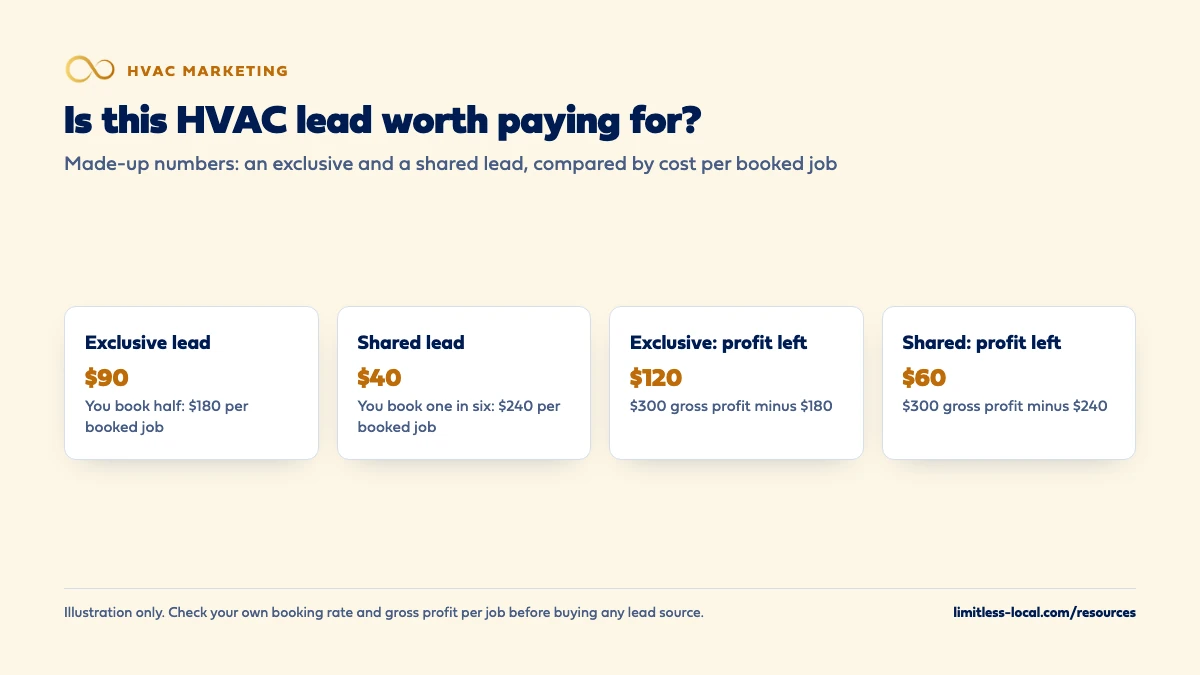
These numbers are made up to show the math, not a benchmark for your market. Say you’re comparing two lead sources for AC repair:
- Source A sells exclusive leads at $90 each, and you book half of them. Cost per booked job: $90 × 2 = $180.
- Source B sells shared leads at $40 each, and you book one in six. Cost per booked job: $40 × 6 = $240.
Now say an average booked repair earns $300 in gross profit. Source A leaves you $120 per job ($300 − $180). Source B leaves you $60 ($300 − $240). The lead that costs more than twice as much is the better deal.
Run the same math with your own numbers before you sign up for any lead source, and again after a couple of months of real results.
Frequently asked questions
Are Local Services Ads leads exclusive?
The homeowner contacts your business directly from your ad, so the call or message comes to you. That doesn’t stop the same homeowner from contacting other advertisers, which is why fast answers still matter.
Can a lead seller sell the same lead twice?
Shared leads are sold to more than one company by design. If a seller promises exclusivity, get it in writing, and track how often homeowners say they’ve already heard from other companies.
Is pay-per-call better than pay-per-lead?
It can be, because a live call is easier to qualify than a form. Ask how long a call has to last before you’re charged, and whether wrong-service calls are credited.
Should I sign a contract with a lead company?
Only one you can leave. Ask for the minimum term and the cancellation steps in writing, and test a source before you commit to months of it.
What booking rate should I expect from bought leads?
It varies too much by source, season and job type to give one number. Measure your own for each source over a couple of months, and use it in the cost per booked job math.
Key takeaways
- Exclusive means the seller delivers the lead to you only; the homeowner may still call others.
- Ask sellers where leads come from, how many companies get them and how credits work, in writing.
- Qualified means your service, your area, a real number, a decision-maker and near-term timing.
- Read credit policies closely; most don’t credit shoppers or jobs you didn’t win.
- Judge every source by cost per booked job, and build your own lead sources over time.
Want a second set of eyes on your setup?
We'll look at how you show up locally and where calls are leaking, then send you a plain-English breakdown.
More in this section
- How do I avoid wasting money on shared HVAC leads?
- What should an HVAC company fix when its leads are mostly junk?
- How competitive is HVAC marketing in my area, and how do I check?
- How can an HVAC company get more leads?
- How long does it take an HVAC lead to turn into a booked job?
Sources
- How leads work — Google Local Services Help
- FTC Order Requires HomeAdvisor to Pay Up To $7.2 Million and Stop Deceptively Marketing its Leads for Home Improvement Projects — Federal Trade Commission
- What are leads, preset jobs, and opportunities? — Thumbtack Help
- Lead Credit Guidelines — Angi Leads (HomeAdvisor)
- About Automated Local Services Ads lead credits — Google Local Services Help