
How do I hire a plumbing marketing agency with an old website?

- How should a growing plumbing company with an outdated website hire an agency and sequence the site work and ads?
- Does an old website mean I'm not ready to hire an agency?
- What should an agency check on my old site first?
- Should I fix the old site or rebuild it?
- Can I run ads while my website is being fixed?
- What order should the site work and ads go in?
- How do I keep my Google rankings if the site gets rebuilt?
- What should I ask an agency about my website before I sign?
- What should the agency fix first when I'm hiring plumbers and growing?
- What does it cost to fix or replace a plumbing website?
- What red flags should I watch for?
- How will I know the new website is working?
- What's different about websites for plumbing companies
- A worked example: the first six months with an old site
- Frequently asked questions
- Key takeaways
- More in this section
- Sources
The short version
- Have the agency check ownership, mobile, pages and current rankings first.
- Fix tracking and build strong landing pages before turning up ads.
- Run ads during the site work so calls don't stall.
- If you rebuild, redirect every old page that brings traffic.
For plumbing owners who are adding trucks or towns, know their website is showing its age, and don’t want the rebuild to stall the calls.
Get a free visibility audit · Book a growth call
How should a growing plumbing company with an outdated website hire an agency and sequence the site work and ads?
Tell the agency up front that your site is old and you’re growing, and have them check it before any ad money points at it: whether you own the domain and logins, whether it works well on phones, whether it has a page for each main job and town, and what it already ranks for. Most plumbing companies should fix ownership and tracking first, run Local Services Ads, or Google Ads pointed at strong landing pages, while the site work happens, and rebuild only if the old site can’t be fixed. If it is rebuilt, every old page that brings traffic should redirect to its new version so the rankings you’ve earned carry over.
That order, foundation first and then lead flow, is how every one of our Limitless Engine packages runs: tracking, follow-up and a clean online presence come first, then local SEO and ads around the towns and jobs you want, then monthly improvement based on calls, leads and revenue. When the site itself needs replacing, our website builds run alongside a package. See how it fits plumbing companies, or browse more plumbing marketing questions.
Does an old website mean I'm not ready to hire an agency?
No. Plenty of plumbing companies come to an agency with a site that was built years ago by a nephew, a former office manager or a company that’s since disappeared. It’s one of the most common starting points, and a decent agency plans around it.
“Old” can mean very different things, though, and they need different fixes:
- It looks dated but works fine on phones.
- It’s slow, hard to use on a phone, or the phone number isn’t tappable.
- It has one “Services” page instead of a page for each job you want.
- Nobody can log in to change it.
- Someone else owns the domain or the hosting.
The first is cosmetic. The last two are urgent. Knowing which you have changes what you ask an agency for. If you’re still deciding whether to hire at all, see when hiring a plumbing marketing agency makes sense.
What should an agency check on my old site first?
Before anyone quotes you a rebuild, the agency should look at what you have. Ask them to cover:
- Ownership. Who owns the domain, the hosting and the admin login. If it isn’t you, that’s the first fix. Who should own the plumbing website and ad accounts explains why.
- Phones. Google uses the mobile version of a site’s content for indexing and ranking, its mobile-first indexing guidance says, so how the site works on a phone is how Google sees it.
- Page experience. Google’s page experience self-check asks whether pages have good Core Web Vitals, are served securely, display well on mobile and avoid intrusive pop-ups.
- What already ranks. Which pages and searches get clicks today, from Search Console if it’s set up.
- Pages. Whether each main job and town has its own useful page.
- Calls and forms. Whether every call and form can be tracked to a source.
Should I fix the old site or rebuild it?
Fix it if the platform is sound, you own it, and the problems are content and pages: missing service pages, thin copy, an old logo, slow images. That’s usually quicker and keeps what already ranks.
Rebuild it if any of these are true:
- It can’t be made to work well on phones without starting over.
- Nobody can edit it, or it’s locked inside a platform you can’t take with you.
- The structure is so tangled that adding a page per service and town means redoing everything anyway.
- It’s not secure and the host can’t fix that.
Ask the agency to explain which side of that line your site is on, in writing, before you sign. A rebuild recommendation made without looking at your current traffic and rankings is a sales pitch, not advice.
Can I run ads while my website is being fixed?
Yes, and if you’re growing you probably should, so the phone keeps ringing while the site work happens.
- Local Services Ads let customers call, message or book straight from the ad, without visiting your website first. Google’s page on how leads work lists the kinds of contact you’re charged for. They depend more on your reviews, profile and how fast you answer than on your site.
- Google Ads search campaigns send people to a page, so that page matters. Google Ads rates landing page experience as above average, average or below average, based on how relevant and useful the page is to people who click.
The usual answer is to build one or two strong landing pages for your most valuable jobs, like emergency service and water heaters, and point ads there while the rest of the site is fixed or rebuilt. For which channel to start with, see whether a plumbing company should start with LSAs, Google Ads or SEO.
What order should the site work and ads go in?
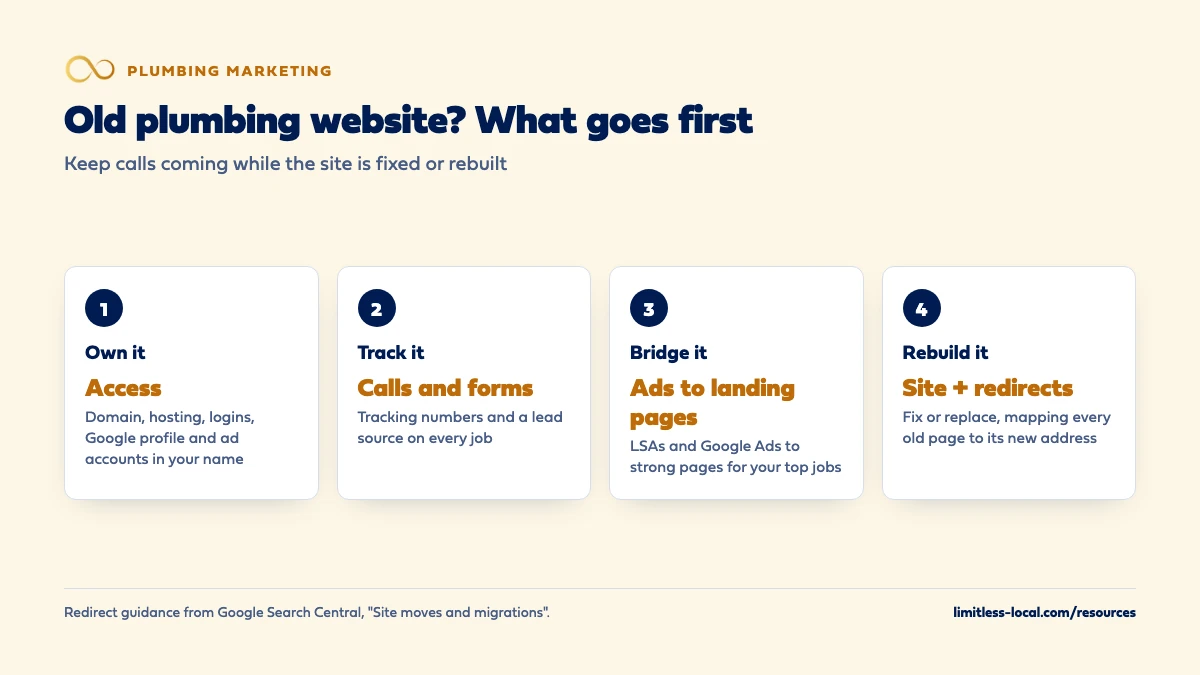
- Ownership and access. Domain, hosting, website login, Google Business Profile, Google Ads and Search Console all in your company’s name.
- Tracking. Tracking numbers, form tracking and a lead source on every job in your field software.
- Google Business Profile. Accurate name, hours, service area and services, linked to the right website page.
- Landing pages for your top jobs.
- Ads on. Local Services Ads and Google Ads aimed at those pages and those jobs.
- Site fix or rebuild, running in the background.
- SEO on the finished site: service and town pages, content and links.
With us, onboarding takes your team about 2 to 3 hours, and campaigns go live in weeks 1 to 2. A full website takes 100 days or less from concept to launch, and themed sites about 60 days; that timeline is deliberately buffered because waiting on feedback is the usual delay. Ads carry the calls in the meantime.
Curious what your marketing is actually booking?
Get a free visibility audit — no obligation, no sales pitch.
How do I keep my Google rankings if the site gets rebuilt?
This is where rebuilds go wrong. If your old pages vanish and nothing points to the new ones, the rankings and links they earned can go with them.
Google’s guide to site moves and migrations describes the safe way:
- Make a list of every current page and map each one to its new address.
- Use permanent (301) redirects from old addresses to new ones.
- Update your sitemap and your own internal links.
- Expect some temporary ranking fluctuation while Google recrawls. For medium-sized sites, it can take a few weeks or more for the new addresses to replace the old ones.
Ask the agency for the redirect map before launch, and keep a copy. It’s also the reason not to rebuild in your busiest season: launch when a few weeks of wobble costs you least.
What should I ask an agency about my website before I sign?
- Will you check my current site and rankings before recommending a rebuild?
- If you build a new site, who owns it, the domain and the content if we part ways?
- Is the website priced separately from the monthly fee, and what does each cover?
- Can ads start before the site is finished, and where will they send people?
- Who writes the service and town pages, and how do my plumbers’ details get into them?
- How will you handle redirects from the old pages?
- How will calls and forms on the new site be tracked to booked jobs?
- What’s the realistic timeline, and what do you need from me?
Write the answers into the agreement. What to look for in a plumbing marketing agency contract covers the rest of the contract.
What should the agency fix first when I'm hiring plumbers and growing?
Growth changes the priority list. If you’re adding plumbers, trucks or towns, ask for:
- A real careers page. Good plumbers check your website too. Show what a week looks like, the trucks and tools, the kind of work they’d do, and a way to apply in a minute from a phone.
- Pages for the work new hires will do. If you’re bringing on a plumber to grow water heater or sewer work, those pages come first.
- Pages for the new towns you’ll actually serve, with real jobs and reviews from there over time.
- Booking that scales: online booking or a request form that drops into your field software, so the office isn’t the bottleneck.
Match the marketing push to the hiring timeline. Turning up ads two weeks before the new plumber starts fills their first days; turning them up before you’ve found anyone just fills the waiting list.
What does it cost to fix or replace a plumbing website?
Fixing pages on a sound site is usually part of ongoing SEO work rather than a separate project. A full replacement is a separate cost from monthly marketing.
Our prices, for comparison: a themed website is $3,750, or $3,000 with any Limitless Engine package, with up to 25 pages. Custom websites start at $5,000. Both come with 6- or 12-month payment plans, 10% off if you pay in full, and 30 days of support after launch. Monthly marketing starts with Essentials at $3,500 a month, and ad spend is paid to Google separately.
For what plumbing sites cost more broadly and what drives the price, see how much a plumbing company website costs.
What red flags should I watch for?
- “We’ll rebuild everything” before anyone has looked at what your current site ranks for.
- The domain or site registered in the agency’s name, or built on a platform you can’t take with you.
- No ads until the new site is done, leaving months without a push while you’re trying to grow.
- No plan for redirects.
- Promised rankings or lead counts. Nobody can honestly guarantee rankings, lead counts or revenue, because platforms change how they work.
- Vague timelines with no list of what they need from you.
A good agency will tell you plainly if your site only needs a few fixed pages, even when a rebuild would earn them more.
How will I know the new website is working?
Compare before and after on the numbers that pay the bills:
- Calls and form leads from the website and from organic search, by tracked number.
- Booked jobs from those leads in your field software.
- Clicks and searches in Search Console for your main jobs and towns.
- Landing page experience status on your Google Ads keywords.
Give it a few months. Expect a short wobble after launch while Google catches up, then judge the trend. SEO typically takes 3 to 6 months to show meaningful organic growth, so a new site’s biggest payoff comes after the first quarter, while ads should be booking jobs from the start.
Not sure which of these is costing you jobs?
A free visibility audit checks the Google profile, reviews, site and tracking, and shows what to fix first.
What's different about websites for plumbing companies
Emergencies happen on phones. Someone with water on the floor is searching one-handed. A tappable phone number at the top of every page, clear hours and a quick way to request help matter more than any design choice. What an emergency plumbing page should include goes deeper.
Big jobs need their own pages. Water heaters, repipes, sewer lines and drain work are searched separately and paid separately. One “Services” page can’t rank or convert for all of them.
After-hours honesty. If you take night calls, say so clearly and make sure the number reaches someone. If you don’t, say when you’ll call back.
Trust shows up in photos. Real trucks, real techs, real jobs. An old site full of stock photos is one of the cheapest things to fix.
A worked example: the first six months with an old site
The job and profit numbers here are made up to show the math. Say a three-truck plumbing company is adding a fourth plumber, and its website is ten years old, not built for phones, and owned by the owner. It signs up for Essentials at $3,500 a month and a themed website at $3,000 with the package, paid over six months, so $500 a month. It sets Google Ads spend at $2,000 a month, paid to Google.
Weeks 1 to 2: tracking, the Google profile and two landing pages, then ads go live. The new site launches around day 60, with every old page redirected. Monthly cost for the first six months: $3,500 + $500 + $2,000 = $6,000.
If an average booked job brings $300 in gross profit, the company needs about 20 extra jobs a month to cover that, which is the number to watch in the dashboard, not traffic.
Frequently asked questions
Can I hire an agency for ads only and fix the website later?
Yes, as long as the ads point to at least one strong landing page and calls are tracked. Plan the website work for a slower season.
Should I keep my old domain name?
Usually yes. It carries your history and links. A new design can live on the same domain, which avoids a domain move entirely.
Is a Facebook page enough while my website is rebuilt?
Not for Google. Whether a plumbing company can use a Facebook page instead of a website covers why a site still matters.
My old web designer won't give me the login. What now?
Ask in writing for the domain, hosting and admin access. If that stalls, ask your domain registrar what it needs to confirm you own the domain, and make sure everything ends up in your company’s name.
Will a new website fix my rankings on its own?
No. A better site makes ranking easier, but pages, content, reviews and your Google profile still have to do the work.
Do I need a new website to run Local Services Ads?
No. Customers contact you straight from the ad. Your reviews, profile and how fast you answer matter more there.
Key takeaways
- An old website is a normal starting point; tell the agency up front and have them check it before quoting a rebuild.
- Fix ownership and tracking first, then build landing pages for your top jobs.
- Run Local Services Ads and Google Ads during the site work so calls don’t stall while you grow.
- If you rebuild, map every old page to a new one with permanent redirects.
- Judge the new site on calls and booked jobs over several months, not on looks.
Want a second set of eyes on your setup?
We'll look at how you show up locally and where calls are leaking, then send you a plain-English breakdown.
More in this section
- Should I hire a plumbing marketing agency or do it myself?
- When does hiring a plumbing marketing agency make sense?
- How do I know if a marketing agency really knows plumbing?
- How can I tell if my plumbing marketing agency is making progress?
- What makes a good plumbing marketing company?
Sources
- Mobile-first Indexing Best Practices — Google Search Central
- Understanding Google Page Experience — Google Search Central
- How leads work — Google Local Services Help
- Landing page experience: Definition — Google Ads Help
- Site Moves and Migrations — Google Search Central