
Electrician growth: residential, commercial or emergency work?
- Should I build my electrical marketing around residential, commercial or emergency jobs to grow faster?
- What does growing faster really mean for an electrical shop?
- How do residential, commercial and emergency work compare?
- Which kind of electrical work makes the most money per hour?
- Which lane brings in calls the soonest?
- What does emergency work need before I market it?
- What does commercial work need before I market it?
- How does cash flow change which lane grows fastest?
- How do I check demand for each lane in my area?
- Can I grow in more than one lane at once?
- How should my marketing budget follow the lane I pick?
- When should I switch lanes or add a new one?
- What's different about this choice for electricians
- A worked example: gross profit per crew-hour in three lanes
- Frequently asked questions
- Key takeaways
- More in this section
- Sources
The short version
- Residential: steady search demand, paid at completion, quickest to scale.
- Emergency: high value per hour, but only if someone answers and goes out at night.
- Commercial: bigger jobs, slower sales, and cash tied up while you wait to be paid.
- Decide with gross profit per crew-hour, sellable hours and days to get paid.
- Build marketing around one main lane and use the others to fill gaps.
For electrical contractors deciding which kind of work to build their marketing, hiring and schedule around for the next stage of growth.
Get a free visibility audit · Book a growth call
Should I build my electrical marketing around residential, commercial or emergency jobs to grow faster?
For most electrical shops, residential service and upgrade work is the fastest lane to grow, because search brings steady calls, jobs are usually paid when they’re done, and one more truck adds revenue quickly. Emergency work speeds that up if someone can answer and dispatch at night, and commercial work grows bigger but slower, through bids, relationships and payment terms that tie up cash. Choose using three of your own numbers: gross profit per crew-hour in each kind of work, how many hours your crews can really sell, and how long you wait to get paid, then build the marketing around the lane that wins.
Whichever lane you pick, the marketing has to match it: ads and pages for the jobs you want, a schedule that fits your on-call coverage, and tracking that shows which calls booked. That’s what our packages are built around, starting with Essentials at $3,500 a month for one location, with ad spend paid directly to Google. Our electrical contractor marketing page shows how we work with electrical shops, and the electrical marketing questions library goes question by question.
What does growing faster really mean for an electrical shop?
Before picking a lane, decide what you’re trying to grow. More revenue, more profit and a fuller schedule are three different goals, and each kind of electrical work is better at some than others. A shop chasing revenue might take a large commercial job that keeps two crews busy for months. A shop chasing profit might rather fill the same hours with panel upgrades.
Then look at what actually limits you. For many electrical shops it isn’t leads. It’s electricians, dispatch and cash. The U.S. Bureau of Labor Statistics’ Occupational Outlook Handbook projects about 72,700 openings for electricians each year, on average, over the decade to 2035, so every shop is competing for the same people. If you can’t staff the work, marketing more of it only grows your backlog and your unanswered calls.
So the real question is which kind of work turns your limited crew hours and cash into the most profit, and which one your marketing can feed reliably.
How do residential, commercial and emergency work compare?
Here’s how the three lanes usually stack up for a local shop:
- Residential service and upgrades (repairs, panel upgrades, EV chargers, generators, rewires): many small and mid-size jobs, short sales conversations, usually paid on completion, and steady demand from search, Maps and referrals. It scales one truck at a time.
- Emergency calls (no power, burning smell, tripping breakers, storm damage): urgent, often after hours, with little price shopping and fast payment. Volume swings with weather and season, and it only works if someone answers and goes out.
- Commercial work (tenant build-outs, service contracts, lighting retrofits, EV charging for businesses): fewer, bigger jobs that come through bids and relationships. Longer sales cycles, more paperwork, and payment that often arrives well after the work is done.
None of these is better in general. Each one fits a certain kind of shop, crew and owner. Which channels work best for residential vs commercial electricians covers where each kind of customer looks for you.
Which kind of electrical work makes the most money per hour?
Your own invoices will tell you better than any rule of thumb. Pull the last few months of jobs and sort them into the three lanes. For each one, work out:
- Gross profit per job: the invoice, minus materials, labor and any permit or subcontractor costs.
- Crew-hours per job: every hour your people spent on it, including drive time and return trips.
- Gross profit per crew-hour: the first number divided by the second.
That last number is the one to grow on, because crew-hours are the thing you can’t easily buy more of. A lane with big tickets can still lose if it eats hours, and a lane with small tickets can win if the jobs are quick.
Watch for hidden costs that don’t show on the invoice: overtime for night calls, estimating time on commercial bids you didn’t win, and the trips back to fix punch-list items. Put those hours in, or the numbers will flatter the wrong lane.
Which lane brings in calls the soonest?
Residential and emergency work, almost always. Homeowners search when they need an electrician, so search ads and Local Services Ads can put you in front of them within days of going live, and the map pack and your website keep calls coming as your reviews grow. Commercial work rarely starts with a search. It starts with a general contractor or property manager who already knows you, which takes months of showing up.
Emergency calls have one catch. On Local Services Ads, Google’s page on how leads work says you’re charged for a missed call during your business hours when the caller stays on the line for more than 20 seconds. If you list long hours to catch emergencies and then miss the calls, you pay for leads you never spoke to. List the hours you can really cover.
Which marketing wins emergency calls vs planned projects goes channel by channel.
What does emergency work need before I market it?
Emergency calls reward the shop that answers first and shows up fast. Before you spend a dollar advertising them, line up:
- Live answering after hours. A person or answering service that picks up, not voicemail.
- An on-call rotation your electricians agree to. Evenings, weekends and overtime already come with the trade, but a rotation people resent is one they’ll quit over.
- After-hours pricing that’s set in advance and said on the phone, so nobody is surprised at the door.
- Stocked trucks so a night call doesn’t stall waiting for a supply house to open.
Then match the ads to the coverage. In Google Ads you can set up an ad schedule to show ads only at certain times, with a maximum of 6 ad schedules per day for each campaign, so your emergency campaign runs only when someone is on call.
Curious what your marketing is actually booking?
Get a free visibility audit — no obligation, no sales pitch.
What does commercial work need before I market it?
Commercial customers buy differently, and they check you out before they call. Before you go after them, make sure you can handle:
- The paperwork. Certificates of insurance, licenses, safety records and sometimes bonding, ready to send the same day they’re asked for.
- Estimating time. Bids take hours, and you won’t win most of them. Someone has to do the takeoffs without pulling a lead electrician off the job.
- Crew size. A tenant build-out can tie up two crews for weeks. Your residential customers still need someone.
- Cash. You’ll pay wages and buy materials long before the general contractor pays you.
If you have those, commercial work can smooth out the slow residential months and build relationships that send work for years. How to market to commercial customers covers bid lists, maintenance agreements and outreach.
How does cash flow change which lane grows fastest?
Growth costs cash before it makes cash. Every new electrician, truck and job needs wages and materials paid up front. How fast the money comes back decides how fast you can grow.
- Residential and emergency jobs are usually paid when they’re done, often on the spot. Cash comes back in days, so you can reinvest in the next truck sooner.
- Commercial jobs are usually invoiced on terms, and some contracts hold back part of the payment until the whole project is finished. Cash can be out for weeks or months.
A shop with little cash in the bank can grow faster in residential, even at lower margins, simply because the money turns over quicker. A shop with a cash cushion or a line of credit can take on commercial work and use it to keep crews busy. Look at your bank balance and your payroll before you decide, not just your job list.
How do I check demand for each lane in my area?
Use three quick checks before you commit:
- Search demand. Google’s Keyword Planner shows estimates of how many searches a keyword gets each month. Look up the job types you want (“panel upgrade,” “EV charger installation,” “emergency electrician,” “commercial electrician”) in your towns. Very low-volume terms may not show numbers at all.
- Your own call log. Sort the last year of calls by job type. If emergency calls already come in at night and go to voicemail, that’s demand you’re leaving on the table.
- Who builds and manages around you. Count the general contractors, property managers and new commercial projects in your area. Commercial demand doesn’t show up in searches, so you have to look for it.
A lane with strong demand, good profit per crew-hour and cash that comes back fast is the one to build around.
Can I grow in more than one lane at once?
Yes, and many shops do, but give one lane the lead. A common pattern is a residential base that keeps the trucks busy, an emergency layer on top for nights and weekends once someone can cover them, and commercial work added through a few relationships as the shop gets bigger.
What doesn’t work is splitting a small budget three ways. If you run residential, emergency and commercial campaigns on the money that should feed one, none of them gets enough to learn what works. Start with one, prove its cost per booked job, then add the next.
When you run more than one, keep them separate: different ads, different pages on your website, and tracking that shows which lane each call came from. Getting more panel upgrade and EV charger jobs is a good example of building one residential lane on purpose.
How should my marketing budget follow the lane I pick?
Each lane spends money differently:
- Residential: mostly ad spend and search, like Google search ads, Local Services Ads, your Google profile and service pages, plus a steady stream of review requests.
- Emergency: ad spend concentrated in the hours you cover, plus the cost of answering and on-call pay. The answering part matters as much as the ads.
- Commercial: mostly time, like walking sites, meeting general contractors and preparing bids, plus a small, tightly targeted search campaign for commercial service calls.
If you’re moving from “keep the schedule full” to “grow,” expect the budget to rise before results do. How to change your marketing to grow vs stay busy covers how much more to spend and how to tell it’s working.
When should I switch lanes or add a new one?
Watch for these signals:
- Your main lane is full. Crews are booked out and you’re turning work away. Add capacity before more marketing, or add a lane with better profit per hour.
- Calls are steady but profit isn’t. Lots of small service calls and thin margins can mean it’s time to push upgrades or emergency work.
- The slow season hurts. If winter or a quiet stretch empties the schedule, commercial maintenance or a seasonal lane like generators can fill it.
- You’ve hired well. A strong lead electrician who can run a commercial job without you opens a lane you couldn’t take before.
Growing past one or two crews is when most shops add a second lane. Scaling past one or two crews covers hiring, dispatch and marketing in the right order.
Not sure which of these is costing you jobs?
A free visibility audit checks the Google profile, reviews, site and tracking, and shows what to fix first.
What's different about this choice for electricians
Electricians have more lanes than most trades. Service calls, panel upgrades, EV chargers, generators, solar tie-ins, lighting retrofits, tenant build-outs and service contracts can all come through one shop. That’s a strength, but it makes it easy to market everything and grow nothing.
Residential upgrades bridge the gap. Panel upgrades, EV chargers and generators are planned residential jobs with bigger tickets than service calls. For many shops, they’re the fastest path to higher profit per crew-hour without leaving residential.
Emergency calls come with storms. Outages and storm damage bring bursts of urgent calls. A shop set up to answer and dispatch at night can win customers who stay for years; one that isn’t just collects voicemails.
Licensing and permits shape the work. Commercial and larger residential jobs usually need permits and inspections, and rules vary by state and city. Make sure your license and crew qualifications fit the lane before you market it.
A worked example: gross profit per crew-hour in three lanes
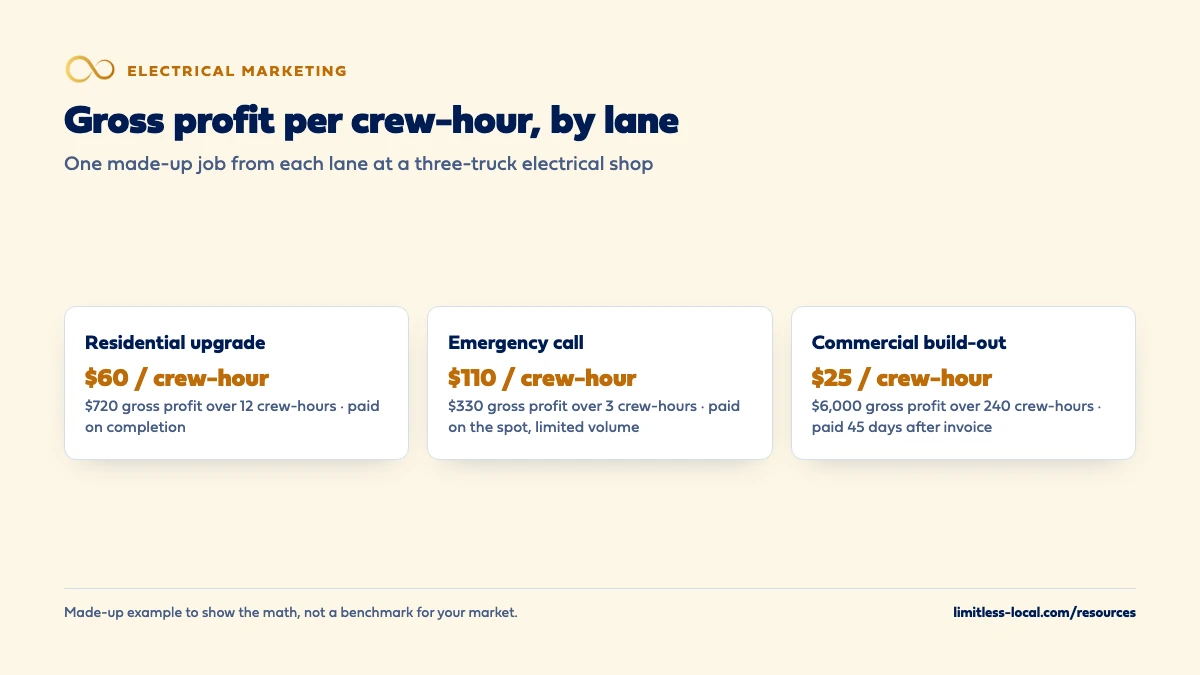
These numbers are made up to show the math, not a benchmark for your market. Say a three-truck shop pulls one typical job from each lane:
- Residential panel upgrade: $1,800 invoice, $720 gross profit, 12 crew-hours. That’s $720 divided by 12, or $60 per crew-hour, paid on completion.
- After-hours emergency call: $650 invoice, $330 gross profit after overtime, 3 crew-hours. That’s $330 divided by 3, or $110 per crew-hour, paid on the spot.
- Commercial tenant build-out: $24,000 invoice, $6,000 gross profit, 240 crew-hours. That’s $6,000 divided by 240, or $25 per crew-hour, paid 45 days after the invoice.
Emergency work wins per hour, but this shop only gets a handful of those calls a week, and its electricians won’t take more nights. Commercial work keeps crews busy but earns the least per hour and ties up cash. Residential upgrades are the lane to grow: solid profit per hour, fast payment, and steady search demand the shop can buy more of. The plan becomes residential upgrades as the main lane, emergency calls on the nights someone is on call, and commercial jobs only when the residential schedule has gaps.
Frequently asked questions
Is emergency electrical work worth it for a one-truck shop?
Only if you’re willing to answer and go out at night. A one-truck owner can take emergency calls a few nights a week and schedule ads to match, but burning out on calls every night will cost more than the jobs pay.
Do I need a separate business name for commercial work?
Usually not. One name keeps your reviews, Google profile and reputation in one place. Separate the two sides in your ads, website pages and proposals instead.
Should a new electrical contractor start with commercial work?
Most start with residential, because it pays faster and needs less paperwork and cash. Small commercial service calls for local businesses are an easy way to build commercial experience on the side.
Can I charge more for emergency electrical calls?
Many shops charge an after-hours rate. Set it in advance, say it on the phone before dispatching, and put it on the invoice the same way, so nobody is surprised at the door.
What if my best-paying lane has the least demand?
Use it to raise your average, not as your only lane. Keep a steady lane for volume and push the high-profit work through your ads, website and quotes wherever it fits.
Key takeaways
- Residential service and upgrades are usually the fastest lane to grow: steady demand and fast payment.
- Emergency work pays well per hour but only works with live answering, an on-call rotation and ads scheduled to match.
- Commercial work brings bigger jobs but slower sales and cash tied up in payment terms.
- Choose your main lane by gross profit per crew-hour, sellable crew hours and days to get paid.
- Give one lane the lead, prove it, then add the next with separate ads, pages and tracking.
Want a second set of eyes on your setup?
We'll look at how you show up locally and where calls are leaking, then send you a plain-English breakdown.
More in this section
- Which channels work best for residential vs commercial electricians?
- How should an electrician change marketing to grow vs stay busy?
- How long to rank for electrician near me versus specific services?
- Which marketing wins emergency electrical calls vs planned projects?
- How do electricians get referrals beyond past customers and builders?
Sources
- Electricians: Occupational Outlook Handbook — U.S. Bureau of Labor Statistics
- How leads work — Google Local Services Help
- Set up an ad schedule — Google Ads Help
- Use Keyword Planner — Google Ads Help