
How do I get HVAC calls without paying for ads?

- What are the free ways to get more HVAC calls?
- What are the free ways to get more HVAC calls?
- Step 1: Is my Google Business Profile doing its job?
- Step 2: How do I get more Google reviews without paying for them?
- Step 3: Are Google Business Profile posts worth the time?
- Step 4: Which other free listings should my HVAC company claim?
- Step 5: How do I get more calls from past customers?
- Step 6: How do I get more HVAC referrals?
- Step 7: Which local businesses can send an HVAC company work?
- Step 8: Am I already losing calls I could have booked?
- How long do free channels take compared with ads?
- When does it make sense to start paying for ads?
- What's different about free marketing for HVAC companies
- A worked example: putting a dollar value on free calls
- Frequently asked questions
- Key takeaways
- More in this section
- Sources
The short version
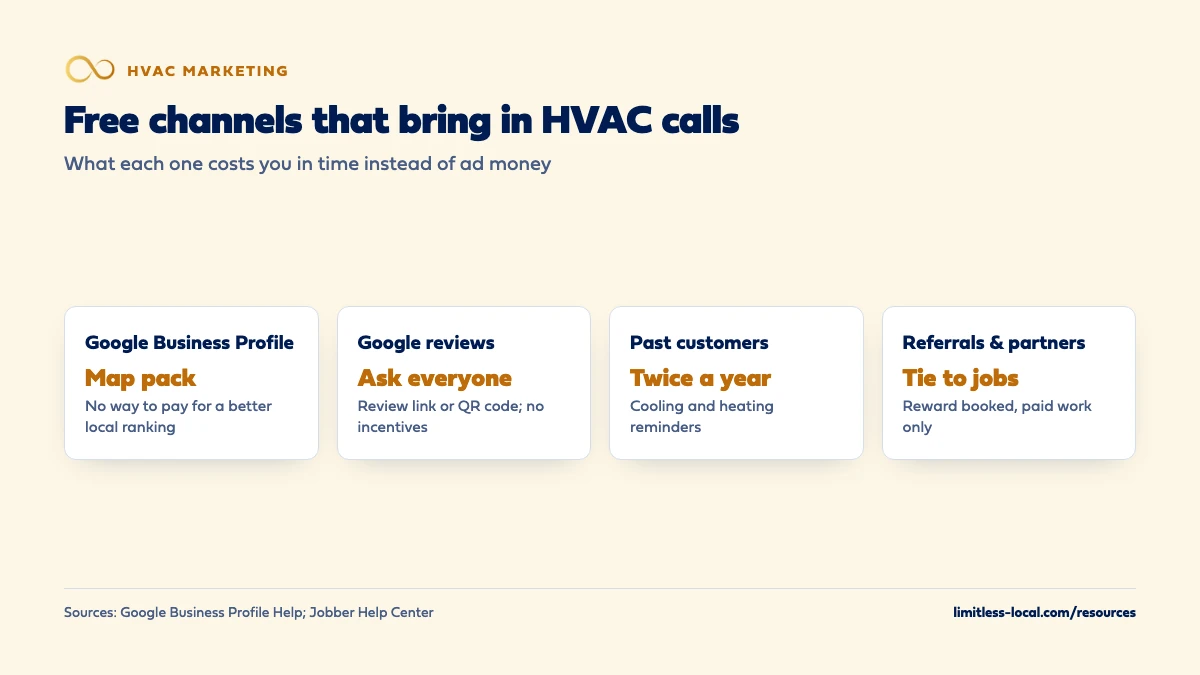
- Your Google Business Profile is the biggest free source of HVAC calls; Google says you can't pay for a better local ranking.
- Ask every customer for a Google review with a link or QR code, and offer nothing in return.
- Past customers, plan members and referrals are calls you don't have to win on Google again.
- Free channels take time to build; ads are the only one that's fast.
For HVAC owners who want the phone to ring more without an ad budget, and want to know which free channels are worth their time.
Get a free visibility audit · Book a growth call
What are the free ways to get more HVAC calls?
Get HVAC calls without ads by working the channels Google and your own customers give you for free: a verified, complete Google Business Profile, a steady flow of Google reviews from every job, reminders to past customers before each season, referrals from happy customers, and a few local businesses that send you work. Answer every call, too, because the cheapest call is one you already got. These cost time instead of ad money, and they build over months rather than days, so they work best as a base that ads can sit on later.
Free channels are where we’d start too: the first phase of our work is building the foundation, which means tracking, follow-up and a clean online presence before the lead flow is turned up. Google Business Profile management and review generation are part of every local SEO package on our HVAC marketing page, and if you’d rather do it yourself, this page is the list. The HVAC lead generation guide compares free and paid channels side by side, and the rest of the HVAC marketing questions library goes question by question.
What are the free ways to get more HVAC calls?
Six channels cost nothing but time:
- Your Google Business Profile, which puts you in the map pack and on Google Maps.
- Google reviews, which help that profile rank and help homeowners pick you.
- Other free listings, like Bing Places and Apple’s business listings.
- Past customers and maintenance plan members.
- Referrals from happy customers.
- Local businesses that meet your customers before you do.
Two more aren’t channels but decide how much the six are worth: a website that turns visits into calls, and someone who answers the phone. The steps below go in roughly the order we’d tackle them, starting with what reaches the most homeowners.
One honest caveat: free isn’t fast. In our judgement, most of these build up over months, and only paid ads can make the phone ring within days of starting.
Step 1: Is my Google Business Profile doing its job?
For most HVAC companies it’s the biggest source of calls that doesn’t cost ad money, and Google is clear that you can’t buy your way up: its help center says there’s no way to request or pay for a better local ranking (Google Business Profile Help). Local results are mainly based on relevance, distance and popularity. What you control:
- Verify the profile. Google says verified businesses are more likely to show up in search results.
- Fill in everything. Google says complete, accurate profiles are more likely to show in local results: hours, category, service area, phone, website, photos.
- Keep categories tight. Google’s guidelines say to choose the fewest categories that describe your core business, and that your service area should be accurate (Google Business Profile Help).
- Reply to reviews, which Google says can help your business stand out.
- Add real photos of your trucks, crew and work.
The full checklist is in optimizing your Google Business Profile. To see whether it’s working, the profile’s Performance report counts how many times people tapped the call button. Google notes those numbers include views and actions from Google Ads too, so if you run ads, the count isn’t purely free calls (Google Business Profile Help).
Step 2: How do I get more Google reviews without paying for them?
Ask every customer, every time, and make it easy. Google lets you create a review link or QR code from your Business Profile and suggests putting it on receipts and in thank-you emails (Google Business Profile Help). For an HVAC company that means the invoice, the follow-up text and a card the tech can hand over.
Reviews feed the free channel above. Google says popularity is partly based on how many reviews you have, and more reviews and positive ratings can help your local ranking (Google Business Profile Help).
What you can’t do: offer anything for a review. Google’s review-link help page says offering incentives such as free or discounted services in exchange for reviews counts as fake engagement. Getting your crew to actually ask is the hard part, and getting techs to ask for reviews covers scripts and timing.
Step 3: Are Google Business Profile posts worth the time?
They’re free and quick, so they’re worth a few minutes a week, but don’t expect them to carry the profile. Google lets you post updates, offers and events that show on your profile on Search and Maps (Google Business Profile Help):
- Offers need a title and dates, and get a View Offer button automatically. A spring tune-up special fits here.
- Updates can carry a photo and a button that links to a page on your site, such as your booking page.
One trap: Google says posts with a phone number in the description may be rejected if the number can’t be verified as connected to the business. Use the call button on the profile instead of typing a number into the post. In our judgement, posts help most as proof that the business is active and as a home for seasonal offers; complete info and reviews do more for your ranking.
Step 4: Which other free listings should my HVAC company claim?
Google isn’t the only map. Claim the free business listings where homeowners and AI tools look things up:
- Bing Places. Bing says it uses many data sources for its local listings and that Bing Places is one of the primary ones. Search for your business, claim the listing if it exists, verify it, and fill in name, address, phone, category, website and hours (Bing Places Help). Bing allows up to 100 photos.
- Apple Business (formerly Apple Business Connect), for Apple Maps.
- Yelp and Nextdoor, where neighbors ask each other for recommendations.
The rule across all of them is the same name, address and phone everywhere. Bing also warns against editing an old listing when a business moves or changes its name; it recommends creating a new listing and marking the old one closed. If your details are already scattered across old listings, clean those up before adding new ones.
Curious what your marketing is actually booking?
Get a free visibility audit — no obligation, no sales pitch.
Step 5: How do I get more calls from past customers?
Past customers already know your name, so the job is staying in touch before they need you again. The short version, in our judgement:
- Offer a maintenance plan on every residential call, so the next two visits are booked before the tech leaves.
- Send a reminder before cooling season and another before heating season, from the customer list in your field software.
- Follow up after big repairs, and reach out to customers whose equipment is getting old.
None of that costs ad money; most field software can send the reminders. Getting more repeat customers and referrals covers plans, reminders and tracking in detail.
Step 6: How do I get more HVAC referrals?
Ask when the customer is happiest, usually right after the heat or cooling is back on, and give them an easy way to pass your name along: a card, a text with a link, or a note on the invoice.
A small reward can help, as long as it’s tied to a booked job. Jobber’s referral program, for example, gives each client a unique link and applies the reward as a credit on the referring customer’s next invoice once the referred client pays (Jobber Help Center). Paying only for booked, paid work keeps the cost tied to results.
Keep referrals and reviews separate. A referral reward is fine; a reward for a Google review is not, as Step 2 explains. Record “Referral” as a lead source so you can see what the program actually books.
Step 7: Which local businesses can send an HVAC company work?
Businesses that meet your customers before you do. In our judgement, these are the ones worth a coffee:
- Plumbers and electricians who don’t do HVAC and get asked about it on every call.
- Home inspectors, who flag old or failing equipment during home sales.
- Property managers for rental homes, who need someone reliable for every unit.
- Remodelers and builders who need ductwork and equipment moved or replaced.
- Real estate agents, whose buyers often want a system checked before or after closing.
Offer to send work back where you can, and be someone they’re comfortable recommending: answer fast, show up when you say, and tell them how the job went. If you’re thinking about paying another business for referrals, check the rules that apply to its industry first. Track each partner as its own lead source so you know who actually sends booked jobs.

Step 8: Am I already losing calls I could have booked?
Before chasing new calls, check the ones you already get. A call that rings out on a busy afternoon, a web form nobody answers until the next day, or an after-hours voicemail that waits until Monday all cost you jobs that were free to begin with.
The checks, in our judgement: how many calls go unanswered during business hours, how long web leads wait for a reply, and what happens to calls after hours. How fast you should respond to new leads covers the targets and the fixes. For many shops, this is the cheapest step on the list.
How long do free channels take compared with ads?
Longer, and nobody can promise a date. Ads can bring calls within days of launching because you’re paying to appear right away. SEO, which includes the work on your profile and website, typically takes 3-6 months to show meaningful organic growth. If you want to do that work yourself, improving your Google ranking yourself lays out the steps in order. Reviews and referrals build at whatever pace you ask for them.
That’s the trade: free channels cost your time and patience instead of money, and what they build keeps working after you stop paying for anything. Ads stop the day the budget does.
When does it make sense to start paying for ads?
In our judgement, when the free base is in place and you have room on the schedule: a complete, verified profile, a steady flow of reviews, a website with a page for each main service, call tracking, and someone answering the phone. Ads on top of that base tend to cost less per booked job than ads covering for its absence.
Ads also make sense when you need calls faster than free channels can deliver, such as a new location or a slow season you can’t wait out. Choosing where to start is covered in whether to start with LSAs, Google Ads or SEO.
Not sure which of these is costing you jobs?
A free visibility audit checks the Google profile, reviews, site and tracking, and shows what to fix first.
What's different about free marketing for HVAC companies
Two seasons, two reasons to call. Few trades get a built-in reason to contact every past customer twice a year. A spring cooling reminder and a fall heating reminder are the most reliable free calls an HVAC company has.
Emergency calls go to the map pack. A homeowner with no heat at night doesn’t browse; they call one of the first companies on Google Maps. That’s why the profile and reviews come first on this list.
Your techs are your marketing. They’re in the house, they see the old equipment, and they’re the ones a homeowner remembers. A review ask, a plan offer and a referral card all happen in the driveway or not at all.
A worked example: putting a dollar value on free calls
These numbers are made up to show the math, not a benchmark. Say your Business Profile’s Performance report shows 40 taps on the call button last month, you run no ads, and your call log shows 15 of those calls booked a job.
- If ads in your market cost you about $180 per booked job, the profile produced the equivalent of 15 × $180 = $2,700 in ad-driven bookings.
- If the 15 jobs averaged $350 each, that’s 15 × $350 = $5,250 in revenue from a channel with no media cost.
That’s why the free channels come first. It’s also a reason to put a value on the hours they take: if keeping the profile current, asking for reviews and sending reminders takes a few hours a week, compare that time with what the same bookings would cost in ads. Google Business Profile management, review generation and call tracking are all part of our Essentials package at $3,500 a month, for owners who’d rather spend those hours on the trucks. Whether that’s worth it is what a free visibility audit is for.
Frequently asked questions
Can I pay Google to rank higher in the map pack?
No. Google says there’s no way to request or pay for a better local ranking, and that local results are mainly based on relevance, distance and popularity.
Is it worth adding service areas to my Google Business Profile?
Yes, if they’re accurate. Google’s guidelines ask that your address or service area be accurate and precise, so list the areas your trucks actually cover.
Can I give customers a discount for a referral?
A referral reward is a business decision; tying it to a booked, paid job keeps it fair. Just don’t offer anything in exchange for a Google review, which Google treats as fake engagement.
Do I need a website to get free calls?
Your Google profile can bring calls without one, but a website with a page for each main service gives the profile something to link to and gives homeowners a reason to trust you.
How many hours a week does free marketing take?
There’s no standard figure. It depends on how many reviews you ask for, how often you post and how big your customer list is; track it for a month and compare it with what the same calls would cost in ads.
Does Nextdoor or Facebook count as a free channel?
Their business pages and neighborhood recommendations are free to use. In our judgement they work best as a place for happy customers to mention you, so focus on doing the job well enough that they do.
Key takeaways
- Your Google Business Profile is the biggest free source of calls, and Google says you can’t pay for a better local ranking.
- Ask every customer for a Google review, and never offer anything in exchange.
- Past customers, plan members, referrals and local partners bring calls you don’t have to win on Google again.
- Answer every call before chasing new ones; missed calls are free leads lost.
- Free channels take months to build; ads are the fast option once the base is in place.
Want a second set of eyes on your setup?
We'll look at how you show up locally and where calls are leaking, then send you a plain-English breakdown.
More in this section
- Do Facebook ads work for getting HVAC calls?
- How do I keep HVAC calls coming in during slow months?
- How soon will Google Ads start bringing in HVAC calls?
- Which HVAC services should I advertise first?
- What happens to my HVAC calls if I stop marketing?
Sources
- Tips to improve your local ranking on Google — Google Business Profile Help
- Guidelines for representing your business on Google — Google Business Profile Help
- Create a Google link or QR code to request reviews — Google Business Profile Help
- Create & manage posts on your Business Profile — Google Business Profile Help
- Understand your Business Profile performance & insights — Google Business Profile Help
- Manage your listing — Bing Places for Business Help
- Referrals — Jobber Help Center