
Which channel gives an electrician the lowest cost per lead?

- Which marketing channel brings electrical leads in at the lowest cost?
- Which channel usually has the lowest cost per lead?
- Why isn't there one cost-per-lead benchmark for electricians?
- What does a Local Services Ads lead cost an electrician?
- What does a Google Ads lead cost an electrician?
- What do Angi or Thumbtack leads cost?
- Are SEO and Google profile leads really cheaper?
- Why isn't the cheapest lead always the cheapest job?
- How do I work out cost per lead for each channel myself?
- How do I lower my cost per lead without losing good jobs?
- When is a higher cost per lead worth paying?
- Should I move my whole budget to the cheapest channel?
- What's different about cost per lead for electricians
- A worked example: cheap leads versus cheap jobs
- Frequently asked questions
- Key takeaways
- More in this section
- Sources
The short version
- Referrals, past customers and your Google profile usually have the lowest cost per lead once they're built.
- Paid channel costs swing with your market, job type and competition, so there's no fair national benchmark.
- Local Services Ads charge per valid lead; Google Ads charge per click; Thumbtack prices leads by job value.
- Compare channels on cost per booked job, not cost per lead.
For electrical contractors comparing what a lead really costs from referrals, the Google profile, SEO, Local Services Ads, Google Ads and lead marketplaces, and why the cheapest lead isn’t always the cheapest job.
Get a free visibility audit · Book a growth call
Which marketing channel brings electrical leads in at the lowest cost?
For most electricians, the lowest cost per lead comes from channels you’ve already built: referrals, past customers and calls from your Google profile and website, where the cost is spread across every lead they bring. Among paid channels there’s no reliable published benchmark for electricians, because Local Services Ads lead prices, Google Ads click costs and marketplace lead prices all move with your market, the job type and the competition. Work out cost per lead for each channel from your own numbers, then compare them on cost per booked job, because a cheap lead that rarely books is the expensive one.
Cost per lead only means something when it’s tied to the jobs it books, which is why every package we run includes call tracking, source tagging and a monthly cost-per-lead breakdown next to booked jobs. Our Google Ads and Local Services Ads management page shows how the paid side works, our electrical contractor marketing page explains how we work with electrical shops, and the rest of the electrical marketing questions library goes question by question.
Which channel usually has the lowest cost per lead?
Ranked roughly from cheapest to most expensive per lead, for an established shop:
- Referrals and repeat customers. Close to free. The cost is the time it takes to ask and to stay in touch.
- Your Google profile and organic search. The work costs money up front, but once it ranks, each extra call costs very little.
- Local Services Ads. You pay per valid lead, so there’s no paying for clicks that never call.
- Google search ads. Wide range. Tightly run campaigns on the right job searches can be competitive; loose ones can be the most expensive channel you run.
- Lead marketplaces. Leads arrive fast, but a low price per lead can hide a low booking rate, so count what they book before calling them cheap.
This order is a starting point, not a rule. A brand-new shop has no referrals or rankings yet, so a paid channel is its cheapest real option for a while. And a well-run search campaign in a quiet market can beat a marketplace in a busy one.
Why isn't there one cost-per-lead benchmark for electricians?
Because every paid channel is priced by competition in your own market. In Google Ads, your actual cost per click comes out of an auction: you pay what it takes to beat the ad below you, and Google says the competitiveness of the auction affects that price. An electrician in a crowded metro and one in a small town can bid on the same search and pay very different amounts.
Job type matters as much as place. A search for an EV charger installer or a panel upgrade usually draws more competition than a search for outlet repair, because each job is worth more to the shops bidding. A national average blends all of that together, which is why it’s rarely useful for setting your own budget. The numbers that count are the ones from your market and your jobs.
What does a Local Services Ads lead cost an electrician?
Google’s page on how Local Services Ads leads work says you pay for valid leads, and that lead prices may vary with your location, the job type, the type of lead and your bidding mode. Message leads are typically priced lower than phone leads, though not always. You set a weekly budget and a bidding mode, and the price per lead comes out of that.
A few details change your real cost per lead:
- Spam and duplicates aren’t charged. Google filters out invalid activity, and charged leads that later prove to be low quality can be credited automatically.
- Missed calls can still count. A call you miss during your business hours is charged if the caller stays on the line for more than twenty seconds. Answering every call is the cheapest way to lower your cost per useful lead.
- Follow-ups are free. Once a lead is charged, more calls or messages from the same customer within 15 days aren’t charged again.
Narrowing your service areas and job types can attract more of the customers you want, though Google notes it may reduce lead volume.
What does a Google Ads lead cost an electrician?
Google Ads don’t charge per lead; they charge per click. Your cost per lead is the click cost divided by the share of clicks that turn into a call or form. If you pay an average of $10 a click and one click in ten calls you, each lead costs about $100. Improve the page so one in five calls, and the same clicks cost you $50 a lead.
That’s why the landing page and call tracking matter as much as the bid. To estimate click costs before you spend, Google’s Keyword Planner shows search volume and the cost to target keywords in your area. Treat those as rough planning numbers; Google says actual performance depends on your bid, budget, ad quality, location targeting and more.
What do Angi or Thumbtack leads cost?
Marketplaces set prices around what the job is worth. Thumbtack’s page on what you pay for leads says prices vary with the type and size of the job, how many pros are available and your market, and you choose your own lead prices within that. The cost per lead can look low next to search ads.
The catch is what you’re buying: a lead, not a job. If more of those leads end in a price conversation than a booked job, the low lead price is misleading. Count cost per booked job, not cost per lead, before deciding a marketplace is cheap. Whether electricians should pay for leads from Angi or Thumbtack runs those numbers.
Curious what your marketing is actually booking?
Get a free visibility audit — no obligation, no sales pitch.
Are SEO and Google profile leads really cheaper?
Over time, usually yes, but they aren’t free. The cost is whatever you pay for the work, plus your own time, spread across the calls it brings. In the first months that number can look terrible, because you’re paying for work before the calls arrive; SEO typically takes three to six months to show meaningful organic growth.
Once rankings build, the math flips. The monthly cost stays about the same while calls keep climbing, so the cost per lead falls month after month. That’s the opposite of ads, where each new lead costs roughly what the last one did. If you’re comparing channels, compare SEO on a six- or twelve-month view, not month one.
Why isn't the cheapest lead always the cheapest job?
Because leads don’t all book at the same rate. A $40 lead that books one time in five costs you $200 per job. A $90 lead that books one time in two costs you $180. The second channel looks more than twice as expensive per lead and is actually cheaper per job, before you even look at job size.
Price shoppers, wrong-town calls and do-it-yourselfers all drag a cheap channel’s booking rate down. That’s why cost per booked job is the number to manage. What a good cost per booked job looks like for electrical marketing shows how to set your ceiling.
How do I work out cost per lead for each channel myself?
- Count everything you spend on the channel. Ad spend, management fees, software and any lead fees, for the same month.
- Count real leads, not every ring. Leave out spam, sales calls and existing customers calling about a job in progress.
- Tag the source on every lead. Call tracking numbers do this for calls automatically. Jobber’s Lead Source Report, for example, shows which channels bring in leads and the revenue tied to them, and most field service programs have something similar.
- Divide spend by leads, then by booked jobs. You’ll have cost per lead and cost per booked job side by side.
- Look at three months, not one. One big week or one slow week can swing a single month badly.
Tracking which electrical marketing brings real jobs covers the setup in detail.

How do I lower my cost per lead without losing good jobs?
- Block the searches that never book. Negative keywords stop your ads showing for searches like jobs, training, parts and do-it-yourself questions.
- Draw the real service area. Paying for clicks from towns your trucks don’t reach is wasted money.
- Answer every call. A missed call is a lead you paid for and lost, and in Local Services Ads it may still be charged.
- Fix the page, not just the bid. A clearer page with your number up top can cut cost per lead without touching the budget.
- Ask for reviews after every job. More recent reviews help your profile and your ads earn the click.
Be careful with cuts that just shrink the lead count. Lowering cost per lead by cutting the job types that bring your biggest tickets saves money and loses profit.
When is a higher cost per lead worth paying?
When the job pays for it. A lead for a panel upgrade, a whole-home generator or a commercial tenant fit-out can be worth several times a lead for a single outlet, so it can carry a higher cost and still leave more profit. Set a different ceiling for each job type based on the gross profit it leaves you. How much an electrician can afford to pay for a new customer walks through the ceiling math.
Should I move my whole budget to the cheapest channel?
Usually not. The cheapest channels tend to have a ceiling on volume: you can’t buy more referrals, and your Google profile only gets so many calls a month. Paid channels fill the gap between what the cheap channels bring and what your crews can handle. Push the cheap channels as far as they’ll go, then spend on the paid channel with the best cost per booked job for the work you want. If speed matters more than cost right now, which marketing channel brings an electrician leads fastest covers the other side of the trade-off.
Not sure which of these is costing you jobs?
A free visibility audit checks the Google profile, reviews, site and tracking, and shows what to fix first.
What's different about cost per lead for electricians
Ticket sizes vary enormously. The same shop can run a small repair in the morning and a panel upgrade in the afternoon. One blended cost per lead hides that, so split your numbers by job type.
Emergency leads cost more and book faster. Urgent searches draw heavy competition, so those clicks and leads tend to be pricier, but the homeowner usually books on the first call. Planned work is cheaper to reach and slower to close.
Small jobs open bigger ones. A service call can turn into a panel replacement once you’re on site. Count what a customer is worth over time, or you’ll undervalue channels that bring small first jobs.
A worked example: cheap leads versus cheap jobs
These numbers are made up to show the math, not a benchmark for any channel or market. Say you compare two channels over the same three months.
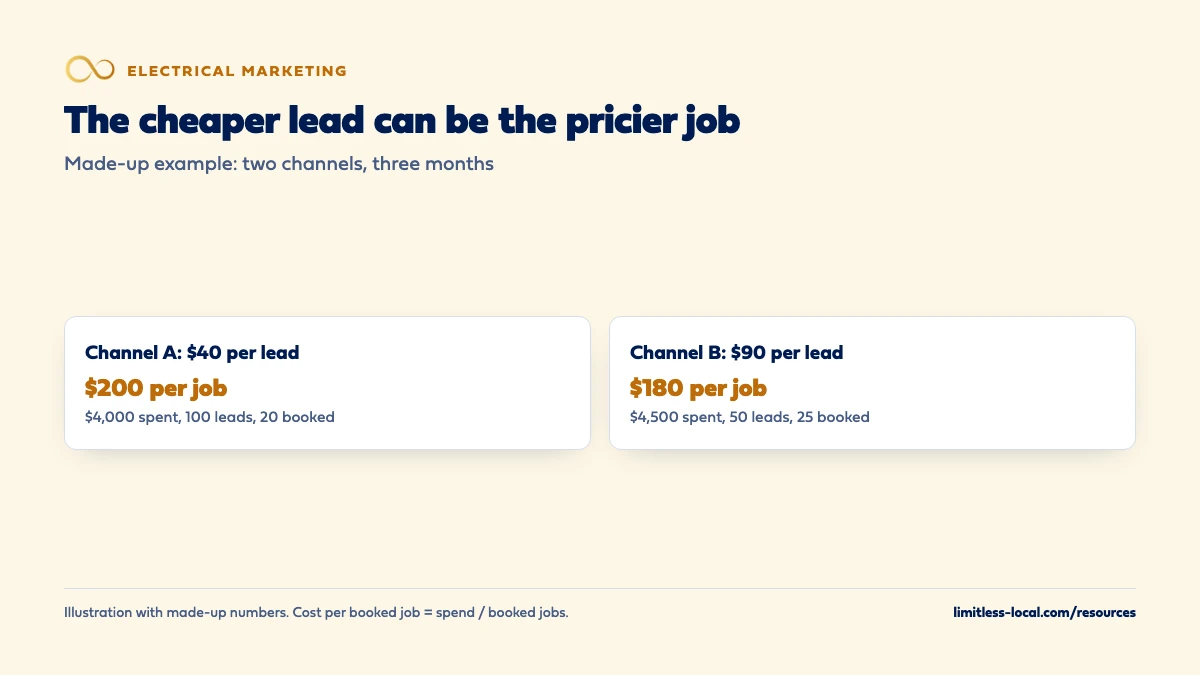
- Channel A: $4,000 spent, 100 leads, 20 booked jobs. That’s $40 per lead and $200 per booked job.
- Channel B: $4,500 spent, 50 leads, 25 booked jobs. That’s $90 per lead and $180 per booked job.
Channel A wins on cost per lead by more than half. Channel B wins on cost per booked job, and it books five more jobs from fewer calls your office had to handle. If Channel B’s jobs are also bigger, the gap widens further.
Frequently asked questions
Is a cost per lead under $60 good for an electrician?
It depends on how many of those leads book and what the jobs are worth. A $60 lead that books one time in ten costs you $600 per job, which may or may not fit your margins.
Are Local Services Ads cheaper per lead than Google Ads?
Sometimes, because you pay only for valid leads rather than clicks. But lead prices vary by market and job type, so run both on similar work for a few months and compare cost per booked job.
Does Facebook give electricians cheap leads?
Facebook leads can look cheap, but people weren’t searching for an electrician when they saw the ad, so they tend to book less often. Judge them on cost per booked job like any other channel.
Should I count referral leads in my cost per lead?
Track them separately. Mixing near-free referrals into your paid numbers makes your paid channels look cheaper than they are.
Why did my cost per lead go up when I raised my budget?
More budget usually buys the next-best clicks and leads, which cost more or book less often. That’s normal; check whether cost per booked job still fits your ceiling.
Do direct mailers have a low cost per lead?
Usually not per lead, because you pay for every home whether they call or not. They can still work for planned jobs in neighborhoods with older homes, so measure them with a dedicated phone number.
Key takeaways
- Referrals, past customers and your Google profile usually have the lowest cost per lead once they’re built.
- Paid lead costs move with your market, job type and competition; national averages rarely fit your shop.
- Local Services Ads charge per valid lead, Google Ads per click, and Thumbtack prices leads by job value.
- Compare channels on cost per booked job; a cheap lead that rarely books is the expensive one.
- Lower cost per lead by answering every call, blocking junk searches and fixing the landing page.
Want a second set of eyes on your setup?
We'll look at how you show up locally and where calls are leaking, then send you a plain-English breakdown.
More in this section
- Which channel brings electricians the highest-quality leads?
- Which marketing channel brings an electrician leads fastest?
- Which channels work best for residential vs commercial electricians?
- Should electricians pay for leads from Angi or Thumbtack?
- How many leads per month before an electrician hires an agency?
Sources
- How leads work — Local Services Help
- Actual cost-per-click (CPC): Definition — Google Ads Help
- Use Keyword Planner — Google Ads Help
- How much do I pay for leads and opportunities? — Thumbtack Help
- Lead Source Report — Jobber Help Center
- About negative keywords — Google Ads Help