
What is marketing attribution for an electrical business?

- What does attribution mean for my electrical business, and how do I see which ads book jobs?
- What does attribution mean for an electrical contractor?
- Why should an electrician care about attribution?
- What's the difference between first touch and last touch?
- What is data-driven attribution, and does it help a small shop?
- How do I see which ads produced booked jobs, not just calls?
- Should I trust it when customers say "I found you on Google"?
- Why do searches for my business name get so much credit?
- How long after a click should a job still count?
- Can Google Ads learn which leads turned into jobs?
- How do I read attribution numbers without fooling myself?
- What's different about attribution for electricians
- A worked example: how brand searches change the picture
- Frequently asked questions
- Key takeaways
- More in this section
- Sources
The short version
- Attribution decides which marketing gets credit for each booked job.
- First touch credits what introduced the customer; last touch credits what they used to call.
- Google Ads now offers only last click and data-driven models.
- The lead source in your field software is what turns tracking into cost per booked job.
For electrical contractors who want to know which ads, listings and referrals actually produce booked jobs: what attribution means, first touch versus last touch, and how to read the numbers.
Get a free visibility audit · Book a growth call
What does attribution mean for my electrical business, and how do I see which ads book jobs?
Marketing attribution is how an electrical business decides which ad, listing, referral or other marketing gets credit for each booked job. In practice, every call and web request carries a source tag, the source follows the lead into your field software, and you divide what each channel cost by the jobs it booked. When a homeowner touches several things before calling, an attribution model decides how credit is shared; Google Ads now offers last click or data-driven. Judge channels by cost per booked job, not by calls or clicks.
Attribution is built into how we report: every package includes call tracking with recording, form tracking, source tagging and a monthly cost-per-lead breakdown, with basic attribution in Essentials, advanced attribution in Growth and custom attribution and dashboards in Scale. Our packages page lists what each level covers, our electrical contractor marketing page explains how we work with electrical shops, and the rest of the electrical marketing questions library goes question by question.
What does attribution mean for an electrical contractor?
Google’s Analytics help on attribution settings defines attribution as assigning credit for important actions to the ads, clicks and other touchpoints along the way. For an electrical shop, the important action is a booked job, and the touchpoints are everything a homeowner saw or clicked before calling: a Google ad, your map listing, your website, a Local Services Ad, a yard sign, your truck, a neighbor’s recommendation.
Attribution is the answer to one question: which of those should get credit for this job? Once every job has an answer, you can add up what each channel cost and what it booked, and decide where the next dollar goes.
Why should an electrician care about attribution?
Because without it, every marketing decision is a guess. The phone rings, the schedule fills or it doesn’t, and nobody can say whether the Google Ads, the SEO or the new truck wrap made the difference. Owners in that spot tend to do one of two things: keep paying for everything because they’re afraid to cut the wrong thing, or cut the channel that was quietly carrying the business.
With attribution, the monthly question changes from “is marketing working?” to “what did a booked job cost from each source, and what kind of jobs were they?” That’s a question you can act on. What a good cost per booked job looks like for electrical marketing covers what to compare the answer against.
What's the difference between first touch and last touch?
They’re two ways of handing out credit when a homeowner touches more than one thing before calling.
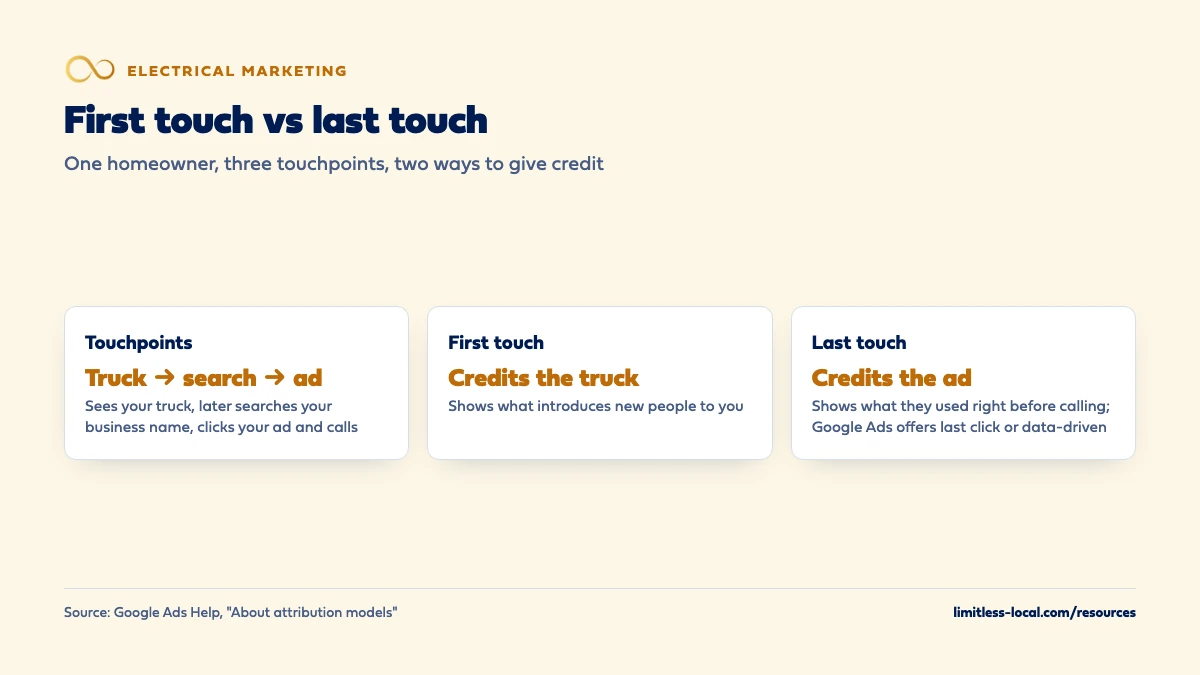
- First touch credits whatever introduced them to you. If they first noticed your truck, the truck gets the job.
- Last touch credits whatever they used right before contacting you. If they later Googled your business name and clicked your ad, the ad gets the job.
Neither is wrong; they answer different questions. First touch tells you what’s bringing new people in. Last touch tells you what’s closing the gap to a call.
Inside Google’s own tools the choice has narrowed. Per Google Ads’ page about attribution models, the first click, linear, time decay and position-based models are no longer supported. You can use last click, which gives all the credit to the last-clicked ad and keyword, or data-driven, which is now the default for most conversion actions. If you want a first-touch view, you’ll build it yourself, usually by asking customers how they first heard of you and recording it alongside the tracked source.
What is data-driven attribution, and does it help a small shop?
Data-driven attribution spreads credit across the ad clicks on a customer’s path, based on your own account’s history of which paths lead to conversions and which don’t. On Google’s data-driven attribution page, it looks at Search, YouTube, Display and Demand Gen ad interactions.
The catch for most electrical shops is volume. Any conversion action can use it, but Google recommends at least 200 conversions and 2,000 ad interactions within a thirty-day period for it to work well, and notes that, depending on how much data you have, last click and data-driven can give the same results. A one- or two-truck shop rarely gets near that, so don’t expect it to reveal much at small volume.
It also only sees Google ads. It can’t credit your truck, your referrals or your Google profile. For those, the source has to be captured on the call and in your field software.
Curious what your marketing is actually booking?
Get a free visibility audit — no obligation, no sales pitch.
How do I see which ads produced booked jobs, not just calls?
- Give every source its own way to be counted. Source tracking gives each campaign its own tracking number that forwards to your main line, so each call arrives labeled. Tracked web forms do the same for online requests.
- Carry the source into your field software. Every lead in ServiceTitan, Housecall Pro or Jobber should have a lead source filled in, every time.
- Mark what happened. Booked, quoted, sold or lost, plus the job type and invoice amount.
- Add it up monthly. Spend per source divided by booked jobs per source gives cost per booked job.
The step that usually breaks is the second one: a busy office skipping the lead source field. Make it required if your software allows. How to track which electrical marketing brings in real jobs goes through the setup step by step, and whether you need call tracking numbers covers the phone side.
Should I trust it when customers say "I found you on Google"?
Use it, but don’t rely on it alone. “Google” could mean a Local Services Ad, a search ad, your map listing or your website, and those are paid for very differently. Customers also remember the last thing they did, not the first.
Ask a sharper question: “Did you find us from an ad, the map, a friend, or did you see one of our trucks?” Then put the tracked source and the customer’s answer side by side. When they disagree, you’ve usually found a touchpoint your tracking can’t see, like a referral who later searched your name. That’s your first-touch view, collected for free.
Why do searches for my business name get so much credit?
Because they’re the last step for people who already decided on you. A homeowner who heard about you from a neighbor, or passed your truck, often just searches your business name. If you run ads on your own name, last-click attribution gives that ad the job, even though the neighbor did the work.
The fix is to keep searches for your name in a separate campaign from searches like “electrician near me” or “panel upgrade”. Judge them separately. Brand-name clicks are cheap and book well, which is fine, but they don’t tell you whether your ads are finding new customers. The worked example below shows how much this can change the picture.
How long after a click should a job still count?
In Google Ads, the conversion window is the stretch of time after an ad click during which a conversion still gets recorded, and it defaults to 30 days for clicks. Anything after the window doesn’t show in your reports.
For a same-day service call that’s plenty. For a whole-home generator, a service upgrade or a rewire, the homeowner may get quotes and think it over for weeks. If you import sold jobs back into Google Ads, set the window long enough to cover your normal quote-to-sale time, or the ads behind your biggest jobs will look like they did nothing.
Can Google Ads learn which leads turned into jobs?
Yes. An ad often starts a sale that finishes offline, over the phone or at the customer’s house. Offline conversion imports let you send those outcomes back so Google Ads can measure what happened after the click or call, and Google now recommends enhanced conversions for leads as the easier starting point. Once sold jobs flow back, your reports, and any automated bidding, can be judged on jobs instead of form fills.
It’s worth doing once your lead sources are clean. Doing it before then just feeds bad data in faster. What an electrician should set up for conversion tracking first covers the order.
How do I read attribution numbers without fooling myself?
- Look at three months, not one. A single big job or a slow week can swing a month badly.
- Split by job type. A source that books ten small repairs and one that books two panel upgrades aren’t comparable on job count alone.
- Don’t cut what starts the journey. Trucks, yard signs and referrals rarely get last-touch credit, yet they’re often why someone searched your name.
- Watch for gaps. If a third of jobs have no source, the numbers you do have are describing the wrong business.
- Change one thing at a time. Cut a campaign and raise another in the same week, and you won’t know which change did what.
If keeping all of this running is the part that keeps slipping, what a marketing agency does for an electrician that’s hard to do alone covers where outside help fits.
Want to see where your company stands?
A free visibility audit shows where you show up on Google, Maps and AI answers, and what it's costing you in calls.
What's different about attribution for electricians
Two very different sales cycles. A dead circuit books the same day; a generator or EV charger install might take weeks of quotes. Track them as separate job types, or the fast jobs will make the slow channels look useless.
Trucks and yard signs do real work. Electrical jobs happen in driveways and garages where the neighbors can see your truck. A tracking number on the truck or the signs helps, but many of those people will search your name instead, so the customer’s own answer matters here.
Builder and commercial work won’t show up in call tracking. General contractor referrals and commercial bids come through relationships and email. Tag them by hand in your field software so they don’t vanish from the picture.
Small jobs lead to big ones. A service call can turn into a panel replacement months later. When you can, credit the follow-up job to the source of the first call.
A worked example: how brand searches change the picture
These numbers are made up to show the math, not a benchmark. Say your Google Ads cost $1,800 last month and, on last-click attribution, got credit for 9 booked jobs. That looks like $200 per booked job.
Now split searches for your business name from everything else. Brand searches cost $300 and booked 3 jobs, or $100 per job. The rest of the campaign cost $1,500 and booked 6 jobs, or $250 per job. Those 3 brand jobs came from people who already knew your name, likely from a referral or a truck. The $250 is the real cost of the ads finding new customers, and it’s the number to compare with your other channels.
Neither number is bad on its own. The point is that one blended figure hid both, and you’d have made different budget calls with each.
Frequently asked questions
Is attribution the same as call tracking?
No. Call tracking records where a call came from. Attribution is deciding which marketing gets credit for the job, and it needs call tracking, form tracking and your field software working together.
Do I need Google Analytics for attribution?
It helps for website visits and forms, but it can’t see phone calls from your truck or referrals on its own. For most electrical shops, tracking numbers plus the lead source in field software do the heavy lifting.
Can attribution show me which Local Services Ads leads booked?
Yes, if you record it. The ads show each charged lead, but only your office knows which became a job, so mark them in your field software.
Should I switch my Google Ads to data-driven attribution?
It’s already the default for most conversion actions. Depending on how much data you have, it can give the same results as last click, so don’t expect it to change much at small volume.
What if a customer calls my regular number instead of a tracking number?
That call arrives with no source. Ask how they found you and record the answer, and look for old places your regular number is still printed.
Key takeaways
- Attribution decides which marketing gets credit for each booked job.
- First touch shows what brings new people in; last touch shows what gets them to call.
- Google Ads now offers last click or data-driven; build a first-touch view by asking customers.
- Split brand-name searches from the rest, or your ads will look better than they are.
- Set conversion windows to match how long your bigger jobs take to sell.
- The lead source in your field software is the step that makes it all work.
Not sure what's working right now?
Start with a free visibility audit: rankings, Google profile, reviews and tracking, checked against your service area.
More in this section
- Will a marketing agency understand the electrical trade?
- How do I grow a small electrical business with marketing?
- What does a marketing agency do for an electrician I can't?
- Which electrical marketing tasks should an owner outsource or keep?
- How do I track which electrical marketing brings in real jobs?
Sources
- Select attribution settings — Google Analytics Help
- About attribution models — Google Ads Help
- About data-driven attribution — Google Ads Help
- About conversion windows — Google Ads Help
- Source tracking basics — CallRail Help Center
- About offline conversion imports — Google Ads Help