
Which electrical marketing tasks should an owner outsource or keep?

- Which electrical marketing tasks should I keep in-house, automate or hand to someone else?
- How do I decide which marketing tasks to keep or hand off?
- Which tasks should the owner always keep?
- Should I keep answering the phone in-house?
- Who should ask for reviews, and who should reply?
- Should I hand off Google Ads and Local Services Ads?
- What about the Google Business Profile?
- Should I write my own website content and SEO?
- Which tasks are better automated than outsourced?
- Who should own tracking and the monthly numbers?
- How do I hand a task off without it falling through the cracks?
- How does the split change as the shop grows?
- What's different about this split for electricians
- A worked example: pricing your own marketing hours
- Frequently asked questions
- Key takeaways
- More in this section
- Sources
The short version
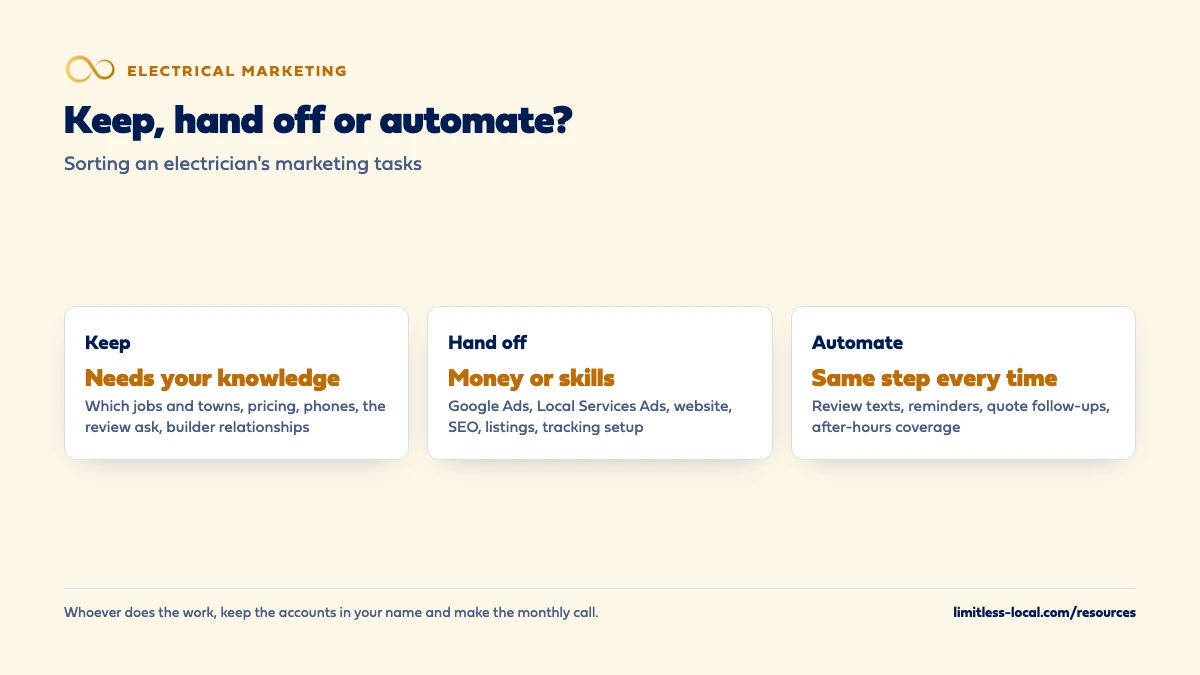
- Keep: which jobs you want, pricing, the phones, the review ask, builder relationships.
- Hand off: Google Ads, Local Services Ads, website, SEO, listings, tracking setup.
- Automate: review request texts, reminders, quote follow-ups, after-hours coverage.
- Always keep: account ownership and the monthly decision on what's working.
For electrical contractors sorting their marketing to-do list task by task: what only the owner should do, what to hand off, and what to put on autopilot.
Get a free visibility audit · Book a growth call
Which electrical marketing tasks should I keep in-house, automate or hand to someone else?
Keep the tasks that depend on knowing your business: deciding which jobs and towns you want, pricing and offers, answering the phone, asking customers for reviews and builder relationships. Hand off the ones where money moves daily or the skills are specialized, such as Google Ads, Local Services Ads, website and SEO work, listings and tracking setup. Automate the steps that happen the same way after every job, like review request texts, appointment reminders and quote follow-ups. Whoever does the work, you keep the accounts and make the monthly call on what’s booking jobs.
That’s the split we’re built around: you keep the phones, the review ask and the say on which jobs you want, and we run the ads, SEO, listings and tracking, with a monthly report on what each booked job cost. Automation add-ons such as after-hours answering, calendar reminders, unified messaging and AI website chat plug into any package and are priced on the discovery call; our automation page explains each one. Our electrical contractor marketing page shows how it fits an electrical shop, and the rest of the electrical marketing questions library goes question by question.
How do I decide which marketing tasks to keep or hand off?
Run every task on your list through three questions:
- Does it need something only you or your crew know? Your customers, your prices, which jobs make money, how a job actually went. If yes, keep it.
- Does money move every day, or does it need specialized skills and tools? Ad accounts, website code, tracking setup. If yes, hand it off.
- Is it the same step every time something happens? A job closes, a quote goes out, a call comes in after hours. If yes, automate it.
Plenty of tasks land in a fourth bucket: shared. Someone else does the work, and you supply the knowledge or make the decision. Most of what follows sorts the usual electrical marketing tasks into those buckets. For the bigger question of whether to hire help at all, whether to hire an agency or do it yourself covers the overall decision.
Which tasks should the owner always keep?
The decisions. Nobody else can make them well, and they take minutes, not hours:
- What you want more of. Panel upgrades or service calls, residential or commercial, which towns. Every campaign starts from this.
- Pricing and offers. Whether you’ll run a generator inspection special, show prices on the website, or charge for estimates.
- Anything that makes a claim about your business. Your license, permits, warranties and any promises about your workmanship. Read and approve it before it goes live.
- Builder, GC and property manager relationships. Commercial work comes from people who know you, not from ads.
- The monthly decision. Someone can prepare the numbers, but you decide what gets more money and what gets cut.
Should I keep answering the phone in-house?
Yes, during business hours. The person answering is part of your sales team: they triage a burning smell from a flickering light, book the right tech, and set the homeowner’s first impression. That’s hard to hand to someone who doesn’t know your schedule and prices.
It’s also where paid marketing wins or loses. On Local Services Ads, Google’s page on ad rankings lists responsiveness as a factor and says missed calls may negatively affect it. So every call that rings out while everyone’s in an attic costs twice: the job and your ranking.
After hours is different. That’s where an answering service or automated coverage earns its keep, as long as emergencies reach someone who can decide. How to stop missing calls walks through the options.
Who should ask for reviews, and who should reply?
Split it three ways:
- The ask: keep it with your techs. A quick word at the end of every job, from the person who did it, is the strongest ask there is. Don’t give techs a review quota, though. Google’s Maps content policy lists asking staff to collect a certain number of reviews among the things businesses shouldn’t do, along with offering incentives or asking only happy customers.
- The link: automate it. A review request text that goes out when the invoice is paid never forgets on a busy day. Automating review requests after each job covers the setup in Jobber and Housecall Pro.
- The replies: shared. Someone else can thank happy customers using a few guidelines you set. Negative reviews come to you or your office manager, because the reply needs the facts of the job.
Should I hand off Google Ads and Local Services Ads?
For most electricians, yes. This is the clearest outsourcing case: money moves every day, the settings are technical, and a few weeks of neglect can waste real spend on searches like "how to wire a three-way switch". Local Services Ads are also mid-move into Google Ads as Performance Max campaigns with pay-per-lead goals, with electrical in the first phase from August 2026 for select advertisers, so the setup keeps changing.
What you keep, even when someone else runs the account:
- Admin access to your own account. Google’s page on access levels sets out different levels of access for different users. Give your helper their own login and keep yourself as an admin.
- Job types and service areas. You decide what work and which towns; they set it up.
- Lead quality feedback. Your office knows which leads were junk. Pass that back weekly so the person running ads can act on it.
Curious what your marketing is actually booking?
Get a free visibility audit — no obligation, no sales pitch.
What about the Google Business Profile?
Shared. Your crew has the raw material: job photos, the questions customers ask, what’s new. Someone else can turn that into posts, keep hours and services current, and answer questions.
Set it up so you stay in control. Google’s help page on Business Profile owners and managers explains that a profile can have multiple owners but only one primary owner, and that managers can do almost everything owners can, such as editing info, replying to reviews and managing posts, except add or remove users or remove the profile. Stay the primary owner and add your helper as a manager.
The one task to keep close: photos. Ask techs to take a couple of clean shots of finished work before they leave. Nobody outside your company can do that part.
Should I write my own website content and SEO?
Split the knowledge from the work. Google’s page on whether you need an SEO says a small local business can probably do much of the work itself, and that a professional can help and save time, while a careless one can damage your site and reputation.
In practice, what makes an electrician’s service pages good is knowledge only you have: what a panel upgrade involves in your area, how long an EV charger install takes, what you check before quoting a generator. Keep supplying that, even if it’s just a short phone interview per service. Hand off the structure, writing, site speed, technical fixes and listings across directories, which take steady hours and specialized tools. Which service pages an electrical website needs shows where that knowledge goes.
Which tasks are better automated than outsourced?
Anything triggered by the same event every time. These don’t need a person, they need a rule:
- Review request texts when an invoice is paid.
- Appointment reminders the day before a visit.
- Quote follow-ups a few days after an estimate goes out with no answer.
- After-hours coverage, so a night call reaches an answering service or automated reply instead of voicemail.
- Lead routing, so calls, forms and messages land in one place with their source.
Many of these already live in ServiceTitan, Housecall Pro or Jobber, so check what you’re paying for before buying anything new. Automating them doesn’t remove you from the loop; it just stops the busy weeks from breaking the habit.

Who should own tracking and the monthly numbers?
Split it by step:
- Setup: hand it off. Call tracking numbers, form tracking and getting sold jobs back into Google Ads are one-time technical jobs. What to set up first for conversion tracking lays out the order.
- Lead source entry: keep it. Whoever books the job picks the source in your field software. Thirty seconds per job, and only your office can do it.
- The monthly review: shared. Someone prepares cost per booked job by channel; you make one decision from it.
If you pay someone for marketing, they should bring you that number every month. If they can’t, that’s a sign worth paying attention to.
How do I hand a task off without it falling through the cracks?
- Write the list. Every marketing task, who owns it, and how often it happens.
- One owner per task. "The office and the agency" means nobody.
- Give access, not passwords. Separate logins for Google Ads, your Business Profile and your website, with you as admin or primary owner.
- Agree on what you approve. New ads, new pages and anything stating a license, warranty or price.
- Check monthly. Run down the list and confirm each task actually happened.
If the work is spread across several vendors, someone has to own the whole picture. Choosing a full-service agency or one specialist covers how that changes the split.
How does the split change as the shop grows?
One or two trucks. You keep most of it. Automate review requests and reminders first, since they cost nothing in hours once set up. If you run ads, that’s the first thing worth handing off.
A few trucks and an office person. The office takes the phones, lead source entry, review replies and gathering photos. Ads, website and SEO go to outside help. You keep the decisions.
Ten or more trucks, or several locations. An in-house marketing coordinator can own the day-to-day and manage outside specialists, while you keep the strategy and the budget. That’s when a marketing hire tends to make sense, because there’s a full week of work every week.
Not sure which of these is costing you jobs?
A free visibility audit checks the Google profile, reviews, site and tracking, and shows what to fix first.
What's different about this split for electricians
Your techs hold the best marketing material. They’re inside the home, at the panel, with the homeowner watching. The before-and-after photo of a messy panel and the in-person review ask both happen there, so they can’t be outsourced. Make them part of how a job is closed, not an extra chore.
Safety and licensing claims stay with you. Electrical marketing often mentions licenses, permits, inspections and code. Whoever writes the copy, the owner or a licensed lead should approve anything that states what you’re licensed or insured for.
Emergency calls need a person who can decide. A homeowner smelling burning plastic needs different advice from one with a dead outlet. Automate the routing, but make sure the emergencies reach someone who knows the trade.
A worked example: pricing your own marketing hours
These numbers are made up to show the math, not a benchmark for your business. Say your time is worth $120 an hour, and in a normal week you spend 3 hours in Google Ads, an hour on your Google profile, an hour on reviews, an hour on the website and an hour on the numbers. That’s 7 hours a week, or 28 hours over four weeks: $3,360 of your time a month.
Now apply the split. You keep the review ask, the photos and the monthly decision, about 2 hours a week, or 8 hours a month: $960. That frees $2,400 of time.
For comparison, our Essentials package is $3,500 a month, with ad spend paid to Google separately. On time alone, handing off doesn’t pay for itself in this example. It pays when the freed hours go into estimates and billable work, or when a better-run account books more jobs for the same ad spend. Run your own numbers before deciding, and judge any help on cost per booked job.
Frequently asked questions
Can my office manager handle the marketing?
Much of the day-to-day, yes: phones, lead sources, review replies and gathering photos. Ad accounts and website work usually need more specialized time than an office manager can give between calls.
Should my techs post on social media for the company?
Let them take the photos and leave the posting to one person, so the pages stay consistent and customer addresses and faces stay out unless the customer agrees.
Is it risky to hand off my Google Business Profile?
Not if you set it up right. Stay the primary owner and add your helper as a manager, so they can post and reply but can’t remove you or the profile.
Can I outsource just one task, like Google Ads?
Yes, as long as someone still owns tracking and the overall picture. Ads sent to a slow website, or with nobody checking which leads booked, can look busy without filling the schedule.
What should I never hand off?
Account ownership, the decision on which jobs you want, and approval of anything that states your license, warranties or prices.
Key takeaways
- Keep what needs your knowledge: which jobs you want, pricing, the phones, the review ask and builder relationships.
- Hand off what moves money daily or needs specialized skills: ads, website, SEO, listings and tracking setup.
- Automate what happens the same way every time: review texts, reminders, quote follow-ups and after-hours coverage.
- Keep admin access and primary ownership of every account, and give helpers their own logins.
- Write one owner next to every task, and check monthly that each one happened.
Want a second set of eyes on your setup?
We'll look at how you show up locally and where calls are leaking, then send you a plain-English breakdown.
More in this section
- Should I hire an agency or DIY my electrical marketing?
- Can an electrical owner do DIY marketing first, then hire an agency?
- How should an electrician change marketing to grow vs stay busy?
- What tools and software does an electrician need to DIY marketing?
- What marketing should an electrician never hand to an agency?
Sources
- About ad rankings — Google Local Services Help
- Prohibited & restricted content — Maps User Generated Content Policy Help
- About access levels in your Google Ads account — Google Ads Help
- Manage your Business Profile owners & managers — Google Business Profile Help
- Do You Need an SEO? Tips for Hiring an SEO — Google Search Central
- Local Services Ads transition to Performance Max campaigns with pay-per-lead goals — Google Ads Help