
What are the risks of hiring the wrong HVAC marketing agency?

- What can go wrong when an HVAC company hires the wrong marketing agency?
- What does the wrong agency actually cost an HVAC company?
- Risk 1: Paying for activity instead of booked jobs
- Risk 2: Ad money spent on the wrong searches and towns
- Risk 3: Losing control of your accounts
- Risk 4: Penalties from SEO shortcuts
- Risk 5: Fake or bought reviews
- Risk 6: Damage to how your company looks and sounds
- Risk 7: Getting locked in
- Risk 8: The time you can't get back
- Which warning signs show up before you sign?
- What if I've already hired the wrong agency?
- What's different about these risks for HVAC companies
- A worked example: what six months with the wrong agency can cost
- Frequently asked questions
- Key takeaways
- More in this section
- Sources
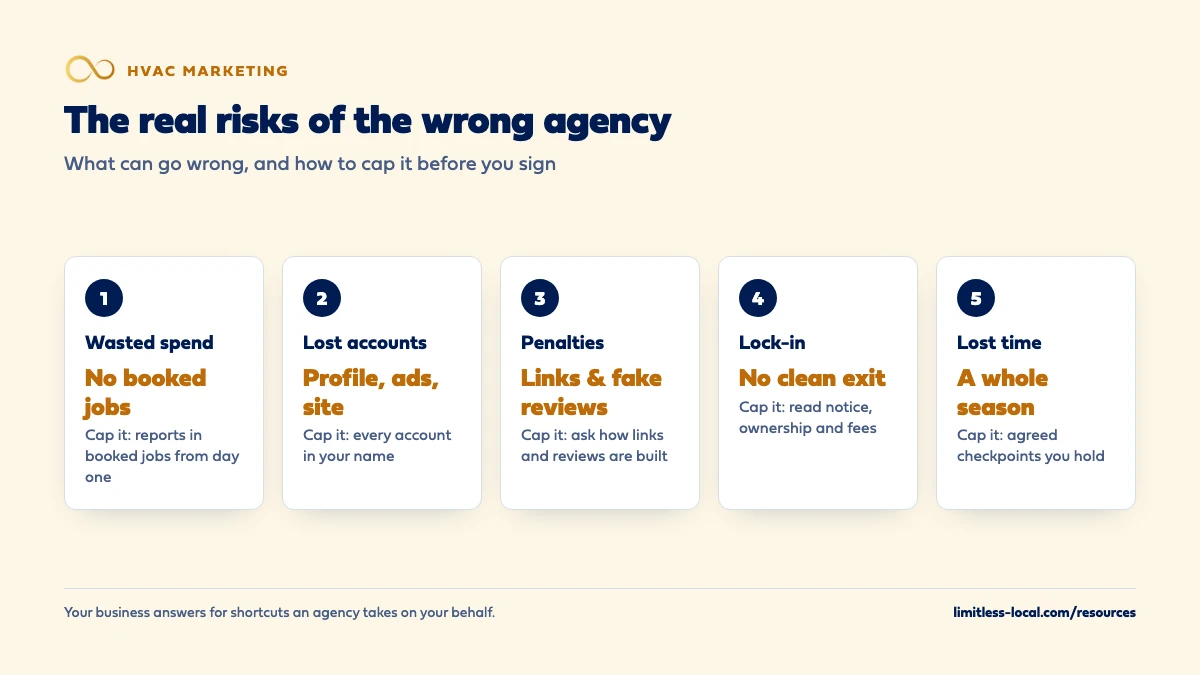
The short version
- Wasted spend: fees and ad money that never become booked jobs.
- Lost accounts: your Google profile, ad account, site or numbers held by the agency.
- Penalties and reputation damage from shortcuts you're responsible for.
- Lock-in and lost time, often a full peak season.
For HVAC owners about to sign with an agency, or wondering whether the one they have is costing more than it shows.
Get a free visibility audit · Book a growth call
What can go wrong when an HVAC company hires the wrong marketing agency?
The biggest risks are paying for marketing that never turns into booked jobs, losing control of your Google Business Profile, ad account, website or tracking numbers, and damage to your rankings or reputation from shortcuts like bought links or fake reviews, which your business answers for, not the agency. Close behind are a contract that keeps you paying after you know it isn’t working, and the months you lose, sometimes a whole peak season, before you find out. You can cap most of these before you sign by owning every account, requiring reports in booked jobs, and reading the exit terms.
We’d rather you avoid these risks with any agency, including us. Every account we work in belongs to you, every package includes call tracking and a monthly report with a cost-per-lead breakdown, and we don’t guarantee rankings, lead counts or revenue, because nobody honestly can. What we promise is transparency: you’ll know what we’re doing, why, and what it produced, and if something isn’t working, we’ll tell you and fix it. Our packages list exactly what’s included, and our HVAC marketing page shows how it fits an HVAC company. How to choose an HVAC marketing agency covers the shortlist, the HVAC marketing guide covers every channel, and the HVAC marketing questions library goes question by question.
What does the wrong agency actually cost an HVAC company?
The monthly fee is the part you see. It’s rarely the biggest part. A bad fit usually costs you in four ways at once:
- Money: the agency fee plus the ad spend it manages, for work that doesn’t book jobs.
- Control: accounts, data and phone numbers that end up in someone else’s hands.
- Reputation: rankings, reviews or a Google profile damaged by shortcuts.
- Time: the months before you realize it isn’t working, plus the months it takes to recover.
None of these means agencies are a bad idea. They’re reasons to set things up so a bad fit is cheap to undo.
Risk 1: Paying for activity instead of booked jobs
This is the most common one. The monthly report shows clicks, impressions, rankings and “leads”, and every number goes up, while your office isn’t booking noticeably more work. Because the report never mentions booked jobs, it can go on for a year.
It’s rarely fraud. More often the agency is measuring what’s easy to measure, and nobody connected the marketing to your field software. The result is the same: you can’t tell good spend from wasted spend, so you keep paying for both.
How to cap it: before you sign, ask to see a real monthly report and find where it shows booked jobs and cost per booked job. Make sure calls and forms are tracked by source and the office marks which ones booked. How to know if your HVAC marketing agency is getting results covers what a useful report looks like.
Risk 2: Ad money spent on the wrong searches and towns
An agency that doesn’t know HVAC, or doesn’t watch your account closely, can spend your ad budget on searches you’d never want: “HVAC jobs”, “HVAC school”, “window AC unit”, or towns your trucks don’t reach. Every one of those clicks is paid for.
Local Services Ads carry their own version of this risk. Google no longer gives credits for leads about a job type you don’t do or an area you don’t serve (see automated lead credits), so an agency that leaves commercial job types on for a residential-only shop, or draws the service area too wide, is spending your money on leads you can’t use.
How to cap it: ask how often they review search terms and add negative keywords, and check your Local Services Ads job types and service areas yourself once a quarter. You don’t need to manage the account; you just need to spot-check it.
Risk 3: Losing control of your accounts
This is the risk that hurts most when you leave. Your call history, ad history, reviews and rankings live inside a handful of accounts. If the agency owns them, you can lose years of history on the way out:
- Google Business Profile. Owners have full control, including adding and removing users and deleting the profile. If the agency is the only owner, it controls your Maps presence (see owners and managers).
- Google Ads. If the agency creates your account from its manager account, the agency becomes the owner, and without a login of your own, getting at your history depends on them. If you create the account and link it, the agency isn’t the owner by default, and you can unlink its manager account when you leave (see ownership of client accounts).
- Website and domain. A domain registered in the agency’s name, or a site built on a platform only they can use, can leave you starting over.
- Tracking numbers. Numbers printed on trucks, mailers and directory listings may belong to the agency’s call tracking account.
How to cap it: every account in your company’s name, you as owner or admin, the agency added as a user. How much control over your brand you lose hiring an HVAC agency goes account by account.
Risk 4: Penalties from SEO shortcuts
Some agencies chase quick ranking gains with tactics Google treats as spam. A common one is link spam, which includes buying or selling links for ranking purposes, excessive link swaps, and automated programs that create links to your site. Google’s spam policies say sites that violate them may rank lower or not appear in results at all.
The part owners don’t expect: the penalty lands on your site, not the agency’s. Google’s guidance on hiring an SEO says you are responsible for the actions of any companies you hire, and that deceptive or misleading content created on your behalf could get your site removed from Google’s index entirely.
Your Google Business Profile carries a similar risk. Google may suspend or disable profiles that don’t follow its guidelines, so tricks like stuffing keywords into your business name or listing an address you don’t operate from can take you off Maps while you appeal.
How to cap it: ask exactly how the agency builds links and what it changes on your profile, and expect a plain answer.
Curious what your marketing is actually booking?
Get a free visibility audit — no obligation, no sales pitch.
Risk 5: Fake or bought reviews
Reviews matter so much for HVAC calls that some agencies offer to “boost” them. Don’t let anyone do that for you. The FTC’s final rule on fake reviews, announced in August 2024, prohibits businesses from buying fake reviews or from paying for reviews that express a particular sentiment, and lets the FTC seek civil penalties against knowing violators. The rule also covers reviews from company insiders that don’t disclose the connection.
Google’s Maps content policy also treats reviews influenced by a payment, discount or other benefit as incentivized reviews, which can mislead customers.
How to cap it: the agency can help you ask real customers for reviews, make the ask easy, and reply to reviews. It should never write, buy or trade them, and it should never offer customers anything in exchange for a review. How to get HVAC techs to ask for Google reviews covers the right way to build them.
Risk 6: Damage to how your company looks and sounds
An agency speaks for you every day: ads, Google profile posts, website pages, review replies. The wrong one can put words in your mouth you’d never say:
- Ads promising a price, a same-day arrival or a financing offer you don’t actually offer.
- Pages claiming services, brands or certifications you don’t have.
- Defensive or canned replies to unhappy reviewers.
- Generic stock photos that make a local family company look like a call center.
To homeowners, it’s you, and your tech at the door has to deal with what the ad promised.
How to cap it: agree up front on what needs your sign-off, at least prices, offers, financing language and anything that promises a timeline. Send the agency real photos of your trucks, team and work.
Risk 7: Getting locked in
Lock-in usually isn’t one clause. It’s a combination: a long minimum term, a cancellation fee, a website you rent instead of own, tracking numbers you can’t take with you, and accounts you don’t control. Each one alone is manageable. Together, they keep you paying for months after you’ve decided it isn’t working.
A minimum term isn’t automatically a trap. Some work, like SEO, needs a few months to show anything, and a short commitment protects both sides from judging it too early. The problem is a term with no clean way out, or an exit that costs you the accounts.
How to cap it: before you sign, find the answers to three questions in the contract: how much notice to leave, what happens to the website, domain and numbers when you go, and whether there’s any fee for leaving early. What to look for in an HVAC marketing agency contract goes clause by clause.

Risk 8: The time you can't get back
Money can be earned back. A missed season can’t. If a bad agency runs your account from spring into summer, you might not find out until the peak is over, and the calls that went to competitors that summer are gone.
SEO makes the time risk bigger, because it typically takes 3-6 months to show meaningful organic growth. If the work was never right, you’ve lost half a year before the starting line. Ads have a shorter fuse, since they can generate leads within days of launch, but without booked-job tracking a bad ad account can run for a long time before anyone notices.
How to cap it: agree on checkpoints and what each should show, such as tracking working in the first month, booked-job numbers for paid channels soon after, and visible SEO progress along the way. Then hold the checkpoints, even when the phones are busy.
Which warning signs show up before you sign?
Most bad fits announce themselves on the sales call, if you know what to listen for:
- A promise of a #1 ranking. No one can guarantee a #1 ranking on Google, and claims of a “special relationship” with Google are a red flag.
- Vague answers about the work. They won’t say what they’ll do each month or show you the changes.
- Ads in their account. They plan to run your ads from an account they own.
- A sample report with no booked jobs. Clicks and rankings only.
- Talk of link packages, link networks or submitting your site to thousands of directories.
- No questions about your business. A good agency asks about your services, towns, seasons and phones before it pitches.
How to tell if an SEO offer for your HVAC company is a scam covers the pitch-side warning signs in more depth.
What if I've already hired the wrong agency?
Limit the damage first, then decide what’s next:
- Get owner or admin access to your Google Business Profile, Google Ads, Search Console, Analytics, website and domain. Ask in writing.
- Download your data: ad reports, call recordings and lead lists, so the history leaves with you.
- Check for shortcuts: odd links pointing at your site, changes to your business name on Google, or reviews you didn’t earn.
- Read your exit terms and give notice the way the contract says.
- Plan the next step before the old agency’s access is removed.
How to choose an HVAC agency after a bad agency experience covers the next hire.
Want to see where your company stands?
A free visibility audit shows where you show up on Google, Maps and AI answers, and what it's costing you in calls.
What's different about these risks for HVAC companies
Two seasons are at stake. A bad hire in spring can cost you the summer peak, and one in the fall can cost you the winter. Time a change of agency for the shoulder months if you can.
Emergency calls magnify ad mistakes. No-heat and no-cool searches are urgent and competitive. An account that runs at night with nobody to answer, or bids on the wrong towns in a heat wave, burns money fastest exactly when demand is highest.
Customer lists are valuable. Maintenance plan members and past customers are the cheapest jobs you’ll ever book. If an agency holds your email lists or customer data in its own tools, make sure you can export them.
Numbers are everywhere. HVAC companies print phone numbers on vans, stickers on equipment and door hangers. If those are agency-owned tracking numbers, leaving can break years of printed marketing.
A worked example: what six months with the wrong agency can cost
These numbers are made up to show the math, not a benchmark for your market.
Say an agency charges $1,800 a month and manages $2,200 a month in ad spend, so you’re paying $4,000 a month. After six months, that’s $24,000. When you finally match the agency’s “leads” against your field software, marketing booked 18 jobs in that time. That’s about $1,333 per booked job.
Now say a setup that tracked booked jobs and fixed problems as they appeared could have brought that same spend down to $200 per booked job. The same $24,000 would have booked 120 jobs. The difference, 102 jobs, is the real cost of the wrong fit, and it doesn’t include the cleanup: rebuilding an ad account, reclaiming a Google profile, or replacing tracking numbers on your trucks.
Your numbers will differ. The point is to measure what the agency booked, not what it reported, so the gap shows up in month two instead of month six.
Frequently asked questions
Is a cheap agency riskier than an expensive one?
Not by price alone. A low price can mean less work or shortcuts, and a high price doesn’t promise results. Judge on reporting, ownership, how they build links and reviews, and the exit terms.
Can my old agency delete my Google Business Profile?
An owner can remove a Business Profile, so if the agency is an owner, it has that power. Managers can’t. Keep yourself as an owner, and give the agency a manager role for day-to-day work.
Will a bad agency's link building hurt my site after I leave?
It can. Spammy links don’t disappear when the agency does. Ask your next agency to review the links pointing at your site as part of the handover.
Are agencies that only work with HVAC companies safer?
Not automatically. Knowing the trade helps, but the same risks apply: who owns the accounts, how results are reported and how the work is done. Check those either way.
Is it risky to let an agency reply to my Google reviews?
It’s fine if the replies sound like your company and you’ve agreed on how to handle unhappy customers. Ask to approve replies to negative reviews, at least at first.
How do I know if I'm already locked in?
Check three things: whether you’re an owner or admin on every account, what your contract says about notice and early exit, and who holds the domain and tracking numbers. If any answer is the agency, fix that first.
Key takeaways
- The biggest risk is paying for clicks and rankings that never become booked jobs.
- Keep your Google Business Profile, Google Ads, website, domain and tracking numbers in your company’s name.
- Your business answers for bought links, profile tricks and fake reviews, even when an agency did them.
- Read the notice, ownership and early-exit terms before you sign.
- Agree on checkpoints so a bad fit shows up in weeks, not after a lost peak season.
Not sure what's working right now?
Start with a free visibility audit: rankings, Google profile, reviews and tracking, checked against your service area.
More in this section
- What are the biggest marketing mistakes HVAC companies make?
- What should I look for in an HVAC marketing agency contract?
- How do I know if a marketing agency really understands HVAC?
- How much control over my brand do I lose hiring an HVAC agency?
- How do I switch HVAC marketing agencies without losing anything?
Sources
- Do you need an SEO? — Google Search Central
- Spam Policies for Google Web Search — Google Search Central
- Federal Trade Commission Announces Final Rule Banning Fake Reviews and Testimonials — Federal Trade Commission
- Incentivized or Biased Reviews — Maps User Generated Content Policy Help
- Manage your Business Profile owners & managers — Google Business Profile Help
- Manager Accounts (MCC): About ownership of client accounts — Google Ads Help
- Fix suspended or disabled profiles — Google Business Profile Help
- About Automated Local Services Ads lead credits — Google Local Services Help