
How to choose an HVAC agency after a bad agency experience?

- How do I pick a better HVAC marketing agency after getting burned by the last one?
- What actually went wrong with the last agency?
- Step 1: Get your accounts back before you shop
- Step 2: Decide what "working" means before the sales calls
- Step 3: Ask the questions the last agency couldn't answer
- Step 4: Make sure they know the HVAC trade
- Step 5: Read the contract for the clauses that burned you
- Step 6: Should I start small this time?
- Step 7: Give access in stages
- Step 8: Set checkpoints at 30, 60 and 90 days
- Which red flags should send me walking this time?
- How do I recover from a bad agency on a tight budget?
- What's different about switching agencies at an HVAC company
- A worked example: setting the 90-day scorecard
- Frequently asked questions
- Key takeaways
- More in this section
- Sources
The short version
- Name what went wrong last time; each problem points to a different fix.
- Own your Google profile, ad account, website, domain and tracking first.
- Hire on reporting, who does the work and the contract, not the pitch.
- Start with a clear scope and agreed checkpoints at 30, 60 and 90 days.
For HVAC owners who paid an agency, didn’t get the calls, and want the next hire to go differently without starting from zero.
Get a free visibility audit · Book a growth call
How do I pick a better HVAC marketing agency after getting burned by the last one?
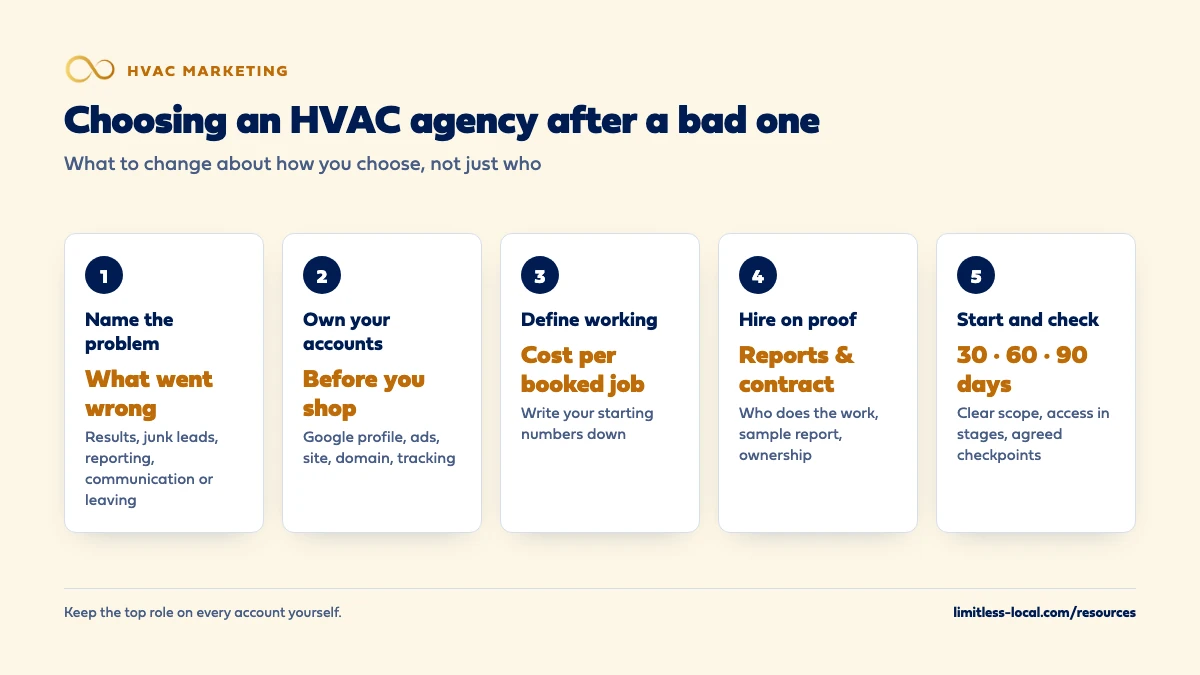
Change how you choose, not just who you choose. Pin down exactly what went wrong last time, get every account back under your own company’s ownership before you talk to anyone new, and judge the next agency on who does the work, how it reports booked jobs and what it will put in writing, not on the pitch. Then start with a clear scope, give access in stages, and agree on the numbers you’ll check together at 30, 60 and 90 days.
If you’re weighing us as the next agency, the setup works the way this page describes. You own the accounts, every package includes call tracking and monthly reports with a cost-per-lead breakdown, and if something isn’t working we’ll tell you and fix it. There are no long-term contracts: the standard ask is three months, written into the contract, but we won’t make you stay. See our packages and our HVAC marketing page for scope and prices. How to choose an HVAC marketing agency covers the shortlist, the HVAC marketing guide covers every channel, and the HVAC marketing questions library goes question by question.
What actually went wrong with the last agency?
Before you look at anyone new, get specific. “They didn’t work” covers very different problems, and each one points to a different thing to check next time:
- The calls never came. Was it the wrong channel, too little budget for your market, or SEO judged after two months?
- Calls came, but they were junk. Wrong services, wrong towns, price shoppers. That’s usually targeting.
- You couldn’t tell what was working. Reports full of clicks and impressions, nothing about booked jobs. That’s tracking and reporting.
- You never knew what they were doing. Slow replies, a different person every month. That’s communication and who does the work.
- Leaving was a mess. They kept the ad account, the site or the phone numbers. That’s ownership and the contract.
Write your list down. It becomes the checklist for the next hire, and it keeps you from judging every agency by the one that burned you.
Step 1: Get your accounts back before you shop
Do this first, while it’s fresh and before any new agency is involved. Every account should belong to your company, with your own login at the top level:
- Google Business Profile. You should be an owner. Owners have full control and can add or remove users, while managers can do most day-to-day work but can’t add or remove users or delete the profile.
- Google Ads. The account should be yours, with you as an admin. If an agency’s manager account was made the owner, the client account still owns its data and can unlink the manager to remove that ownership (see ownership of client accounts).
- Search Console and Google Analytics. You should be an owner, not just a user.
- Website hosting and the domain name. Registered to your business, with login details you hold.
- Call tracking numbers. Know who holds them, especially numbers printed on trucks or mailers.
How to switch HVAC marketing agencies without losing anything walks through each account in order.
Step 2: Decide what "working" means before the sales calls
Last time, the agency probably defined success for you. This time, write it down yourself before the first call:
- The jobs you want more of. Repairs, replacements, maintenance plans, commercial work.
- The towns you want them in. Where your trucks can get to profitably.
- Your starting numbers. Booked jobs from marketing last month, and what each one cost, as best you can tell.
- The number you’ll judge on. Cost per booked job, not leads, clicks or rankings.
If you don’t have reliable starting numbers because the last agency didn’t track them, say so. A good agency will make fixing that the first piece of work, because nobody can show improvement without a starting point. The difference between a click, a lead and a booked HVAC job helps you set definitions you and the next agency will both use.
Step 3: Ask the questions the last agency couldn't answer
You don’t need a new list of fifty questions. You need sharper versions of the ones that would have caught the last problem. Google’s own tips for hiring an SEO are a good base: ask for examples of past work, what results to expect and in what timeframe, how success is measured, and whether they’ll share every change they make and the reasoning behind it. Then add questions aimed at your list:
- “Show me a real monthly report. Where does it show booked jobs?”
- “Who will actually do the work on my account, and who do I call when something’s wrong?”
- “What happens in month three if the numbers aren’t moving?”
- “Which accounts will you create, and whose name will they be in?”
Then check references: ask past clients whether the work was useful, the agency was easy to work with, and the results were positive. What to ask before hiring an HVAC SEO agency has the full question list.
Step 4: Make sure they know the HVAC trade
A lot of bad agency experiences come from a generic contractor playbook dropped on an HVAC company. Listen for whether they bring up, without prompting:
- Summer and winter peaks and what happens to the budget in between.
- The difference between a repair call and a replacement estimate.
- Maintenance agreements and how they smooth the slow months.
- After-hours no-heat and no-cool calls, and who answers them.
If they can’t talk about those without you leading them, they’ll learn the trade on your money. How to know if a marketing agency really understands HVAC has more checks.
Curious what your marketing is actually booking?
Get a free visibility audit — no obligation, no sales pitch.
Step 5: Read the contract for the clauses that burned you
Go back to your list from the first section and find the matching clause in the new contract:
- Ownership. Does it say your company owns the ad account, the website, the domain, the content and the tracking numbers?
- Term and cancellation. How long is the commitment, how much notice do you give, and what happens to your accounts when you leave?
- Fee and ad spend. Is the management fee separate from ad spend, and is ad spend paid straight to Google so you can see every dollar?
- Reporting. What will the monthly report show, and how often will you talk?
A short commitment isn’t automatically safer, and a longer one isn’t automatically a trap. What matters is that you can see the work, own the accounts and leave cleanly. What to look for in an HVAC marketing agency contract goes clause by clause.
Step 6: Should I start small this time?
Start with a clear scope, yes. Start with the cheapest option on the market, no. A bargain package is often how owners end up in a bad agency experience in the first place.
Starting small works when the first piece of work is something you can judge quickly:
- Tracking and a clean Google Business Profile. Done in weeks, and every later result depends on it.
- One paid channel. Ads can generate leads within days of launch, so you’ll see booked jobs or their absence early.
SEO is a poor thing to judge in a short trial, because it typically takes 3-6 months to show meaningful organic growth. If SEO is part of the plan, agree on what progress should look like along the way: pages built, profile cleaned up, reviews coming in, more searches showing your business. Judge calls from it later.
Step 7: Give access in stages
Trust gets earned in steps, and your access settings can follow the same steps:
- During the sales process or an audit, give read access only, not write access. In Search Console, a restricted user has simple view rights on most data.
- Once you’ve signed, add the agency to the accounts you own. In Google Ads, standard access lets someone edit campaigns, while only admins can add or remove users and unlink manager accounts. On your Google Business Profile, a manager role covers day-to-day work.
- Keep the top role yourself. You stay an owner or admin on every account, and the agency never becomes the only admin.
This isn’t about distrusting the new agency. It’s about making sure that if this one doesn’t work out either, leaving takes an afternoon, not months.

Step 8: Set checkpoints at 30, 60 and 90 days
Agree on these in writing before work starts, so neither side is guessing:
- 30 days: setup finished. Tracking works, accounts are in your name, the plan is written down, and paid campaigns are live if they’re in scope.
- 60 days: first real numbers. Calls and forms by source, booked jobs marked in your field software, and cost per booked job for any paid channel.
- 90 days: a decision point. Paid channels should show a cost per booked job you can compare with your starting numbers. SEO should show the progress you agreed on in step six.
At each checkpoint, ask the agency what it would change. A good one comes with its own list. How to know if your HVAC marketing agency is getting results covers what to look for in the reports.
Which red flags should send me walking this time?
- Ranking promises. No one can guarantee a #1 ranking on Google. Walk away from anyone who claims a “special relationship” with Google or offers a “priority submit”.
- Secrecy. They won’t explain what they’ll do or show you the changes. You’re responsible for the actions of any company you hire, so you need to know what they’re doing.
- Your ads in their account. They want to run your ads from an account they own instead of yours.
- Link schemes. They talk about link networks or submitting your site to thousands of search engines.
- A cold email that opened the conversation. Treat unsolicited SEO pitches with heavy skepticism.
- Reports with no booked jobs. They can’t show you a sample report that ties marketing to jobs.
One red flag doesn’t always mean a bad agency. Two or three, and you’ve seen this movie before.
How do I recover from a bad agency on a tight budget?
If the last agency used up most of your marketing budget, fix the cheap things yourself first, then hire for one specific job:
- Get the accounts back (step one). This costs nothing but time.
- Clean up your Google Business Profile. Correct services, service areas, hours and photos. A small local business can do much of this work itself.
- Restart review requests after every job.
- Set up basic tracking, so the next dollar you spend can be judged.
- Then hire for the one channel most likely to book jobs soon, usually paid search or Local Services Ads, and add more once it pays for itself.
A tight budget is a reason to narrow the scope, not to pick the cheapest agency. Paying less for work that doesn’t book jobs is how you end up back here.
Not sure which of these is costing you jobs?
A free visibility audit checks the Google profile, reviews, site and tracking, and shows what to fix first.
What's different about switching agencies at an HVAC company
Timing around the seasons. Switching agencies in July or January means setting up tracking and campaigns while the phones are at their busiest. If you can, make the change in spring or fall, so the new agency is ready before the next peak.
Compare year over year. An HVAC company’s month-to-month numbers swing with the weather. Judge the new agency against the same months last year, not against the month before.
Local Services Ads history. HVAC Local Services Ads accounts began moving into Google Ads in August 2026, and old Local Services Ads reports don’t carry over. If the last agency managed them, ask for any history they saved.
Numbers on trucks and mailers. HVAC companies often print tracking numbers on vans, door hangers and maintenance stickers. Make sure you control those numbers before you leave the old agency.
A worked example: setting the 90-day scorecard
These numbers are made up to show the math, not a benchmark for your market.
Say the last agency charged $2,000 a month in fees and you spent $3,000 a month on ads, so marketing cost $5,000 a month. Their reports showed 400 clicks a month, but when you went back through your field software, the office booked about 20 jobs a month from marketing. That’s $250 per booked job, and it’s your starting number.
With the new agency, you agree on a 90-day target of $200 per booked job at the same $5,000 a month, which means 25 booked jobs a month. You also agree on what counts: a job on the schedule, from a tracked source, in your service area.
At day 90, you’re not asking “do I like them?” You’re asking whether cost per booked job is moving toward $200, and if it isn’t, what the agency says it will change. That one number keeps the decision clear.
Frequently asked questions
Should I go back to doing marketing myself instead?
For some of it, maybe. Your Google profile, review requests and basic tracking are realistic to handle in-house. Paid ads and SEO take ongoing time and skill, so most owners who go fully DIY end up short on one or the other.
Can I report an agency that misled me?
Yes. In the United States, the Federal Trade Commission handles complaints about deceptive or unfair business practices, and you can file one on the FTC website.
Should I hire a freelancer instead of another agency?
It depends on the job. One person can do good work on a single channel, but you’re relying on them alone. The same rules apply: you own the accounts, you get booked-job reporting, and you give access in stages.
How many agencies should I talk to?
Two or three is usually enough to compare. Bring the same list of questions and the same starting numbers to each, so you’re comparing answers, not sales skills.
Is it a red flag if an agency asks for admin access?
Not on its own, once you’ve signed. It becomes one if they want to be the only admin, or want access before you’ve agreed on scope. Keep yourself as an owner or admin on every account.
What if my old agency still has my Google Business Profile?
If you’re not an owner, ask them to add you as one in writing. Owners can add and remove users, so once you’re an owner you can remove them yourself.
Key takeaways
- Name exactly what went wrong last time, and turn that into your checklist.
- Own every account before you shop: Google profile, Google Ads, Search Console, website, domain and tracking numbers.
- Judge agencies on who does the work, sample reports with booked jobs, and the contract.
- Start with a clear scope you can judge quickly, and give access in stages.
- Agree on 30, 60 and 90-day checkpoints and a cost-per-booked-job target in writing.
Want a second set of eyes on your setup?
We'll look at how you show up locally and where calls are leaking, then send you a plain-English breakdown.
More in this section
- How do I recover after a run of bad reviews on my HVAC company?
- How do I switch HVAC marketing agencies without losing anything?
- How do I know if a marketing agency really understands HVAC?
- What are the risks of hiring the wrong HVAC marketing agency?
- How much control over my brand do I lose hiring an HVAC agency?
Sources
- Do you need an SEO? — Google Search Central
- Manage your Business Profile owners & managers — Google Business Profile Help
- Manager Accounts (MCC): About ownership of client accounts — Google Ads Help
- About access levels in your Google Ads account — Google Ads Help
- Managing owners, users, and permissions — Search Console Help
- Local Services Ads transition to Performance Max campaigns with pay-per-lead goals — Google Ads Help