
What should I ask before hiring an HVAC SEO agency?

- Which questions should an HVAC owner ask an SEO agency on the sales call?
- Why do the questions matter more than the pitch?
- "What exactly will you do each month?"
- "Who will actually do the work, and who will I talk to?"
- "What do you know about HVAC and about my area?"
- "How will you measure success?"
- "What results should I expect, and when?"
- "What will you do to my Google Business Profile, and what access do you need?"
- "Who owns the website, Search Console and the domain?"
- "How do you build links and content?"
- "What does it take to cancel?"
- "Can I talk to a couple of your clients?"
- Which answers mean I should walk away?
- What's different about hiring SEO help for an HVAC company
- A worked example: the math to do before you sign
- Frequently asked questions
- Key takeaways
- More in this section
- Sources
The short version
- Ask what they'll do each month, who does it, and how they'll report it.
- Ask how they measure success: calls and booked jobs, not just rankings.
- Ask who owns your site, Google profile, Search Console and domain.
- Walk away from promised rankings and secret methods.
For HVAC owners with an SEO proposal on the table, who want the questions to ask on the sales call and what a good answer sounds like.
Get a free visibility audit · Book a growth call
Which questions should an HVAC owner ask an SEO agency on the sales call?
Before hiring an HVAC SEO agency, ask what they’ll do each month and who will do it, what they know about HVAC and your service area, how they’ll measure success in calls and booked jobs rather than rankings alone, and what results to expect and when. Then ask who owns the website, Google Business Profile, Search Console and domain if you leave, how they build links and content, and what it takes to cancel. A good agency answers plainly, explains its reasoning and asks about your business; one that guarantees a #1 ranking or won’t explain its methods isn’t worth the risk.
We’d expect you to ask us every one of these. We won’t guarantee rankings, lead counts or revenue, because nobody honestly can; what we promise is transparency, so you’ll know what we’re doing, why, and what it produced. Our local SEO work covers your Google profile, listings, content, links and reviews, and every package reports calls and leads by source with a cost-per-lead breakdown. For the bigger picture, see our HVAC marketing page, the HVAC marketing guide, and the rest of the HVAC marketing questions library.
Why do the questions matter more than the pitch?
Every SEO proposal looks good on paper. The difference shows up in how an agency answers when you push on the details. Google’s own advice on hiring an SEO says to interview them, check their references, and be careful with anyone who’s secretive or won’t clearly explain what they intend to do. It also makes a point owners tend to miss: you’re responsible for the actions of any company you hire, so if an SEO creates deceptive content on your behalf, it’s your site that can be removed from Google’s index.
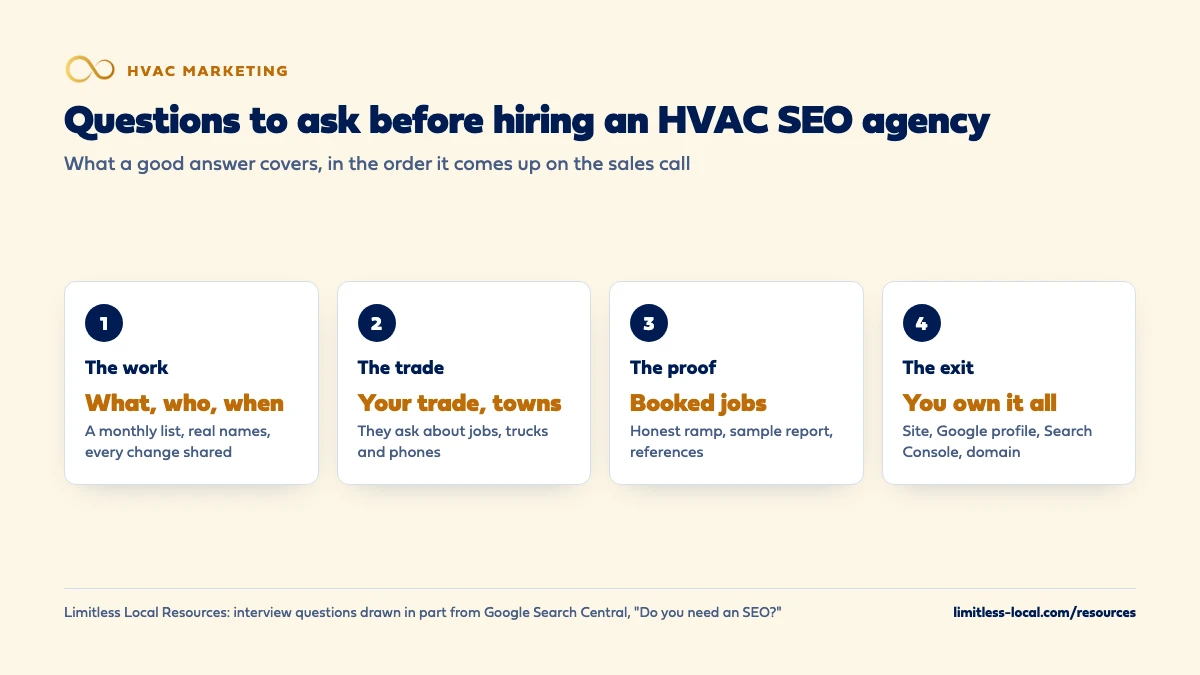
So treat the sales call like a job interview for someone who’ll get the keys to your website and your Google profile. The questions below are grouped in the order they tend to come up. You don’t need to ask all of them in one sitting, but you should have an answer to each before you sign.
"What exactly will you do each month?"
You want a list, not a slogan. A good answer sounds like: “In month one we fix your Google Business Profile categories and service areas, clean up your listings, and rewrite your AC repair and replacement pages. After that, each month we add or improve a set number of pages, request reviews, build local links and report.”
A weak answer sounds like: “We optimize your online presence” or “We handle all the SEO.” Follow up with:
- How many pages will you write or rewrite, and which ones first?
- What will you do on my Google Business Profile, and how often?
- Will I see every change you make to my site before or after it goes live?
An agency worth hiring shares every change it makes to your site and explains why. If the answer is no, that’s your answer. What HVAC SEO should include month to month gives you a checklist to compare against.
"Who will actually do the work, and who will I talk to?"
The person on the sales call often isn’t the person doing the work. That’s normal; what matters is that you know who is. Ask:
- Who writes the content, and do they know HVAC or just SEO?
- Who will I talk to month to month, and how often?
- Is any of the work sent to another company?
- How do I reach someone if my Google profile gets suspended in July?
There’s no single right answer. A team model with a dedicated account manager is fine; so is a smaller shop. What you’re listening for is a clear answer. “We have a team” with no names, roles or meeting rhythm usually means you’ll be chasing updates.
"What do you know about HVAC and about my area?"
An agency that knows the trade will bring it up before you do: the summer and winter peaks, the gap between a $150 repair call and a full system replacement, emergency calls at night, maintenance plans, and towns where your techs will or won’t drive.
A good SEO is interested in your business: what makes you different, who you’re up against and how your customers find you. So watch which questions they ask you:
- Which jobs do you want more of: repairs, replacements, maintenance plans?
- Which towns are worth the drive?
- How many trucks do you run, and how full is the schedule?
- Who answers the phone?
If they don’t ask anything like this, they’re planning to run the same playbook they use for everyone. How to know if a marketing agency understands HVAC has more ways to test it.
"How will you measure success?"
This question separates agencies faster than any other. Rankings and traffic are fine to report, but they aren’t the goal. The goal is calls, booked jobs and what each booked job cost you.
A good answer covers:
- Calls and forms by source, with call tracking so organic calls are counted separately from ads and Google profile calls.
- Booked jobs, matched against your field software, whether that’s ServiceTitan, Housecall Pro or Jobber.
- Cost per lead and per booked job, including their fee.
- A report you can read in five minutes, every month.
Ask to see a sample report with names blanked out. If it’s twenty pages of impressions and keyword positions with no calls or jobs anywhere, that’s the report you’ll get. How to know if your HVAC marketing agency is getting results shows what to look for once you’re signed.
Curious what your marketing is actually booking?
Get a free visibility audit — no obligation, no sales pitch.
"What results should I expect, and when?"
Ask it straight: what results do you expect, and by when? The best answers are honest ramps, not promises. SEO typically takes 3 to 6 months to show meaningful organic growth, and the first month or two is mostly foundation work: fixing your Google profile, your listings and your key service pages.
A good agency will tell you what they expect to see first (more calls from Maps, say, before the website ranks for broader searches) and what could slow it down, like a crowded market or a thin website. They’ll also tell you what they can’t promise.
That last part matters. No one can guarantee a #1 ranking on Google, so an agency that promises first place is one to walk away from. How long HVAC SEO takes to bring in calls breaks down what’s realistic.
"What will you do to my Google Business Profile, and what access do you need?"
For an HVAC company, your Google Business Profile is often where the most organic calls come from, so ask exactly what they’ll change: categories, services, service areas, photos, posts, review replies.
Then ask what access they need. Google’s help page on Business Profile owners and managers explains the difference. Owners have full control, including adding or removing users and deleting the profile. Managers have mostly the same access, except they can’t add or remove users or remove the profile. A profile can have several owners but only one primary owner.
An agency can do nearly all its work as a manager. Your business should stay the primary owner. If an agency asks to be the primary owner, ask why, and get the answer in writing.
"Who owns the website, Search Console and the domain?"
Ask this before you sign, not when you’re trying to leave. You want your business to own:
- The domain, registered in your business name, with you able to log in to the registrar.
- The website and its content, including pages they write while you’re paying them.
- Search Console, Google’s free tool for your site’s search data.
- Google Analytics and any tracking numbers set up for your business.
On Search Console, Google’s page on owners, users and permissions says owners have full control, including adding and removing users, while full users can view all data and take some actions. Keep yourself as an owner and give the agency only the access it needs. If it’s just auditing your site before you sign, read access is enough.
The contract should say all of this plainly. What to look for in an HVAC marketing agency contract covers the clauses.

"How do you build links and content?"
This is where shortcuts hide. Ask where links will come from and how content gets written. Good answers sound local and specific: supplier and manufacturer dealer listings, local sponsorships, chamber and trade association memberships, pages written from your actual jobs.
Answers that should worry you:
- “We have a network of sites.” Google’s spam policies list buying or selling links for ranking purposes as link spam.
- “We’ll publish hundreds of pages.” Mass-producing pages that add nothing for readers, with AI or without, is scaled content abuse under those same rules.
- “A page for every town in three states.” Near-identical city pages are a classic doorway pattern.
AI-assisted writing isn’t a red flag on its own. Ask how they use it and who checks the facts. The test is whether the result says things only your company could say.
"What does it take to cancel?"
Ask for the term, the notice period and what you keep. Specifically:
- How long is the minimum term, and what happens after it?
- How much notice do I give to cancel?
- What do I walk away with: the site, the content, the profile, the tracking numbers, the reports?
- Is there a setup fee, and is any of it refundable?
A short minimum is reasonable, because SEO needs a few months before anyone can judge it. A long lock-in with no way out, or a contract that keeps your site or phone numbers when you leave, is a problem no matter how good the pitch was.
Here’s how we handle it: we ask for three months and put it in the contract, but if you want to leave, we won’t make you stay.
"Can I talk to a couple of your clients?"
References tell you what the sales call can’t. For an HVAC owner, the best reference is another home-service owner, ideally outside your market so they’re not your competitor.
When you get them on the phone, skip “were you happy?” and ask:
- What changed in your calls and booked jobs, and how long did it take?
- Did you always know what they were working on?
- How did they handle a bad month?
- If you left, did you keep everything?
An agency that can’t produce a single reference, or only offers case studies with no way to check them, is asking you to take a lot on trust.
Which answers mean I should walk away?
Most bad fits show themselves in a few answers:
- A promised ranking, a promised map pack spot or a promised number of leads.
- A “special relationship” with Google or a “priority submit.”
- “We can’t share our methods, they’re proprietary.”
- The agency owns the website, the profile or the phone numbers.
- Reports with rankings and traffic but no calls or booked jobs.
- No questions about your business at all.
If an offer came out of the blue, by cold email or a call claiming to be from Google, how to tell if an SEO offer for your HVAC company is a scam covers those red flags in detail.
Not sure which of these is costing you jobs?
A free visibility audit checks the Google profile, reviews, site and tracking, and shows what to fix first.
What's different about hiring SEO help for an HVAC company
Timing around the season. SEO takes months to build, so the best time to start is well before your busy season, not during the first heat wave. Ask the agency what they’d do first if you signed today, given where you are in the year.
Repair versus replacement. Emergency repair searches and replacement searches are different jobs with different pages. An agency that treats “HVAC” as one keyword will miss your highest-ticket work.
Service-area business rules. Most HVAC companies serve customers at their homes, so the Google profile, service areas and city content need to be set up for how you actually work. Ask how they’d handle the towns you want that sit farther from your shop.
Capacity. A good HVAC agency will ask how many trucks you run and how full the schedule is, because more calls in July can be a problem if you’re already booked out.
A worked example: the math to do before you sign
These numbers are made up to show the math, not a benchmark for your market. Say a proposal is $2,000 a month for SEO, and your average booked job brings in $400 in gross profit.
- Once it’s working, the SEO has to bring in 5 extra booked jobs a month to pay for itself ($2,000 ÷ $400).
- SEO typically takes 3 to 6 months to show meaningful growth, so you could pay $12,000 before judging it (6 × $2,000).
Now take those numbers into the sales call. Ask the agency how they’d expect to get to those five extra jobs, which kinds of jobs they’d go after first, and how you’ll see them in the report. If they can’t connect their plan to booked jobs, the proposal is about rankings, not your business. If they can, you have something to hold them to.
Frequently asked questions
Should I hire an SEO agency or do it myself?
If you run a small shop and have the time, you can do a lot of the basics yourself, starting with your Google Business Profile and your service pages. An agency makes sense when the time it would take you costs more than the fee.
Is a cheap SEO package worth trying first?
Only if it answers these questions well. A low fee that can’t tell you what it does each month or how it’ll show booked jobs is hard to judge, so you may never know if it worked.
Do I need an agency that only works with HVAC companies?
Not necessarily. What matters is that they understand home-service work, your seasons and your service area, and can show it in the questions they ask.
Should SEO and Google Ads be with the same agency?
It can help, because one team sees which searches turn into jobs on both sides. Either way, insist on reports that split calls by source so you can judge each one.
What should I have ready before the sales call?
Your rough monthly job count, the jobs and towns you want more of, your average ticket for repairs and replacements, and logins or owner access for your website and Google profile.
How many agencies should I talk to?
Two or three is usually enough to see the difference in how they answer. Use the same questions with each so you’re comparing like for like.
Key takeaways
- Ask what they’ll do each month and who’ll do it, and expect a list, not a slogan.
- Judge their HVAC knowledge by the questions they ask you.
- Success means calls and booked jobs, shown in a report you can read.
- Keep your business as the owner of the site, Google profile, Search Console and domain.
- Walk away from promised rankings, secret methods and link networks.
Want a second set of eyes on your setup?
We'll look at how you show up locally and where calls are leaking, then send you a plain-English breakdown.
More in this section
- How do I tell if an SEO offer for my HVAC company is a scam?
- How long does HVAC SEO take to bring in calls?
- What should I look for in an HVAC marketing agency contract?
- How much does HVAC SEO cost per month?
- How do I know if a marketing agency really understands HVAC?
Sources
- Do You Need an SEO? Tips for Hiring an SEO — Google Search Central
- Manage your Business Profile owners & managers — Google Business Profile Help
- Managing owners, users, and permissions — Search Console Help
- Spam Policies for Google Web Search — Google Search Central