
Do competitors bidding on HVAC keywords affect my ad budget?

- How much do rival HVAC companies in my market change what my Google Ads budget buys?
- How do other HVAC companies change what I pay per click?
- What happens to my monthly budget when the auction gets crowded?
- How can I see which competitors are in my auctions?
- Is it my budget or my competitors holding my ads back?
- Should I outbid the biggest HVAC company in town?
- How can I pay less per click without bidding more?
- Should I cut my hours or towns when competition heats up?
- What can I do if a competitor bids on my company name?
- Should I bid on competitors' names myself?
- When should a crowded auction push me toward other channels?
- What's different about ad competition for HVAC companies
- A worked example: same budget, more bidders
- Frequently asked questions
- Key takeaways
- More in this section
- Sources
The short version
- You pay just enough to beat the ad ranked below yours, so more rivals usually means a higher price per click.
- A fixed budget doesn't grow when prices rise: you get fewer clicks, calls and booked jobs for the same money.
- Auction insights and impression share show who you're up against and whether budget or ad rank is holding you back.
- Ad quality, timing, targeting and your office's booking rate are the levers that don't cost more per click.
For HVAC owners running Google Ads who’ve watched the same monthly budget bring in fewer calls once more companies started bidding in town.
Get a free visibility audit · Book a growth call
How much do rival HVAC companies in my market change what my Google Ads budget buys?
Yes. Google Ads runs an auction on every search, and when more HVAC companies bid on the same keywords in your area, each click tends to cost more, so the same monthly budget buys fewer clicks and fewer calls. Your bill doesn’t go up on its own, because Google holds spending to your budget; what shrinks is what that budget brings in. You can win some of it back without a bidding war through better ads and landing pages, tighter towns and hours, and a higher share of calls that book.
That’s why we judge every campaign on cost per booked job, not cost per click: competitors move the click price, but your ads, your pages and your office decide what each job costs. Google Ads management is part of every one of our HVAC marketing packages, and ad spend is always paid to Google separately. The HVAC marketing guide covers every channel, and the rest of the HVAC marketing questions library goes question by question.
How do other HVAC companies change what I pay per click?
Every time a homeowner searches something like “AC repair near me,” Google runs an auction among the advertisers targeting that search. You don’t pay your full bid. Per Google’s definition of actual cost-per-click, you pay only what’s needed to clear Google’s minimum thresholds and beat the Ad Rank of the competitor directly below you. If nobody is below you, you pay a reserve price.
That’s the whole reason competition matters. In a town with two HVAC companies bidding, the ad below yours may be weak or missing, and clicks can be cheap. Add five more shops chasing the same search and there’s always someone close behind you, so each click costs more to win.
The gap matters too. When two ads have similar Ad Rank, each has a similar shot at the spot. As one pulls ahead, it’s more likely to win but may pay more per click for that certainty, and your price is shaped by the competitors further down the page, not only the one right below.
What happens to my monthly budget when the auction gets crowded?
The budget holds; what it buys shrinks. Google keeps your spend to the budget you set: a single day can run up to twice your average daily budget, but over the month you won’t be charged more than 30.4 times it, so a crowded auction won’t double your bill. It quietly cuts the number of clicks, which cuts calls, which cuts booked jobs.
The spend line looks the same as last month, so watch these instead:
- Average cost per click creeping up for the same keywords.
- Fewer clicks and calls on the same budget.
- Cost per booked job rising even though your office and techs haven’t changed.
When all three move together and your ads, pages and settings haven’t changed, the market around you probably has. If you’re still sizing the budget itself, how much an HVAC company should spend on Google Ads walks through the math from booked jobs backward.
How can I see which competitors are in my auctions?
Google Ads has a report for exactly this. The auction insights report compares you with the other advertisers in the same auctions, for a keyword, an ad group or a whole campaign. For Search campaigns it shows six numbers:
- Impression share: how often your ad showed out of the times it could have.
- Overlap rate: how often a rival’s ad showed when yours did.
- Outranking share: how often you ranked above them, or showed when they didn’t.
- Position above rate: how often they showed above you when you both appeared.
- Top of page rate and absolute top of the page rate: how often each ad showed above the unpaid results, and as the very first ad.
Two catches. The report only covers keywords, ad groups and campaigns with enough activity, and it doesn’t show insights when your impression share is under 10%. Run it monthly and compare month to month: a new name with a high overlap rate is the clearest sign someone moved into your market.
Is it my budget or my competitors holding my ads back?
Two columns in your campaign settle this. Google’s guide to impression share data defines them:
- Search lost IS (budget) is the share of time your ads didn’t show because the budget ran out.
- Search lost IS (rank) is the share of time they didn’t show because your Ad Rank wasn’t high enough to compete.
They point to different fixes. Mostly lost to budget means you’re competitive but running out of money, often by early afternoon. Mostly lost to rank means competitors are beating your bid, your ad quality or both, and more budget alone won’t buy you those searches.
Read either one next to cost per booked job. Losing searches to budget while booking jobs at a cost you’re happy with is a reason to consider more spend. Losing to rank at a poor cost per job is a reason to fix the ads and pages first. When to raise, lower or pause ad spend covers that decision.
Curious what your marketing is actually booking?
Get a free visibility audit — no obligation, no sales pitch.
Should I outbid the biggest HVAC company in town?
Usually not across the board. The top spot costs extra for two reasons: thresholds and resulting prices are typically higher for ads above the search results than below them, and widening your lead over the next ad can mean paying more per click for the certainty. A shop with a bigger budget can keep that up longer than you can.
Pick where being on top pays you most and accept a lower spot elsewhere:
- Fight for the searches that book fast and pay well for your shop, such as no-cool and no-heat repair in your core towns during the hours someone can answer.
- Ease off on research searches, outer towns and hours when calls go to voicemail.
Being second or third on a search that books is often worth more than being first on one that doesn’t. For everything that sets the price of a click, see what decides what an HVAC company pays per click.
How can I pay less per click without bidding more?
Raise the quality side of the auction. Google’s page on Ad Rank says your position comes from your bid, the quality of your ad and landing page, the thresholds, the competition, the context of the search and the expected impact of your ad assets, and that higher quality ads can often lead to lower costs per click.
For an HVAC company that comes down to a few things:
- Match the ad to the search. Keep AC repair, furnace repair and system replacement in separate ad groups with their own ads, so the ad says what the homeowner typed.
- Send people to a page about that job. A repair click should land on a repair page with your phone number at the top, not your homepage. Whether you need landing pages for Google Ads covers what that page needs.
- Fill in your ad assets. Call buttons, sitelinks to service pages and your locations give the ad more to work with.
None of this stops a rival from bidding. It means you need a smaller bid to hold the same spot.
Should I cut my hours or towns when competition heats up?
Often, yes. Narrowing where and when you show up is a way to spend the same budget only where you’re most likely to win the job.
- Hours. An ad schedule in Google Ads limits your ads to the days and hours you choose. If nobody answers after 7 p.m., a click at 9 p.m. is money spent on a voicemail. If you do run a 24-hour emergency line, late hours may be where the bigger shops ease off.
- Towns. The far edge of your service area is where your drive time is longest and a local shop has the edge. Pulling the budget back to the towns your trucks reach fastest puts more of it into auctions you can win.
Use your own call and booking data by hour and by town to decide. The ad schedule report in Google Ads shows clicks and cost by day and hour.

What can I do if a competitor bids on my company name?
Bidding on another company’s name as a keyword is allowed. Google’s Trademarks policy says it won’t restrict trademarks used as keywords. What it may restrict, after reviewing a complaint from the trademark owner, is a direct competitor using the trademark in the ad text itself, or ads that use it in a confusing, deceptive or misleading way. The trademark has to appear in the ad, not only on the landing page, and Google only accepts complaints in the countries and industries where the owner has shown trademark rights.
So the practical defense is usually your own ad. A campaign on your company name puts you at the top for people already looking for you, and auction insights on that campaign shows how often a rival appears there. If they show up rarely, it may not be worth the spend; if they show up constantly, it’s cheap insurance for calls you’ve already earned.
Should I bid on competitors' names myself?
You can, as long as their trademark stays out of your ad text, but go in with low expectations. Someone who types a specific HVAC company’s name is usually trying to reach that company. Some will happily call you instead, especially if the other shop can’t come for days, but many clicks will be people who wanted the other number.
If you test it, keep it in its own campaign with its own small budget, so it can’t eat the money your repair ads need, and judge it on booked jobs, not clicks. Most owners get more from the searches where homeowners haven’t picked anyone yet.
When should a crowded auction push me toward other channels?
When cost per booked job stays above what the work can carry even after you’ve fixed quality, hours and towns. At that point, adding budget just buys the same expensive clicks.
Paid search isn’t the only way to be found. Google’s Maps results and the regular listings aren’t sold, so a rival’s ad budget doesn’t buy them; reviews, a complete Google Business Profile and real service pages do. They take longer: ads can bring in leads within days of launch, while SEO typically takes 3 to 6 months to show meaningful organic growth. Many HVAC owners keep ads on their best-booking searches and build the rest underneath so they aren’t hostage to the auction. To gauge how crowded each channel is where you work, see how competitive HVAC marketing is in your area.
Want to see where your company stands?
A free visibility audit shows where you show up on Google, Maps and AI answers, and what it's costing you in calls.
What's different about ad competition for HVAC companies
Everyone shows up on the same hot afternoon. The first heat wave and the first cold snap pull every HVAC shop’s ads into the same auctions at once, and budgets that lasted all day in April can be gone by lunch. Check Keyword Planner before the season: its top-of-page bid columns show roughly the 20th and 80th percentile of what advertisers have historically paid for a top spot, for the location you pick, and its competition column rates each keyword low, medium or high (About Keyword Planner forecasts). Run the same check for summer and winter months.
Replacement searches draw a different crowd. System replacement keywords tend to attract the bigger shops that sell installs every day. Their clicks can cost far more than repair clicks, so keep repair and replacement in separate campaigns with separate budgets, or the expensive keywords will drain the money your repair calls need.
The phone decides who wins in the end. In an emergency, the homeowner calls more than one company. A higher click price hurts least when your office answers every call and books it on the spot. Scaling up ads for peak season covers the order to do it in.
A worked example: same budget, more bidders
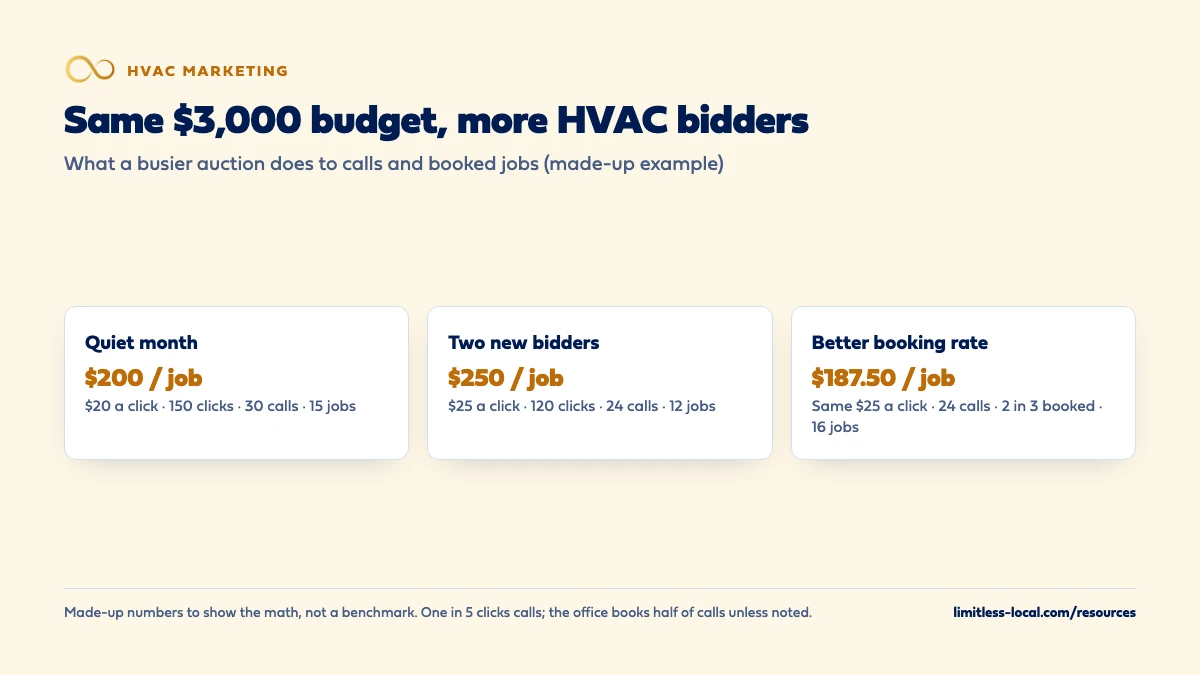
These numbers are made up to show the math, not a benchmark for your market. Say you spend $3,000 a month on Google Ads. In a quiet spring, a click costs about $20, so you get 150 clicks. One in 5 people who click calls you, which is 30 calls, and your office books half of them: 15 booked jobs, or $200 per booked job.
Then two more HVAC companies start bidding in your towns, and the average click climbs to $25. The same $3,000 now buys 120 clicks, 24 calls and 12 booked jobs, or $250 per booked job. Your bill didn’t change. You just booked three fewer jobs.
Now look at the fix you control. If your office books 2 out of every 3 calls instead of half, those same 24 calls become 16 booked jobs, about $187.50 per booked job, better than the quiet month, without paying Google a cent more. Working through your own version of this, with your real click prices and booking rate, is what a free visibility audit is for.
Frequently asked questions
Will a competitor's bidding make Google charge me more than my budget?
No. Your campaign budget still caps what you spend. A busier auction raises the price of each click, so the same budget buys fewer clicks.
Can I stop a competitor from showing up when people search my company name?
Not as a keyword: Google doesn’t restrict trademarks used as keywords. If a direct competitor puts your trademark in their ad text, the trademark owner can submit a complaint, and Google may restrict that use after review.
Why don't I see any competitors in auction insights?
The report needs a minimum amount of activity for the period you pick, and it doesn’t show insights when your impression share is under 10%. Try a longer date range or a whole campaign instead of one keyword.
Does a competitor clicking my ads drain my budget?
That’s a different problem from competitors bidding. A rival in the auction raises your click price; it doesn’t spend your money. If you suspect fake clicks, look for repeated clicks with no calls from the same towns and hours, and raise it with Google Ads support.
Should I raise my bids when a new HVAC company starts advertising?
Not as a reflex. Check whether you’re losing searches to rank or to budget first, and whether your cost per booked job has actually moved. Better ads and a better booking rate are often cheaper than a higher bid.
Do competitors affect Local Services Ads the same way?
Differently. In Local Services Ads your bid is the most you’ll pay for a lead, not a click, and the auction also weighs how responsive you are and your profile quality, including rating and number of reviews. Rivals still compete for the same top spots, but answering fast and collecting reviews counts alongside the bid.
Key takeaways
- In the Google Ads auction you pay just enough to beat the ad below yours, so more HVAC bidders usually means pricier clicks.
- Your budget still caps spend; a crowded auction shows up as fewer clicks, calls and booked jobs for the same money.
- Auction insights shows who you’re up against; lost impression share tells you whether budget or Ad Rank is the problem.
- Better ads and landing pages, tighter hours and towns, and a higher booking rate lower your cost per job without a bidding war.
- Rivals can bid on your company name as a keyword; a campaign on your own name is usually the practical defense.
Not sure what's working right now?
Start with a free visibility audit: rankings, Google profile, reviews and tracking, checked against your service area.
More in this section
- What happens if competitors click on my HVAC Google Ads?
- Should an HVAC company run emergency ads while SEO builds?
- How much should an HVAC company spend on Google Ads?
- What decides how much my HVAC company pays per click on Google Ads?
- How can I tell if HVAC SEO or Google Ads is making profitable jobs?
Sources
- Actual cost-per-click (CPC): Definition — Google Ads Help
- About Ad Rank — Google Ads Help
- Use auction insights to compare performance — Google Ads Help
- Get impression share data — Google Ads Help
- Trademarks — Advertising Policies Help
- About average daily budgets — Google Ads Help
- About Keyword Planner forecasts — Google Ads Help
- About ad rankings — Local Services Help