
Which marketing channel brings roofers the best-quality leads?
- Which roofing lead sources sign the most roofs, not just the most calls?
- What makes a roofing lead good quality?
- How do the main roofing channels compare on lead quality?
- Why do leads from my Google profile and website usually sign better?
- How good are Local Services Ads leads for roofers?
- Do Google search ads bring quality roofing leads?
- Why do Facebook and Instagram ads bring lower-quality roofing leads?
- Are leads from shared lead marketplaces good quality?
- Are door-knocking and storm canvassing leads good quality?
- How do I measure lead quality by channel in my own roofing company?
- Should I put all my money into the highest-quality channel?
- What's different about lead quality for roofing companies
- A worked example: cheaper leads that cost more per roof
- Frequently asked questions
- Key takeaways
- More in this section
- Sources
The short version
- Quality means the lead books an inspection and signs, not that the phone rang.
- Referrals and homeowners who find you on Google usually sign best.
- Local Services Ads and search ads are strong when job types and keywords are tight.
- Social ads and shared lead marketplaces bring more volume and more shoppers.
- Track each lead's source through to the signed roof to find your best channel.
For roofing owners tired of chasing tire-kickers, who want to know which channels bring homeowners ready to book an inspection, and how to prove it with their own numbers.
Get a free visibility audit · Book a growth call
Which roofing lead sources sign the most roofs, not just the most calls?
For most roofers, the best-quality leads come from referrals and from homeowners who find you on their own through your Google Business Profile and website, because they picked you after seeing your reviews, live where you work and usually call with a real problem. Local Services Ads and tightly run Google search ads come next, since the homeowner is searching for a roofer right now. Social media ads, shared lead marketplaces and storm canvassing tend to bring more price shoppers and homeowners who are also talking to other roofers. The channel that wins for your company is the one whose leads sign the most roofs per dollar, so track every lead to a signed job.
We judge every channel the same way: by what each signed roof cost, not by lead count. Call tracking and source tagging come with every package on our roofing marketing page, so you can see which channel’s leads actually sign. The guide to getting roofing leads covers every channel in depth, and the roofing marketing questions library has the rest.
What makes a roofing lead good quality?
A good roofing lead passes five tests:
- They’re in your service area. A great homeowner two counties past where your crews drive isn’t a lead.
- They need a job you do. Not gutters if you don’t do gutters, not a flat commercial roof if you only do shingles.
- They need it soon. An active leak or a roof that’s at the end of its life, not a “just curious what it’d cost someday.”
- They’re not shopping you against eight others. Two or three quotes is normal. Eight is a price auction.
- They can say yes. They own the home and can make the call, or they’ll bring the person who can.
The final test is the only one that pays the bills: did they book an inspection, and did they sign? Lead quality is a sign rate, not a feeling. Everything below is a starting point for where to look; your own numbers decide it.
How do the main roofing channels compare on lead quality?
Ranked roughly from highest typical quality to lowest, for a residential roofer:
- Referrals and past customers. Trust is built before the first call.
- Your Google Business Profile and website. The homeowner searched, compared and chose you.
- Local Services Ads. Searching right now, contacting you directly, with spam screened out.
- Google search ads. High intent when keywords are tight; junk when they aren’t.
- Yard signs, truck wraps and mailers. Neighbors who saw your work, mixed with curiosity calls.
- Social media ads. Homeowners who weren’t looking until they saw your ad.
- Shared lead marketplaces. Real requests, often sent to several roofers at once.
- Storm canvassing. Lots of conversations, many with homeowners who hadn’t planned to replace anything.
Quality isn’t the only thing that matters. Referrals are the best leads most roofers get and also the hardest to grow on purpose, which is why every channel lower on the list still has a job to do.
Why do leads from my Google profile and website usually sign better?
Because the homeowner did the work of choosing you. They searched “roof repair near me” or your company name, looked at your star rating, read a few reviews, maybe looked at photos of your work, and then called. By the time the phone rings, you’re already on a short list.
You can see this in your Google Business Profile’s performance report, which shows the search terms people used to find your business and how many calls and website clicks your profile got. If many of those searches are your company name, that’s a sign referrals and word of mouth are feeding your profile, and those homeowners tend to be the warmest of all.
The catch is volume. You can’t buy more of these leads overnight. You build them with reviews, a complete profile and service pages for the towns you want, and that takes months.
How good are Local Services Ads leads for roofers?
Usually good, with one thing to watch. With Local Services Ads you pay for valid leads, and Google screens out invalid activity like spam and duplicate contacts before you’re charged. The homeowner taps to call or message you directly, so they’re actively looking for a roofer right now.
The thing to watch: they’re often contacting more than one roofer. Google even prices message leads partly on whether the customer has contacted other Local Services advertisers. Whoever answers first and sounds most competent usually gets the inspection. LSA lead quality depends as much on your speed and your job-type settings as on the channel itself. Whether Local Services Ads are worth it for a roofing company goes deeper on costs and setup.
Curious what your marketing is actually booking?
Get a free visibility audit — no obligation, no sales pitch.
Do Google search ads bring quality roofing leads?
They can bring some of the best paid leads you’ll get, or some of the worst. The difference is almost entirely in the setup. “Roof replacement [your town]” and “roof leak repair near me” are homeowners with a problem. “Roofing jobs,” “how to fix a roof leak yourself” and “cheap roof” are not.
Google Ads’ search terms report shows the actual searches that triggered your ads, which is where you find out whether you’re paying for homeowners or for job seekers and DIYers. Check it every week when a campaign is new. Adding the junk searches as negative keywords is the fastest lead-quality fix in paid search; which negative keywords a roofer should add to Google Ads has a starter list.
Why do Facebook and Instagram ads bring lower-quality roofing leads?
Because most of those homeowners weren’t looking for a roofer when they saw your ad. They were scrolling. A quick form with their name and phone pre-filled is easy to submit on impulse and easy to forget a day later.
There’s a setting that helps. When you run lead ads with instant forms, Meta’s default form type is built for more volume, designed to make submitting quick on a phone. The “Higher intent” form type is designed for more intentional leads. Adding a step that asks about roof age, the problem and the address costs you some volume and saves your estimators a lot of wasted drives.
Social ads still have a place for roofers: retargeting homeowners who already visited your site, and staying in front of neighborhoods after a storm. Just don’t judge them against search leads on cost per lead alone. Whether Facebook ads work for roofing leads covers when they pay off.
Are leads from shared lead marketplaces good quality?
They’re real homeowners with real requests, but you’re rarely the only roofer they hear from. On Thumbtack, for example, you pay for leads, and prices vary with the type and size of the job, how many pros are available and your market. More roofers competing for the same request usually means the homeowner gets more calls and the job goes to whoever is fastest or cheapest.
That doesn’t make them useless. They can fill a gap while your own channels ramp up. But expect a lower sign rate and plan to call within minutes. If you’re weighing it, whether a roofer should buy leads from a lead-selling company lays out the trade-offs.
Are door-knocking and storm canvassing leads good quality?
They’re a different kind of lead. Canvassing creates conversations, not demand: many homeowners you talk to hadn’t planned to do anything until someone knocked. That gives you lots of inspections and a sign rate that depends heavily on your reps and on whether there was real damage.
After a storm, homeowners are also wary. They’ve heard about out-of-town crews and they’re getting knocks from several companies. A rep who can point to your Google reviews and a local office usually does better than one who can’t, which is another reason the profile and reviews matter even for a canvassing-heavy company.
How do I measure lead quality by channel in my own roofing company?
Tag every lead with its source the moment it comes in, then follow it to the end. Most job software can do this. Housecall Pro’s help center describes its lead source field as a way to invest in the sources that bring you good jobs; check your own job software for a similar field.
For each channel, track four numbers every month:
- Leads.
- Inspections booked.
- Estimates given.
- Roofs signed, with the contract amount.
Divide signed roofs by leads and you have a sign rate. Divide what you spent on the channel by signed roofs and you have cost per signed roof. Phone leads need call tracking with a separate number per channel, or you’ll be guessing. Tracking which roofing leads turn into signed jobs walks through the setup.
Should I put all my money into the highest-quality channel?
Usually not. The highest-quality channels are often the hardest to scale. You can’t double your referrals next month, and SEO takes months to grow. Paid channels with a lower sign rate can still be worth it if their cost per signed roof is acceptable and they fill the schedule.
A better rule: rank channels by cost per signed roof and by the profit on the jobs they bring, then fund them in that order until the next dollar stops paying for itself. Cut a channel when its leads don’t sign after you’ve fixed what’s fixable: the targeting, the follow-up speed and the questions you ask on the first call.
Not sure which of these is costing you jobs?
A free visibility audit checks the Google profile, reviews, site and tracking, and shows what to fix first.
What's different about lead quality for roofing companies
Repair versus replacement. A repair lead and a full replacement lead are worth very different amounts. A channel that brings fewer leads but more replacements can beat one that brings lots of small repairs. Track job type along with source.
Storm spikes change every channel. After hail, every channel gets more leads and more shoppers at once, and homeowners call several companies. Sign rates usually dip even as volume jumps, so compare storm months with storm months.
Long decisions hide quality. A replacement lead can take weeks to sign, so a channel can look bad in its first month and fine by the third. Judge sign rates on leads that are at least a couple of months old.
Commercial is its own channel. Commercial roofing leads come from property managers, general contractors and relationships more than from searches. Don’t judge a commercial program by residential lead numbers.
A worked example: cheaper leads that cost more per roof
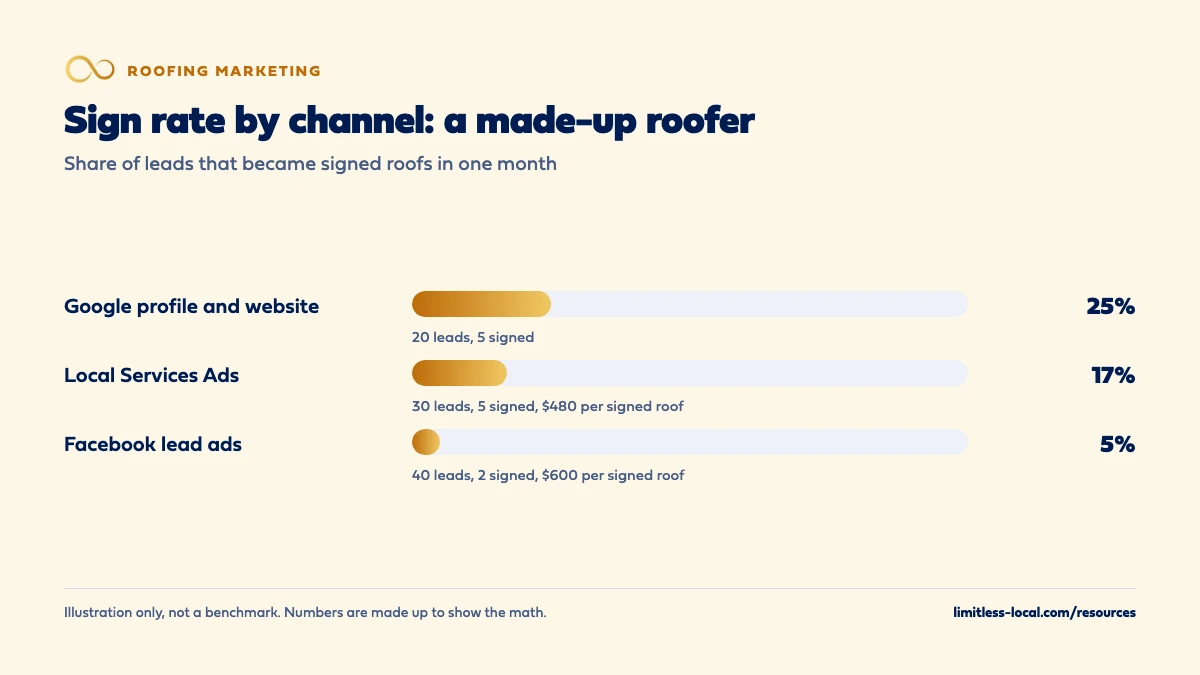
These numbers are made up to show the math, not a benchmark for your market and not a client result. In one month a roofer tracks three channels:
- Google profile and website: 20 leads, 10 inspections, 5 signed roofs. Sign rate: 25%.
- Local Services Ads: 30 leads, 12 inspections, 5 signed roofs, on $2,400 in ad spend. Sign rate: about 17%. Cost per signed roof: $480.
- Facebook lead ads: 40 leads, 8 inspections, 2 signed roofs, on $1,200 in ad spend. Sign rate: 5%. Cost per signed roof: $600.
Facebook brought the most leads at the lowest cost per lead ($30, against $80 for Local Services Ads), yet each signed roof cost more. The Google profile signed the best of all. That points to more review requests and better service pages before more social spend.
How we’d handle it: every package includes call tracking with recording, form and chat lead tracking, source tagging and a monthly report with a cost-per-lead breakdown, so this table builds itself. Our Growth package, at $4,500 a month, adds Local Services Ads management to Google Ads and local SEO; ad spend is paid directly to the platforms.
Frequently asked questions
Are exclusive leads always better than shared leads?
Usually, because the homeowner isn’t hearing from several roofers at once. But an exclusive lead outside your area or for a job you don’t do is still a bad lead, so check the targeting too.
Do branded searches count as a channel?
Treat them as a sign of referrals and offline marketing working. A homeowner who searches your company name heard about you somewhere, so ask new callers where.
Why do my LSA leads ask for a price on the first call?
Many homeowners contact more than one roofer through Local Services Ads. A quick, confident answer about how inspections and estimates work helps more than a phone quote.
How long should I track a channel before judging its lead quality?
Long enough for its leads to finish your sales cycle. For replacements that’s often two or three months of leads, not the first few weeks.
Does faster follow-up improve lead quality?
It doesn’t change who calls, but it changes how many sign. A homeowner who’s contacted several roofers often books with whoever responds first.
Should I ask every caller how they found us?
Yes, even with call tracking. It catches referrals, yard signs and word of mouth that tracking numbers miss.
Key takeaways
- Lead quality is a sign rate: inspections booked and roofs signed, not calls received.
- Referrals and homeowners who find you on Google usually sign best, but they grow slowly.
- Local Services Ads and search ads bring strong leads when settings and keywords are tight and you answer fast.
- Social ads and shared marketplaces bring more volume and more shoppers; judge them on cost per signed roof.
- Tag every lead’s source in your job software and follow it to the signed contract.
Want a second set of eyes on your setup?
We'll look at how you show up locally and where calls are leaking, then send you a plain-English breakdown.
More in this section
- How quickly can each roofing marketing channel produce leads?
- Which service provides qualified roofing leads?
- What marketing brings a roofing company the most phone calls?
- What is the fastest way for a roofer to get leads online?
- Which keywords should a roofing company target for local leads?
Sources
- How leads work — Google Local Services Help
- About the search terms report — Google Ads Help
- About instant form types — Meta Business Help Center
- How much do I pay for leads and opportunities? — Thumbtack Help
- How to Use Lead Sources — Housecall Pro Help Center
- Understand your Business Profile performance & insights — Google Business Profile Help