
How quickly can each roofing marketing channel produce leads?
- How long does each roofing marketing channel take to start bringing in leads?
- Which roofing marketing channels bring leads fastest?
- How quickly can Google search ads produce roofing leads?
- How quickly can Local Services Ads produce roofing leads?
- How quickly does a Google Business Profile start bringing roofing calls?
- How long does SEO take to bring in roofing leads?
- How fast can Facebook and Instagram ads bring roofing leads?
- How fast does a new roofing website start bringing in leads?
- How quickly do past customers, referrals and yard signs bring leads?
- Why do signed roofs lag behind the first leads?
- How should a roofer combine fast and slow channels?
- What's different about channel timing for roofers
- A worked example: a roofer's first six months, channel by channel
- Frequently asked questions
- Key takeaways
- More in this section
- Sources
The short version
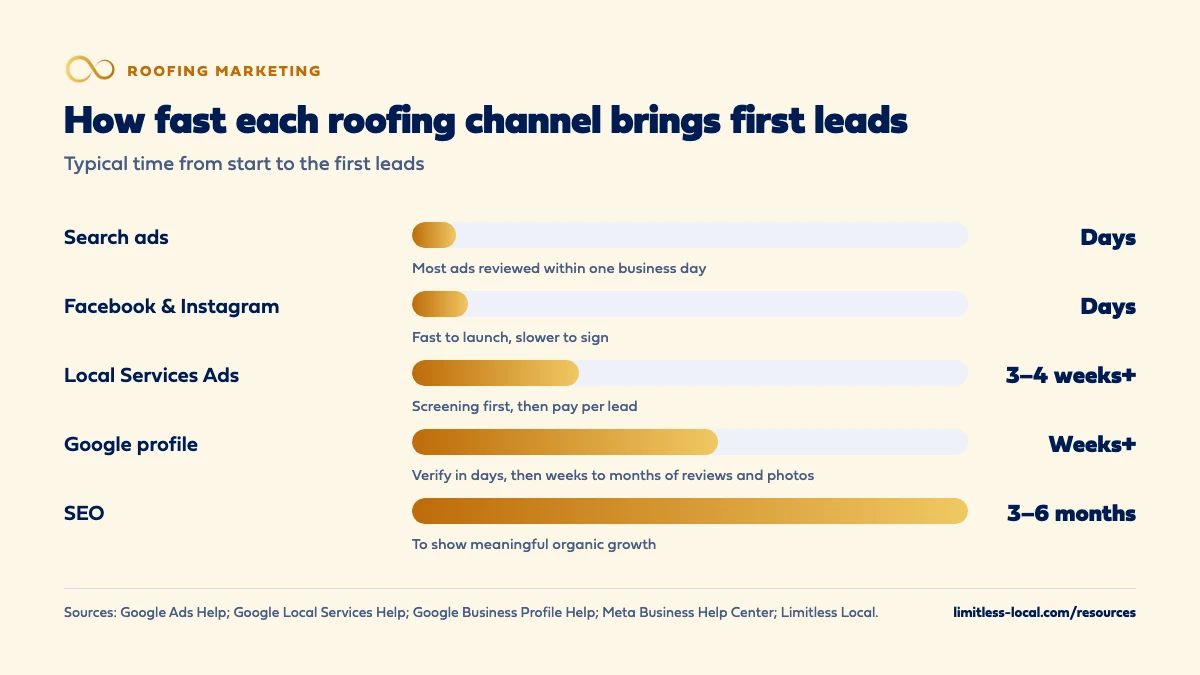
- Search ads: leads within days of launch.
- Local Services Ads: about 3 to 4 weeks of screening, then fast.
- Google Business Profile: days to verify, then weeks to months to build calls.
- SEO: typically 3 to 6 months; signed roofs lag every channel by weeks.
For roofing owners planning the next few months who want to know which channels can ring the phone soon, and which ones are a longer build.
Get a free visibility audit · Book a growth call
How long does each roofing marketing channel take to start bringing in leads?
Google search ads and Facebook or Instagram ads are the quickest roofing channels: most ads are reviewed within a day, and search ads can bring leads within days of launch. Local Services Ads are quick once they’re running, but screening usually takes 3 to 4 weeks first, while a Google Business Profile takes days to verify and then weeks to months of reviews and photos to bring steady calls. SEO is the slowest, typically 3 to 6 months to show meaningful organic growth, and signed roofs lag every channel by weeks because each lead still needs an inspection and an estimate.
That mix of fast and slow channels is how we plan the first months for any roofer: tracking and follow-up first, then ads to bring calls while local SEO builds. Our packages lay out what’s included at each level, and campaigns go live in weeks 1 to 2 after a short onboarding. Our roofing marketing page shows how that fits a roofing company, the roofing marketing guide covers each channel in depth, and the roofing marketing questions library goes question by question.
Which roofing marketing channels bring leads fastest?
From fastest to slowest, for a typical roofer starting from scratch:
- Past customers and your own list. A text or email to people who already know you can bring calls the same week. It’s small, but it’s yours.
- Google search ads. Leads within days of launch.
- Facebook and Instagram ads. Live just as fast, but usually slower to turn into signed roofs.
- Local Services Ads. Fast once live, after a few weeks of screening.
- Google Business Profile. Days to verify, then a slow build as reviews and photos stack up.
- SEO and your website. The slowest start, and the longest-lasting.
Speed isn’t the same as value. The fast channels charge you every month you run them. The slow ones keep working after the work is done. Most roofers need some of each. If you just need the single fastest option, the fastest way for a roofer to get leads online covers that choice.
How quickly can Google search ads produce roofing leads?
Within days. Google says most ads are reviewed within one business day, though some reviews take longer (About the ad review process). Once approved, a search ad can show the next time a homeowner searches for a roofer in your towns.
Two things slow the very first stretch. If you use a smart bidding strategy, Google may show a “Learning” status for up to 7 days after big changes, and new campaigns without history can see performance swing until conversion data builds up (About Smart Bidding learning). Your ads still run while that happens. And the campaign has to be built well first: tracking, keywords, the towns you want and a page for clicks to land on.
Calls can start in the first week. Judging whether the ads are working takes longer. How long to run roofing Google Ads before judging them covers when it’s fair to decide.
How quickly can Local Services Ads produce roofing leads?
Slow to start, quick once running. Before your ads can show, you have to pass Google’s screening and verification, which can include identity, business and license checks depending on your business type and state. Google says this takes 3 to 4 weeks on average after you submit your documents, and recommends starting as soon as you create your account (Business screening and verification requirements).
Once you’re verified, leads can come in the first days. You’ll also need a verified Google Business Profile, so if yours isn’t done, that comes first.
One more timing wrinkle: Local Services Ads are moving into Google Ads, and roofing is in the first phase. Google says that while many ads start running right away, you should allow up to two weeks for the move to fully complete and for performance to ramp back to stable levels (Local Services Ads transition to Performance Max). How long LSA verification takes for a roofing company covers what slows screening down.
How quickly does a Google Business Profile start bringing roofing calls?
Verification is the quick part. After you complete the steps, Google says its verification reviews take up to 5 business days, and longer on rare occasions. If your only option is a postcard, most codes arrive within 14 days (Verify your business on Google).
The calls take longer, because a verified profile doesn’t automatically rank. Where you show in Maps depends on how well your profile matches the search, how far you are from the person searching, and how well-known and well-reviewed you are. That last part builds job by job. Most roofers see the profile start pulling calls over weeks to months, as reviews, photos and complete details stack up.
The good news: it’s free, and every review you add keeps working. How quickly a Google Business Profile brings roofing calls goes into what speeds it up.
Curious what your marketing is actually booking?
Get a free visibility audit — no obligation, no sales pitch.
How long does SEO take to bring in roofing leads?
SEO typically takes 3 to 6 months to show meaningful organic growth. Google’s own guidance is that some changes might take effect in a few hours while others could take several months, and that you’ll likely want to wait a few weeks to assess whether a change helped (SEO Starter Guide).
What decides where in that range you land:
- How old and healthy your website is.
- How many other roofers are competing for the same towns.
- Whether you have a page for each service and each town you really serve.
- How steadily you add reviews, photos and real job details.
SEO’s slow start is also its strength. Once organic calls arrive, they don’t stop the day a budget runs out.
How fast can Facebook and Instagram ads bring roofing leads?
They can go live quickly. Meta says most ads are reviewed within 24 hours, though some take longer and ads can be reviewed again after they’re live (About ads in review). So the first leads can come within days, much like search ads.
The difference is intent. Someone searching “roof leak repair” on Google needs a roofer today. Someone scrolling Facebook wasn’t looking for one. Social leads often take more follow-up before they book an inspection, and fewer of them turn into signed jobs quickly.
Remarketing is slower to start. It shows ads to people who have already visited your website, for example people who visited in the last 30 days but didn’t get in touch (About website custom audiences). If your site gets little traffic yet, there’s not much of an audience to remarket to.
How fast does a new roofing website start bringing in leads?
A website doesn’t bring visitors on its own. It’s where visitors from your ads, profile and organic search land, and whether they call. So a new site starts “working” as fast as you send traffic to it.
Pointed at search ads, a new site can bring calls in its first week. Found through organic search, it follows the SEO timeline, which typically takes 3 to 6 months to show meaningful organic growth. Our own website builds run from concept to launch in 100 days or less, with themed sites around 60 days, so plan ads around the launch date if you need calls sooner.
How quickly do past customers, referrals and yard signs bring leads?
These are the channels owners forget, and some of them are the fastest of all:
- Past customers. A text or email to homeowners you’ve already worked for, especially after a storm, can bring inspection requests the same week. Only send to people who agreed to hear from you.
- Referrals. Steady but unpredictable. Asking every happy customer at the end of a job is the only way to speed it up.
- Yard signs and truck wraps. Slow and cumulative. A sign on one job won’t ring the phone tomorrow, but signs up and down a street where you’ve done several roofs add up.
- Door hangers and mailers. They land within days of sending, but they need repeat runs to work, and the response depends heavily on whether the neighborhood needs roofs right now.
None of these replace search, but they’re cheap, and they stack well on top of it.
Why do signed roofs lag behind the first leads?
Because a roofing lead isn’t a job yet. Before anyone signs, you usually need to:
- Reach the homeowner and book an inspection.
- Get on the roof, take photos and measure.
- Write and present the estimate.
- Wait while the homeowner compares quotes, talks it over, or meets an insurance adjuster.
That can take days for a leak repair and weeks for a full replacement or an insurance job. So even the fastest channel shows up in your signed jobs a few weeks after the first lead. What to expect in the first 90 days of roofing marketing lays out how leads, estimates and signed roofs line up over that stretch.
How should a roofer combine fast and slow channels?
Use the fast channels to fill the schedule now, and the slow channels to lower what each job costs you later. A common order:
- This week: tracking, phone coverage, and a message to past customers.
- Weeks 1 to 2: search ads in your closest towns, and start Local Services Ads screening.
- First month: a complete, verified Google Business Profile and a review request after every job.
- Months 2 to 6: service and town pages, job photos and steady SEO work.
- From month 6: shift ad money away from towns where organic calls have taken over.
Laying that out across a full year is what a good roofing marketing plan for 2027 covers.
Want to see where your company stands?
A free visibility audit shows where you show up on Google, Maps and AI answers, and what it's costing you in calls.
What's different about channel timing for roofers
Storms don’t wait for setup. If you start Local Services Ads screening or a new website after the storm, you’ll miss it. Start the slow parts in the quiet months so they’re live when demand jumps.
Long sales cycles hide early wins. A channel that looks quiet in signed jobs after four weeks might have a stack of inspections and estimates in progress. Judge early on inspections booked, and later on signed roofs.
Seasons skew the first months. A campaign launched in the off-season will look slower than the same campaign launched in spring. Compare like with like.
A worked example: a roofer's first six months, channel by channel
This timeline is made up to show how the channels stack, not a forecast for your company. A roofer starts in early spring with tracking in place and a list of past customers.
- Week 1: a text to past customers brings 4 inspection requests. Search ads are approved the next business day and bring 11 leads in the first two weeks.
- Weeks 2 to 5: Local Services Ads screening runs while the Google profile gets verified, completed and filled with job photos.
- Month 2: Local Services Ads go live and add a steady trickle of calls. The first signed roofs from week 1 leads close.
- Months 3 to 6: organic search and Maps start contributing, a few calls a month at first and more as reviews and pages build.
By month 6, ads still bring most of the leads, but the free channels are carrying more of the load every month. That’s when the roofer can start trimming ad spend in the towns where Maps is doing the work.
Frequently asked questions
Which roofing marketing channel is fastest overall?
Your own list of past customers, if you have one. After that, Google search ads, which can bring leads within days of launch.
Can I start Local Services Ads and search ads at the same time?
Yes, and it’s smart to. Search ads bring calls while Local Services Ads screening runs, and you can rebalance between them once both are live.
Why haven't my Google Business Profile calls picked up after verification?
Verification only makes the profile yours. Calls depend on how your profile ranks, which builds with complete details, reviews, photos and how close you are to the people searching.
Is there any way to speed up SEO?
You can’t skip the ramp, but you can avoid slowing it down: fix technical problems, build a page for each service and town, add real job photos, and keep reviews coming. Beware anyone who promises fast rankings.
How soon will I see signed roofs from new marketing?
Usually a few weeks after the first leads, because each one needs an inspection, an estimate and the homeowner’s decision. Insurance jobs often take longer.
Should I wait until storm season to start?
No. Start the slow channels, like Local Services Ads screening, your Google profile and SEO, in the quiet months, so they’re ready when demand jumps.
Key takeaways
- Past customers and Google search ads are the quickest sources of roofing leads.
- Local Services Ads screening usually takes 3 to 4 weeks before the first lead.
- A Google Business Profile verifies in days but builds calls over weeks to months.
- SEO typically takes 3 to 6 months, and keeps working after the work is done.
- Signed roofs lag every channel by weeks, so judge early on inspections booked.
Not sure what's working right now?
Start with a free visibility audit: rankings, Google profile, reviews and tracking, checked against your service area.
More in this section
- What makes roofing marketing work faster or slower?
- What is the fastest way for a roofer to get leads online?
- How does a roofer keep up with leads coming in fast?
- What does a roofing marketer actually do each month?
- How do I switch roofing marketing agencies without losing leads?
Sources
- About the ad review process — Google Ads Help
- About Smart Bidding learning — Google Ads Help
- Business screening and verification requirements — Google Local Services Help
- Local Services Ads transition to Performance Max campaigns with pay-per-lead goals — Google Ads Help
- Verify your business on Google — Google Business Profile Help
- SEO Starter Guide: The Basics — Google Search Central
- About ads in review — Meta Business Help Center
- About website custom audiences — Meta Business Help Center