
How much time should an HVAC owner spend on marketing each week?

- How many hours a week should an HVAC business owner put into marketing?
- Is there a standard number of hours an HVAC owner should spend on marketing?
- Which parts of HVAC marketing can only the owner do?
- What can I hand off without losing control?
- What should my weekly marketing check cover?
- What should the monthly marketing review cover?
- How do I get the numbers without pulling them myself?
- How much more time does setting up the marketing take?
- Where do HVAC owners waste time on marketing?
- How do I know I'm spending too little time on marketing?
- When does doing it yourself stop making sense?
- What's different for HVAC owners
- A worked example: the monthly review in one page
- Frequently asked questions
- Key takeaways
- More in this section
- Sources
The short version
- No published benchmark says how many hours an HVAC owner should spend on marketing.
- Keep the decisions and the account access; hand off the hands-on work.
- A weekly check, a monthly review and a seasonal plan cover the owner's part.
- If you can't name your cost per booked job, you're spending too little time on the right things.
For HVAC owners who are still on the trucks or running the office and want to know how much of the marketing they personally have to do.
Get a free visibility audit · Book a growth call
How many hours a week should an HVAC business owner put into marketing?
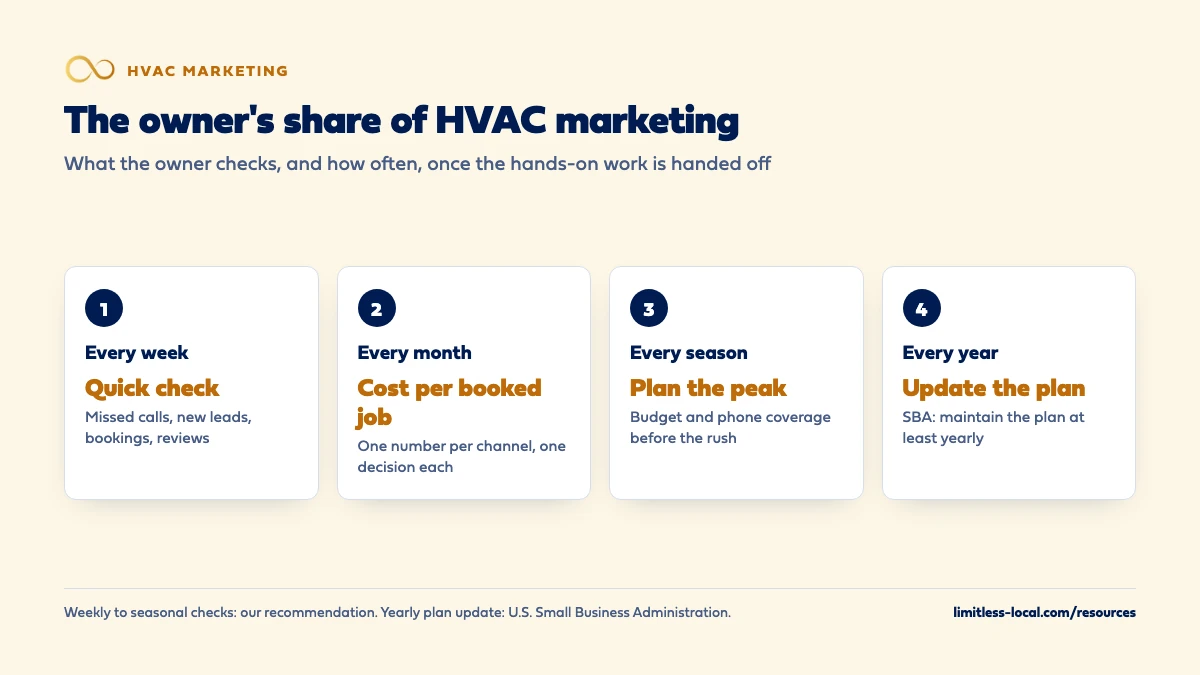
There’s no reliable hours-per-week benchmark for HVAC owners, so size your time by the job you keep, not by the clock. If someone else does the hands-on work, the owner’s share is a short weekly check on calls, booked jobs and reviews, a longer monthly look at cost per booked job, and a seasonal plan. The parts only the owner can do are the decisions (which jobs and towns to chase, the budget, how much work the crews can take) and keeping owner-level access to the accounts; replying to reviews, running ads and posting can all be handed off.
That’s the split we work to: the owner makes the decisions, and our team does the hands-on work and sends a monthly performance report with a cost-per-lead breakdown. Onboarding takes your team about 2-3 hours, then a monthly report and review, as laid out on our marketing packages page and our HVAC marketing page. If you’re still deciding whether to hand the work off at all, whether to hire an HVAC marketing agency covers that choice, and the HVAC marketing questions library goes question by question.
Is there a standard number of hours an HVAC owner should spend on marketing?
No. We looked for a published, sourced figure for HVAC owners and didn’t find one we’d stand behind, and any number you read is someone’s opinion of their own shop. The honest answer depends on one question: are you doing the marketing, or overseeing it?
An owner who writes the posts, builds the ads and answers every review is doing a part-time job, and the time it takes depends on how many channels they run. An owner who has handed the work to an office manager, a freelancer or an agency only needs enough time to make decisions and check results. That second job is smaller, but it doesn’t go away, and it’s the part this page is about.
The U.S. Small Business Administration’s marketing guide puts it plainly: marketing takes time, money and preparation, and one of the best ways to stay on schedule and on budget is to make a marketing plan. The plan is what turns “I should do more marketing” into a short list of things to check on a calendar.
Which parts of HVAC marketing can only the owner do?
In our judgement, four things, and none of them is about posting or clicking buttons:
- Which work to chase. Replacements or repairs, residential or light commercial, which towns are worth the drive. Nobody else knows your margins and your crews the way you do.
- The budget. How much you’ll spend, and the most you’ll pay for a booked job before a channel gets cut.
- Capacity. Whether the schedule has room for more calls next month. Marketing that brings in work you can’t run is wasted money.
- Ownership of the accounts. Your Google Business Profile, Google Ads account and website should be in the company’s name, with you holding the top level of access.
Everything else can be done by someone you trust, as long as they report back in calls and booked jobs, not activity.
What can I hand off without losing control?
Almost all of the hands-on work, because Google’s own tools let you give people access without giving away the business.
- Google Business Profile. Google’s page on owners and managers says additional owners and managers can edit info, respond to reviews and manage posts. Managers have mostly the same access as owners, except they can’t add or remove users or remove the profile. Give your office person or agency manager access, and keep the owner role yourself. Each person needs their own Google Account, so nobody has to share your password.
- Google Ads. Google lists five access levels: Email-only, Billing, Read-only, Standard and Admin. Standard can edit campaigns; only Admin can give account access, change access levels and unlink manager accounts. Google also notes that an account with a single admin may lose access to its tags if that person becomes unavailable, so add a second admin you trust.
- Review replies, photos and posts. These are routine once someone has the access and a few rules: reply to every review, keep it short, never argue in public.
What you shouldn’t hand off is the final say on spend and the admin keys. If you’re working with an agency, checking whether your agency is getting results covers how to confirm you own each account.
What should my weekly marketing check cover?
A weekly check is a quick look at whether the phone is working, not a strategy session. In our view it should answer five questions:
- Did calls get answered? Missed calls during business hours are the most expensive leak in HVAC marketing, and they show up first.
- How many new leads came in, and from where? Your call tracking or the lead source field in your field software answers this.
- How many of them booked? A busy phone with few bookings is a front-office problem, not a marketing one.
- Did any new reviews come in, and did someone reply?
- Is anything obviously off? Wrong hours on your Google profile before a holiday, an ad still running for a service you’ve stopped offering, a sudden drop in calls.
Your Google profile’s performance report shows views and actions such as taps on the call button, and owners and managers can both see it. Google notes the data includes interactions from both organic search and Google Ads, so treat it as a rough signal, not a booked-job count.
Curious what your marketing is actually booking?
Get a free visibility audit — no obligation, no sales pitch.
What should the monthly marketing review cover?
The monthly review is where the owner earns their keep. It’s one number per channel: what each booked job cost. Take what you spent on a channel, including any agency fee, and divide it by the jobs that channel booked. Then make one decision per channel: keep it, cut it or give it more.
The SBA’s example marketing plan does the same thing on a slower clock: the business sets a date to compare marketing costs with the revenue they produced, to see whether it got a positive return. The SBA also says marketing plans should be maintained at least once a year, and that measuring return on investment tells you which part of the plan is working and which needs updating.
If you don’t have the numbers to do this review, that’s the first thing to fix, and it’s a better use of an owner’s time than any amount of posting. Tracking whether your marketing pays off covers the setup.
How do I get the numbers without pulling them myself?
Have the people who handle the calls record the source, and let your software add it up. Your field software already does most of the work if the lead source is filled in on every job:
- ServiceTitan lets you set up marketing campaigns to track incoming leads and run marketing reports, and recommends a campaign for all your incoming business, including referrals and repeat customers. CSRs can attach a campaign to any call, which attaches it to the job.
- Jobber‘s Lead Source Report shows the number of leads by source and the first revenue tied to them, so you can see which channels bring in the most valuable work.
The owner’s job is to make filling in the source a rule, not a suggestion, and to look at the report once a month. A report nobody reads is the same as no report.
How much more time does setting up the marketing take?
A lot more than running it, and that’s normal. Setting up a Google profile properly, building service pages, connecting call tracking and writing the first ads are front-loaded work. Once it’s built, the ongoing owner time drops to the weekly, monthly and seasonal checks above.
That’s why it’s worth separating the two in your head. If the setup is what’s eating your evenings, the answer may be to hand off the build and keep the oversight. If you’re a small shop starting from scratch, the simplest marketing setup for a small HVAC company lists the pieces worth building first and a routine for keeping them up.

Where do HVAC owners waste time on marketing?
In our experience, the time goes to things that feel like marketing but don’t book jobs:
- Sales calls from vendors. Every pitch for leads, listings or a new app takes an hour you don’t get back. Decide your channels in the monthly review and say no to the rest by default.
- Reports full of activity. Impressions, clicks and “engagement” without a line for booked jobs. Ask for cost per booked job or stop reading.
- Fiddling with ads mid-week. Changing budgets and keywords every few days makes it impossible to tell what worked. Make changes on a schedule.
- Posting everywhere. A social account with your hours and number is fine; daily posting on every network rarely books HVAC jobs on its own.
- Rebuilding the website. A redesign every couple of years because the old one feels stale, while the service pages that would actually rank never get written.
How do I know I'm spending too little time on marketing?
Too little isn’t measured in hours either. These are the signs, in our judgement, that the owner’s part isn’t getting done:
- You can’t say what a booked job cost you last month, by channel.
- You don’t have owner access to your Google profile or admin access to your Google Ads account.
- Reviews sit unanswered for weeks.
- You don’t know how many calls were missed last week.
- The ad budget was set once and hasn’t been looked at since.
- You find out about a problem (a suspended profile, a dead tracking number, an ad pointing to a broken page) from a customer.
If two or more of those are true, a regular weekly and monthly check will do more for your marketing than more spend.
When does doing it yourself stop making sense?
When the marketing work starts competing with the work that pays you more. If an evening on ads means an estimate doesn’t get followed up or a tech doesn’t get trained, the trade is probably a bad one. Our guide on whether to hire a marketing agency walks through when an agency, a freelancer, an in-house hire or doing it yourself fits.
Whichever you pick, the owner’s share on this page doesn’t change. Handing off the work moves the hands-on hours to someone else; it doesn’t move the decisions, and it doesn’t move the responsibility for knowing what each booked job cost.
Not sure which of these is costing you jobs?
A free visibility audit checks the Google profile, reviews, site and tracking, and shows what to fix first.
What's different for HVAC owners
Your free time runs opposite to your marketing needs. In the first heat wave or cold snap, the owner is on calls, covering techs and juggling the schedule, which is exactly when ads and phones need the most attention. Do the planning in the spring and fall shoulder months, and set the rules for the busy weeks in advance: who raises or lowers the ad budget, who watches missed calls. Scaling up ads for peak season covers the order to do it in.
Your techs are part of the marketing. The review request, the photo of the finished install and the note about which lead source sent the call all happen in the field. Building those into the job close-out takes owner time once, then runs without you. Getting your techs to ask for reviews covers how.
Emergency calls set the standard. A no-heat call at night is a marketing result whether or not anyone answers it. Deciding who covers after-hours calls is an owner decision, not a marketing task.
A worked example: the monthly review in one page
These numbers are made up to show the math, not a benchmark. Say last month your Google Ads cost $3,000 in spend and booked 20 jobs, and your Google profile and website booked another 12 jobs with no ad spend behind them. Your Google Ads cost per booked job is $3,000 divided by 20, or $150. If your average repair ticket comfortably covers $150 plus the cost of the job, the owner decision is to keep it running and check again next month. If most of those bookings were small service calls, it may be time to point the budget at the jobs you want more of.
That’s the whole review: one division per channel and one decision. When we work with an owner, the time on their side starts with a 15-minute discovery call and an onboarding form that takes their team about 2-3 hours; after that, our monthly performance report breaks down cost per lead, and the owner’s job is the decision at the end of it.
Frequently asked questions
Should I let my office manager run our Google Business Profile?
Yes, as a manager. Google says managers can edit info, reply to reviews and manage posts, but can’t add or remove users or remove the profile, so you keep control as the owner.
Is it safe to give my marketing person admin access to Google Ads?
Give Standard access for day-to-day campaign work and keep Admin for yourself and one other trusted person. Only Admin users can give account access, change access levels and unlink manager accounts.
How often should I change my ad budget?
On a schedule, not on a hunch. In our judgement, a monthly decision with an extra check before each peak season is enough for most HVAC shops; when to raise, lower or pause ad spend covers the signals.
Do I need to post on social media every week?
Not to book HVAC jobs. A current page with your hours and number is enough for most shops; time is better spent on reviews, tracking and answering the phone.
How much of my time does an agency need once we start?
Most of it comes at the start, while the agency gets access, learns which jobs and towns you want and sets up tracking. After that, it should be a monthly review of results and the decisions only you can make.
Key takeaways
- There’s no sourced hours-per-week benchmark; size the owner’s time by the decisions, not the clock.
- Keep owner access to your Google profile and admin access to Google Ads; hand off the hands-on work.
- A weekly check covers missed calls, new leads, bookings and reviews.
- The monthly review is one number per channel: cost per booked job, then keep, cut or grow.
- Plan the busy season in the shoulder months, because there’s no owner time to spare during a heat wave.
Want a second set of eyes on your setup?
We'll look at how you show up locally and where calls are leaking, then send you a plain-English breakdown.
More in this section
- What should I do with the marketing after buying an HVAC business?
- How do I track whether my HVAC marketing is paying off?
- Should I market more before or after hiring another HVAC tech?
- How should HVAC marketing change once you have 10 or more trucks?
- How competitive is HVAC marketing in my area, and how do I check?
Sources
- Manage your business: marketing and sales — U.S. Small Business Administration
- Manage your Business Profile owners & managers — Google Business Profile Help
- About access levels in your Google Ads account — Google Ads Help
- Understand your Business Profile performance & insights — Google Business Profile Help
- Add marketing campaigns in ServiceTitan — ServiceTitan Help
- Lead Source Report — Jobber Help Center