
At what close rate do roofing ads pay for themselves?

- What's the break-even close rate for a roofing company's ads?
- What does "pay for themselves" mean for roofing ads?
- What's the formula for a break-even close rate?
- What numbers do I need to work it out?
- Why do repairs and replacements break even at such different close rates?
- Should management fees count toward break-even?
- Should I use close rate per lead or per inspection?
- What if my close rate is below break-even?
- Is break-even good enough?
- How long should I wait before I calculate my close rate?
- Can Google Ads use my close rate to bid better?
- What's different for roofing companies
- A worked example: four break-even close rates
- Frequently asked questions
- Key takeaways
- More in this section
- Sources
The short version
- Break-even close rate = cost per lead ÷ gross profit per signed job.
- Use gross profit (after materials, labor and job costs), not the contract price.
- Include management fees and tools in cost per lead, not just ad spend.
- Replacements break even at a far lower close rate than repairs.
For roofing owners who want the one number that says whether their ads are making money: the close rate where ad costs and gross profit meet.
Get a free visibility audit · Book a growth call
What's the break-even close rate for a roofing company's ads?
Roofing ads pay for themselves once the share of leads you sign is higher than your cost per lead divided by the gross profit on an average signed job. In a made-up example, at $100 a lead and $3,600 gross profit per replacement, you break even by signing about one lead in 36 (2.8%); on a $1,000 repair that leaves $500 gross profit, you need one in five. Count everything you pay to run the ads, including management fees, and use gross profit, not the contract price.
This is the math we run with roofers before talking budget: what each lead costs all-in, what a signed job leaves after costs, and the close rate that makes the two meet. Our local ads management includes call tracking and reporting with a cost-per-lead breakdown, so the inputs are there every month, and our roofing marketing page shows how we work with roofers. For the bigger question of whether ads suit your company at all, read whether Google Ads are worth it for roofers, and the rest of the roofing marketing questions library goes question by question.
What does "pay for themselves" mean for roofing ads?
Your ads pay for themselves when the gross profit from the jobs they sign covers everything you spent to get those jobs. Not the revenue. The profit left after the job’s own costs.
Gross profit is your sales minus the direct costs of the work (Gross profit margin, BDC). For a roof, that means the contract price minus materials, crew labor, dumpsters, permits and anything else the job itself eats. A $12,000 replacement doesn’t bring $12,000 home, so it can’t be weighed against your ad bill as if it did.
On the other side goes everything you pay to run the ads: the spend to Google, any management fee, call tracking, landing pages. If you leave the fee out, the math will tell you the ads are paying when they aren’t.
What's the formula for a break-even close rate?
It comes from the standard break-even idea, the same one behind the SBA’s break-even point calculator: fixed costs divided by what each sale leaves you after its own costs. For ads, it becomes:
Break-even close rate = cost per lead ÷ gross profit per signed job
Here’s why it works. Each lead costs you a set amount. Each signed job pays back its gross profit. If one lead costs $100 and a signed job leaves $3,600, you need to sign one lead out of every 36 to cover the cost of all 36. That’s a close rate of about 2.8%.
Anything above that close rate is profit the ads earned. Anything below means you’re paying more for leads than the jobs give back.
Flip it around to sanity-check your ads: the most you can afford per lead = your close rate × gross profit per signed job. If you sign one lead in five and a job leaves $500, you can afford up to $100 a lead and still break even.
What numbers do I need to work it out?
Three, all from your own books and accounts:
- Cost per lead, all-in. Last quarter’s ad spend plus fees and tools, divided by the real roofing leads the ads brought in. Leave out junk calls and job seekers, and count each homeowner once.
- Average signed job value. The average contract price of jobs that came from those ads, not from referrals or door knocking.
- Gross margin on those jobs. What share of the contract price is left after the job’s direct costs. Your bookkeeper or job-costing report has it.
Multiply the average job value by your gross margin to get gross profit per signed job, then divide cost per lead by that figure.
Your field software can carry much of this. Jobber’s quotes report, for example, tracks a quote conversion rate and the value of quotes sent and converted each month (Quotes Report). Tag where each lead came from, and you can pull the same numbers for ad leads only.
Why do repairs and replacements break even at such different close rates?
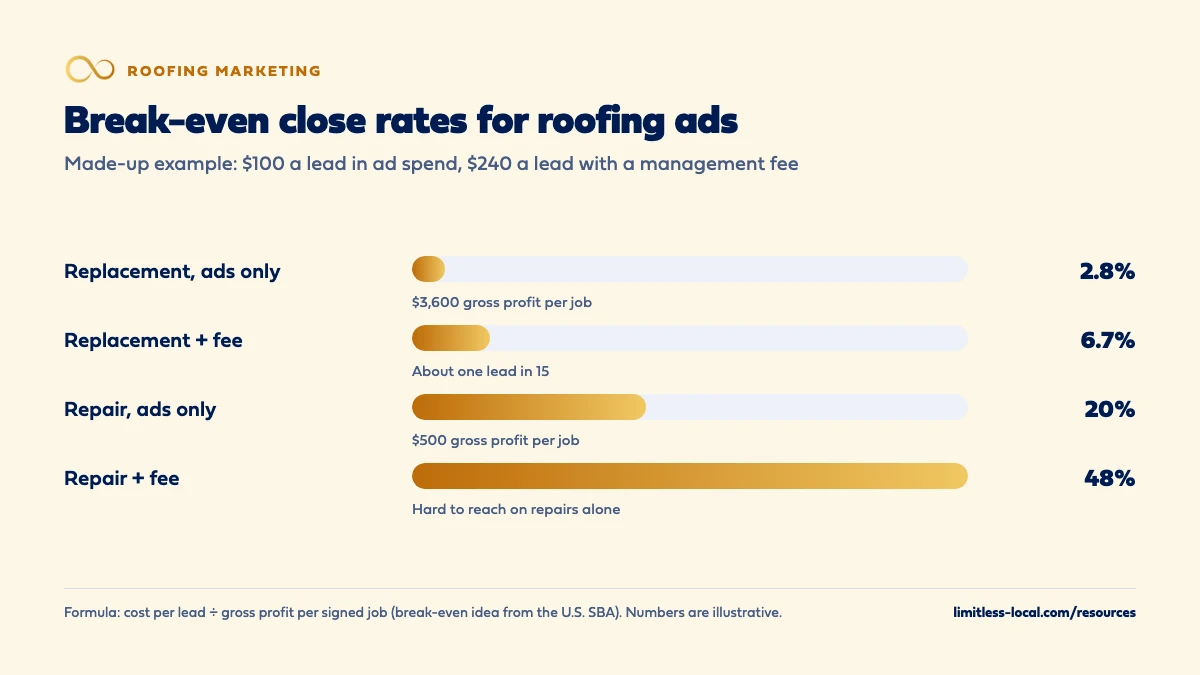
Because the gross profit per job is so different. Using made-up numbers at the same $100 per lead:
- A replacement leaving $3,600 in gross profit breaks even at about 2.8%, roughly one signed job for every 36 leads.
- A repair leaving $500 in gross profit breaks even at 20%, one signed job for every five leads.
That’s a huge gap. An ad campaign that pulls mostly repair calls has to close a lot of them to pay its way. One that pulls replacement leads can afford a low close rate and still make good money.
So work out the break-even separately for each type of job, and look at which kind your ads actually bring. If most of your ad leads are small repairs, aiming the ads at replacement searches may matter more than any change to your sales process. Whether to market roofing repairs or replacements covers that choice.
Curious what your marketing is actually booking?
Get a free visibility audit — no obligation, no sales pitch.
Should management fees count toward break-even?
Yes. A fee is part of what each lead costs you, and leaving it out flatters the ads.
Here’s how much it moves the line, still with made-up lead counts. Say you spend $2,500 a month on Google Ads and get 25 real leads, so $100 a lead in ad spend. Add a $3,500 monthly management fee, the price of our Essentials package, which manages Google Ads spend up to $2,500 a month, and your all-in cost is $6,000, or $240 a lead.
- For replacements leaving $3,600: break-even goes from about 2.8% to about 6.7%, roughly one job in 15 leads.
- For repairs leaving $500: break-even goes from 20% to 48%.
The replacement math still works comfortably for most roofers who close well. The repair math gets very hard. That’s not a reason to avoid outside help; it’s a reason to know which jobs your ads are for. Ad spend isn’t included in any of our packages and is paid directly to Google, so always add the two together when you run this.
Should I use close rate per lead or per inspection?
Use per lead for the break-even, because that’s how you pay for ads. But track both, because they tell you where the leak is.
- Lead to inspection: what share of real leads you get on a roof. A low number points at speed, phone handling or lead quality.
- Inspection to signed job: what share of inspections you close. A low number points at pricing, the estimate or follow-up.
Multiply the two and you get your close rate per lead. If 40% of leads book an inspection and you sign half of those inspections, your close rate per lead is 20%.
You can also run the break-even per inspection: cost per inspection divided by gross profit per signed job. It’s useful if you buy appointments rather than leads. What close rate a roofer should expect from online leads covers what’s realistic for each step.
What if my close rate is below break-even?
You have four levers, and only one of them is the ads:
- Lower cost per lead. Block junk search terms, tighten the towns and job types, cut what doesn’t sign.
- Raise the close rate. Call back faster, book inspections on the first call, follow up on every unsigned estimate. How to follow up on unsigned roofing estimates covers the follow-up.
- Shift the job mix toward the work with more gross profit per job, usually replacements.
- Raise gross profit per job through pricing or job costs. That’s your business, not your marketer’s, but it moves the break-even line as much as anything else.
Before you touch anything, find out which side is short. If the leads are real and well-handled but don’t sign, it’s a sales problem; if they’re wrong from the first call, it’s a targeting problem. Whether it’s the marketing or the sales process when leads don’t close helps you tell which.
Is break-even good enough?
No. Break-even is the floor, not the goal. At break-even the ads pay for themselves but leave nothing for overhead, your office, your time or profit.
A better way to set your target is to decide what share of a job’s gross profit you’re willing to spend to win it. If you’ll spend a quarter of gross profit on marketing, your target close rate is four times your break-even close rate. If break-even is about 2.8% on replacements, the target becomes about 11%.
That share is your call, and it depends on your overhead and what other channels cost you. What cost per booked job a roofing company should aim for walks through setting it.
How long should I wait before I calculate my close rate?
Longer than a month, in most cases. A roofing lead often needs an inspection, an estimate and some back-and-forth, and insurance jobs can wait weeks on an adjuster. If you calculate close rate at the end of the month, many of that month’s leads haven’t had time to sign yet, and your close rate looks worse than it is.
Two ways to handle it:
- Use a quarter and let the leads from early in the quarter finish their sales cycle before you judge.
- Close the books late: calculate last month’s close rate a month or two after it ends, once most of its estimates are signed or dead.
Also look at enough leads to mean something. With a handful of leads, one more or one fewer signed roof swings the close rate wildly.
Can Google Ads use my close rate to bid better?
It can, if you tell it which leads signed. Google Ads lets you import offline conversions, so a call or form that later turns into a sale at your office or over the phone gets counted back to the ad that started it (About offline conversion imports). Google now recommends starting with enhanced conversions for leads, an upgraded version that’s easier to set up.
With signed jobs and their values coming back in, the bidding can lean toward the searches that sign, not just the ones that call. For a roofer, that’s the difference between optimizing for any call and optimizing for replacement contracts.
It takes some setup and a steady habit of marking leads as signed in your software. But it’s the most direct way to get the ads working toward the close rate that actually pays you.
Not sure which of these is costing you jobs?
A free visibility audit checks the Google profile, reviews, site and tracking, and shows what to fix first.
What's different for roofing companies
High tickets make the math forgiving. A trade with small tickets can’t break even signing one lead in 36. A roofer selling replacements often can, which is why a roofer can afford a higher cost per lead than a trade with smaller jobs.
Small samples swing hard. One more or one fewer signed replacement changes the month’s close rate a lot. Judge over a quarter.
Storm work skews it. After a storm, leads and close rates jump, then fall back. Run the break-even for normal months separately, so a good storm season doesn’t hide ads that lose money the rest of the year.
Insurance jobs change the timing, not the formula. The job still has a gross profit and the lead still had a cost. It just takes longer to see whether it signed.
A worked example: four break-even close rates
These numbers are made up to show the math, not a benchmark for your market. Say a roofer spends $2,500 a month on Google Ads and gets 25 real leads, so $100 a lead in ad spend. Their average replacement is $12,000 at a 30% gross margin, leaving $3,600. Their average repair is $1,000 at a 50% gross margin, leaving $500.
- Replacement, ad spend only: $100 ÷ $3,600 = about 2.8%.
- Replacement, with a $3,500 fee: $240 ÷ $3,600 = about 6.7%.
- Repair, ad spend only: $100 ÷ $500 = 20%.
- Repair, with the fee: $240 ÷ $500 = 48%.
If this roofer signs one lead in five and most leads are replacements, the ads are well past break-even even with the fee. If most leads are repairs, the same close rate barely covers the ad spend alone. A free visibility audit runs this with your own numbers.
Frequently asked questions
Is a 10% close rate good for roofing ads?
It depends entirely on your cost per lead and gross profit per job. On replacements with a healthy margin, 10% can be well past break-even; on small repairs, it may not cover the ad spend. Run the formula with your own numbers.
Should I count referrals and door knocking in my close rate?
Not when you’re judging ads. Referrals usually close far better than ad leads, so mixing them in makes the ads look better than they are. Tag every lead’s source and calculate ad close rate on ad leads only.
What if I don't know my gross margin?
Start with a rough job-costing of a few recent jobs: contract price minus materials, crew labor, disposal and permits. A rough number is far better than using the contract price, which makes every channel look profitable.
Do Local Services Ads change the break-even math?
No, only the input. You pay per lead instead of per click, which makes cost per lead easy to read. The formula stays cost per lead divided by gross profit per signed job.
Should the cost of my own time count?
If you or a salesperson spend hours on each inspection, that’s a real cost of winning the job. Many owners leave it out of the ad math and cover it in their target margin instead, which works as long as you’re consistent.
How often should I recalculate my break-even close rate?
Every quarter, and whenever something big changes: a new fee, a price increase, a shift toward repairs or replacements, or a jump in cost per lead.
Key takeaways
- Break-even close rate = cost per lead ÷ gross profit per signed job.
- Use gross profit, not the contract price, and include management fees in cost per lead.
- Replacements can break even at a very low close rate; repairs need a much higher one.
- Break-even is the floor; set a target close rate based on the share of gross profit you’re willing to spend.
- Judge close rate over a quarter, after estimates have had time to sign.
Want a second set of eyes on your setup?
We'll look at how you show up locally and where calls are leaking, then send you a plain-English breakdown.
More in this section
- What happens to roofing leads if I stop paying for ads?
- How much should a roofer spend on ads before calls are steady?
- What are the quickest ways to get roofing leads without paid ads?
- Is $1,000 a month enough for roofing marketing?
- Why are my roofing ads getting clicks but no calls?
Sources
- Break-even point calculator — U.S. Small Business Administration
- Gross profit margin — BDC (Business Development Bank of Canada)
- Quotes Report — Jobber Help Center
- About offline conversion imports — Google Ads Help