
How do I grow my HVAC company past $5 million with marketing?

- What marketing changes help an HVAC company grow beyond $5 million a year?
- What changes about HVAC marketing past $5 million?
- Step 1: Know what each channel earns, not just what it brings in
- Step 2: Match marketing to crew capacity
- Step 3: Grow the work that grows the number
- Step 4: Add service areas and locations the right way
- Step 5: Build reviews and reputation across every crew
- Step 6: Track results by territory
- Step 7: Decide who runs marketing
- Step 8: Keep ownership of every marketing account
- How much should marketing spend grow as the company grows?
- What are the signs marketing is holding growth back?
- Does buying another HVAC company change the marketing plan?
- What's different about growing an HVAC company at this size
- A worked example: working back from $1 million in added revenue
- Frequently asked questions
- Key takeaways
- More in this section
- Sources
The short version
- Track revenue and profit by channel and by territory, not just leads.
- Market to the capacity you have or are hiring for, not to the phone.
- Weight the marketing toward replacements, maintenance plans and commercial agreements.
- Put one accountable person in charge, and keep ownership of every account.
For owners of established HVAC companies who’ve outgrown running marketing from the truck and want it to carry the next stage of growth.
Get a free visibility audit · Book a growth call
What marketing changes help an HVAC company grow beyond $5 million a year?
Past $5 million, marketing grows an HVAC company less by buying more calls and more by being run like a department: revenue and profit tracked by channel and territory, ad spend matched to crew capacity, new service areas added only where you have trucks and staff, reviews coming in from every tech, and one accountable person in charge. The work that moves the number at this size is usually replacements, maintenance plans and commercial agreements, so build the marketing around those. Then scale what the numbers show is working, in steps your hiring can keep up with.
That’s the stage our Scale tier is built for: custom pricing, unlimited multi-location SEO, Local Services Ads across multiple markets, custom follow-up and custom attribution and dashboards. We build the foundation first, turn on lead flow around the towns and jobs you want, then improve it every month based on calls, leads and revenue. See how it fits on our HVAC marketing page. The HVAC marketing guide covers every channel, and the rest of the HVAC marketing questions library goes question by question.
What changes about HVAC marketing past $5 million?
Mostly, the owner can’t be the marketing department anymore. Below that size, a lot of shops grow on the owner’s reputation, a decent Google profile, some ads and a busy summer. Past it, three things change.
- Mistakes cost more. A campaign that wastes money for a month at this size wastes real money, and nobody notices if nobody owns it.
- Channels start to overlap. Trucks, mailers, reviews, ads and brand searches all feed each other, so it gets harder to tell what’s actually working.
- Capacity becomes the ceiling. Getting calls is rarely the hard part anymore. Having the techs, CSRs and install crews to run them profitably is.
The steps below deal with those three changes, so each marketing dollar’s results are visible and you can put more behind what works.
Step 1: Know what each channel earns, not just what it brings in
At this size, lead counts aren’t enough to steer by. You need revenue and gross profit by channel, net of what each channel cost, ideally split into first jobs and repeat work.
That means every job in your field software carries a lead source, each channel has its own tracking number where possible, and someone reviews the numbers every month. A channel that brings in plenty of calls but mostly low-margin work can quietly hold the company back, while a smaller channel that feeds replacements and plan sign-ups deserves more budget.
How to work out the revenue and profit each channel produces walks through the math, including what to count as a channel’s cost and how to handle jobs that no channel claims.
Step 2: Match marketing to crew capacity
More calls only help if someone can run them. Before turning up the budget, check what’s limiting you:
- Service techs. If the board is full by mid-morning in peak season, more repair calls just push work to next week or to a competitor.
- Install crews. More sold replacements need more crew days. A backlog of weeks loses some of the jobs you already sold.
- The office. More calls need more CSRs, and the booking rate is often the first thing to slip when the phones get busier.
- Comfort advisors or estimators. Replacement leads that wait days for an appointment cool off.
Plan hiring and marketing together. Raise spend in steps, a few weeks ahead of the hires who’ll run the work, and watch the booking rate and cost per booked job after each step. If either one slips, stop and fix the bottleneck before the next step.
Step 3: Grow the work that grows the number
At this stage, the fastest way to add revenue usually isn’t more small service calls. It’s more of the higher-value work:
- Replacements. Each sold system is worth many repair calls, so dedicated replacement campaigns, landing pages and estimate follow-up pull more weight than another repair ad.
- Maintenance plans. Plan members book visits without new marketing and give your techs a regular look at older systems. A growing plan base also evens out the slow months.
- Commercial agreements. If you do commercial work, service agreements bring steady revenue that isn’t tied to the weather.
This is where splitting your marketing by customer type pays off. How to segment your HVAC marketing audience covers the different messages and channels for emergency, replacement, maintenance, landlord and commercial customers.
Step 4: Add service areas and locations the right way
Growing into new towns or opening another location is often the biggest growth lever past $5 million, and the easiest to get wrong on Google.
Google’s guidelines for representing your business set the rules:
- A service-area business should have one profile for the central office or location, with a designated service area.
- If you have different locations with separate service areas and separate staff at each, you’re allowed one profile for each location.
- The boundaries of a profile’s service area shouldn’t extend farther than about 2 hours of driving time from where the business is based, though Google notes larger areas may be appropriate for some businesses.
- A virtual office, a rented mailing address you don’t operate from, isn’t eligible for a profile.
So a second location needs a real, staffed base, not just an address. And before you open it, check that your current area is close to full. How to market a second HVAC location covers the launch.
Curious what your marketing is actually booking?
Get a free visibility audit — no obligation, no sales pitch.
Step 5: Build reviews and reputation across every crew
Reviews stop being the owner’s job and become a system. With many techs in the field, the number of reviews you collect depends on whether every tech asks, every time, and whether the ask is easy.
- Make the review request part of closing out every job, sent automatically by text or email.
- Track review counts by tech, and talk about them at team meetings.
- Reply to every review, good or bad, from one consistent voice.
- If you have more than one location, make sure each profile gets its own steady flow, not just the original one.
Your name becomes marketing in its own right at this size. Wrapped trucks, yard signs, sponsorships and years of happy customers lead people to search for your company by name. Those brand searches are some of your cheapest calls, so protect them with a clean Google profile and a website that makes the next step obvious.
Step 6: Track results by territory
A company-wide cost per booked job can hide a town that’s losing money behind two that are doing well. Once you serve several areas, look at results by territory.
In Google Ads, location targeting lets you show ads to people in, regularly in or who’ve shown interest in the locations you choose. By default it uses both physical location and location of interest, and you can change that in the advanced location options. Separate campaigns or location settings for each territory let you set budgets by area and see which ones pay.
Do the same in your field software: tag jobs by territory as well as lead source. Then you can see whether a distant town’s jobs are worth the drive time, or whether the budget would earn more closer to the shop.
Step 7: Decide who runs marketing
Someone has to own it, and at this size it shouldn’t be the owner on nights and weekends. The usual options:
- An in-house marketing manager. Knows the company well and can coordinate with the office and field. Needs either the skills or the budget to manage specialists.
- An agency. Brings a team of specialists for ads, SEO and tracking. Needs a clear owner on your side who reviews results.
- Both. An in-house manager who sets direction and an agency that does the specialist work is a common setup at this size.
Whatever you choose, your role changes to setting targets (cost per booked job, booked jobs by type, territory goals) and reviewing results monthly. Whether to outsource HVAC marketing or keep it in house covers the trade-offs in more depth.

Step 8: Keep ownership of every marketing account
As more people touch the marketing, make sure the company owns everything: the Google Ads account, the Google Business Profiles, the website and domain, the analytics, the call tracking numbers and the customer lists.
Google’s page on access levels in your Google Ads account lists email-only, billing, read-only, standard and admin access. It also notes that if an account has only one administrator, you may lose access to your tags if that user becomes unavailable, and that adding at least one more administrator may help ensure uninterrupted tag management.
In practice: keep at least two admins who work for your company, give agencies and staff the lowest access that lets them do the job, and review the user list whenever someone leaves.
How much should marketing spend grow as the company grows?
Tie it to cost per booked job, not to a percentage of revenue. A percentage target can tell you to spend more in a year when your crews are already full, or less in a year when a new territory needs a push.
A better approach: set a target cost per booked job for each job type, work out how many booked jobs your crews can run next year, and multiply. That’s the budget. If the result is more than you’re comfortable with, grow capacity or improve booking rates first.
Spend usually rises in steps rather than a smooth line, because each step lines up with new hires, a new territory or a new service line.
What are the signs marketing is holding growth back?
A few patterns show up in companies that stall past $5 million:
- One channel carries everything. If most jobs come from one source, a change in that platform can cut your calls overnight.
- Nobody can say what works. If the answer to “which channel pays best?” is a guess, budget decisions are guesses too.
- The office books a falling share of calls. Growth that adds calls but not booked jobs is mostly adding cost.
- Reviews have stalled. More jobs with flat review counts usually means the ask has fallen out of the routine.
- The phones are full of small jobs. Busy isn’t the same as growing if the work is mostly low-margin.
Each of these is fixable, and fixing them is often worth more than any new channel.
Does buying another HVAC company change the marketing plan?
Yes. An acquisition brings its own marketing work: a second brand, its Google profiles and reviews, its phone numbers, its customer list and maybe a different field software. Decide early whether to keep the acquired brand, merge it into yours or run both for a while, and plan the Google profiles, websites and tracking numbers around that decision.
The acquired customer list is often the most valuable marketing asset in the deal. Bring it into your segments, so plan members, older systems and past customers each get the right message from day one. Marketing after buying an HVAC business covers the first months after a purchase.
Not sure which of these is costing you jobs?
A free visibility audit checks the Google profile, reviews, site and tracking, and shows what to fix first.
What's different about growing an HVAC company at this size
Seasonal hiring sets the pace. HVAC demand comes in two peaks, so capacity has to be ready before each one. Marketing that ramps up after the first heat wave is buying calls you can’t run; marketing that ramps up after the techs are hired and trained is buying work you can.
Replacements carry the growth. A sold system is worth many service calls, so a few points on your replacement close rate or a few more booked estimates a week can move the year more than a big jump in repair calls.
Maintenance plans smooth the year. A large plan base keeps techs busy in the shoulder months and feeds replacements later, which makes the slow seasons less of a drag on growth.
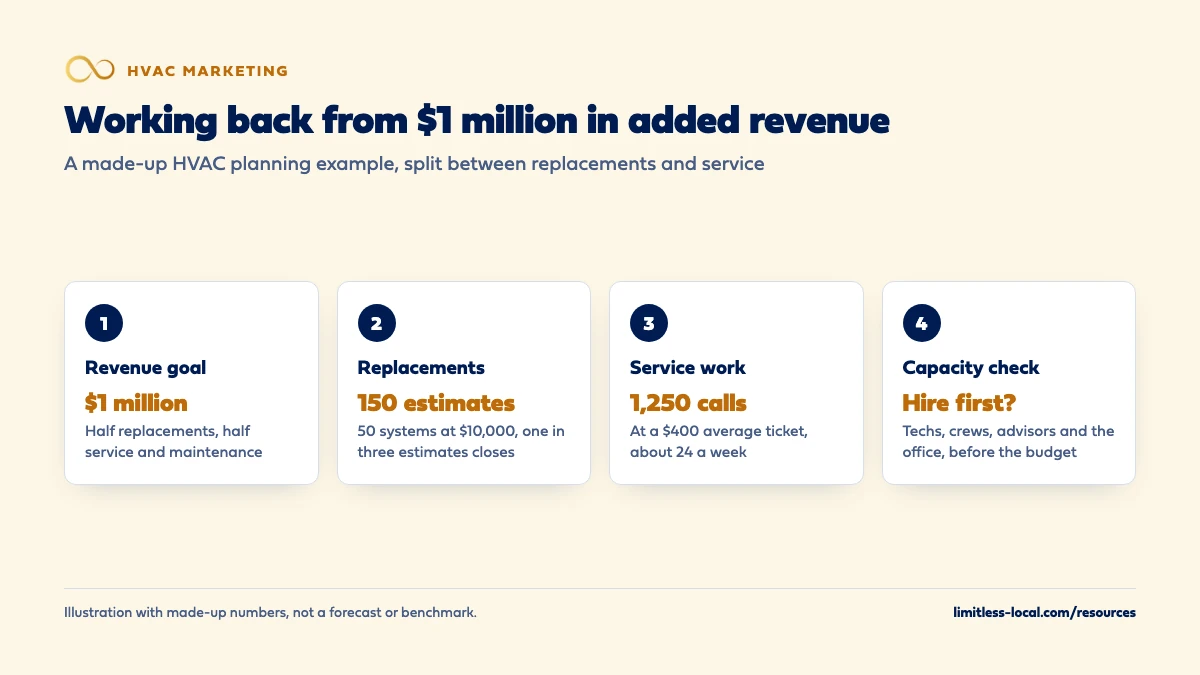
A worked example: working back from $1 million in added revenue
These numbers are made up to show the planning math. They aren’t a forecast or a benchmark for HVAC companies.
Say a $5 million HVAC company wants to add $1 million next year, and plans for half to come from replacements and half from service and maintenance.
- Replacements: $500,000. At a made-up average of $10,000 per system, that’s 50 more sold systems. If one in three booked estimates closes, that’s 150 more booked estimates, about three a week.
- Service and maintenance: $500,000. At a made-up average ticket of $400, that’s 1,250 more paid calls, or about 24 a week.
Now the capacity questions. Can the comfort advisors run three more estimates a week, and can the install crews handle about one more system a week? Can the service techs absorb about 24 more calls a week, or does someone need to be hired first? Can the office book that many more calls without the booking rate slipping?
Only once those answers are clear does the marketing budget follow: the number of booked estimates and booked calls you need, times your target cost per booked job for each.
Frequently asked questions
Should I spend a set percentage of revenue on marketing at this size?
A percentage is a rough check, not a plan. Work from the booked jobs your crews can run and your target cost per booked job for each job type, then compare the result with your percentage as a sanity check.
Do I need a marketing manager once I pass $5 million?
You need someone accountable for it. That can be an in-house manager, an agency with a clear owner on your side, or both. What doesn’t work at this size is nobody in charge.
Should each location have its own website?
Usually not. One website with a strong page for each location and service area is easier to keep up and builds on one domain. Each staffed location can have its own Google Business Profile.
Is it better to grow into new towns or go deeper in the ones I serve?
Go deeper first, if your current area isn’t full. New towns cost more to break into and add drive time. Expand once your core area’s results start to level off.
How often should I review marketing results at this size?
Monthly for budget and channel decisions, with a weekly look at calls, booking rate and booked jobs. Compare months with the same months last year, because the seasons swing every number.
Key takeaways
- Past $5 million, marketing needs to run like a department, with an accountable owner and monthly reviews.
- Track revenue and profit by channel and territory, and match spend to crew capacity.
- Weight marketing toward replacements, maintenance plans and commercial agreements.
- Add locations only with a real, staffed base, following Google’s Business Profile rules.
- Keep company ownership of every account, with at least two admins who work for you.
Want a second set of eyes on your setup?
We'll look at how you show up locally and where calls are leaking, then send you a plain-English breakdown.
More in this section
- How do I grow my HVAC company with marketing?
- How do I scale my HVAC business with marketing?
- How much revenue should I expect from my HVAC marketing budget?
- What should I do with the marketing after buying an HVAC business?
- What percent of revenue should an HVAC company spend on marketing?
Sources
- Guidelines for representing your business on Google — Google Business Profile Help
- About targeting geographic locations — Google Ads Help
- About access levels in your Google Ads account — Google Ads Help