
How do I tell if an SEO offer for my HVAC company is a scam?

- What are the warning signs of an SEO scam aimed at HVAC contractors?
- What are the quickest signs an SEO offer is a scam?
- Red flag: a call that says it's from Google
- Red flag: an email saying your site isn't showing up
- Red flag: a promised top spot on Google or in the map pack
- Red flag: "we're a Google partner" or "approved by Google"
- Red flag: they won't say what they'll actually do
- Red flag: hundreds of backlinks or directory submissions for a flat fee
- Red flag: they want your logins or to own your accounts
- Red flag: an "AI search" package built on tricks
- What should I ask an SEO company before I sign anything?
- What do I do if I already paid for a bad SEO deal?
- Why HVAC companies get so many of these offers
- A worked example: pricing out a "top of Maps" offer
- Frequently asked questions
- Key takeaways
- More in this section
- Sources
The short version
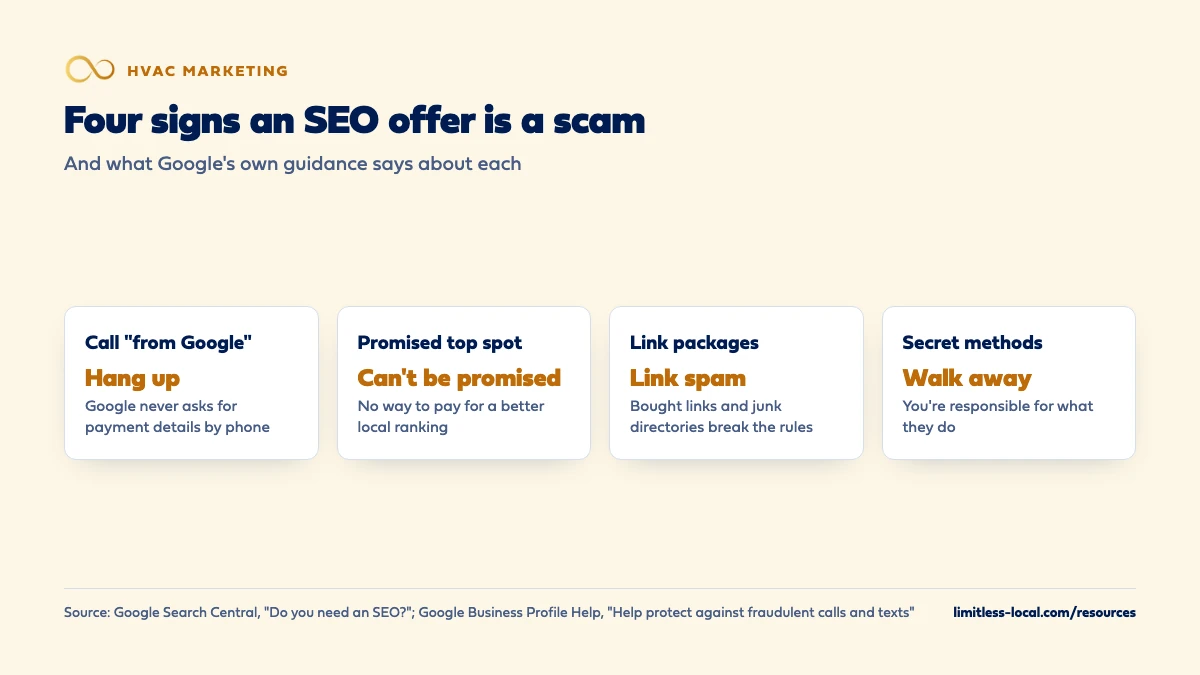
- Google never calls to sell rankings or asks for payment details over the phone.
- No one can promise a top ranking; Google says so in its own hiring advice.
- Link packages and mass directory submissions are what Google's link spam policy describes.
- A real offer explains the work, shows checkable results and leaves you owning every account.
For HVAC owners getting calls, texts and emails offering to get them to the top of Google, and trying to tell a real offer from a bad one.
Get a free visibility audit · Book a growth call
What are the warning signs of an SEO scam aimed at HVAC contractors?
Treat an SEO offer as a likely scam if it comes out of the blue, promises a top ranking or a map pack spot, claims a special relationship with Google, or won’t explain exactly what it will do. Google says no one can guarantee a #1 ranking, it never takes money to rank sites in its organic results, and there’s no way to pay for a better local ranking. A real SEO offer names the work, shows past results you can check, and leaves you owning your website, Google Business Profile and accounts.
We sell SEO, so this is the standard we hold ourselves to: we won’t guarantee rankings, because nobody honestly can, and you’ll know what we’re doing, why, and what it produced. Our local SEO service for HVAC companies is reported in calls and booked jobs. If you’re comparing agencies, how to choose an HVAC marketing agency covers the shortlist, and the rest of the HVAC marketing questions library goes question by question.
What are the quickest signs an SEO offer is a scam?
Most bad SEO offers give themselves away in the first minute. Google’s own advice on hiring an SEO names the warning signs, and they map closely to what lands in an HVAC owner’s inbox:
- It came to you unasked, by cold email, text or robocall.
- It promises a top spot on Google or in the map pack.
- It claims a “special relationship” with Google or a “priority submit”.
- It won’t explain clearly what it will do to your site or profile.
- It talks about link packages or submitting your site to hundreds or thousands of places.
One of these doesn’t prove fraud; a legitimate company can send a cold email. Two or more, in our judgement, is enough to walk away. The sections below take each one in turn. Source: Do you need an SEO?.
Red flag: a call that says it's from Google
Google has a whole help page about this one. It says people and companies make suspicious calls saying they work “with Google” or “for Google” and sell marketing services. Its rules for Google’s own calls are clear:
- Google will never ask you for payment information over the phone or guarantee you a special spot in its products.
- You won’t be asked to sign up for a service, pay money or give personal information.
- Its automated calls are about things like checking your business details on Maps, and you can opt out by saying so.
If someone calls claiming to be Google, Google’s advice is to hang up and not press any buttons, even if the recording tells you to, because that can lead to more calls. In the US, you can report repeat calls to the FTC through donotcall.gov, and tell Google through its complaint webform. And if the pitch is that your listing will be removed unless you pay to verify it: Google says you can add or claim your Business Profile at no charge. Sources: Help protect against fraudulent calls and texts and Add or claim your Business Profile.
Red flag: an email saying your site isn't showing up
“I visited your website and noticed that you are not listed in most of the major search engines and directories…” is a template so old Google quotes it in its own guide, and says it gets these spam emails too. Google’s advice is to be wary of SEO firms and consultants that email you out of the blue, and to treat unsolicited email about search engines with the same skepticism you’d give “burn fat at night” diet pills.
The quick check takes a minute. Search Google for your company name and for your main service plus your town. If you show up, the email’s premise is false. If you don’t, that’s worth fixing, but not by the stranger who emailed you. Source: Do you need an SEO?.
Red flag: a promised top spot on Google or in the map pack
Google’s hiring guide says it plainly: no one can guarantee a #1 ranking on Google, and if an SEO guarantees their changes will give you first place, find someone else. For the map results, Google says there’s no way to request or pay for a better local ranking, and that local results are mainly based on relevance, distance and popularity. Distance from the homeowner searching is something nobody can change for you.
Watch for softer versions of the same promise, such as these made-up examples of typical pitch wording: “page one in 30 days”, “top 3 in Maps or you don’t pay”, “we’ll get you ranked in every city you serve”. In our judgement, any offer that names a position and a date is selling something it can’t control. What an honest SEO can tell you is what work they’ll do, how long it usually takes to show, and how they’ll measure it. Sources: Do you need an SEO? and Tips to improve your local ranking on Google.
Red flag: "we're a Google partner" or "approved by Google"
Google tells you to beware of SEOs that allege a “special relationship” with Google or advertise a “priority submit” to Google. It also says it doesn’t evaluate third-party SEO services, so be wary of claims that a service is somehow acceptable or approved by Google Search. Third-party tools don’t have access to Google’s internal ranking data, and any predictions they make are their own.
Don’t let a badge or a logo do the convincing. Google never accepts money to include or rank sites in its search results, and it says advertising with Google has no effect on your site’s presence in organic results. Any program that suggests paying it will move you up in the regular results or Maps is describing something Google says doesn’t exist. Sources: Do you need an SEO? and Guidance on third-party SEO tools, services, and advice.
Curious what your marketing is actually booking?
Get a free visibility audit — no obligation, no sales pitch.
Red flag: they won't say what they'll actually do
“Proprietary process”, “our secret method”, “we can’t share that” should all end the call. Google says to be careful if a company is secretive or won’t clearly explain what it intends to do, and to ask for explanations if anything is unclear. It gives two reasons that should matter to any owner:
- If an SEO creates deceptive or misleading content on your behalf, your site could be removed entirely from Google’s index.
- You’re responsible for the actions of any company you hire.
Google adds that if an SEO has server access, they should be willing to explain every change they make to your site. A real proposal lists the work: which pages get written or fixed, what changes on your Business Profile, how reviews get requested, where links come from and what the monthly report shows. Source: Do you need an SEO?.
Red flag: hundreds of backlinks or directory submissions for a flat fee
Google says to avoid SEOs that talk about link popularity schemes or submitting your site to thousands of search engines, calling them typically useless exercises that don’t affect your ranking, at least not in a way you’d like. Its spam policies go further: buying links for ranking purposes, automated link building, and low-quality directory or bookmark links are all examples of link spam, and sites that break the policies may rank lower or not appear in results at all.
So an offer of “500 backlinks” or “listed in 300 directories” (made-up examples of the usual pitch) isn’t a bargain. In our judgement, it’s the offer most likely to leave you worse off than doing nothing. Real links for an HVAC company come from the brands, suppliers, associations and community groups you actually work with, as covered in how an HVAC company earns backlinks. Sources: Do you need an SEO? and Spam policies for Google web search.
Red flag: they want your logins or to own your accounts
A legitimate SEO works inside accounts you own. Google’s hiring advice says that if an SEO offers an audit, give them read access to Search Console only, and not write access at that stage. In our judgement, they should be added as a user on your Business Profile while you stay the owner, and your website and domain should be registered to your business.
Be suspicious of anyone who asks for your Google password, wants to set up a “new” Business Profile under their own account, or says the site they build stays theirs. If you leave, those accounts and years of reviews leave with them. What the paperwork should say about ownership is covered in what to look for in an agency contract. Source: Do you need an SEO?.

Red flag: an "AI search" package built on tricks
The newest pitch is getting your company into ChatGPT or Google’s AI answers, often called AEO or GEO. Google’s hiring advice now asks you to check whether an SEO’s advice on AI experiences lines up with its official guidance. That guidance lists things you don’t need to do for Google Search: special AI files like llms.txt, extra markup, breaking content into small “chunks”, or rewriting pages just for AI systems. It also says chasing inauthentic “mentions” around the web isn’t as helpful as it might seem.
A package built on those tactics is selling work Google says it doesn’t use. Google says its AI features are rooted in its core Search ranking and quality systems, and that your Business Profile can help your services show up in AI responses, so the ordinary basics still do the work. What’s known so far about AI recommendations is in getting recommended by ChatGPT and AI search. Sources: Do you need an SEO? and Optimizing for generative AI features on Google Search.
What should I ask an SEO company before I sign anything?
Google’s own interview list, put in HVAC terms:
- Can you show me examples of your past work and share some success stories?
- Do you follow Google Search Essentials?
- What results do you expect, in what timeframe, and how will you measure them?
- What’s your experience with HVAC companies, and in my area?
- Will you tell me every change you make, and why?
- Do you back your recommendations with Google’s official documentation?
Then check the references. Google suggests asking past clients whether the SEO was useful, easy to work with and produced positive results. It also notes a good SEO will ask about you: what makes your business different, who your competitors are and how your customers find you. A salesperson who never asks which towns you want or which jobs pay best isn’t building a plan for your business. For checking an agency once you’ve hired one, see knowing if your agency is getting results. Source: Do you need an SEO?.
What do I do if I already paid for a bad SEO deal?
Work through it in this order:
- Get your accounts back. Remove their access to your Business Profile, website, Search Console and ad accounts, and change any passwords you shared. Switching agencies without losing anything has the full checklist.
- Check for damage. Open the Manual actions report in Search Console. Google says that’s where it notifies you if a reviewer found pages that break its spam policies, and that most manual actions lead to pages ranking lower or being left out of results.
- Report it. Google says that in the US, the FTC handles complaints about deceptive or unfair business practices, and it points people deceived by an SEO there. For callers pretending to be Google, use Google’s complaint webform too.
In our judgement, don’t pay a second company that cold-calls promising to undo the first one’s work. Start from your own Search Console data. Sources: Manual actions report, Do you need an SEO? and Help protect against fraudulent calls and texts.
Not sure which of these is costing you jobs?
A free visibility audit checks the Google profile, reviews, site and tracking, and shows what to fix first.
Why HVAC companies get so many of these offers
Your phone number is public by design. An HVAC company lists its number everywhere so homeowners can call in an emergency, which also puts it on every robocaller’s list. Google notes its own automated calls go only to businesses with public phone numbers, and in our judgement a public number is also what puts you on scammers’ lists.
Busy season makes it easy to say yes. A cold call during a heat wave catches an owner with no time to ask questions. In our judgement, a rule that nobody signs a marketing agreement from a cold call on the same day saves more money than any filter.
The office answers, not the owner. Make sure whoever answers the phone knows Google won’t call asking for payment, so a fake “Google verification” call never reaches a card number.
A worked example: pricing out a "top of Maps" offer
These numbers are made up to show the math, not real prices. Say a cold caller offers to get you “to the top of Maps” for $250 a month on a 12-month agreement. That’s $250 times 12, or $3,000 for the year.
Run it through this page. It came unasked, it names a position, and when you ask how, the answer is “our system”. If what you get is a batch of directory submissions, Google’s spam policies count low-quality directory links as link spam, so the $3,000 buys nothing you’d want and possibly a problem to clean up. Even before that, Google says there’s no way to pay for a better local ranking.
Compare that with an offer you can check. Our Essentials package is $3,500 a month, and the proposal says what’s in it: Business Profile management, up to 10 pages of content, link building, review response, tracking and a monthly report. We ask for three months in the contract, but if you want to leave, we won’t make you stay, and we don’t guarantee rankings, because nobody honestly can. Whether it’s worth it comes down to cost per booked job, which is what a free visibility audit is for.
Frequently asked questions
Is it a bad sign if an SEO company won't promise results?
No, it’s a good one. Google says no one can guarantee a #1 ranking on Google. An honest SEO tells you what work they’ll do, what they expect and how they’ll measure it.
Do I have to pay to be listed on Google Maps?
No. Google says you can add or claim your Business Profile at no charge, and that there’s no way to request or pay for a better local ranking.
Is every cold email from an SEO company a scam?
Not every one, but Google advises being wary of SEO firms that email you out of the blue. Hold a cold pitch to the same questions as any other: what exactly will you do, and can I check your past results?
Should I give an SEO company my Google password?
No. Add them as a user on your Business Profile and keep ownership yourself. Google’s hiring advice says to grant only read access to Search Console during an audit.
Can a cheap SEO package actually hurt my HVAC website?
Yes. Google says deceptive content created on your behalf can get your site removed from its index, and link spam can make a site rank lower or disappear from results.
Key takeaways
- Google won’t call to sell rankings or ask for payment details over the phone; hang up and report it.
- No one can promise a top ranking, and there’s no way to pay Google for a better local ranking.
- Link packages and mass directory submissions are the link spam Google’s policies describe.
- Walk away from secret methods; Google says you’re responsible for what the people you hire do.
- Keep ownership of your website, domain, Business Profile and Search Console, and give an auditor read access only.
Want a second set of eyes on your setup?
We'll look at how you show up locally and where calls are leaking, then send you a plain-English breakdown.
More in this section
- Is SEO worth it for a small HVAC company?
- How do I make my HVAC company look trustworthy online?
- How long does HVAC SEO take to bring in calls?
- Are Google Local Services Ads worth it for an HVAC company?
- How does an HVAC company earn backlinks?
Sources
- Do you need an SEO? — Google Search Central
- Help protect against fraudulent calls and texts — Google Business Profile Help
- Add or claim your Business Profile — Google Business Profile Help
- Tips to improve your local ranking on Google — Google Business Profile Help
- Google Search's guidance on using third-party SEO tools, services, and advice — Google Search Central
- Spam policies for Google web search — Google Search Central
- Google's guide to optimizing for generative AI features on Google Search — Google Search Central
- Manual actions report — Search Console Help