
What decides how much my HVAC company pays per click on Google Ads?

- Why do HVAC Google Ads clicks cost what they do, and what can I change?
- Is there a set price for an HVAC click on Google Ads?
- What's the difference between my bid and what I actually pay?
- How does Ad Rank work in plain terms?
- Why do clicks at the top of the page cost more?
- How do competitors push up what I pay per click?
- Does Quality Score set my cost per click?
- What does expected clickthrough rate mean for an HVAC ad?
- Does my landing page change what I pay per click?
- Do ad assets like a call button change the price?
- Does the time, place or device of the search change the price?
- What can an HVAC owner actually change to pay less per click?
- What's different for HVAC companies
- A worked example: the cheaper click that costs more per job
- Frequently asked questions
- Key takeaways
- More in this section
- Sources
The short version
- Your maximum bid is a ceiling; you pay only what it takes to clear the thresholds and beat the ad below yours.
- Ad quality (expected clickthrough rate, ad relevance, landing page experience) can lower the price you pay.
- Top-of-page spots have higher thresholds, so they usually cost more per click.
- The goal is a lower cost per booked job, not the cheapest possible click.
For HVAC owners who see a cost per click in their Google Ads account and want to know where that number comes from and which parts they control.
Get a free visibility audit · Book a growth call
Why do HVAC Google Ads clicks cost what they do, and what can I change?
What you pay per click on Google Ads is set by an auction that runs on every search: Google ranks ads by Ad Rank, which combines your bid, the quality of your ad and landing page, minimum quality thresholds, how close the competition is, the context of the search and the expected impact of your ad assets. What you’re actually charged is calculated from your Ad Rank, the thresholds and the competition in that auction, and it’s often less than your maximum bid. So an HVAC company can lower its click price by improving how relevant its ads, keywords and landing pages are, not only by bidding less, while competitors, the season and where and when people search set the rest.
That’s the part of Google Ads we spend most of our time on for HVAC clients: tighter keywords, ads that match them and pages that match the ads, judged by what each booked job cost. Google Ads management is part of our local ads work in every one of our HVAC marketing packages. For how click prices fit into the whole marketing budget, see what HVAC marketing costs, and the rest of the HVAC marketing questions library goes question by question.
Is there a set price for an HVAC click on Google Ads?
No. Google runs an auction every time someone searches, and the price of a click comes out of that auction. Google lists six main factors that decide which ads appear and in what order (How the Google Ads auction works):
- Your bid, the most you’re willing to pay for a click.
- The quality of your ad and landing page, including how relevant and useful they are and whether the page matches what the ad led people to expect.
- Ad Rank thresholds, the minimum quality an ad must reach to show in a given spot.
- The competitiveness of the auction, meaning how close the other ads are to yours.
- The context of the search: the words used, the person’s location, their device, the time, and the other ads and results on the page.
- The expected impact of your ad assets, like a call button or extra links.
That’s why two HVAC companies bidding on the same AC repair search in the same town can pay different prices for the same click.
What's the difference between my bid and what I actually pay?
Your bid, the maximum cost per click, is the most you’ll typically be charged. What you’re actually charged is the actual cost per click, and Google says it’s often less, sometimes much less. The reason is how the auction prices a click: you only pay what’s minimally required to clear the Ad Rank thresholds and beat the Ad Rank of the advertiser immediately below you (Actual cost-per-click (CPC): Definition). Google calculates that price from your Ad Rank, including the thresholds, and from the competition from other advertisers in that auction (Ad Rank thresholds: Definition).
If yours is the only ad that clears its threshold, you pay what Google calls the reserve price: the threshold rounded up to the smallest billable amount, the next penny in the U.S. Google adds a warning worth knowing: depending on your ad quality and the thresholds, that can still be relatively expensive, even with no other ad showing below yours.
There are exceptions to the ceiling. Google says a click can cost more than your maximum if you’ve set bid adjustments or use Enhanced CPC (Actual cost-per-click (CPC): Definition), and with automated bidding the system sets bids for you (About ad quality). If you’ve capped bids and still see a higher average, check those settings first.
How does Ad Rank work in plain terms?
Ad Rank is the set of values Google uses to decide whether your ad can show and where. It’s calculated twice in each auction: first to see whether your ad is eligible, then to rank it against the other eligible ads. Google also runs separate auctions for different spots, so the ads at the top of the page are picked in a different auction from the ads lower down (About Ad Rank).
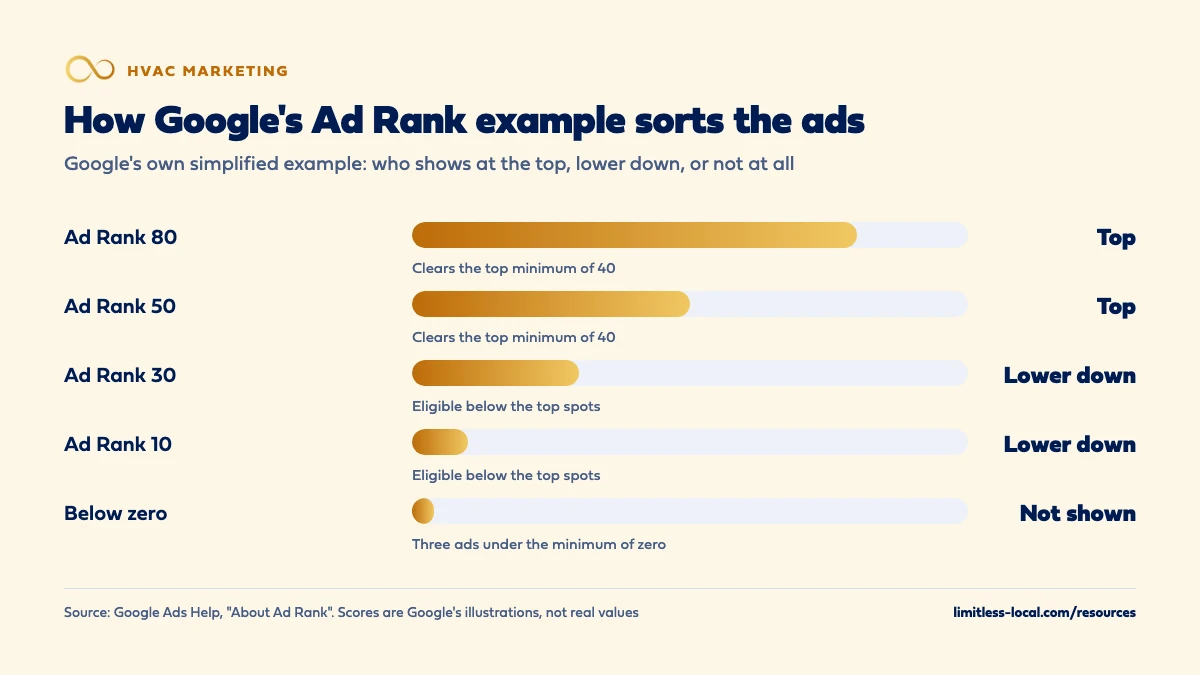
Google gives a simplified example that maps neatly onto a small HVAC market. Seven advertisers have Ad Ranks of 80, 50, 30 and 10, plus three with negative scores. The minimum to show anywhere is zero, and the minimum to show at the top, generally above the search results, is 40:
- The ads at 80 and 50 clear the top minimum and show above the results, in that order.
- The ads at 30 and 10 can’t show at the top but are eligible lower down the page.
- The three below zero don’t show at all.
The scores are illustrations, not real values, and Google doesn’t publish the formula. Its advice for getting a bigger share of the top spots is short: improve the quality of your ads and landing page experience, or increase your bid (About Ad Rank).
Why do clicks at the top of the page cost more?
Because the bar is higher there. Google sets Ad Rank thresholds fresh for each auction, and ads that appear higher on the page have higher thresholds than ads lower down. Thresholds also rise for lower-quality ads, and they vary with the person’s location and device and with the topic of the search (Ad Rank thresholds: Definition). Google says the result is that a click above the search results often costs more than one below them, even when no other advertiser is immediately below you, and that top ads usually get higher clickthrough rates in return (Actual cost-per-click (CPC): Definition).
Some ad assets only show above the search results, and need high enough ad quality to appear there (About ad quality). In our judgement, for an emergency repair search on a phone, where few people scroll past the first results, the top is usually worth paying for. For a slower, researched job like a system replacement, a lower spot at a lower price can be a fair trade.
How do competitors push up what I pay per click?
Through how close their Ad Rank is to yours. Google says that if two ads competing for the same spot have similar Ad Ranks, each has a similar chance of winning it. As the gap grows, the higher-ranking ad is more likely to win but may also pay a higher cost per click for that certainty (About Ad Rank).
For an HVAC owner, that means a new company bidding hard on your main repair searches, or every shop in town raising bids before the first heat wave, can raise your price without anything changing in your account. You can see who you’re up against in the auction insights report; how competitive HVAC marketing is in your area explains how to read it. What you can’t see is their bids.
Curious what your marketing is actually booking?
Get a free visibility audit — no obligation, no sales pitch.
Does Quality Score set my cost per click?
Not directly, and the distinction matters. Google says Quality Score, the one-to-ten rating in your account, is a diagnostic tool and not an input in the ad auction (About Quality Score). What the auction uses is ad quality measured at the moment of each search, including expected clickthrough rate, ad relevance and landing page experience. Quality Score is Google’s summary of that, for you to read.
The quality underneath it does affect price. Google says higher-quality ads typically cost less per click, and that if your ads are low quality, your actual cost per click may sit close to your maximum bid even when there’s little competition for the search (About ad quality).
A practical tell: Google says a very high estimated top of page bid on a keyword means its Quality Score is poor and could be improved (Top of page bid estimate: Definition).
What does expected clickthrough rate mean for an HVAC ad?
It’s Google’s prediction of how likely your ad is to be clicked when it shows for a keyword, with the effect of ad position and assets removed. It considers how the keyword has performed in your account and across other advertisers, and at auction time Google recalculates it for the actual search, device and other factors (Expected clickthrough rate: Definition).
Google gives it a status of above average, average or below average. If it’s below average, Google suggests changing your ad text so it relates more closely to your top keywords. For an HVAC company, that usually means an AC repair keyword shows an ad that says AC repair, your area and how soon you can come, rather than a general ad about heating and cooling services.
Does my landing page change what I pay per click?
It can, because landing page experience is one of the quality signals in Ad Rank. Google looks at how useful and relevant the page is, what people expect after clicking the ad, and how easy the page is to navigate (About Ad Rank). A specific repair ad that lands on a general homepage tends to match less well than one that lands on a page about that repair.
Whether you need separate ad pages, or your existing service pages will do, is covered in whether an HVAC company needs landing pages for Google Ads.

Do ad assets like a call button change the price?
They can change where you rank for the same bid. Ad Rank includes Google’s estimate of how your assets, like a phone number or links to specific pages, will affect your ad’s performance. Google’s auction page goes further: even if competitors bid more, you can still win a higher position at a lower price with highly relevant keywords, ads and assets (How the Google Ads auction works). Ad Rank also decides whether your assets are eligible to show at all (About Ad Rank).
For an HVAC company, the call asset is the obvious one, since many homeowners with a broken system would rather call than fill in a form. Sitelinks to your repair, replacement and maintenance plan pages come next. How a smaller shop uses this to compete with bigger budgets is covered in how a small HVAC company can compete.
Does the time, place or device of the search change the price?
Yes. The context of the search is one of the six auction factors: Google looks at the search terms, the person’s location at the time, their device, the time of the search, and the other ads and results on the page (How the Google Ads auction works). The same keyword can cost a different amount on a phone on a hot Saturday afternoon than on a laptop on a mild weekday morning.
You influence this through your settings: where you target, when your ads run and whether you raise or lower bids for certain times, devices or areas. Keep in mind that bid adjustments are one of the settings Google says can push your actual cost per click above your maximum bid.
What can an HVAC owner actually change to pay less per click?
Sorted into what you control and what you don’t:
- You control: which keywords you bid on, the negative keywords that keep out jobs you don’t do, how closely each ad matches its keywords, the page each ad sends people to, your assets, your bids or bid strategy, and where and when your ads run.
- You don’t control: how many other companies bid in your towns, how aggressively they bid, the season, and what each homeowner types and when.
One warning. The cheapest click isn’t the goal. A broad keyword that costs less per click can bring calls about jobs you don’t want, and a precise repair keyword that costs more can book work at a lower cost per job. The number to manage is cost per booked job, which the difference between a click, a lead and a booked job defines, and the budget math that uses your click price is in how much to spend on Google Ads.
Want to see where your company stands?
A free visibility audit shows where you show up on Google, Maps and AI answers, and what it's costing you in calls.
What's different for HVAC companies
Weather moves the auction. When a heat wave or cold snap hits, more homeowners search and more HVAC companies raise budgets and bids at once. In our judgement, expect click prices on repair searches to rise with demand, and plan the budget for it instead of reading a pricier week as a broken campaign.
Repair and replacement clicks aren’t the same purchase. A replacement click often costs more and books less often than a repair click, but the job is worth far more. Keep them in separate campaigns so you can judge each click price against what that kind of job is worth.
Emergency wording sets expectations. An ad that promises same-day or round-the-clock service will draw clicks, and the landing page and the phone have to keep that promise. If they don’t, the ad quality signals Google measures, and the homeowner’s patience, go the wrong way.
A worked example: the cheaper click that costs more per job
These numbers are made up to show the math, not a benchmark for your market. Two HVAC companies advertise for AC repair in the same area. The first bids on broad terms like air conditioning and AC units, pays about $18 per click, and 1 in 12 clicks turns into a booked job. That’s $216 in ad spend per booked job.
The second bids only on repair searches, with ads that say AC repair and pages about AC repair. Its clicks cost more, about $27, because it’s competing for the searches everyone wants, but 1 in 6 clicks books a job. That’s $162 per booked job, even though every click costs half again as much.
Cost per click is one input; the click price you can afford depends on how often clicks turn into booked work. For comparison, our Essentials package is $3,500 a month and includes Google Ads management for up to $2,500 a month in ad spend, with ad spend paid to Google separately. Working out what you can afford per click from your own booking numbers is what a free visibility audit is for.
Frequently asked questions
Will I ever pay more than my maximum bid?
Normally, no: Google calls your maximum bid the most you’ll typically be charged for a click (Google Ads Help). Bid adjustments, Enhanced CPC and automated bidding are the exceptions Google names.
Does bidding more improve my Quality Score?
No. Google says your bid can affect your Ad Rank but doesn’t affect its assessment of your ad quality. Quality comes from the ad, the keyword match and the landing page.
Why did my cost per click jump when I didn't change anything?
The auction changed around you. Google prices each click at what it takes to clear the thresholds and beat the ad below yours, so more competitors, closer Ad Ranks, a busy season or more searches on phones at peak hours can all raise that price.
What does a dash in the Quality Score column mean?
Google says it means there aren’t enough searches that exactly match the keyword to score it yet (Google Ads Help). It’s common on low-volume HVAC keywords in small service areas.
Is the estimated top of page bid what I'll pay?
No. It’s an estimate of the bid you’d likely need to show at the top when a search exactly matches the keyword, and Google says meeting it doesn’t guarantee a top spot (Google Ads Help). What you actually pay is set by the auction each time.
Key takeaways
- Every search runs an auction; your maximum bid is a ceiling, and the actual price is often less.
- Your actual price is calculated from your Ad Rank, the quality thresholds and how close the competition is.
- Higher ad quality typically lowers what you pay per click; low quality can push it close to your maximum bid.
- Quality Score is a diagnostic, not an auction input, but the quality behind it does affect price.
- Top-of-page spots cost more because their thresholds are higher.
- Manage cost per booked job, not cost per click.
Not sure what's working right now?
Start with a free visibility audit: rankings, Google profile, reviews and tracking, checked against your service area.
More in this section
- How much should an HVAC company spend on Google Ads?
- What happens if competitors click on my HVAC Google Ads?
- Are Google Local Services Ads worth it for an HVAC company?
- How soon will Google Ads start bringing in HVAC calls?
- Should my HVAC company start with LSAs, Google Ads or SEO?
Sources
- How the Google Ads auction works — Google Ads Help
- About Ad Rank — Google Ads Help
- Ad Rank thresholds: Definition — Google Ads Help
- Actual cost-per-click (CPC): Definition — Google Ads Help
- About ad quality — Google Ads Help
- About Quality Score for Search campaigns — Google Ads Help
- Expected clickthrough rate: Definition — Google Ads Help
- Top of page bid estimate: Definition — Google Ads Help