
How many booked jobs come from 100 HVAC leads?

- How many of 100 HVAC leads should turn into booked jobs, and where do the rest go?
- Is there a standard number of booked jobs per 100 HVAC leads?
- What counts as one of my 100 HVAC leads?
- Step 1: How many of the 100 are real leads?
- Step 2: How many real leads does the office actually reach?
- Step 3: How many reached leads get booked?
- Step 4: How many booked jobs actually happen?
- What changes for HVAC replacement and install leads?
- Where do HVAC jobs usually leak between the lead and the schedule?
- Does the lead source change how many of 100 leads book?
- How do I work out my own booked jobs per 100 leads?
- How do I use the 100-lead math to plan my marketing?
- What's different about the 100-lead math for HVAC companies
- A worked example: following 100 HVAC leads to the schedule
- Frequently asked questions
- Key takeaways
- More in this section
- Sources
The short version
- Start with real leads: take out spam, duplicates, wrong services and out-of-area calls.
- Then count how many real leads the office actually reached.
- Booked jobs = reached leads x your booking rate; subtract cancellations.
- For replacements, sold jobs = booked estimates x your close rate.
For HVAC owners looking at a lead count in a report and wondering how many real jobs it should have put on the schedule.
Get a free visibility audit · Book a growth call
How many of 100 HVAC leads should turn into booked jobs, and where do the rest go?
There’s no standard number, because it depends on three rates you can measure: how many of the 100 are real leads, how many of those your office actually reaches, and how many of those it books. Multiply your own rates through: if 85 are real, you reach 75 and book 60% of them, 100 leads become about 45 booked jobs. For replacement leads, take one more step, because a booked estimate only becomes a sold job at your close rate.
Most of the jobs that go missing between 100 leads and the schedule leak out after the lead arrives, which is why every one of our HVAC marketing packages tracks calls, forms and chats by source and reports cost per lead, so you can follow each lead to a booked job. Automation add-ons like calendar reminders and after-hours answering plug in when the leak is on the phone side. For the bigger picture, the HVAC marketing guide covers every channel, and the rest of the HVAC marketing questions library goes question by question.
Is there a standard number of booked jobs per 100 HVAC leads?
No, and any single number you see should be treated with suspicion. Two HVAC companies can each get 100 leads in a month and book very different numbers of jobs, because they count leads differently, answer the phone differently and serve different markets. A shop with a full-time dispatcher and a tight service area will book far more of its leads than a one-truck owner answering from a ladder.
What you can do is work out your own number, stage by stage. Every lead passes through the same four gates: is it real, did you reach the person, did you book them, and did the job actually happen. Each gate has a rate you can measure, and multiplying those rates tells you how many booked jobs 100 leads should give you. More useful still, it tells you which gate is losing the most.
What counts as one of my 100 HVAC leads?
It depends on who’s counting, and that’s the first place the math goes wrong. Google Ads, for example, can count a call from your ad as a conversion when it lasts at least the minimum call length you set, according to its guide to phone call conversion tracking. That call might be a homeowner with no cooling, or a supplier, or someone looking for a different company. With Local Services Ads, a valid lead includes a missed call during business hours where the caller stays on the line for more than 20 seconds, and a call that goes to voicemail during business hours and lasts more than 20 seconds, message or not.
Your field software counts differently again. So when a report says “100 leads,” ask which system counted them and what it counted. The difference between a click, a lead and a booked HVAC job lays out a set of definitions your office and any agency can share.
Step 1: How many of the 100 are real leads?
Go through the list and take out anything that was never a chance at a job:
- Spam and robocalls, including sales calls to your office.
- Duplicates: the same homeowner who called twice and filled in a form.
- Wrong service: someone wanting appliance repair, plumbing or a commercial rooftop unit you don’t touch.
- Out of area: callers from towns your trucks don’t go to.
- Existing customers calling about a job already on the schedule.
What’s left is your real lead count. If the share of junk is high, the fix sits upstream in your ads, service area or Google profile settings, not in the office.
Step 2: How many real leads does the office actually reach?
A real lead you never speak to can’t book. This is often the biggest leak, and the one owners see least, because missed calls don’t show up on the schedule. Count a lead as reached when someone from your company actually spoke with the homeowner, by phone or text, before they hired someone else.
The usual gaps: calls that ring out during a busy afternoon, calls after hours with no answering plan, voicemails returned the next day, and web forms that sit in an inbox until someone checks. Each of those homeowners is often calling the next company on the list within minutes. How fast an HVAC company should respond to new leads covers response times and how to close the gap.
Step 3: How many reached leads get booked?
This is your booking rate: reached leads that ended with a date and time on the schedule, divided by all reached leads. It’s where the office’s skill shows. The things that lower it are usually fixable:
- No clear answer on the diagnostic or trip fee, so price shoppers hang up.
- No available slot soon enough for a no-cool call.
- No callback for homeowners who said “let me check with my spouse.”
- No script for turning a question into an appointment.
Track it per person and per lead source, so you can see whether the problem is one CSR, one channel or the whole office. How to calculate your lead-to-booked-call conversion rate walks through the formula and where to pull the numbers.
Curious what your marketing is actually booking?
Get a free visibility audit — no obligation, no sales pitch.
Step 4: How many booked jobs actually happen?
A booked job isn’t revenue until the tech is in the driveway. Some homeowners cancel because the system started working again, a neighbor fixed it, or another company got there first. Others aren’t home when the tech arrives.
Count cancellations and no-shows as their own line, separate from the booking rate. If they’re climbing, look at how far out you’re booking, whether customers get a reminder and an on-the-way text, and whether the office confirms the appointment the day before. Shorter waits and a quick confirmation usually do more than anything else here.
What changes for HVAC replacement and install leads?
A replacement lead goes through one more gate. Booking the in-home estimate is step three; the job isn’t sold until the homeowner signs. That makes your close rate part of the math: sold jobs equal booked estimates times the share you close.
ServiceTitan’s help article on technician close and conversion rates defines close rate as exclusive to sales and estimates, separate from the conversion rate on service invoices, which is a useful split to keep in your own reports. Mixing the two makes 100 leads look better or worse than they are. What a good close rate for HVAC replacement estimates looks like covers that last gate in more depth.
Where do HVAC jobs usually leak between the lead and the schedule?
In rough order of how often it’s the biggest leak:
- Missed and slow-answered calls, especially in peak season and after hours.
- No follow-up on leads that didn’t book the first time: the “call me back” and “let me think about it” crowd.
- Junk from loose targeting: wide service areas and broad ad settings that fill the count with leads you can’t use.
- Price conversations that end the call instead of booking the visit.
- Cancellations from long waits.
Fixing the follow-up side often moves the number more than buying more leads does. One HVAC client got 47% more booked estimates from speed to lead, automated reminders and better follow-up.

Does the lead source change how many of 100 leads book?
Yes, a lot. Leads from past customers and referrals already trust you and book at a high rate. Homeowners who call straight from Google Search, Maps or Local Services Ads usually have a problem right now and are comparing two or three companies. Form fills that come in overnight are slower to reach. Shared leads bought from lead sites go to several companies at once, so you’re racing others to the same homeowner.
That’s why one blended number across all sources hides the real picture. Housecall Pro’s conversion rate reporting, for example, can break lead conversion down by lead source, and other field software does something similar. If one source books far below the rest, how to avoid wasting money on shared HVAC leads may be worth a read.
How do I work out my own booked jobs per 100 leads?
Take one full month, or longer if volume is low, and fill in five numbers:
- Total leads, from every source, counted once per person.
- Real leads, after removing junk, duplicates and existing customers.
- Reached leads: real leads someone actually spoke with.
- Booked jobs: reached leads with a date and time.
- Jobs run: booked jobs that weren’t cancelled or no-shows.
Divide each number by the one before it to get the rate at each gate, and divide jobs run by total leads, times 100, to get your booked jobs per 100 leads. Pull the call side from your call tracking and the booking side from ServiceTitan, Housecall Pro or Jobber. Repeat it monthly so you can see a change the month it happens.
How do I use the 100-lead math to plan my marketing?
Run it backward. Start from the number of booked jobs you need in a month, divide by your booked jobs per lead, and you have the leads you need. Multiply by your cost per lead and you have a realistic budget, or a clear sign that fixing a leak is cheaper than buying more leads.
It also tells you what to fix first. If you lose more leads at “reached” than at “booked,” phones come before ads. If you lose most at “real,” targeting comes before anything else. How many booked calls an HVAC company needs covers the planning side, starting from your trucks and revenue goal.
Want to see where your company stands?
A free visibility audit shows where you show up on Google, Maps and AI answers, and what it's costing you in calls.
What's different about the 100-lead math for HVAC companies
Peak season breaks the reach rate. In a heat wave, the leads arrive faster than the office can answer them, so the share you reach can drop just when lead volume is highest. Measure July and January separately from the shoulder months.
Repairs and replacements need separate funnels. A service call books and runs in a day; a replacement goes through an estimate and a close. Lumping them together makes your booked-jobs number hard to read.
Maintenance-plan calls skew the count. Plan members calling to schedule a tune-up are existing customers, not new leads. Keep them out of the 100, or your rates will look better than your marketing really is.
A worked example: following 100 HVAC leads to the schedule
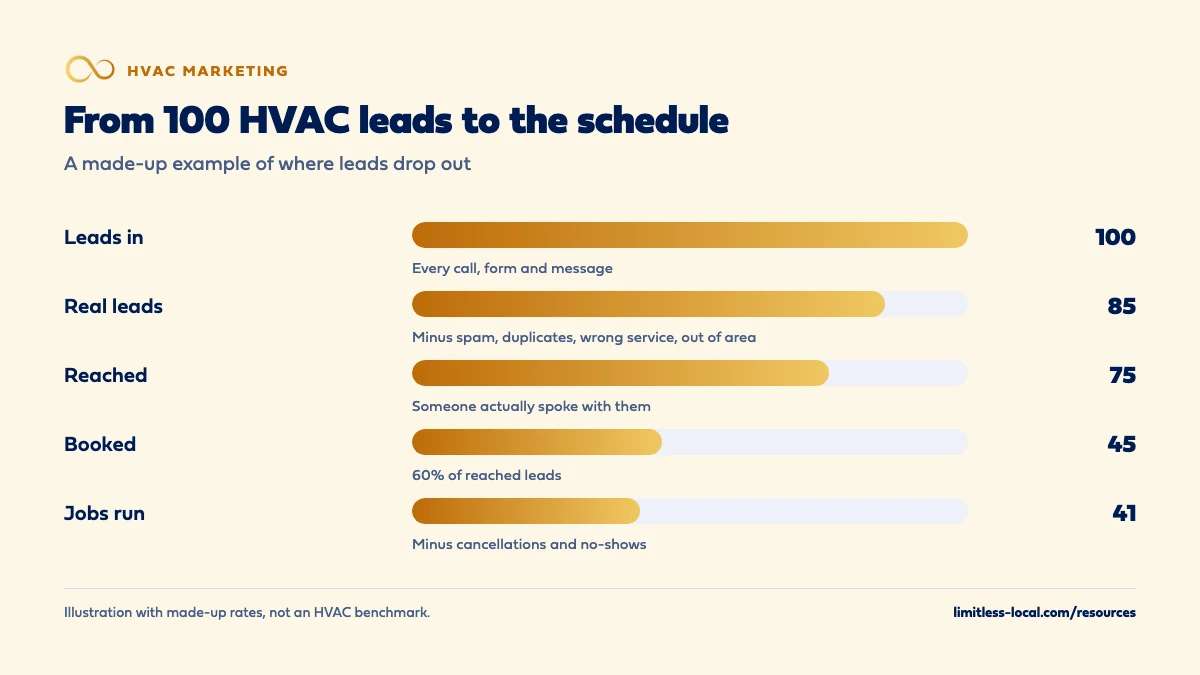
These numbers are made up to show the math, not a benchmark for HVAC booking rates.
Say your marketing brought in 100 leads last month and cost $4,000.
- Real leads: 15 are spam, duplicates, wrong services or out of area, leaving 85.
- Reached: 10 rang out or got a callback too late, leaving 75 you spoke with.
- Booked: the office books 60% of them: 45 booked jobs, or about $89 per booked job.
- Run: 4 cancel or aren’t home, so 41 jobs actually happen, about $98 per job run.
Now fix two leaks. Calling back every missed caller within minutes means you reach 80 instead of 75, and a better script lifts booking to 65%. That’s 52 booked jobs from the same 100 leads and the same $4,000, or about $77 per booked job, without buying a single extra lead.
If 20 of those 100 had been replacement leads, the same gates would give you about 9 booked estimates at the same rates, and at a 35% close rate, about 3 sold systems.
Frequently asked questions
Should existing customers count as leads?
Not in this math. A plan member calling to schedule a tune-up is a booking, not a new lead from your marketing. Counting them makes your rates look better than they are.
Does a missed call count as a lead?
Yes, if it was a real person who needed service. It belongs in your real-lead count and then shows up as not reached, which is exactly the leak you want to see.
How often should I recalculate my booked jobs per 100 leads?
Monthly, and by season. A heat wave or a new CSR can change the rates fast, and a monthly check shows it while you can still act.
Is a booked estimate a booked job?
For this math, yes: it’s on the schedule. For revenue, no. Track sold replacements separately, using your close rate.
What if my agency's lead count doesn't match my CRM?
Agree on one definition of a lead and one place it’s counted. Then reconcile the two each month by lead source so the gaps show up as real leads, junk or duplicates.
Key takeaways
- There’s no standard booked-jobs-per-100-leads number; it’s your real-lead rate x reach rate x booking rate, minus cancellations.
- Ask which system counted the 100 leads and what it counted before you judge the result.
- Missed and slow calls are often the biggest leak between a lead and a booked job.
- Replacement leads need one more step: booked estimates x your close rate.
- Fixing reach and booking can add more jobs than buying more leads.
Not sure what's working right now?
Start with a free visibility audit: rankings, Google profile, reviews and tracking, checked against your service area.
More in this section
- How many leads and booked jobs to justify hiring an HVAC agency?
- How long does it take an HVAC lead to turn into a booked job?
- What percentage of calls should my HVAC office be booking?
- How can an HVAC company get more leads?
- What's the difference between a click, a lead and a booked HVAC job?
Sources
- About phone call conversion tracking — Google Ads Help
- How leads work — Google Local Services Help
- Conversion Rate Reporting — Housecall Pro Help Center
- Technician's Close or Conversion Rate does not look correct — ServiceTitan Help