
What share of HVAC leads from each channel become booked calls?

- What percentage of HVAC leads from each marketing channel actually book?
- Is there a typical booking rate for each HVAC marketing channel?
- Why do booking rates differ so much by channel?
- Why do referrals and past customers usually book highest?
- How do Local Services Ads leads usually book?
- How do Google search ad leads usually book?
- How do leads from my Google profile and organic search book?
- How do Facebook, direct mail and lead-site leads book?
- How do I measure the booked share for each channel?
- Which leads should count in each channel's rate?
- How do I read my numbers once I have them?
- What does a low booking rate in one channel tell me?
- What's different about booking rates for HVAC companies
- A worked example: three months of booking rates by channel
- Frequently asked questions
- Key takeaways
- More in this section
- Sources
The short version
- No public benchmark is worth planning on; your own booking rate by channel is the number that counts.
- Referrals usually book highest, then Google search channels, then social and shared lead sites.
- Each platform counts a lead differently, so apply one definition of a real lead to every channel.
- Read booking rate next to cost per lead; a channel that books less can still cost less per booked call.
For HVAC owners comparing referrals, Local Services Ads, Google Ads, their Google profile and social, and wondering why the booking rates look so different.
Get a free visibility audit · Book a growth call
What percentage of HVAC leads from each marketing channel actually book?
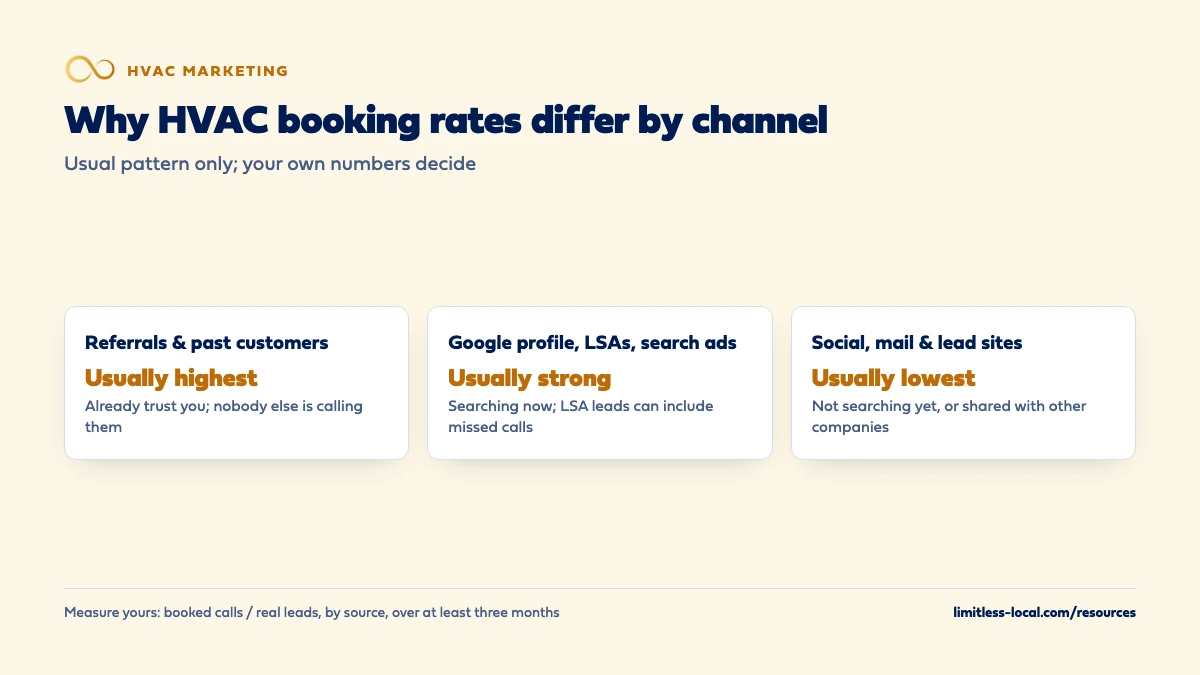
There’s no reliable published share for HVAC by channel, because it depends on your market, your office and what each channel counts as a lead. As a general pattern, referrals and past customers book at the highest rate, people searching Google right now (your profile, Local Services Ads, search ads, organic) come next, and social ads and shared lead sites book the least. Many of the gaps owners see come from counting, not quality: a Local Services Ads lead can be a missed call, and a Google Ads conversion can be any call longer than a length you set, so measure every channel by your own rule, booked calls divided by real leads, over at least three months.
Booking rate by channel only works if every call is tracked to its source, which is why call tracking and source tagging are part of every HVAC marketing package we run, with reporting that ends in booked jobs, not clicks. For how each channel fits the whole plan, the HVAC marketing guide covers every channel, and the rest of the HVAC marketing questions library goes question by question.
Is there a typical booking rate for each HVAC marketing channel?
Not one worth planning around. Any national figure blends hot metros and small towns, shops with a full-time call center and shops where the owner answers from a ladder, and platforms that each count a “lead” their own way. A number like that tells you about somebody else’s office.
What you can rely on is the pattern, and your own numbers. The pattern explains why channels differ. Your numbers tell you where to put the next dollar. Which marketing channels give an HVAC company the best leads ranks the channels on quality; this page is about reading the booking rate each one produces.
Why do booking rates differ so much by channel?
Five things drive most of the gap:
- Urgency. Someone searching for AC repair on a hot afternoon needs a truck today. Someone who tapped a social ad might want a tune-up next month.
- Whether they called only you. A referral calls one company. A homeowner on a lead site may hear from four.
- What counts as a lead. Each platform has its own definition, and some include calls nobody answered.
- How they reach you. A live call can be booked on the spot. A form or a message has to be chased.
- The job mix. A channel full of repair calls books differently from one full of replacement estimate requests.
Keep those in mind when one channel looks great and another looks terrible. Often it’s one of the five, not the channel itself.
Why do referrals and past customers usually book highest?
They already trust you, nobody else is competing for the call, and they usually know what they want. That combination books at a rate paid channels rarely match.
Two cautions when you measure it. First, keep calls from existing customers about a job already on the schedule out of your lead count, or this channel will look better than it is. Second, referral volume is small and lumpy, so a month with five referrals can swing wildly. It’s the strongest channel per lead and usually the hardest to grow on demand.
How do Local Services Ads leads usually book?
Local Services Ads bring people who are searching right now, so the leads you actually talk to tend to book well. The catch is what Google counts. Under its rules for how leads work, a charged lead can be an answered call, a call you missed during business hours where the caller stayed on the line more than 20 seconds, a voicemail, a text or email, or a booking request.
So if you divide booked calls by every charged lead, missed calls and voicemails drag the rate down, and that’s fair, because you paid for them. Track two numbers: booked out of all charged leads, which shows what the budget is buying, and booked out of the leads someone actually spoke with, which shows how the office is doing. Message leads tend to take longer to book than calls, so give them a reply window before you call them lost. Setting an LSA budget without junk calls covers cutting the leads that should never have come in.
How do Google search ad leads usually book?
Search ads can book very well when the keywords match urgent jobs and the landing page makes calling easy. They book worse when broad keywords bring in people researching prices or looking for parts.
Don’t read the Conversions column as booked calls. Google Ads can count a call from an ad as a conversion either by using AI on call recordings to judge lead quality, or by counting calls longer than a minimum length you set. Either way it’s a lead signal, not a job on the schedule. Your booking rate for this channel has to come from your own call tracking and field software. What a good ad click to booked call rate looks like for HVAC covers the step before this one, from click to call.
Curious what your marketing is actually booking?
Get a free visibility audit — no obligation, no sales pitch.
How do leads from my Google profile and organic search book?
These are often strong leads: free, local and searching right now. But they’re easy to over-count. The Calls figure in your Business Profile performance report is the number of times someone clicked the call button on your profile, not the number of calls you answered, and some of those taps are existing customers looking up your number.
To get a real booking rate, give your profile its own tracking number so those calls land in your call tracking under the right source. CallRail, for example, recommends a source tracking number on your Google Business Profile for this. Then count only new, real leads from that number, the same way you count every other channel.
How do Facebook, direct mail and lead-site leads book?
These channels mostly reach people who aren’t searching yet. A homeowner who fills out a Facebook form for a tune-up special or calls from a mailer is planning, not panicking, so they book more slowly and drop off more often. Shared lead sites add a second problem: the same request can go to several companies at once, so speed decides who books it.
That doesn’t make these channels bad. It means you measure them over a longer window, follow up more than once, and judge them on cost per booked call rather than on booking rate alone. A cheap lead that books one time in five can still beat an expensive one that books one time in two.
How do I measure the booked share for each channel?
- Give every lead a source. Housecall Pro has a Lead Source field you can set on customers, jobs and estimates. Jobber’s Lead Source Report shows, for each source, how many leads came with a request, a quote, a job and an invoice.
- Classify every call. ServiceTitan’s call classifications sort calls into booked, unbooked, abandoned, excused and not a lead. Set up your call reasons first; otherwise any call longer than 60 seconds is classified as a lead.
- Count real leads by source for the same period, leaving out spam, vendors and existing customers.
- Divide booked by real leads for each source, and multiply by 100.
Calculating your HVAC lead-to-booked-call conversion rate covers the overall formula and the counting rules in detail.
Which leads should count in each channel's rate?
Use one rule for every channel, written down, and apply it the same way to all of them. A workable rule:
- Count each new person once, even if they called three times.
- Count missed calls and unanswered forms as leads that didn’t book. You paid to get them.
- Leave out spam, wrong numbers, vendors and existing customers calling about scheduled work.
- Decide what “booked” means for replacements: a booked estimate visit, or a sold job. Pick one and stick to it.
Never mix platform counts. If you use Google’s lead count for LSAs and your own call log for search ads, you’re comparing two different rulers, and the comparison is meaningless.
How do I read my numbers once I have them?
Look at at least three months together. A channel with a dozen leads a month can swing by twenty points on two calls. Then put each channel’s booking rate next to what its leads cost, because the number that decides budget is cost per booked call: what you spent on a channel divided by the calls it booked.
That’s where surprises show up. A channel that books less can be cheaper per booked call if its leads cost little, and the channel with the best booking rate can be too small to grow. Once cost per booked call is clear, carry it one step further to revenue and profit by channel. How much revenue and profit each HVAC marketing channel produces shows how.
What does a low booking rate in one channel tell me?
If one channel books badly and the others are fine, the problem is usually that channel’s leads: the keywords, job types, service area or offer it’s set up with. If every channel is sliding at once, look at the office first, such as missed calls, slow callbacks or a full schedule with no open slots to offer.
And if someone else runs your marketing, a low booking rate in their channels is worth raising with them early. A good partner listens to the calls with you and changes the settings. Telling a good HVAC agency from one that sends bad leads covers what to look for.
Want to see where your company stands?
A free visibility audit shows where you show up on Google, Maps and AI answers, and what it's costing you in calls.
What's different about booking rates for HVAC companies
The season moves the rate. In peak season the board fills and the office can’t offer a slot for days, so booking rates drop across every channel even when the leads are good. In the shoulder months the same leads book more easily. Compare each month with the same month last year.
Emergency calls and replacement leads are different events. A no-cool call books a repair on the spot. A replacement lead books an estimate visit, and the sale happens later. Track them separately, or a channel full of replacement leads will look weak when it’s actually your most valuable one.
Maintenance members aren’t leads. A member calling to schedule their spring tune-up is a customer, not a new lead. Leave those calls out, or whichever channel they’re tagged to will look far better than it is.
A worked example: three months of booking rates by channel
These numbers are made up to show the math, not a benchmark for your market. Over three months, an HVAC shop tags every real lead by source:
- Referrals and past customers: 40 leads, 30 booked, 75%
- Google profile and organic: 70 leads, 35 booked, 50%
- Local Services Ads: 90 charged leads, 38 booked, about 42%. But 18 were missed calls or voicemails, so out of the 72 leads someone spoke with, about 53% booked.
- Google search ads: 110 leads, 45 booked, about 41%
- Facebook: 25 leads, 6 booked, 24%
Now add cost. LSA leads cost $58 each, so 90 leads cost $5,220, or about $137 per booked call. Search ads cost $5,500 for the three months, or about $122 per booked call. Search ads book a lower share of leads yet cost less per booked call, and the LSA gap is mostly missed calls, which is an office fix, not a budget one.
A free visibility audit can run this same split on your own call tracking and field software.
Frequently asked questions
Should missed calls count against a channel's booking rate?
Yes. A missed call is a lead that didn’t book, and with Local Services Ads you may have paid for it. Track a second rate without missed calls if you want to see how the office does on the calls it answers.
Why does my Google Ads account show more conversions than my booked calls?
Because a Google Ads call conversion is a call judged likely to be a good lead, either by AI on the recording or by a minimum call length you set. It isn’t a booked job. Your booked calls come from your own call tracking and field software.
Is booking half my leads good for an HVAC channel?
It depends on the channel and on what the leads cost. A channel booking half its leads at a high cost per lead can be worse than one booking a quarter of cheap leads, so compare cost per booked call.
How many leads do I need before a channel's rate means anything?
More than a month’s worth for most small channels. Combine three months, and treat any channel with only a handful of leads as unknown, not good or bad.
Should I count form fills the same as calls?
Count them as leads under the same rule, but expect them to book differently because they have to be chased. Calling form leads back within minutes is usually the biggest lever on that rate.
Can my call tracking tell me the source automatically?
For most online channels, yes, if each source has its own tracking number or your website swaps numbers by visitor source. Referrals and word of mouth still need the office to ask “how did you hear about us?” and record it.
Key takeaways
- No published booking rate by channel is worth planning around; measure your own.
- Referrals usually book highest, Google search channels next, social and shared lead sites lowest.
- Platforms count leads differently, so use one written rule for what counts as a real lead in every channel.
- Local Services Ads charge for some missed calls, so track booked out of charged and out of spoken-with.
- Read booking rate next to cost per lead; cost per booked call decides where the budget goes.
Not sure what's working right now?
Start with a free visibility audit: rankings, Google profile, reviews and tracking, checked against your service area.
More in this section
- How many booked jobs come from 100 HVAC leads?
- What percentage of calls should my HVAC office be booking?
- How do I calculate my HVAC lead-to-booked-call conversion rate?
- How much revenue and profit does each HVAC marketing channel produce?
- How many leads and booked jobs to justify hiring an HVAC agency?
Sources
- How leads work — Google Local Services Help
- Measure calls from ads — Google Ads Help
- Understand your Business Profile performance & insights — Google Business Profile Help
- How to Use Lead Sources — Housecall Pro Help Center
- Lead Source Report — Jobber Help Center
- Understand call classifications — ServiceTitan Help
- Common marketing sources to use with call tracking — CallRail Help Center