
What percentage of a roofing job should go to paying for leads?
- How much of a roofing job's price can I spend on leads and still make money?
- Is there a standard percentage of a roofing job for lead costs?
- Should I measure lead cost against the job price or the gross profit?
- How do I work out the most I can spend to win a roofing job?
- How does the percentage per lead differ from the percentage per signed job?
- Should repairs and replacements have different percentages?
- What counts as "paying for leads" in the percentage?
- Can I spend a bigger percentage while I'm trying to grow?
- How do pay-per-lead prices compare with this math?
- Can Google Ads bid toward my percentage automatically?
- What if my lead costs are above my target percentage?
- What's different about lead-cost percentages for roofing companies
- A worked example: a replacement and a repair
- Frequently asked questions
- Key takeaways
- More in this section
- Sources
The short version
- No fixed industry percentage: your margin sets the ceiling.
- Measure against gross profit, not the contract price.
- Count cost per signed job, then convert to a per-lead limit with your close rate.
- Repairs and replacements need separate targets.
For roofing owners who want a simple rule for how much of each job can go to leads and marketing, and the margin math behind it.
Get a free visibility audit · Book a growth call
How much of a roofing job's price can I spend on leads and still make money?
There’s no standard percentage for roofing, so set your own ceiling from your margin: the marketing cost of winning a signed roof can’t be more than the job’s gross profit minus the profit you need to keep. In a made-up example, a $12,000 replacement at a 35% gross margin leaves $4,200 of gross profit, and spending $1,200 to win it is 10% of the job price but about 29% of the gross profit. Set the target as a share of gross profit, not the job price, measure it per signed job rather than per lead, and keep separate targets for repairs and replacements.
This is the math we put in front of owners before talking budget: what a signed roof is worth to you, and what it can afford to cost. Our packages list the monthly fee and what it covers, ad spend is paid directly to Google or Meta, and every package includes monthly reporting with a cost-per-lead breakdown and source tagging, so you can track the percentage instead of guessing. See how it fits a roofing company on our roofing marketing page, read the guide to getting roofing leads, or browse more roofing marketing questions.
Is there a standard percentage of a roofing job for lead costs?
No. Roofers sell very different jobs at very different margins, from small repairs to large replacements, and no one lead-cost percentage fits all of them. Any single number you hear is someone else’s margin, not yours.
General business guidance gives you a sanity check, though. Canada’s Business Development Bank, in its guide to lifetime value and cost of acquisition, calls it a very general guideline that a customer’s lifetime value should be 2.5 to 3 times what it cost to acquire them. Put the other way, winning a customer shouldn’t cost much more than a third to two-fifths of what that customer is worth to you. For a roofer, “worth to you” is best read as gross profit, not the contract price, which is where the rest of this page goes.
Should I measure lead cost against the job price or the gross profit?
Gross profit. The job price includes materials, labor, dumpsters and permits, and that money was never yours to spend on marketing. Gross profit is what’s left after those direct costs, and it’s the pool that pays for marketing, overhead and your profit.
The standard gross profit margin formula is net revenue minus direct costs, divided by net revenue. For a roofing job, take the contract price, subtract materials, crew labor, disposal and other job costs, and divide by the price.
Here’s why it matters. Spending 10% of the job price on leads sounds small. But if the job’s gross margin is 20%, that’s half of everything the job earned before overhead. The same 10% on a job with a 45% margin is a much easier number to live with. Percent of price hides that; percent of gross profit shows it.
How do I work out the most I can spend to win a roofing job?
- Find your average signed job for the work you’re marketing, from the last six to twelve months.
- Find your gross margin on those jobs, from your job costing or your accountant.
- Multiply them to get gross profit per signed job.
- Decide how much of that you’re willing to spend to win the job. The rest has to cover overhead and profit.
- That’s your ceiling per signed job. Divide it by the job price if you want it as a percentage of the job.
The step that takes judgment is the fourth one. A company with heavy overhead (office, trucks, salaried estimators) needs to keep more of each job’s gross profit than a lean one. What cost per booked job a roofing company should aim for goes deeper on setting that ceiling.
How does the percentage per lead differ from the percentage per signed job?
A lot, and mixing them up is a common budgeting mistake. Not every lead signs, so you pay for several leads to win one roof. The per-lead limit is your per-job ceiling times the share of leads that sign.
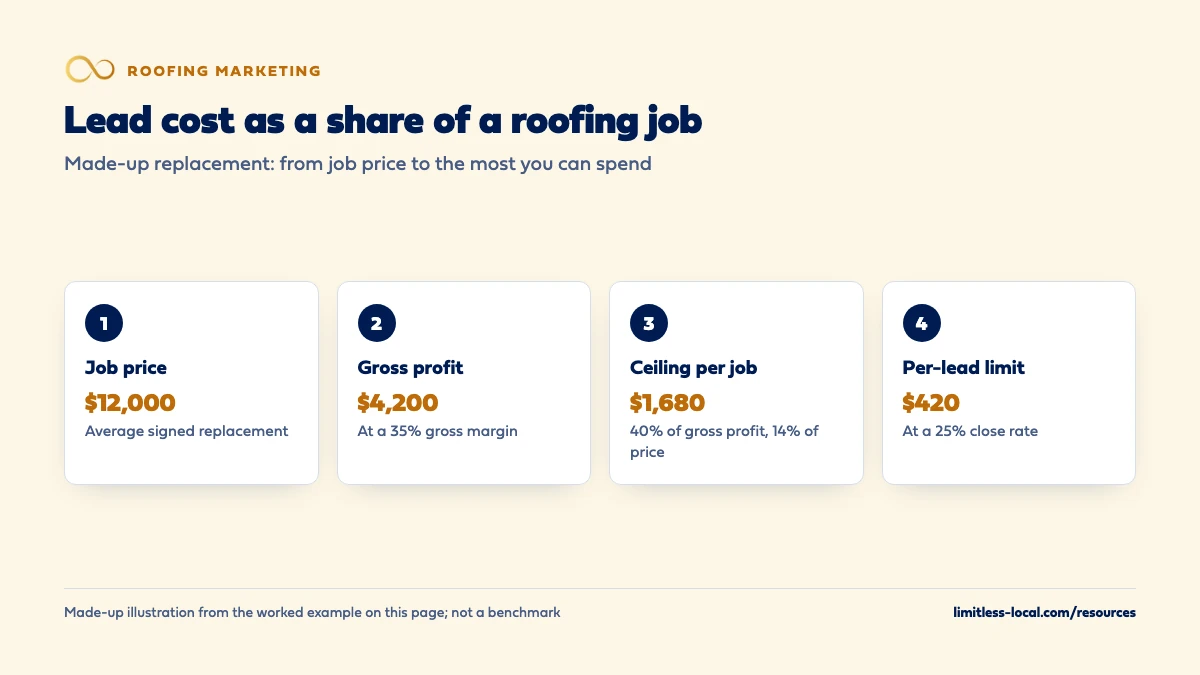
Say your ceiling is $1,680 per signed roof and one lead in four signs, a 25% close rate. You can afford up to $420 per lead. If only one in eight signs, the same ceiling allows half that per lead. That’s why a lead source that looks expensive can be fine when it closes well, and a cheap one can be a money pit.
If you know your cost per lead but not your close rate, the close rate at which roofing ads pay for themselves works the math from that side.
Curious what your marketing is actually booking?
Get a free visibility audit — no obligation, no sales pitch.
Should repairs and replacements have different percentages?
Yes. A repair is a small ticket. Even at a healthy margin, its gross profit in dollars is small, so a lead cost that’s easy for a replacement to carry can eat most of a repair’s profit.
Set two targets. For replacements, a ceiling per signed roof based on replacement gross profit. For repairs, a much lower ceiling, or a decision that repair leads only need to break even because some of them turn into replacements later. If you do count that, track it: tag repair customers and check how many come back for a full roof.
Split your marketing the same way where you can, with separate campaigns or at least separate tracking for repair and replacement leads, so one doesn’t hide the other.
What counts as "paying for leads" in the percentage?
Everything you spend to get the phone to ring, not just ad spend:
- Ad spend on Google, Local Services Ads and Meta.
- Per-lead fees from lead platforms.
- Management fees, whether to an agency, a freelancer or a share of an employee’s pay.
- Tools used for marketing: call tracking, review requests, the marketing side of your CRM.
Sales commissions and your estimator’s time are a cost of selling, not of getting leads. Keep them on their own line, but look at them next to the lead cost, because together they’re what it costs to win a job. Leave out a fee or a tool and your percentage looks better than it is. What goes into a roofing marketing budget besides ad spend and tools lists every line.
Can I spend a bigger percentage while I'm trying to grow?
Sometimes, and the reason is overhead. Your office, trucks, insurance and salaried staff cost the same whether you sign ten roofs this month or fifteen. The SBA’s break-even calculator uses that logic: fixed costs divided by the price minus variable costs gives the number of units you need to break even.
Once your fixed costs are covered, each extra roof only has to pay for its own materials, labor and lead cost. So while you’re filling a new crew’s schedule, it can make sense to accept a higher lead cost per job for a while, as long as each extra roof still leaves something after its own costs.
Two cautions. Do this on purpose, with a time limit, and stop when the crew is full. And check that the extra roofs really are extra, not jobs you’d have signed anyway. How many extra jobs a roofer must book to cover marketing cost covers that math.

How do pay-per-lead prices compare with this math?
Pay-per-lead pricing is set by the platform, not by your margin, so check it against your own ceiling. On Thumbtack, for example, the price of a lead varies with the type and size of the job, how many pros are available and your market, and you can set how competitive you want your lead prices to be.
Run every pay-per-lead source through the same test: price per lead divided by the share of those leads that sign. If that’s under your per-job ceiling, it fits. If it’s over, either the close rate has to improve or the source isn’t worth it. How much roofing leads cost covers what drives those prices, and whether to pay per lead or a monthly retainer compares the models.
Can Google Ads bid toward my percentage automatically?
Partly. With Target CPA bidding, you set your desired average cost per conversion and Google Ads sets bids to get as many conversions as possible around it. You need conversion tracking set up first.
The catch is what counts as a conversion. If it’s a call or a form, your target is a cost per lead, so set it from your per-lead limit, not your per-job ceiling. If you import signed jobs from your CRM, you can bid closer to what you really care about, but small accounts may not have enough signed jobs for that to work well.
What if my lead costs are above my target percentage?
Work through it in this order before you cut spend:
- Close rate. Faster callbacks and better estimate follow-up can lower cost per job without touching the ads.
- Junk leads. Wrong services, wrong towns, renters. Tighten targeting and forms.
- Job mix. If repair leads drag the average down, separate them.
- Channel mix. Move money from the sources with the worst cost per signed job to the best.
- Price and margin. If every channel is over target, the issue may be the job’s margin, not the marketing.
Not sure which of these is costing you jobs?
A free visibility audit checks the Google profile, reviews, site and tracking, and shows what to fix first.
What's different about lead-cost percentages for roofing companies
A wide range of ticket sizes. Roofers sell everything from a small leak repair to a full tear-off, often from the same ads. One blended percentage hides that range, which is why repair and replacement targets should be separate.
Storms move costs fast. After hail or high wind, more roofers bid on the same homeowners, and lead costs can climb for a few weeks while close rates shift. Judge storm months on their own, and don’t reset your yearly target off one.
One job can lead to more. A happy replacement customer can send referrals and future work like gutters. That value is real but hard to count, so treat it as a cushion, not part of the target.
A worked example: a replacement and a repair
These numbers are made up to show the math, not a benchmark for your market.
Replacement. The average signed replacement is $12,000 at a 35% gross margin, so gross profit is $4,200. The owner decides to keep at least 60% of gross profit for overhead and profit, so the most they’ll spend to win a replacement is 40% of $4,200: $1,680, or 14% of the job price. At a 25% close rate, that allows up to $420 per lead. Last quarter, marketing actually cost $1,200 per signed replacement: 10% of the job price and about 29% of the gross profit. Comfortably under the ceiling.
Repair. The average repair is $900 at a 50% gross margin, so gross profit is $450. If winning a repair costs $250 in marketing, that’s about 28% of the price but about 56% of the gross profit. Same ads, very different picture, which is exactly why the repair needs its own target.
Frequently asked questions
Is 10% of the job price too much to spend on leads?
It depends on your margin. On a replacement with a healthy gross margin it can be fine; on a thin-margin job it can take most of the profit. Compare it with gross profit, not price.
Should I use my average job or my typical job?
Use the average signed job for the type of work you’re marketing, and check that a few very large jobs aren’t pulling it up.
Do I count leads that didn't sign in the percentage?
Yes. You paid for them. Cost per signed job is total marketing cost divided by signed jobs, which includes every lead that didn’t sign.
How often should I recalculate my target?
When your prices, material costs or margins change, and at least once a year. Material price swings can move your gross margin quickly.
Does a marketing agency's fee count toward the percentage?
Yes. The fee is part of what it costs to get leads, so leave it out and your percentage looks lower than it really is.
Can someone promise me a lead cost percentage?
No one can promise it, because platforms change and markets move. What you can get is clear reporting that shows the number every month.
Key takeaways
- No standard industry percentage fits every roofer; your margin sets the ceiling.
- Measure lead cost against gross profit, not the contract price.
- Set a ceiling per signed job, then multiply by your close rate to get a per-lead limit.
- Keep separate targets for repairs and replacements.
- Count every cost of getting leads, including fees and tools, before judging the percentage.
Want a second set of eyes on your setup?
We'll look at how you show up locally and where calls are leaking, then send you a plain-English breakdown.
More in this section
- How much do roofing leads cost?
- How many roofing leads a month do I need to hit my job goal?
- What percentage of roofing leads come from Google?
- Should a roofer pay per lead or pay a monthly marketing retainer?
- Should a roofer buy leads from a lead-selling company?
Sources
- Calculating customer lifetime value & cost of acquisition — BDC
- What is the gross profit margin — BDC
- Break-even point calculator — U.S. Small Business Administration
- About Target CPA bidding — Google Ads Help
- How much do I pay for leads and opportunities? — Thumbtack Help