
Should a roofer pay per lead or pay a monthly marketing retainer?

- Pay-per-lead services or a roofing marketing agency on retainer: which is the better deal?
- What's the actual difference between pay-per-lead and a retainer?
- Who owns the leads and the marketing under each model?
- Are pay-per-lead roofing leads shared with other roofers?
- Are Google Local Services Ads pay-per-lead too?
- When does pay-per-lead make sense for a roofer?
- When does a monthly retainer make sense for a roofer?
- Should I just buy leads while my own marketing ramps up?
- What does each model really cost per signed roof?
- What should a roofing marketing retainer include?
- How long should a roofer commit to a retainer?
- What's different about this choice for roofing companies
- A worked example: per-lead versus retainer over one month
- Frequently asked questions
- Key takeaways
- More in this section
- Sources
The short version
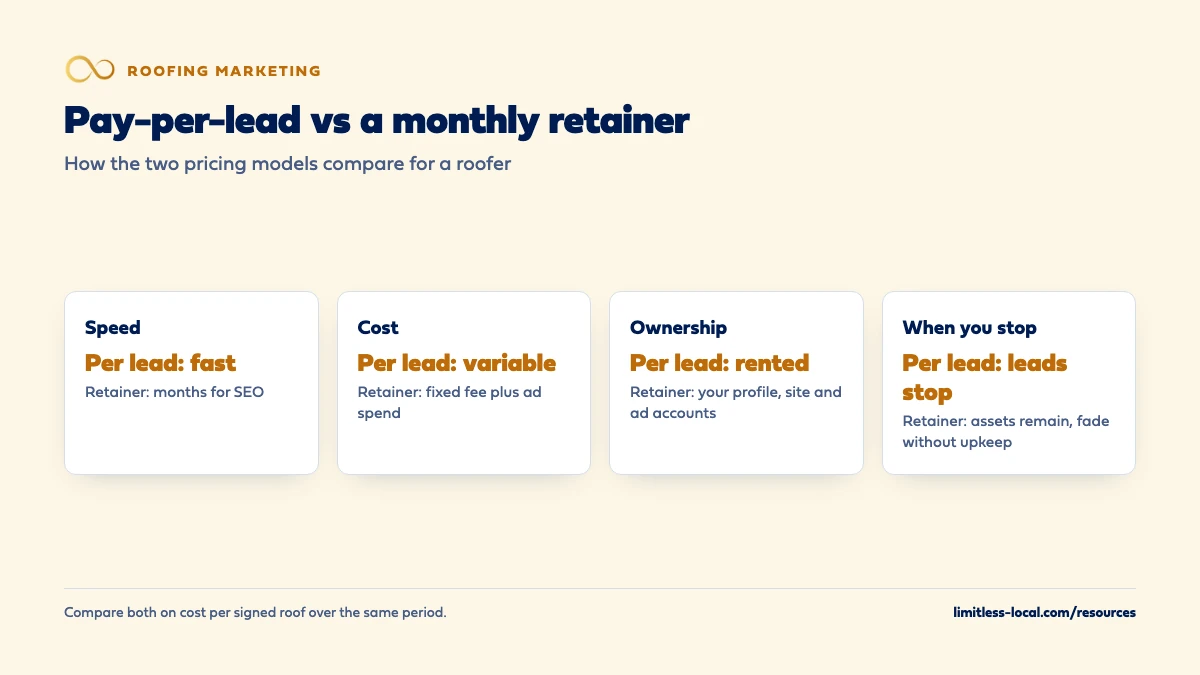
- Pay-per-lead: fast, variable cost, easy to stop, but you rent the leads and often share them.
- Retainer: a fixed monthly fee for work on assets you own, which builds more slowly.
- Compare both on cost per signed roof, not cost per lead or the size of the monthly bill.
- Whatever you pay for, make sure your Google profile, website and ad accounts are in your name.
For roofing owners comparing lead services that bill per lead with agencies that bill a monthly fee, and wondering which one leaves them better off a year from now.
Get a free visibility audit · Book a growth call
Pay-per-lead services or a roofing marketing agency on retainer: which is the better deal?
Pay per lead when you need roofing leads quickly, can answer them within minutes and want spend you can switch off; pay a monthly retainer when you want to build things you keep, like your own Google profile, website, reviews and ad account, that keep producing after the work is done. Pay-per-lead buys a lead that often goes to other roofers too and stops the day you stop paying, while a retainer buys work whose results take months to build. Many roofers use both for a while: per-lead or Local Services leads now, a retainer building their own channels, then shift money to whichever signs roofs at the lower cost per job.
Our packages are monthly retainers covering the roofer’s Google Business Profile, local SEO, Google Ads management and tracking; the roofing marketing page shows the approach. The guide to getting roofing leads covers whether paid leads are worth it at all; this page compares the two pricing models. More owner questions are in the roofing marketing questions library.
What's the actual difference between pay-per-lead and a retainer?
With pay-per-lead, you pay a set or bid price each time a homeowner’s contact details or call reaches you. Thumbtack, for example, says that when a customer contacts you from search results and the job matches your preferences, you auto-pay for the lead at the price you set. You don’t pay for the work that produced the lead, and you don’t own anything when you stop.
With a retainer, you pay a monthly fee for someone to do marketing work for you: managing your Google profile, building pages, running your ads, tracking calls. The fee is the same whether the month produces many leads or few. What you get is the work, and, if the agreement is set up properly, the results of that work stay with your business.
Neither is a scam and neither is magic. They solve different problems.
Who owns the leads and the marketing under each model?
This is the question most roofers skip. Under pay-per-lead, the lead service owns the platform, the profile homeowners saw and the history. If you leave, your ratings and visibility there stay behind. Under a retainer, ownership depends entirely on the setup.
Check three things before you sign anything:
- Google Business Profile. Google lets a profile have multiple owners but only one primary owner, and managers can’t add or remove users. You should be the primary owner; an agency should be a manager. Google also says that if you transfer a business, transferring primary ownership keeps business info like reviews with the profile.
- Ad accounts. Google Ads and Meta ad accounts should be in your business’s name, with the agency given access, so the history stays with you.
- Website and domain. The domain should be registered to you.
Switching agencies without losing leads covers what to collect if this was set up wrong.
Are pay-per-lead roofing leads shared with other roofers?
Often, depending on the service. Thumbtack’s own help pages describe Opportunities, also called open leads, as customers who’ve reached out to other pros but haven’t hired anyone yet. Its standard leads are customers who found you in their search results and chose to contact you directly. Read each service’s terms to see which kind you’re buying.
A shared lead changes the math. If three roofers call the same homeowner, the fastest and most convincing one usually gets the inspection, and the others paid for a phone number. That’s why calling back new leads fast matters even more on per-lead platforms. It’s also worth reading a service’s claims about lead quality carefully. In January 2023 the FTC announced a proposed order that would bar HomeAdvisor from making false or misleading claims about its leads, including that they concern people who are ready to hire a service provider. That’s a summary of the FTC’s announcement, not legal advice.
Are Google Local Services Ads pay-per-lead too?
Yes, and they sit in between the two models. Google says that as Local Services Ads move into Google Ads as Performance Max campaigns with pay-per-lead goals, you still pay only for valid leads, such as phone calls and messages, rather than clicks. Google also says leads judged invalid or low quality aren’t charged, and charged leads can be credited later if found to be low quality, with credits usually applied within 30 days.
The difference from a lead marketplace: the leads come to you directly from your own Google listing, your business details sync from your own Google Business Profile, and the reviews you build there are yours. So an LSA lead is pay-per-lead pricing on an asset you largely own. Whether LSAs are worth it for roofers covers the details.
Curious what your marketing is actually booking?
Get a free visibility audit — no obligation, no sales pitch.
When does pay-per-lead make sense for a roofer?
In our judgement, pay-per-lead fits when:
- You need work this month and your own Google profile, website and ads aren’t producing yet.
- You can answer every lead within minutes, because a slow call-back wastes the fee.
- You want a cost you can turn off during a backlog or a slow cash month.
- You’re testing a new service or town before committing to build marketing around it.
Set a monthly cap, an exit rule and a way to track each lead to a signed roof before you start. Without those, a per-lead service quietly becomes your main lead source, and your own channels never get built.
When does a monthly retainer make sense for a roofer?
A retainer fits when you want marketing that keeps working after you stop paying for it, at least partly. A stronger Google profile, more reviews, a website that ranks for the towns you serve: none of those disappear the month the retainer ends, though they fade without upkeep. SEO typically takes 3 to 6 months to show meaningful organic growth, so a retainer is a commitment to a ramp, not a switch.
It also fits when the work is more than one channel. Someone has to keep the profile current, run and tune ads, watch call tracking and report what signed. If you have no one in-house for that, a retainer is how you buy it. If you’re weighing a hire instead, when a roofer is ready for a marketing hire covers that option.
Should I just buy leads while my own marketing ramps up?
That’s a common and reasonable plan, as long as it has an end date. Buying leads while SEO builds keeps crews busy, but every month you rely on bought leads is a month you’re paying rent instead of building equity. Using lead marketplaces while SEO ramps up walks through how to cap and exit that bridge.
In our judgement, the sensible version is a small, capped per-lead budget alongside a retainer or in-house work on your own profile and ads, with a monthly look at cost per signed job for each. When your own channels sign roofs at a lower cost per job, move money there.

What does each model really cost per signed roof?
The monthly bill tells you almost nothing. A per-lead service can look cheap per lead and expensive per job if most leads are shared, unreachable or outside your area. A retainer can look expensive in month two and cheap in month twelve once the profile and site are producing calls you don’t pay for individually.
The fair comparison is cost per signed roof over the same period, including your own time: total spend on that source, divided by the roofs it signed. That needs every lead tagged by source and followed to a signed contract. Set a target cost per signed roof before you compare.
What should a roofing marketing retainer include?
In our view, a retainer worth paying for spells out, in writing:
- The work each month: which channels, how many pages or posts, what ad management covers.
- Whether ad spend is included or paid directly to Google or Meta.
- That your profile, ad accounts, website and tracking numbers belong to you.
- What reporting you get, and whether it goes past leads to calls, booked inspections and cost per lead.
- How you leave: notice period, what gets handed over.
A retainer that can’t answer “what did you do this month and what did it produce?” is the bad version of this model, the same way a per-lead service selling shared, stale leads is the bad version of the other.
How long should a roofer commit to a retainer?
Long enough for the slower work to show, short enough that the agency has to keep earning it. Because SEO is a ramp of months, judging a retainer after a few weeks is too early; locking into a long contract you can’t leave if nothing improves is the opposite mistake. Whether to sign a 12-month contract covers what to look for in the terms.
Our own terms: no long-term contracts. Month-to-month means we earn the business every month. The standard ask is three months, written into the contract, but nobody is held against their will; we won’t make you stay.
Not sure which of these is costing you jobs?
A free visibility audit checks the Google profile, reviews, site and tracking, and shows what to fix first.
What's different about this choice for roofing companies
High tickets raise the stakes on every lead. A roof replacement is a large job, so even an expensive lead can pay off if it signs, and a cheap lead that’s shared with several roofers often doesn’t. That’s our judgement, not a platform statement.
Storms distort both models. After hail, per-lead volume can jump overnight, and so can competition for each lead. A retainer-built profile and site keep working through the spike and after it.
Long sales cycles. Inspections, estimates and sometimes insurance adjusters stretch the time from lead to signature, so judge either model on leads that have had time to close.
Reviews compound. Reviews on your own Google profile stay with your business; ratings on a marketplace stay on the marketplace.
A worked example: per-lead versus retainer over one month
These numbers are made up to show the math, not a benchmark, not a forecast and not a client result.
- Pay-per-lead: a roofer buys 25 leads at $120 each, so 25 × $120 = $3,000. Three sign, so $3,000 / 3 = $1,000 per signed roof. Stop paying and the leads stop.
- Retainer, a few months in: the same roofer pays a $3,500 monthly retainer plus $2,000 in ad spend paid to Google, $5,500 in total. Calls from the Google profile, website and ads add up to 28 leads, and five sign, so $5,500 / 5 = $1,100 per signed roof.
In this made-up month the per-lead option looks slightly cheaper per roof. The difference is what’s left afterwards: the retainer month added reviews, pages and ad history that belong to the roofer, while the per-lead month left nothing behind. Neither result is a promise; the point is to compare cost per signed roof, then ask what you own at the end.
How we’d handle it: our Essentials package is $3,500 a month and includes Google Business Profile management, local SEO work and Google Ads management up to $2,500 a month in ad spend; Growth ($4,500 a month) adds Local Services Ads management. Ad spend is paid directly to Google. We don’t guarantee lead counts or rankings; nobody honestly can.
Frequently asked questions
Is a pay-per-lead service cheaper than an agency for a roofer?
Per lead, sometimes; per signed roof, it depends on how many leads are shared, reachable and in your area. Track both by source to find out.
Can a roofing agency charge per lead instead of a monthly fee?
Some do. Ask who owns the profile, website and ad accounts the leads come from, and what happens to them if you leave.
Do I get refunds for bad leads on pay-per-lead platforms?
It depends on the platform. Google says LSA leads judged invalid or low quality aren’t charged and may be credited later; other services set their own rules, so read them before you buy.
Is ad spend included in a marketing retainer?
Usually not, and you should ask. Our packages don’t include ad spend; it’s paid directly to Google or Meta.
Can I pause pay-per-lead services when my crews are booked?
Most let you pause or cap spend. Check each service’s settings, and keep the work on your own profile going while paused.
What happens to my reviews if I stop paying an agency?
Reviews on your own Google Business Profile stay with your business as long as you own the profile. Make sure you’re the primary owner.
Key takeaways
- Pay-per-lead buys fast, switch-off-able leads you rent; a retainer buys work on assets you keep.
- Many marketplace leads go to several roofers, so speed to call decides who gets the inspection.
- Local Services Ads are pay-per-lead on your own Google listing, a middle ground.
- Compare both models on cost per signed roof, after the leads have had time to close.
- Under any model, own your Google profile, website domain and ad accounts.
Want a second set of eyes on your setup?
We'll look at how you show up locally and where calls are leaking, then send you a plain-English breakdown.
More in this section
- Should a roofer sign a 12-month marketing contract?
- Is $1,000 a month enough for roofing marketing?
- How do I switch roofing marketing agencies without losing leads?
- What happens to roofing leads if I stop paying for ads?
- How many roofing leads a month do I need to hit my job goal?
Sources
- How much do I pay for leads and opportunities? — Thumbtack Help
- What are leads, preset jobs, and opportunities? — Thumbtack Help
- Local Services Ads transition to Performance Max campaigns with pay-per-lead goals — Google Ads Help
- About Automated Local Services Ads lead credits — Local Services Help
- Manage your Business Profile owners & managers — Google Business Profile Help
- Transfer primary ownership of a Business Profile — Google Business Profile Help
- FTC Order Requires HomeAdvisor to Pay Up To $7.2 Million and Stop Deceptively Marketing its Leads for Home Improvement Projects — Federal Trade Commission