
Is 25 Google reviews enough for an electrician to look legit?

- Do 25 Google reviews make an electrical company look trustworthy to homeowners?
- What does a homeowner see when they find my 25 reviews?
- Is 25 reviews past the point where homeowners stop worrying?
- When does 25 reviews look thin?
- At 25 reviews, does my star rating matter more than the count?
- How recent do my 25 reviews need to be?
- Do my replies change how 25 reviews look?
- What should my 25 reviews actually say?
- What else makes an electrician look legit next to the reviews?
- Is 25 reviews enough for Local Services Ads?
- How do I grow past 25 without breaking the rules?
- What's different for electricians
- A worked example: three listings in the map pack
- Frequently asked questions
- Key takeaways
- More in this section
- Sources
The short version
- 25 reviews clears the point where the count alone scares homeowners off.
- Next to shops with several times more, it can still look thin.
- Recency, rating and replies decide how 25 reviews read.
- Reviews that name the job and town do more than generic praise.
- Keep asking after every job so the count and the dates keep moving.
For electrical contractors with a couple dozen Google reviews, wondering whether homeowners see a real, busy shop or a risky unknown.
Get a free visibility audit · Book a growth call
Do 25 Google reviews make an electrical company look trustworthy to homeowners?
Usually, yes, as long as the reviews are recent, the rating is solid and you reply to them. In one 2026 survey of US consumers, 47% said they won’t use a business with fewer than 20 reviews, so 25 gets you past the point where the count alone puts people off. Whether 25 looks strong or thin after that depends on the electricians next to you in Maps, how fresh your newest reviews are, and whether they mention the kind of work the homeowner needs done.
Review generation and review responses are part of our local SEO and Google Business Profile work: Essentials, at $3,500 a month, includes review response and basic review generation, and Growth, at $4,500 a month, adds advanced review generation. Our electrical contractor marketing page explains how we work with electrical shops, and the electrical marketing questions library has more on reviews, Maps and the rest.
What does a homeowner see when they find my 25 reviews?
Not the number on its own. A homeowner searching “electrician near me” or “panel upgrade” on their phone sees your listing next to two or three others, and takes in a handful of things in a few seconds:
- Your star rating, right next to the name.
- Your review count, next to everyone else’s.
- The newest reviews, and how long ago they were written.
- Whether you replied, and whether the replies sound like a person.
- Photos of real jobs, trucks and people.
So the question isn’t really whether 25 is enough. It’s whether your 25, with your rating and your dates and your replies, looks better than the listing next to it. Search your main jobs in your main towns and look at what the homeowner sees before you decide you need more.
Is 25 reviews past the point where homeowners stop worrying?
For most of them, yes. BrightLocal’s Local Consumer Review Survey 2026, a panel of 1,002 US adult consumers asked about local businesses of every kind (not electricians specifically), found that 47% won’t use a business with fewer than 20 reviews, and only 9% are willing to use one with five or fewer.
Read that as a floor, not a target. Below 20, a sizeable share of homeowners may skip you before reading a word. At 25, the count stops being the reason people pass. What happens next depends on the rest of the listing.
For a newer shop, that makes the first 20 or so reviews the most valuable ones you’ll ever collect. Ask every happy customer, every job, until you’re past it.
When does 25 reviews look thin?
When the electricians next to you have far more. A homeowner comparing 25 reviews with 140 and 200 will notice the gap, even if all three have good ratings. It’s not that 25 looks fake; it’s that the bigger listings look more established.
It also looks thin for bigger decisions. A homeowner choosing someone to replace a panel, install a standby generator or rewire an older house is spending real money and letting a stranger into their walls. They tend to read more reviews and look harder for reviews about that kind of job. Twenty-five reviews that are all “fixed my outlet, great guy” won’t carry a panel upgrade as well as a handful that describe one.
If you’re well behind the shops in your map pack, 25 is a starting point. How many Google reviews an electrician needs to compete shows how to find the right target for your towns.
At 25 reviews, does my star rating matter more than the count?
Often, yes. The same consumers set a rating bar too: 68% said they’ll only use a business with four or more stars, 31% want 4.5 or more, and just 10% will only use a business with a perfect five. A perfect score isn’t required, and it isn’t always best: a 2017 study of online product reviews by Northwestern’s Spiegel Research Center found that purchase likelihood typically peaked at ratings in the 4.0 – 4.7 range and dropped as ratings approached 5.0. That was retail products, not home services, but the idea that a spotless record can look too good is worth keeping in mind.
The catch at 25 reviews is that every review moves the average. With 24 five-star reviews and one one-star, your average is 4.84. Add a second one-star and it falls to 4.68. On a listing with hundreds of reviews, two bad ones barely register.
So at this size, protect the rating by asking every happy customer, not just the ones who were thrilled, and by fixing problems before they turn into reviews.
Curious what your marketing is actually booking?
Get a free visibility audit — no obligation, no sales pitch.
How recent do my 25 reviews need to be?
Recent enough that the homeowner sees this year’s work: 74% of those consumers look for reviews written in the last three months.
Twenty-five reviews spread across the last year, with a couple from this month, reads as a busy shop doing good work right now. Twenty-five reviews that all arrived in a burst two years ago, with nothing since, reads as a shop that may have changed, slowed down or stopped caring. Same count, opposite impression.
The fix is a habit, not a campaign: ask after every job, every week, so a few new reviews land each month. Whether review velocity matters for electrician rankings covers the pace in more detail.
Do my replies change how 25 reviews look?
Yes, and at 25 reviews replying to every one takes a few minutes a week. Google’s tips to get more reviews recommend replying to reviews to show customers their feedback matters, keeping replies short, and, instead of sending the same “thank you” to everyone, focusing on reviews where you can share a helpful update or answer a question. A mix of positive and negative feedback often feels more trustworthy, too.
For an electrician, a good reply names the job and the town: “Glad the new panel’s working well, and thanks for having us out in Cedar Park.” A calm, specific reply to a critical review often does more for trust than five more good ones. How to respond to a negative Google review covers what to write.
What should my 25 reviews actually say?
The best reviews for an electrician mention the job, the town and something specific about how it went. A homeowner looking for an EV charger install wants to see that you’ve done EV charger installs. A homeowner with a breaker that keeps tripping wants to see that you showed up the same day.
You can’t write reviews for customers, and you shouldn’t script them. But you can make the request specific: “If you have a minute, a Google review about the panel upgrade would really help us.” Customers who are reminded what you did tend to mention it.
Ask after the jobs you want more of. If you want more panel and generator work, make sure those customers get a review request every time, not just the quick service calls.
What else makes an electrician look legit next to the reviews?
Reviews are one signal among several. Homeowners checking an electrician also look for:
- A license number they can check. Whether to show your electrical license number in your marketing covers where it belongs.
- Real photos of your trucks, your crew and finished panels, not stock images.
- The same name, address and phone number everywhere your business is listed.
- A website that says what you do and where you work.
- Hours that match how you answer, so someone calling at the hours listed gets a person.
A listing with 25 reviews and all of the above usually looks more trustworthy than one with twice the reviews and a blank profile.
Is 25 reviews enough for Local Services Ads?
Reviews keep mattering once the ads are live. Google’s page on reviews and ratings on Local Services Ads says star ratings and number of reviews affect how your business is ranked within those ads, and that providers with higher star ratings and more reviews stand out and typically book more jobs.
So at 25 reviews, the electricians with more reviews and better ratings may still show above you. What reviews and rating an electrician needs before local ads covers the setup side.
How do I grow past 25 without breaking the rules?
Ask every customer, the same way, every time. A Google review link or QR code on the invoice, a text after the job is marked complete, and a quick word from the tech before they leave usually do more than any one-off push.
What you can’t do is pay for them. Google treats offering incentives, like free or discounted services, in exchange for customers to post reviews, change reviews or remove negative ones as fake and misleading content. The FTC’s Consumer Reviews and Testimonials Rule, in effect since October 21, 2024, also covers fake reviews and incentives conditioned on reviews expressing a particular sentiment.
How to get more Google reviews for an electrical business walks through a request process that fits a small shop.
Want to see where your company stands?
A free visibility audit shows where you show up on Google, Maps and AI answers, and what it's costing you in calls.
What's different for electricians
Trust carries more weight. Electrical work happens inside walls the homeowner can’t see, and mistakes can be dangerous. Homeowners tend to read reviews for signs of care: explained the problem, pulled the permit, cleaned up.
Job values swing widely. A homeowner hiring for an outlet repair may be fine with 25 generic reviews. One choosing who replaces their panel or installs a generator will look for reviews about that work.
Emergency calls get quick decisions. Someone with no power picks fast. The rating, the count and the newest review date do most of the work in that moment.
Builder and commercial work runs on relationships. A general contractor rarely picks you from Google reviews, so don’t judge your commercial pipeline by your review count.
A worked example: three listings in the map pack
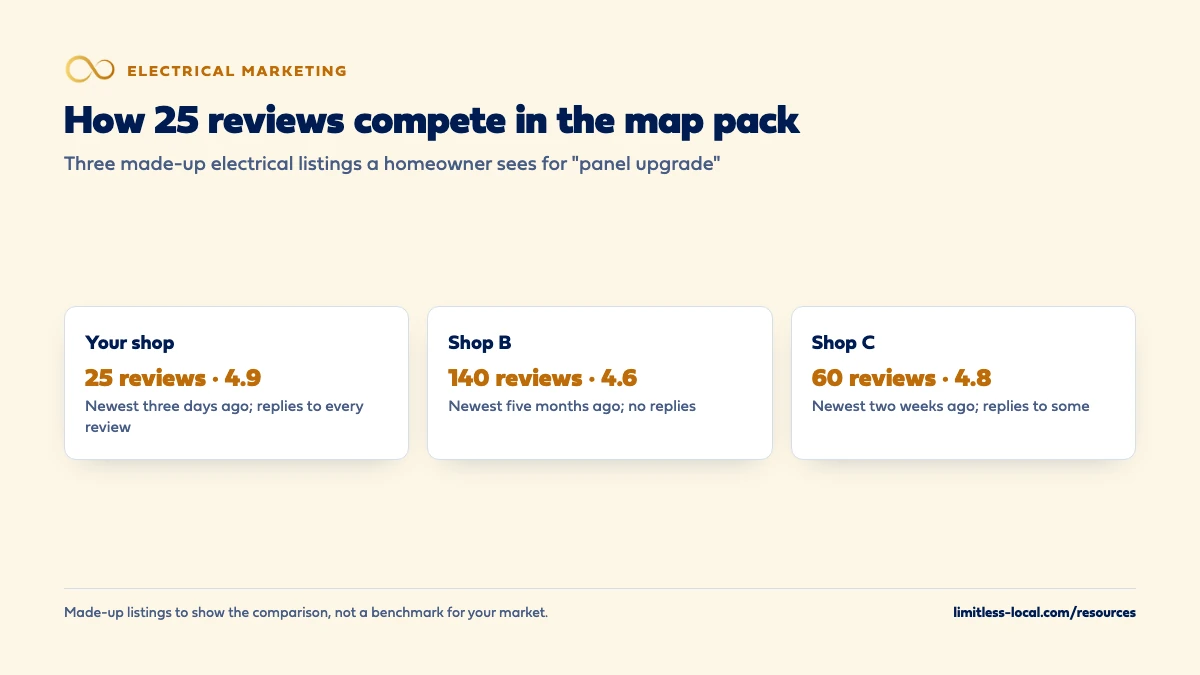
These listings are made up to show how 25 reviews can compete. A homeowner searches “panel upgrade” and sees three electricians:
- Your shop: 25 reviews, 4.9 stars, newest review three days ago, a short reply on every review, two reviews that mention panel upgrades.
- Shop B: 140 reviews, 4.6 stars, newest review five months ago, no replies.
- Shop C: 60 reviews, 4.8 stars, newest review two weeks ago, replies to some.
Shop B has the biggest count, but its reviews look stale and nobody’s answering. Your shop has the fewest reviews but looks active, cared-for and has done this exact job. Many homeowners will call you or Shop C first.
Now change one thing: your newest review is from last year. The same 25 reviews now look like a shop that might not be around anymore, and the call goes to Shop C. The count didn’t change; the date did.
Frequently asked questions
Is 10 Google reviews enough to start getting steady calls?
It’s a start, but it’s below the point where many homeowners stop worrying about the count. Keep asking after every job until you’re past 20, and make sure the profile is complete in the meantime.
Is 50 reviews enough to compete with bigger electricians?
It depends on what they have. If the bigger shops in your map pack sit at a few hundred, 50 still looks smaller, but fresh reviews, a strong rating and good replies narrow the gap. Check the listings you actually show up next to.
Do reviews on Yelp, Facebook or Angi count toward looking legit?
They help homeowners who check those sites, but most will see your Google listing first. Get Google right before spreading effort across other sites.
Will 25 reviews get me into the map pack?
Reviews help, but they’re only one part. Google’s guide to improving your local ranking says local results are mainly based on relevance, distance and popularity, and that more reviews and positive ratings can help your local ranking. Distance and how well your profile matches the search matter too.
Should I worry about one bad review at 25?
Reply to it calmly and specifically, then keep collecting reviews. One critical review with a good reply can make the rest look more believable; a run of them without replies is what hurts.
Key takeaways
- 25 Google reviews clears the point where the count alone puts most homeowners off.
- Next to shops with several times more, 25 can still look thin, especially for panel and generator work.
- At 25, each review moves your rating, so ask every happy customer, not just the thrilled ones.
- Recent reviews and specific replies make 25 reviews read as an active, careful shop.
- Never pay or reward customers for reviews; keep asking after every job instead.
Not sure what's working right now?
Start with a free visibility audit: rankings, Google profile, reviews and tracking, checked against your service area.
More in this section
- How many Google reviews does an electrician need to compete?
- How can an electrician get genuine Google reviews and reply fast?
- How do I get more Google reviews for my electrical business?
- What reviews and rating does an electrician need before local ads?
- What should an electrician do when Google reviews drop?
Sources
- Local Consumer Review Survey 2026 — BrightLocal
- How Online Reviews Influence Sales — Medill Spiegel Research Center, Northwestern University
- Tips to get more reviews — Google Business Profile Help
- Reviews and Ratings on Local Services Ads — Google Local Services Help
- Tips to improve your local ranking on Google — Google Business Profile Help
- The Consumer Reviews and Testimonials Rule: Questions and Answers — Federal Trade Commission