
How long does pool builder SEO take to bring in leads?
- How long until SEO brings a pool construction company consultation requests and signed contracts?
- What counts as a lead when a pool builder measures SEO?
- What happens in the first month of pool builder SEO?
- When will Google start showing my new pool pages?
- What should months two through six look like?
- How does the long pool sales cycle stretch the timeline?
- When in the year should a pool builder start SEO?
- How can I tell SEO is working before contracts come in?
- Does the Google Maps ranking move faster for a pool company?
- What makes pool builder SEO take longer?
- Should I run ads while SEO ramps up?
- How long should I give SEO before deciding it's not working?
- What's different about SEO timing for pool builders
- A worked example: the SEO ramp plus a pool sales cycle
- Frequently asked questions
- Key takeaways
- More in this section
- Sources
The short version
- Meaningful organic growth typically takes 3 to 6 months, and month one is mostly foundation work.
- A pool lead is not a pool contract: add your own sales cycle on top of the SEO ramp.
- Start before your busy season, so the work is in place when homeowners start planning.
- Watch impressions and positions in Search Console first; consultation requests and contracts follow.
For pool builders weighing SEO who want an honest timeline, from the first consultation request to the first signed contract it produces.
Get a free visibility audit · Book a growth call
How long until SEO brings a pool construction company consultation requests and signed contracts?
SEO for a pool builder typically takes 3 to 6 months to show meaningful growth in organic search, and consultation requests build gradually from there rather than arriving all at once. Signed contracts come later still, because homeowners planning a pool usually compare builders, designs and financing before they commit. How fast it goes depends on how crowded your market is, how many reviews and project photos you have, the shape of your website and Google Business Profile, and when in the season you start.
That gap between a lead and a signed contract is why we judge SEO for pool builders on consultations booked and contracts signed, not on rankings alone, and why we set the timeline before any work starts. Local SEO is part of every one of our packages, and the pool builder marketing page shows how it fits with ads, your website and follow-up. The rest of the pool builder marketing questions library goes question by question.
What counts as a lead when a pool builder measures SEO?
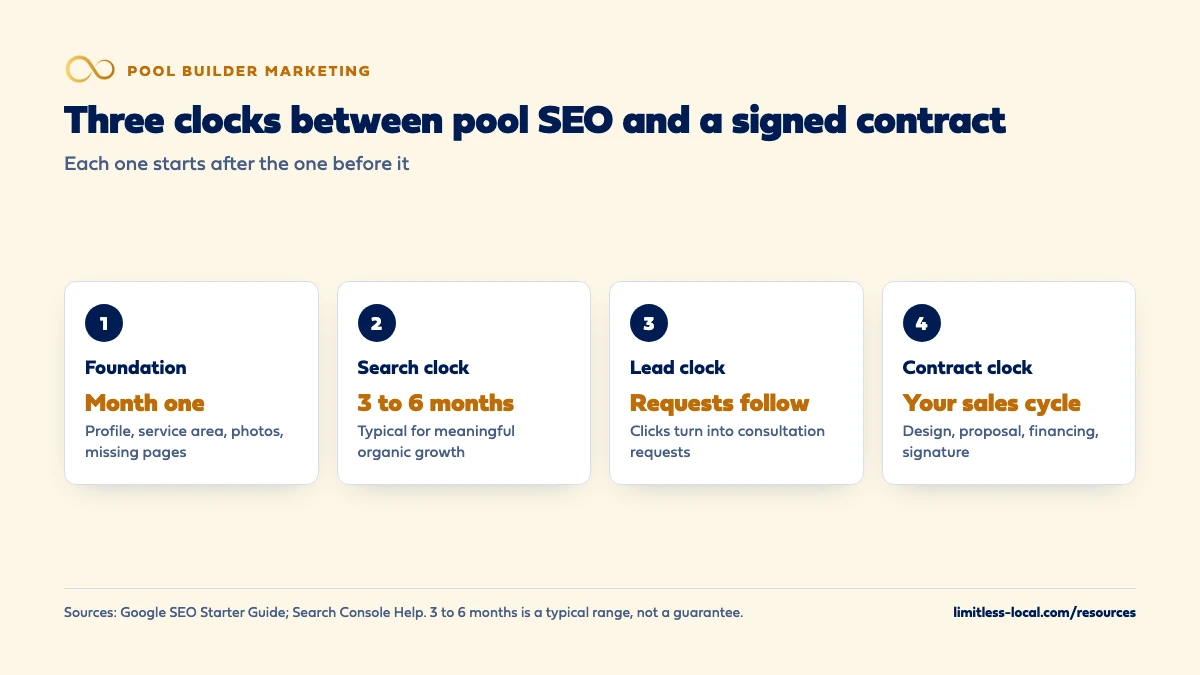
For a service trade, a lead is a phone call that often turns into a job the same week. For a pool builder, the chain is longer: a homeowner finds you, looks through your project photos, sends a consultation request or calls, sits down for a design consultation, gets a proposal, sorts out financing, and only then signs. SEO’s timeline is really three clocks running one after another:
- The search clock. How long until your pages and Business Profile show up for the searches that matter. This is the 3 to 6 month ramp.
- The lead clock. How long until those appearances turn into consultation requests. It follows the search clock, with a lag.
- The contract clock. How long a homeowner takes from first contact to a signature. That’s your sales cycle, and SEO doesn’t shorten it.
Keep the three apart when you judge the work. Strong rankings in month five with no contracts yet can be perfectly normal if your typical buyer takes months to decide. If you aren’t sure how long your own cycle runs, tracking which marketing produces signed contracts shows how to find out.
What happens in the first month of pool builder SEO?
Month one is foundation work, and very little of it changes what a homeowner sees right away. It usually covers:
- Your Google Business Profile. Verified, with the right categories, hours and service area. Google’s local ranking tips say verified businesses are more likely to show up in search results, and that businesses with complete and accurate info are more likely to show up in local results.
- Your service area, drawn honestly. In our experience, pool builders often cover more ground than a plumber or electrician. Google’s service area guidance lets you list up to 20 service areas by city or postal code, says the overall area shouldn’t be more than about two hours of driving time from where your business is based, and asks you to be as specific and accurate as possible.
- Photos of your work. Google’s photo tips suggest at least three photos at work that represent the services you offer, and say photos should represent reality, without heavy filters or AI alterations. For a pool builder, finished backyards sell, but so do excavation, steel and tile shots that show how you build.
- The pages you’re missing. One page for new construction, one for renovations and resurfacing, and pages for the pool types and towns you actually want more of.
- Search Console. Google’s free tool for seeing how your site shows up in search, so there is a starting point to compare against.
In our experience, consultation requests rarely change much in this first month. That’s expected. It’s the groundwork everything after it builds on.
When will Google start showing my new pool pages?
Google’s SEO Starter Guide answers this directly: every change takes some time to be reflected on Google’s end, some changes might take effect in a few hours, and others could take several months. Its advice is to wait a few weeks before judging whether a change helped, and it notes that not every change will make a noticeable difference.
A quick check is to search Google for site: followed by your domain. If your new renovation page or town page shows up, Google has found it. If it doesn’t, the page may not be linked from anywhere on your site yet, which is one of the first things to fix.
What should months two through six look like?
Our published timeline is that SEO typically takes 3 to 6 months to show meaningful organic growth. Inside that window, the order things tend to happen in is more useful than an exact date:
- Impressions climb. Your pages start appearing for more searches, often low on the page where few people click.
- Positions improve. Pages move up for searches like “inground pool builder” or “pool remodel” plus your town.
- Clicks follow. Once a page reaches the first page of results, homeowners start visiting it and browsing your projects.
- Consultation requests follow the clicks. Then your sales cycle starts, and contracts come at the end of it.
That order is our judgement from watching local service sites ramp, not a Google rule. Which searches you aim at in the first place decides how useful those clicks are; the keywords a pool builder should target covers that choice.
How does the long pool sales cycle stretch the timeline?
Say SEO starts producing steady consultation requests in month four. If your typical homeowner takes a few months from the first consultation to a signed contract, the first contracts you can trace to SEO may not land until well after that. Nothing went wrong; the SEO ramp and your sales cycle simply add together.
Two things follow from that, in our judgement:
- Judge the early months on leading signs, not contracts: impressions, positions, consultation requests and how many of those requests turn into design consultations.
- Follow-up decides how much of the ramp you keep. A homeowner who found you in winter and goes quiet isn’t lost. Following up during a long sales cycle covers how to stay in touch without becoming a nuisance.
Curious what your marketing is actually booking?
Get a free visibility audit — no obligation, no sales pitch.
When in the year should a pool builder start SEO?
Earlier than feels natural. Search interest in pools tends to rise as the weather warms and planning season starts, which is when you want to already be showing up, not just beginning the foundation. Google’s Keyword Planner help says its historical metrics show how popular keywords are during different times of the year, so you can check the pattern in your own market instead of guessing.
Because the foundation takes about a month and Google can take anywhere from hours to several months to reflect changes, work started in the fall or early winter has a better chance of being in place when homeowners in your area start planning. That’s our judgement from the ramp, not a promise of timing. The slow months are also a good time to add the project pages and photos you didn’t have time for during build season; keeping leads coming in the off-season goes further on that.
How can I tell SEO is working before contracts come in?
Two free Google tools show progress well before your contract count does.
Search Console’s Performance report. According to Search Console Help, it shows clicks, impressions, click-through rate and average position, and by default it shows the past three months. The Queries tab shows which searches you’re appearing for. Rising impressions and a better average position for searches like “pool builder” plus your town are the early signs.
Your Business Profile performance. Google’s Business Profile performance page counts views, the searches people used to find you, calls from your profile and website clicks. One catch: Google says this data includes views, searches and actions from both organic search and Google Ads, so if you run ads, those are mixed in.
Does the Google Maps ranking move faster for a pool company?
Sometimes, but it runs on different rules. Google’s local ranking help says local results are mainly based on relevance, distance and popularity, and describes three factors:
- Relevance: how well your Business Profile matches what someone searched.
- Distance: how far your business is from the person searching.
- Popularity: how well-known your business is, including how many websites link to you and how many reviews you have. Google says more reviews and positive ratings can help.
Profile fixes can be made in a day, which is why Maps can sometimes respond sooner than the regular results. Distance is the limit for pool builders who sell across a wide area: you’ll tend to show up in Maps more near your address than in the towns at the edge of your territory, where your website’s town and project pages have to do more of the work. That’s our reading of how Google describes distance, not a timing rule. Getting your pool company to rank in Google Maps goes step by step.

What makes pool builder SEO take longer?
- Crowded markets. In warm-weather metros with many established builders, the companies already in the map pack have years of reviews and links. Climbing past that takes longer.
- Few reviews. A pool builder completes far fewer jobs a year than a service company, so reviews pile up slowly. Google names review count and rating as part of popularity, so a thin review count starts you behind. That’s one reason to ask every finished customer.
- A thin portfolio online. If your best builds live only on your phone, there’s little on your site for Google to match to a search, or for a homeowner to judge you by.
- A brand-new site. Older sites usually start ahead, in our view because they’ve had years to collect links and get their pages found, not because age counts by itself.
- Inconsistent listings. Google says your profile might not show up for relevant searches in your area if your business info isn’t accurate.
Buying a domain with “pools” and your city in it won’t shortcut any of this. Google’s Starter Guide says keywords in the domain name alone have hardly any effect on ranking.
Should I run ads while SEO ramps up?
If your schedule needs consultations in the next few weeks, it’s worth considering. Ads can generate leads within days of launch, while SEO typically takes 3 to 6 months to show meaningful organic growth. Ads during the ramp keep design consultations on the calendar while the slower channel builds.
The trade-off for a pool builder is that clicks on high-ticket searches can be expensive, and an ad lead still has to go through your full sales cycle. Whether Google Ads are worth it for pool builders covers when the math works.
How long should I give SEO before deciding it's not working?
Long enough for the foundation to land, but not in the dark. A fair approach:
- After a few weeks: check that the work is done and Google has found the new pages. Google’s own guidance is to wait a few weeks to judge a change.
- Around month three: impressions and average positions in Search Console should be trending up for the searches you care about. If they’re flat, ask why and what’s changing.
- Months three to six: organic growth typically becomes meaningful here, and consultation requests from it should start to show in your tracking.
- After that: judge contracts against your own sales cycle, not against the calendar.
Google’s guide to hiring an SEO suggests asking anyone you hire what results they expect, in what timeframe, and how they measure success, and it says no one can guarantee a #1 ranking on Google. We don’t guarantee rankings, lead counts or revenue either.
Talk it through with someone who runs this every day
A 15-minute growth call: your market, your numbers, and what a realistic budget looks like. No pressure.
What's different about SEO timing for pool builders
Fewer, bigger jobs. A pool builder may sign a handful of contracts in a month where a service company books dozens of calls. One good or bad month says little, so look at a rolling quarter, and at consultation requests as well as contracts.
New builds and renovations behave differently. Renovation and resurfacing work often has a shorter decision than a new pool, so pages for that work may show results in your tracking sooner. In our view, treat them as separate lines when you judge SEO rather than one blended number.
The work is visual. Homeowners judge a builder by the pools they’ve built. A site and Business Profile full of real project photos give SEO something to rank and give the visitor a reason to request a consultation.
A worked example: the SEO ramp plus a pool sales cycle
The gross profit figure here is made up to show the math, not a benchmark for your market. Local SEO is included in every package we sell, and our Essentials package is $3,500 a month. That package also covers Google Ads management, follow-up and reporting, so charging all of it to SEO is the strictest version of the math. Three months of it is $10,500, spent mostly while the foundation is going in.
Say one signed pool contract leaves you $12,000 in gross profit after materials, subs and labor. A single contract traced to SEO would cover the first three months of the fee with room to spare. The catch is timing: if the ramp takes four months and your sales cycle adds a few more, that contract may land well after you’ve paid for the early months. That’s why the leading signs matter, and why a free visibility audit is the place to run this with your own margins and sales cycle.
Frequently asked questions
Do I need a new website before starting pool builder SEO?
Not necessarily. Google’s guide to hiring an SEO says a good SEO can improve an existing site, though it also calls a redesign or new site launch a great time to bring SEO in.
Can I do pool builder SEO myself?
Google says that if you run a small local business, you can probably do much of the work yourself, starting with its SEO Starter Guide. The cost is your time, which is usually spent on job sites and design consultations.
Will running Google Ads help my organic rankings?
No. Google’s guide to hiring an SEO says advertising with Google won’t have any effect on your site’s presence in its search results. Ads can bring consultations sooner, but they’re a separate channel from SEO.
How many service areas can I list on my Business Profile?
Up to 20, by city, postal code or another area. Google says the overall area shouldn’t be more than about two hours of driving time from where your business is based.
Does SEO stop working in winter?
Your rankings don’t switch off with the season, but searches for new pools tend to drop in colder months. In our judgement, winter is a good time to build pages and gather photos so you’re ready when planning season starts.
Key takeaways
- Expect a ramp: month one is foundation work, and meaningful organic growth typically takes 3 to 6 months.
- Add your sales cycle on top: a consultation request in month four can become a contract months later.
- Start in the fall or early winter so the foundation is in place before planning season.
- Judge the early months on impressions, positions and consultation requests, not contracts alone.
- Nobody can honestly promise a date for rankings or signed contracts.
Ready to compare options?
Book a short growth call and we'll walk through the math for your service area, including when we're not the right fit.
More in this section
- How fast should a pool builder respond to a new lead?
- How should pool builders follow up on leads during a long sales cycle?
- How do pool builders qualify leads before the design consultation?
- How do pool builders keep leads coming in the off-season?
- What keywords should a pool builder target?
Sources
- SEO Starter Guide: The Basics — Google Search Central
- Do You Need an SEO? Tips for Hiring an SEO — Google Search Central
- Tips to improve your local ranking on Google — Google Business Profile Help
- Manage your service areas for service-area & hybrid businesses — Google Business Profile Help
- Tips for business-specific photos on your Business Profile — Google Business Profile Help
- Understand your Business Profile performance & insights — Google Business Profile Help
- Performance report (Search results): Overview and basic setup — Search Console Help
- About Keyword Planner forecasts — Google Ads Help