
How do pool builders qualify leads before the design consultation?
- What should a pool builder ask a homeowner before booking a design consultation?
- Why should a pool builder qualify leads before the design consultation?
- Step 1: What makes a pool lead qualified?
- Step 2: What should my website form ask?
- Step 3: How should my office screen phone leads?
- Step 4: How do I ask about budget without scaring homeowners off?
- Step 5: What should I ask about the property before visiting?
- Step 6: Should both decision-makers be at the consultation?
- Step 7: What do I do with leads that don't qualify yet?
- Does qualifying slow down my response to new leads?
- How do I know if my qualifying is working?
- Can I qualify too hard?
- What's different about qualifying pool leads
- A worked example: what qualifying saves
- Frequently asked questions
- Key takeaways
- More in this section
- Sources
The short version
- Write down what a qualified pool lead is before anyone answers the phone.
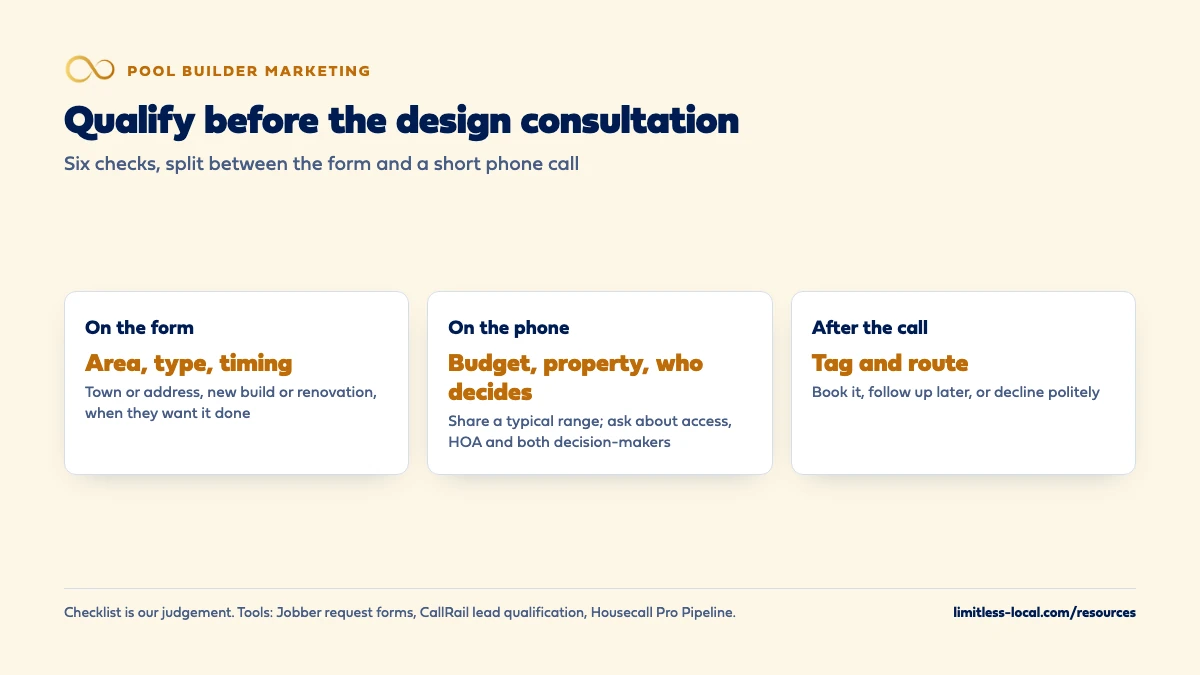
- Ask about location, pool type and timeline on the form; confirm budget and decision-makers by phone.
- Mark each lead qualified or not, and by source, so you can see which marketing sends good-fit homeowners.
- Not ready is not the same as not qualified: put those leads into follow-up.
For pool construction owners and office staff who spend hours on design consultations and want more of them to end in signed contracts.
Get a free visibility audit · Book a growth call
What should a pool builder ask a homeowner before booking a design consultation?
Pool builders qualify leads by deciding in advance what a good-fit project looks like, then checking a few things before the design consultation: that the home is in your service area, that the homeowner wants the kind of pool you build, when they want to swim, how they plan to pay, and who makes the decision. Ask the first questions on your website form and confirm the rest in a short phone call, so the consultation is spent designing, not discovering. Leads that aren’t ready yet go into follow-up instead of being dropped.
Qualifying is where marketing and sales meet, and it’s the part of the process our automation work is built to support: tracking where each lead came from, getting it answered fast, and following up with the ones who aren’t ready yet. Automation add-ons plug into any of our packages, and the pool builder marketing page shows how it fits with SEO and ads. The rest of the pool builder marketing questions library goes question by question.
Why should a pool builder qualify leads before the design consultation?
Because a design consultation is expensive to give. Between the drive, the walk of the backyard, the conversation, and the design and proposal work afterward, a single consultation can take a big part of a day for the owner or a designer. A service trade can afford to send a tech to a call that goes nowhere. A pool builder who books every inquiry onto the calendar spends the busy season designing pools for people who were never going to build one.
Qualifying doesn’t mean turning people away. It means finding out, before the meeting, whether this is a project you can build, for a homeowner who is ready to decide, so the meeting can be about design. In our judgement, a few questions asked early do more for your close rate than a better sales pitch at the table.
Step 1: What makes a pool lead qualified?
Write it down before anyone answers the phone, so the office and the owner use the same yardstick. Most pool builders’ lists cover the same six things, in our view:
- Location. Inside the area you actually build in. Google’s own service area guidance for Business Profiles says the overall area shouldn’t be more than about two hours of driving time from where your business is based, which is a sensible outer limit for consultations too.
- Project type. New build, renovation, or an add-on, and the pool types you build.
- Timeline. When they want to swim, and whether that fits your build calendar.
- Budget and financing. A realistic range for the kind of pool they describe, and whether they plan to finance.
- Property. Whether the yard can take a pool: access for equipment, slope, and any HOA approval they’ll need.
- Decision-makers. Who has to say yes, and whether they’ll all be at the consultation.
A lead that clears all six gets a consultation. One that misses on timing alone is a follow-up lead, not a dead one.
Step 2: What should my website form ask?
Enough to sort the lead, and no more. Field-service software lets you shape the form: Jobber’s request form help says you can create customizable request forms to collect job details, choose whether to review requests first or let clients book directly, and share request links set up with lead tracking so each request is attributed to where it came from.
For a pool builder, in our judgement, the form should ask:
- Address or town, so you can check the service area.
- New pool, renovation or something else, as a simple choice.
- When they’d like the project done, as a choice of time frames.
- Whether they’d like to hear about financing.
- An optional photo of the backyard.
Leave the budget question for the phone, or offer ranges rather than an open box. A long form scares off good leads along with bad ones. Review requests before booking rather than letting anyone grab a consultation slot online. What a pool builder website should include covers the rest of the page around the form.
Step 3: How should my office screen phone leads?
With a short script that covers the six points from Step 1, asked as conversation rather than an interrogation. Whoever answers should know the service area by heart, know which pool types you build, and know when the next consultation openings are.
Then mark the result where you’ll see it later. CallRail’s lead qualification help says qualifying leads lets you report on which marketing is attracting good leads, and lists several ways to do it, including automation rules and marking a lead qualified by hand. Its Keypad Scoring feature lets the person who took the call score it as a lead, add a tag and record a value right after it ends; the caller doesn’t hear the survey. Tags such as “new build”, “renovation” and “outside area” are enough to start.
Step 4: How do I ask about budget without scaring homeowners off?
Give them something to react to. Most homeowners don’t know what a pool costs, so “what’s your budget?” gets a guess or a dodge. In our judgement, a better approach is to share the range your typical projects fall into and ask whether that’s in line with what they had in mind. If you’re comfortable publishing ranges on your website, many of these conversations happen before the call.
If they plan to finance, note it and point them to your lending partner early, so financing isn’t the reason a signed design stalls later. Be careful how you talk about payments in ads and on your site: under the federal Truth in Lending rules (Regulation Z, § 1026.24), an ad that states the amount of a payment or the number of payments must also state the downpayment, the repayment terms and the annual percentage rate. This is general information, not legal advice; get exact wording from your lender or an attorney.
Curious what your marketing is actually booking?
Get a free visibility audit — no obligation, no sales pitch.
Step 5: What should I ask about the property before visiting?
The questions that end projects before they start, in our view:
- Access. Can equipment get into the backyard, or is it fenced in on every side?
- The yard itself. Slope, trees, and roughly how much room there is.
- HOA. Whether they’re in a homeowners association and whether it has to approve the pool.
- Existing features. Septic, easements, or utilities they know run through the yard.
You don’t need answers to every one, and you shouldn’t give a permit or legal opinion over the phone; rules vary by town. The point is to spot a likely dead end early. A backyard photo or a satellite view answers half of these before anyone drives out.
Step 6: Should both decision-makers be at the consultation?
Ask for it, in our judgement. A pool is usually a household decision, and a design presented to one spouse often gets re-explained, second-hand, to the other, with your best points lost on the way. Asking “who else will be part of this decision, and can they join us?” when you book is ordinary, and most homeowners take it well.
If they can’t both make it, offer a short follow-up call or video walk-through of the design for the other person, rather than skipping the consultation.
Step 7: What do I do with leads that don't qualify yet?
Sort them, don’t delete them:
- Not ready yet. Right project, wrong timing. These go into long-term follow-up; many of next season’s contracts are this season’s “maybe next year” leads. Following up during a long sales cycle covers how.
- Wrong fit. A pool type you don’t build, or work you don’t do. Say so plainly and, if you know a good company for it, point them there.
- Outside your area. Decline politely. A consultation two hours past your usual territory is rarely worth it.
- Budget gap. Sometimes a smaller pool, a phased plan or financing closes it. Sometimes it doesn’t, and saying so early saves both of you time.
Housecall Pro’s Pipeline shows one way to keep these visible: leads move through columns such as New Lead, First Contact, Won and Lost, and its tip is to keep statuses updated so no lead falls through the cracks.

Does qualifying slow down my response to new leads?
It shouldn’t. Qualifying is the first conversation, not a gate in front of it. In our judgement, a new inquiry should get a reply the same business day, and the qualifying questions are part of that reply. A homeowner who submitted three requests to three builders tends to book with the one who calls back first and makes it easy.
The mistake to avoid is a form that asks everything and a reply that comes days later. Short form, fast call, then the rest of the questions in the call.
How do I know if my qualifying is working?
Track three numbers by source: inquiries, qualified leads, and consultations that become signed contracts. Jobber’s lead management help describes a lead source field on each client record, with options such as Google, Facebook, referral and event plus custom sources, and a lead label that stays until a job is created, an invoice is sent or a quote is approved.
If one source sends plenty of inquiries but few qualify, that’s a marketing problem, often the wrong searches. The keywords a pool builder should target covers that side. If plenty qualify but few sign, look at the consultation and the follow-up. Tracking which marketing produces signed contracts covers the full setup.
Can I qualify too hard?
Yes. A builder who demands a budget figure, a survey and a financing pre-approval before saying hello will lose good homeowners who simply haven’t thought that far yet. In our view the test is whether a question changes what you do next. Where the house is changes whether you go; how many bathrooms it has doesn’t.
Keep a short list of must-haves (area, project type, a rough timeline) and treat the rest as things to learn on the way to the consultation, not hurdles to clear before it.
Not sure which of these is costing you jobs?
A free visibility audit checks the Google profile, reviews, site and tracking, and shows what to fix first.
What's different about qualifying pool leads
The consultation is the expensive step. In most trades the first visit is short. For a pool builder it can include design time, measurements and a proposal, so every unqualified consultation costs far more than a wasted service call.
Timing is part of fit. A homeowner who wants to swim in a few weeks may be unrealistic for a new build, while one planning for next summer is right on time. Ask about timing early and explain your build calendar honestly.
Financing and property can stop a signed design. In our judgement, more pool deals stall on financing, HOA approval or access than on design. Asking about them before the consultation is how you find out while it’s still cheap.
A worked example: what qualifying saves
These numbers are made up to show the math, not a benchmark. Say you get 20 consultation requests in a busy month, and a short form plus a phone screen finds that 8 of them are outside your area, want work you don’t do, or plan to wait a year. That leaves 12 design consultations. If each consultation takes you about 3 hours with the drive and design prep, screening out those 8 saves roughly 24 hours, most of a working week in the busy season, and the 8 aren’t lost: the “wait a year” ones go into follow-up.
This view comes from inside a pool company, not just from the marketing side. From our own record: the agency was an equity partner in a pool construction company, where it streamlined back-office operations, built the lead-generation engine and ran sales and marketing. That business did $2M+ revenue in year one. Tracking which leads qualified, and where they came from, is part of every package we sell: call, web and form tracking with source tagging and monthly reporting. Automation add-ons such as calendar reminders, unified messaging and after-hours answering plug into any package, with pricing shared on the discovery call. A free visibility audit is where we’d look at your own inquiry mix.
Frequently asked questions
Should I charge for design consultations to filter out tire-kickers?
Some builders do, and in our judgement it can work once your reputation and reviews carry the weight. A free, well-qualified consultation is usually the easier start for a newer company.
Can my office qualify leads instead of me?
Yes, if they have a written list of what qualifies and know the service area, pool types and calendar. Tagging each call after it ends, for example with CallRail’s Keypad Scoring, lets you check their judgement later.
Should I let homeowners book consultations online?
Jobber lets you choose between reviewing requests first and letting clients book directly. For consultations that take a big part of your day, reviewing first is usually the safer setting, in our view.
What if a homeowner won't share a budget?
Share your typical range and ask if it’s in line with what they expected. If they still won’t say, book the consultation only if everything else fits.
Do I need special software to qualify leads?
No. A written checklist and a spreadsheet work. Field-service and call-tracking tools such as Jobber, Housecall Pro and CallRail make tagging and reporting easier once volume grows.
Key takeaways
- A design consultation is the most expensive step in your sales process, so qualify before it.
- Check area, project type, timeline, budget, property and decision-makers, split between form and phone.
- Keep the form short and the reply fast; qualifying is the first conversation, not a gate.
- Tag leads qualified or not, by source, to see which marketing sends good-fit homeowners.
- Leads who aren’t ready yet belong in follow-up, not in the trash.
Want a second set of eyes on your setup?
We'll look at how you show up locally and where calls are leaking, then send you a plain-English breakdown.
More in this section
- How should pool builders follow up on leads during a long sales cycle?
- What should a pool builder website include to get more consultations?
- How do pool builders keep leads coming in the off-season?
- How long does pool builder SEO take to bring in leads?
- What keywords should a pool builder target?
Sources
- How to qualify leads in CallRail — CallRail Help Center
- Keypad Scoring — CallRail Help Center
- Add your Request and Booking Forms to your Website and Social Media — Jobber Help Center
- Lead Management — Jobber Help Center
- Getting Started with Pipeline — Housecall Pro Help Center
- Manage your service areas for service-area & hybrid businesses — Google Business Profile Help
- § 1026.24 Advertising — Consumer Financial Protection Bureau