
How much should a plumbing company spend on marketing each month?

- What's a realistic monthly marketing budget for a plumbing company?
- How do I work out a monthly marketing budget for my plumbing company?
- What does a plumbing marketing budget actually pay for?
- What marketing budget should I start with for my plumbing business?
- How much should I budget for Google Ads and Local Services Ads?
- How much does a plumbing marketing agency cost per month?
- What would it cost to hire a marketing employee instead?
- What monthly budget and time does each plumbing marketing channel need?
- Should a plumbing company's marketing budget change with the seasons?
- Is a percentage of revenue a good way to set my plumbing marketing budget?
- How do I know if I'm spending too much or too little?
- What's different about marketing budgets for plumbing companies
- A worked example: building a plumbing budget backward
- Frequently asked questions
- Key takeaways
- More in this section
- Sources
The short version
- Set the budget backward from booked jobs and the most you can pay to win one.
- Count everything: ad spend, management or your own time, and tools like call tracking.
- Price your own market with Keyword Planner and your own lead costs, not a national average.
- Raise spend only while cost per booked job stays under your ceiling and the schedule has room.
For plumbing company owners setting a monthly marketing budget who want the math behind the number, not a national average.
Get a free visibility audit · Book a growth call
What's a realistic monthly marketing budget for a plumbing company?
There’s no honest single number: a plumbing company should spend what it takes to book the jobs it wants, at a cost per booked job its margins can carry. Work it backward: the most you can afford to pay to win one job, times the extra booked jobs you want each month, gives you a monthly ceiling that has to cover ad spend paid to Google plus whatever you pay someone to run it. Start with a smaller test, measure what each booked job cost, and raise the budget only while jobs keep booking under that ceiling.
Our own prices are public, which makes the math easier: our marketing packages list what each tier costs and how much ad spend it covers, and ad spend is always paid to Google separately. How that fits a plumbing shop is on our plumbing marketing page, and the rest of the plumbing marketing questions library goes channel by channel.
How do I work out a monthly marketing budget for my plumbing company?
Start from the jobs, not from a number that feels comfortable. You need two inputs:
- The most you can pay to win one booked job. Take what an average job brings in, subtract parts, labor and overhead, and decide how much of what’s left you’re willing to spend to get the job. That’s your ceiling per booked job.
- How many extra booked jobs you want each month. Pick a number your crews can actually run, on top of the work you already get from repeat customers and referrals.
Multiply the two and you have a monthly ceiling. Everything goes inside it: what you pay Google, what you pay an agency or employee, and the tools. The SBA’s advice for any marketing plan points the same way: include a complete breakdown of the costs, keep tracking them once the plan is running, and compare marketing costs to the revenue they bring in (SBA: Marketing and sales).
A budget built this way comes with its own test: if a month of spend misses the booked jobs you planned for, you can see which input was off. How much you can afford per lead goes deeper on the ceiling.
What does a plumbing marketing budget actually pay for?
Many owners count only the ad spend, and in our judgement that’s the main reason budgets surprise them. A complete monthly budget usually has three parts:
- Ad spend. What Google charges for clicks or leads. It goes to Google, not to whoever runs the ads.
- The people. An agency’s management fee, a marketing employee’s pay, or your own hours, which have a cost even if you don’t write a check for them.
- The tools and fixed costs. Call tracking, review requests, website hosting and updates, and the software you book jobs in if you’re paying extra for its marketing features.
A one-time website build sits outside the monthly number. In our judgement, budget it as a project rather than letting it crowd out ad spend in the month you pay for it.
What marketing budget should I start with for my plumbing business?
Smaller than your ceiling, and aimed at one thing. A new or newly marketed plumbing company doesn’t know its own cost per booked job yet, so the first job of the budget is to find out. In our judgement, a good first budget does three things:
- Pays for the free foundation first: a verified, complete Google Business Profile and a habit of asking every customer for a review. These cost time, not money.
- Funds one paid channel well, instead of three thinly. Local Services Ads or Google search ads, aimed at the jobs and towns you want most.
- Runs long enough to read. A few weeks of steady spend on paid search tells you far more than a few days.
If you can’t cover a paid channel yet, the SEO side can start with your own time. Google says a small local business can probably do much of its SEO work itself (Google Search Central). It won’t ring the phone next week, but it costs hours rather than dollars. Getting a new plumbing company its first customers covers the order to do it in.
How much should I budget for Google Ads and Local Services Ads?
Price your own market rather than borrowing someone else’s number. Two places to look:
- Google search ads. Keyword Planner shows a top of page bid low and high range for each keyword, which Google describes as roughly the 20th and 80th percentile of what advertisers have historically paid for a top-of-page spot, based on your location settings (About Keyword Planner forecasts). Set the location to the area your trucks cover, and look up the jobs you actually want, such as water heater replacement or sewer line repair, separately from drain cleaning.
- Local Services Ads. There’s no keyword price list. Google says lead prices vary with your location, the job type, the type of lead and your bidding, and message leads are typically priced lower than phone leads, though not always (How leads work). Your real number shows up once leads start coming in.
Search ads, and Local Services Ads that have moved into Google Ads, budget the same way. Google Ads uses an average daily budget: divide your monthly number by 30.4, the average number of days in a month. For most campaigns, a busy day can spend up to twice that, but over a month you won’t be charged more than 30.4 times the daily budget (About average daily budgets). Migrated Local Services Ads follow the same monthly cap (Google Ads Help). Until your account moves, Local Services Ads use an average weekly budget with a monthly maximum (How leads work).
Curious what your marketing is actually booking?
Get a free visibility audit — no obligation, no sales pitch.
How much does a plumbing marketing agency cost per month?
It depends on what’s included, so compare scope before price. Ask any agency, us included, to show three things separately: the management fee, the ad spend it covers (and whether that goes straight to Google), and what’s an extra.
Ours is public. Essentials is $3,500 a month and includes Google Business Profile management, listing cleanup, review generation, content, and Google Ads management for up to $2,500 a month in ad spend. Growth is $4,500 a month and adds SEO for up to two locations, Local Services Ads management, Meta remarketing and Google Ads up to $5,000 a month in spend. Scale is custom. Ad spend isn’t included in any package; it’s paid directly to Google. We ask for three months, but if you want to leave, we won’t make you stay.
Whether an agency is worth that for your shop is the same cost-per-booked-job math as everything else. Hiring an agency or doing it yourself lays out the trade-off.
What would it cost to hire a marketing employee instead?
More than the salary. In our judgement, owners comparing an employee with an agency often compare a paycheck with a full package and forget the rest of the employee’s cost:
- Pay, payroll taxes and any benefits.
- The tools they’ll need: call tracking, a review tool, design software, and access to your field software.
- Time to train them on your business, and your time to manage them.
- The ad spend itself, which is still paid to Google either way.
An employee makes more sense once there’s enough work to keep one busy every week, such as several channels or more than one location.
What monthly budget and time does each plumbing marketing channel need?
- Google Business Profile and reviews. Little or no money; an hour or two a week, plus asking at every job.
- Local Services Ads. A lead budget, plus someone to answer calls and reply to messages fast, because a missed call during business hours can still be charged.
- Google search ads. A click budget, a page worth sending clicks to, and someone checking search terms and budgets every week.
- SEO and your website. A steady monthly cost or steady hours, on a ramp: SEO typically takes 3 to 6 months to show meaningful growth, while ads can bring leads within days.
- Tracking. A small monthly cost for call tracking, and a few minutes per job to record where each customer came from.
The time column matters as much as the money one. A channel you can’t staff costs money without bringing jobs.

Should a plumbing company's marketing budget change with the seasons?
Usually, yes, but around your own data rather than a calendar. In our judgement, much plumbing work (clogs, leaks, water heaters that wear out) comes in year-round, with spikes when a cold snap freezes pipes or heavy rain backs up drains and sewers, and how big those spikes are varies by region. Look at your own booked jobs by month for the last year or two before deciding where the swings are.
Paid channels make adjusting easy: you can raise or lower the daily budget, and pause a campaign when the schedule is full. Google also says to create a separate campaign whenever you need a different budget (Organize your account with ad groups). For a plumber, that can mean one campaign for emergency repairs and another for planned replacement work, so a slow month for one doesn’t starve the other. SEO and reviews can’t be switched on for a busy week, which is the reason to keep them going all year.
Is a percentage of revenue a good way to set my plumbing marketing budget?
It’s a common rule of thumb, but this page doesn’t quote one, because we couldn’t find a primary source for a plumbing-specific figure, and a percentage can’t tell you whether the money books jobs. Two plumbing companies with the same revenue can need very different budgets: one gets most of its work from repeat customers and builders, the other needs every new customer from Google.
If you use a percentage at all, use it as a sanity check on the backward math, not a replacement for it. The SBA’s test is the useful one: compare what marketing costs with the revenue it brings in, and keep measuring it so you know which parts of the plan are working (SBA: Marketing and sales). Working out your customer acquisition cost shows how to get that number from your own books.
How do I know if I'm spending too much or too little?
Look at two numbers together: cost per booked job and how full the schedule is.
- Cost per booked job is under your ceiling and the schedule has room. More budget is probably buying profitable work. Raise it in steps and watch the number.
- Cost per booked job is over your ceiling. More budget won’t help. Fix where leads are lost first: missed calls, slow callbacks, the wrong job types or a weak landing page.
- The schedule is full. More leads turn into customers you can’t reach in time. Hold the budget, or shift it toward the higher-ticket work.
None of this works without knowing which channel each booked job came from. Tracking which marketing books jobs covers the setup.
Talk it through with someone who runs this every day
A 15-minute growth call: your market, your numbers, and what a realistic budget looks like. No pressure.
What's different about marketing budgets for plumbing companies
Emergency calls and planned work don’t cost the same to win. A drain clog and a whole-house repipe can come from the same search on the same day. In Local Services Ads, Google prices leads partly by job type, and in search ads the keywords for different jobs carry different bid ranges. Look each one up separately, because one blended cost per lead hides the jobs that pay best.
Answering the phone is part of the budget. Plumbing calls are often urgent, and in Local Services Ads a missed call during your business hours can still be a charged lead once the caller stays on the line for more than 20 seconds (How leads work). Money spent on after-hours coverage can lower cost per booked job as much as cheaper leads would.
Big tickets raise the ceiling. If water heater replacements, repipes or sewer work make up a real share of your jobs, the most you can pay to win one of those is much higher than for a service call. Budgets for that work can run higher per booked job and still pay.
A worked example: building a plumbing budget backward
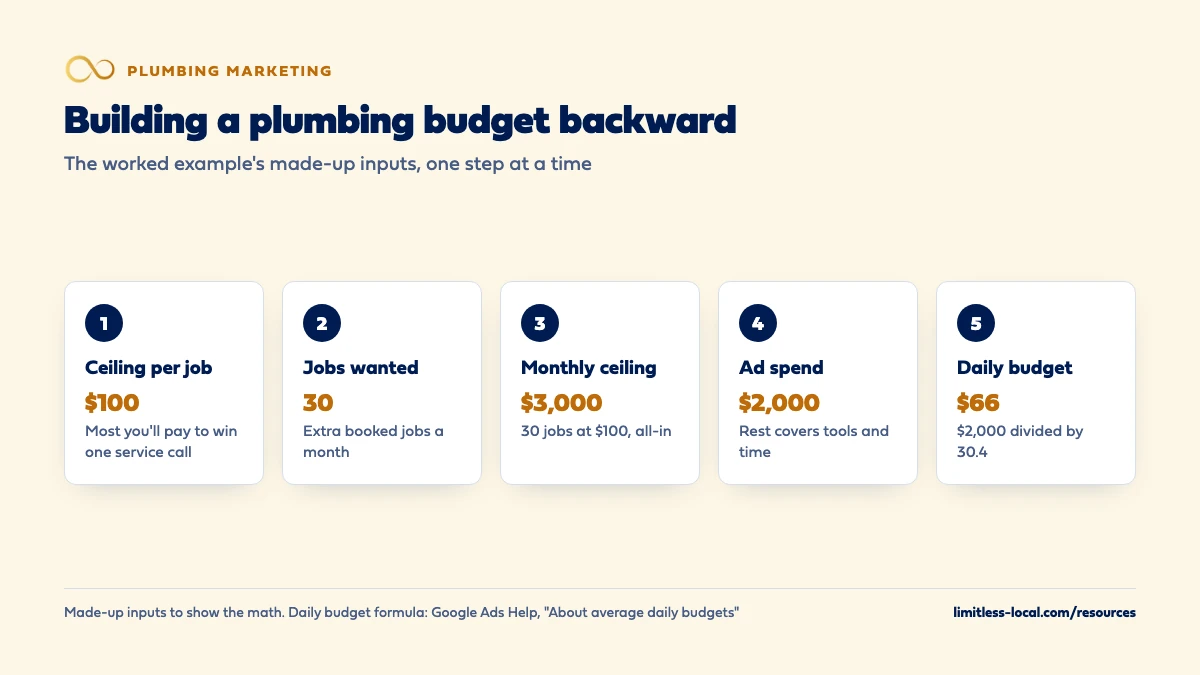
These numbers are made up to show the math, not a benchmark for your market. Say that after parts, labor and overhead, you’re willing to spend up to $100 in marketing to win an average service call, and you want 30 more booked jobs a month. Your monthly ceiling is 30 times $100, or $3,000, all-in.
Split it: $2,000 in ad spend and $1,000 for tools and the time it takes to run the ads. Divide the ad spend by 30.4 and the average daily budget is about $66. On those numbers, a full agency package doesn’t fit: our Essentials package alone is $3,500 a month before ad spend. The honest move at this size is to run one channel yourself, keep it tight, and measure.
Now change one input. Say a third of the jobs you want are water heater replacements and repipes, and across the mix you can afford $250 per booked job. The same 30 jobs give a ceiling of $7,500 a month. Essentials at $3,500 plus up to $2,500 in ad spend comes to $6,000, inside that ceiling with room for tools. The job mix changed the budget more than any ad setting could. A free visibility audit is the simplest way to run your own inputs through the same math.
Frequently asked questions
Can I write off plumbing marketing costs on my taxes?
Often, yes. A 2021 IRS tax tip says advertising and marketing costs may be tax deductible when they’re ordinary and necessary for the business (IRS tax tip on advertising costs). This isn’t tax advice; ask your accountant how it applies to your situation.
Is ad spend included in an agency's monthly fee?
Not with us, and it’s worth asking every agency. Our packages cover management; ad spend is paid directly to Google, so you can see exactly what Google charged.
Can I pay Google to rank my plumbing website higher?
No. Google says it never accepts money to include or rank sites in its search results, and it costs nothing to appear in organic results. What you pay for with SEO is the work.
Will Google spend more than my daily budget?
On a single day it can spend up to twice your average daily budget for most campaigns, but over a month it won’t charge more than 30.4 times the daily budget.
How long should I test a budget before changing it?
Give paid search a few weeks of steady spend so you have enough calls to judge, and give SEO a few months. Changing the budget every few days makes the numbers impossible to read.
Should I spend more in my busy season or my slow season?
Check your own booked jobs by month first. When the schedule is already full, more spend mostly buys calls you can’t take; a slow stretch with room on the schedule is often where extra budget does the most.
Key takeaways
- Set the budget backward: the most you’ll pay to win a booked job, times the extra jobs you want.
- Count ad spend, management or your own time, and tools; ad spend goes to Google either way.
- Price your own market with Keyword Planner and your own lead costs instead of a national average.
- Divide a monthly ad budget by 30.4 for the daily budget Google uses.
- Higher-ticket work like water heaters and repipes raises what you can afford per booked job.
Ready to compare options?
Book a short growth call and we'll walk through the math for your service area, including when we're not the right fit.
More in this section
- Should I hire a plumbing marketing agency or do it myself?
- How do I work out my plumbing customer acquisition cost?
- How do I track which plumbing marketing books jobs?
- How do I get more plumbing leads?
- How much can I afford to pay for a plumbing lead?
Sources
- Manage your business: Marketing and sales — U.S. Small Business Administration
- Tax Tip 2021-159: Small business advertising and marketing costs may be tax deductible — Internal Revenue Service
- About Keyword Planner forecasts — Google Ads Help
- About average daily budgets — Google Ads Help
- Organize your account with ad groups — Google Ads Help
- How leads work — Google Local Services Help
- Local Services Ads transition to Performance Max campaigns with pay-per-lead goals — Google Ads Help
- Do you need an SEO? — Google Search Central