
Is buying leads from Angi or HomeAdvisor worth it for pool builders?

- Are paid lead marketplaces like Angi, HomeAdvisor or Houzz worth the money for a pool company?
- How do Angi and HomeAdvisor leads work for contractors?
- What's the difference between a marketplace lead and a lead from my own marketing?
- Do I get my money back for bad pool leads?
- What did the FTC find about HomeAdvisor's leads?
- Do marketplace leads suit new pool construction or renovations better?
- How do Angi and HomeAdvisor compare with Google Local Services Ads?
- What about Houzz, Thumbtack and other lead sites?
- How should a pool builder test a lead marketplace?
- When should a pool builder skip lead marketplaces?
- What's different about lead marketplaces for pool builders
- A worked example: cost per lead versus cost per signed contract
- Frequently asked questions
- Key takeaways
- More in this section
- Sources
The short version
- HomeAdvisor says you're charged for each lead whether or not you win the job, and that it doesn't provide or guarantee jobs.
- Lead credits cover only a short list of problems, such as duplicates or wrong contact details, and not homeowners who never call back or were just shopping.
- In January 2023 the FTC announced a proposed order barring HomeAdvisor from misleading claims about its leads, so test with a capped budget and your own tracking.
- For most pool builders, marketplaces are a supplement while owned channels build up, not the main source of new-build contracts.
For pool builders weighing pay-per-lead marketplaces against channels they own, such as their Google Business Profile, website, ads and referrals.
Get a free visibility audit · Book a growth call
Are paid lead marketplaces like Angi, HomeAdvisor or Houzz worth the money for a pool company?
Buying leads from Angi or HomeAdvisor can be worth it for a pool builder only as a measured test, usually for smaller renovation or repair jobs, because you pay for each lead whether or not you win the job and the homeowner may be talking to other pros. For custom new builds, owned channels such as your Google Business Profile, website, search ads and referrals usually give you more control over who calls. Judge any marketplace by cost per signed contract over a full season, not by how many leads it sends.
We’d rather build the channels you own: your Google Business Profile, a website that books design consultations, and local search ads aimed at the towns and pool work you want, with call tracking so you can compare all of it against any marketplace you keep. The pool builder marketing page shows how we run it for pool companies, and the pool builder marketing questions library takes the related questions one at a time.
How do Angi and HomeAdvisor leads work for contractors?
You pick the services you offer and the areas you serve, and the platform sends you homeowners who asked for that kind of work. HomeAdvisor’s own how it works page, which describes the service as HomeAdvisor powered by Angi, says you choose service types and ZIP codes, and set a spend target, an estimated 28-day amount it tries to meet when sending you leads.
Three details on that page matter most to a pool builder:
- You pay per lead, not per job. HomeAdvisor says you’re charged for each lead you receive, whether or not you win it, and regardless of whether the homeowner hires anyone.
- The spend target isn’t a cap. It’s an estimated goal; some lead types are charged outside it, and the page says you can go over it, so review your invoices.
- Price depends on your trade and region. The page doesn’t publish lead prices; it says you’ll be told current prices when you call to join.
Angi also lets businesses set up a free profile, which its FAQ separates from paid advertising on the platform.
What's the difference between a marketplace lead and a lead from my own marketing?
Who the homeowner thinks they’re talking to. A homeowner who searched for pool builders, looked at your gallery and called you is already a little bit yours. A homeowner who filled in a form on a marketplace asked the marketplace for help, and you’re one of the pros it connected them with.
That shows up in a few ways, in our judgement:
- You start the conversation cold. The homeowner may not know your name yet when you call.
- Speed decides more. If other pros got the same request, the first useful call often wins the consultation.
- The asset stays with the platform. Reviews, profile and visibility on your own Google Business Profile and website keep working after you stop paying. Marketplace leads stop when the spending stops.
That doesn’t make marketplace leads bad. It makes them a rented source, and rented sources should be judged harder.
Do I get my money back for bad pool leads?
Sometimes, and only for specific problems. HomeAdvisor’s lead credit guidelines say credits are at the platform’s discretion, must be requested within 30 days of the charge, are issued as store credit toward future charges, and expire six months after they’re issued.
The situations it lists as possibly eligible are narrow: duplicate requests, a wrong ZIP code or job type that doesn’t match your profile, a competitor testing the system, or contact details that are all wrong or disconnected. It lists as not eligible a homeowner who doesn’t call back, already found someone, changed their mind, is just shopping, or simply didn’t hire you.
For a pool builder, the second list is where most of the waste sits. Plenty of homeowners price a pool, then decide to wait a year. Under these rules, you paid for that lead.
What did the FTC find about HomeAdvisor's leads?
In January 2023 the Federal Trade Commission announced a proposed order requiring HomeAdvisor to pay up to $7.2 million and stop deceptive marketing of its leads to service providers. The FTC’s complaint alleged that since at least mid-2014 the company made false, misleading or unsubstantiated claims about the quality and source of its leads, that many providers received leads that didn’t match their services or areas, and that it claimed job rates it couldn’t substantiate.
The proposed order bars HomeAdvisor from misleading claims about its leads, including that they come from homeowners ready to hire, and from unsubstantiated claims about how often leads turn into paying jobs.
The practical lesson isn’t that every lead is bad. It’s that a marketplace’s own numbers about lead quality and win rates aren’t a substitute for yours. Track every lead you buy to a consultation and a signed contract, and decide on that.
This summarizes the FTC’s January 2023 announcement; it isn’t legal advice.
Curious what your marketing is actually booking?
Get a free visibility audit — no obligation, no sales pitch.
Do marketplace leads suit new pool construction or renovations better?
In our judgement, they tend to fit smaller, more defined jobs better than custom new construction. A homeowner who needs a pool resurfaced, a heater replaced or a leak found is shopping for a contractor to do a known job soon. A homeowner planning a new pool is often months from signing, wants to see your past builds and meet you in person, and may be collecting several designs.
So if you take renovation, resurfacing or repair work, a capped marketplace test aimed at those job types can make sense. If you only build custom new pools, the fit is weaker, and the lead credit rules above mean you’ll pay for a lot of early-stage browsing.
Either way, tag each marketplace lead with its project type. Our page on marketing renovations separately from new pools explains why the two need separate numbers.
How do Angi and HomeAdvisor compare with Google Local Services Ads?
Both charge per lead, but the lead comes from a different place. With a marketplace, the homeowner asked the platform for help. With Local Services Ads, the homeowner searched on Google and contacted your business from your ad. Our page on whether Local Services Ads are worth it for pool builders covers how Google lists pool contractors, what counts as a chargeable lead and when it’s a good fit, so we won’t repeat it here.
The comparison to make is the same one: cost per signed contract, over a season, by project type. Run them side by side with separate tracking, and the numbers usually make the decision for you.
What about Houzz, Thumbtack and other lead sites?
The same test applies to every paid lead source: how it charges, who else gets the lead, what you can get credited, and what it costs per signed contract. Before you sign up for any of them, get answers in writing to these questions:
- Do I pay per lead, per contact, per click or a flat subscription?
- Is the same request sent to other pros, and how many?
- Can I limit leads to pool construction or renovation in my towns, and turn them off when I’m booked?
- What qualifies for a credit, and how long do I have to ask?
- Is there a minimum term, and how do I cancel?
Sites built around design photos and portfolios can suit a pool builder with strong project photos, because homeowners browsing there are looking at finished work. Treat them as another channel to test, not a replacement for the online listings that matter besides Google.

How should a pool builder test a lead marketplace?
Like any other paid channel: small, tracked and with an end date.
- Set a fixed test budget and a fixed period long enough to reach some consultations. For pool work, in our judgement that’s at least a few months, ideally in your busy season.
- Narrow the settings to the job types and ZIP codes you actually want.
- Answer every lead within minutes. If other pros got the same request, speed is part of what you’re paying for. Our page on how fast a pool builder should respond covers how.
- Log every lead with its source, project type, consultation date and outcome.
- Request credits for the eligible ones inside the 30-day window.
- Decide on cost per signed contract, including the leads still open, at the end of the test.
When should a pool builder skip lead marketplaces?
Skip or stop them when:
- You only build custom new pools and don’t want renovation or repair work.
- Nobody can answer new leads within minutes during the day.
- The cost per signed contract, after a fair test, is higher than what you’d accept from Google Ads or your other channels. Our page on a good cost per signed pool contract shows how to set that ceiling.
- The leads keep arriving outside your area or for work you don’t do, even after you’ve narrowed the settings.
Keep a free profile if it costs nothing and you can keep it accurate. Just don’t let a paid marketplace become the main way new customers find you, because the moment you stop paying, the leads stop too.
What's different about lead marketplaces for pool builders
Long decisions, paid early. You pay for a marketplace lead the day it arrives. A pool homeowner may take months to decide, or decide to wait a year, and under HomeAdvisor’s credit rules a homeowner who changed their mind or was just shopping isn’t eligible for a credit.
Portfolio sells pools. Homeowners choosing a pool builder want to see finished pools and meet the builder. A marketplace form doesn’t show that; your website, your Google Business Profile photos and past customers do.
Mixed project types. Renovation, resurfacing and equipment jobs look more like typical marketplace requests than a custom build does. Track them separately.
Seasonal capacity. When your build calendar is full for the season, check that the platform’s busy setting or budget actually slows the leads, so you aren’t paying for requests you can’t take.
Not sure which of these is costing you jobs?
A free visibility audit checks the Google profile, reviews, site and tracking, and shows what to fix first.
A worked example: cost per lead versus cost per signed contract
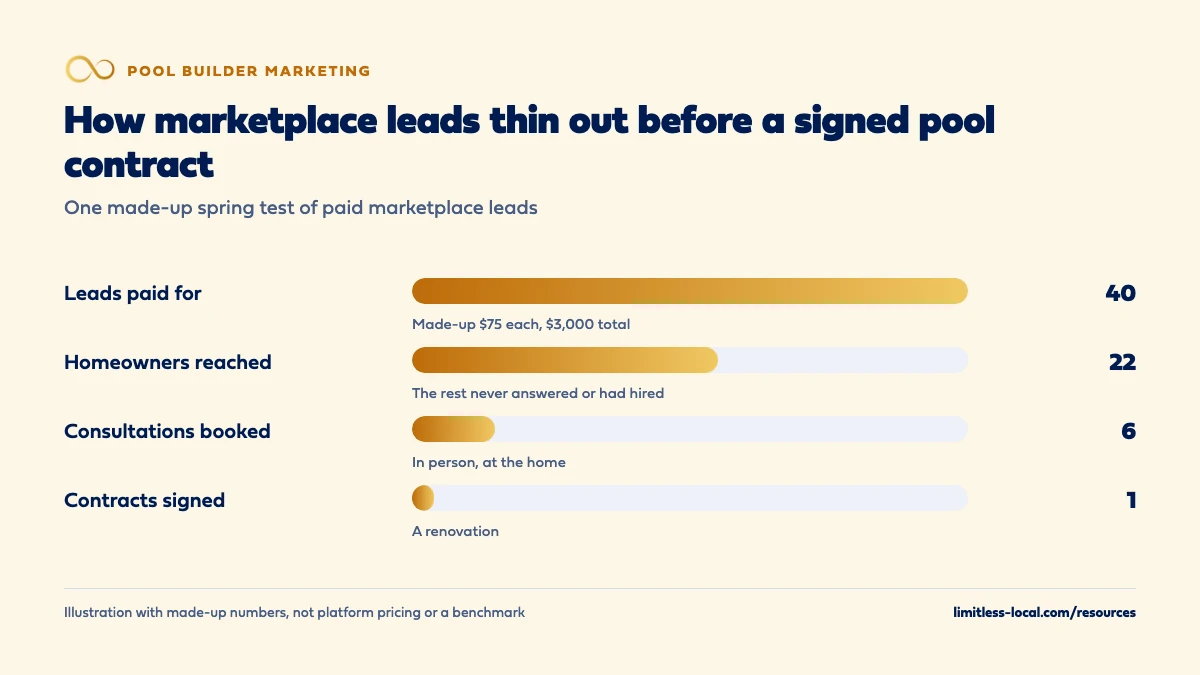
These numbers are made up to show the math, not what any platform charges. Say a pool builder spends $3,000 over a spring test on marketplace leads at a made-up $75 each. That’s 40 leads.
- Of the 40, 3 are credited as duplicates or wrong ZIP codes.
- Your office reaches 22 homeowners; the rest never answer or already hired someone.
- From those, 6 book a design consultation and 1 signs a renovation contract.
The cost per lead looked like $75. The cost per signed contract was close to the full $3,000, because one contract came out of the whole test. Whether that’s good depends on what that renovation leaves you after costs, and on what your other channels cost per signed contract over the same months. Put the numbers side by side before you renew.
Frequently asked questions
Are Angi and HomeAdvisor the same company?
They’re connected. HomeAdvisor describes its service as HomeAdvisor powered by Angi, and the FTC described HomeAdvisor as a company affiliated with Angi that also does business as Angi Leads.
Is an Angi profile free?
Angi’s FAQ says businesses can set up a free profile to share information about their business and services. Advertising on the platform and buying leads are separate, paid options.
How much does a HomeAdvisor lead cost a pool builder?
HomeAdvisor doesn’t publish a price. Its page says lead prices vary by the type of work and region, and that you’ll be told current prices when you call to join.
Can I pause marketplace leads when my build schedule is full?
HomeAdvisor says you can change your spend target at any time and mark when you’re busy to narrow the leads you get. Check your invoices afterward to make sure the change took effect.
Do marketplace reviews help my Google ranking?
Google’s local ranking tips say more reviews and positive ratings can help your local ranking. Reviews on a marketplace live on that marketplace, so in our judgement, ask your best customers for Google reviews first.
Key takeaways
- HomeAdvisor charges per lead whether or not you win the job, and its spend target isn’t a hard cap.
- Lead credits cover narrow problems, not homeowners who were just shopping or changed their mind.
- The FTC’s January 2023 proposed order against HomeAdvisor is a reason to trust your own tracking over a platform’s lead-quality claims.
- Marketplaces fit renovation and repair work better than custom new builds, in our judgement.
- Test any marketplace with a capped budget and judge it by cost per signed contract against your owned channels.
Want a second set of eyes on your setup?
We'll look at how you show up locally and where calls are leaking, then send you a plain-English breakdown.
More in this section
- Are Google Ads worth it for pool builders?
- Are home and garden shows worth it for pool builders?
- Are Local Services Ads worth it for pool builders?
- How long does pool builder SEO take to bring in leads?
- How do pool builders qualify leads before the design consultation?
Sources
- How does HomeAdvisor work for contractors? — HomeAdvisor
- Lead Credit Guidelines — Angi Leads
- FTC Order Requires HomeAdvisor to Pay Up To $7.2 Million and Stop Deceptively Marketing its Leads for Home Improvement Projects — Federal Trade Commission
- Frequently Asked Questions — Angi
- Tips to improve your local ranking on Google — Google Business Profile Help