
At 25 reviews, is my restoration company too weak for the map pack?
- Can a restoration company with 25 Google reviews still show up in the map pack?
- Is 25 reviews enough to get into the map pack?
- How do I tell if 25 reviews is weak in my market?
- What matters more than the review count?
- Does it matter how recent my reviews are?
- Does my star rating matter as much as my count?
- Do 25 reviews hold me back in Local Services Ads?
- Do 25 reviews cost me calls even when I do show up?
- How fast should I add reviews to catch up?
- How do I get more reviews from restoration jobs?
- What shouldn't I do to catch up fast?
- What if I'm not showing in the map pack at all?
- What's different about reviews for restoration companies
- A worked example: how long 25 reviews takes to catch up
- Frequently asked questions
- Key takeaways
- More in this section
- Sources
The short version
- Google sets no minimum review count for the map pack.
- Reviews are part of popularity, one of three main factors with relevance and distance.
- 25 is weak only next to competitors with far more, or if new reviews have stopped.
- A steady flow from every finished job closes the gap faster than any shortcut.
For restoration owners with a couple dozen Google reviews who are wondering whether that number is what’s keeping them out of the map pack.
Get a free visibility audit · Book a growth call
Can a restoration company with 25 Google reviews still show up in the map pack?
Not necessarily. Google doesn’t publish a review threshold, and it says local results are mainly based on relevance, distance and popularity, so 25 reviews can be enough to show in the map pack near your shop when your profile is complete and nearby restoration companies have similar counts. It becomes a real weakness when the companies showing for your main searches have several times as many reviews, or when your newest review is months old. Check the three companies Google actually shows, then add reviews from every finished job at a steady pace.
Reviews are one piece of how we work on Maps. Every package includes Google Business Profile management, review response and review generation, plus syncing your name, address and phone across 50+ directories, so the review count isn’t carrying the profile on its own. See how our restoration marketing works, compare the packages, read the restoration marketing guide, or browse more restoration marketing questions.
Is 25 reviews enough to get into the map pack?
It can be. There’s no review count that unlocks the map pack. Google’s page on improving your local ranking says local results are mainly based on relevance, distance and popularity. Relevance is how well your profile matches the search. Distance is how far you are from the person searching. Popularity, which Google also calls prominence, is how well-known your business is, based partly on how many websites link to you and how many reviews you have. More reviews and positive ratings can help your local ranking.
So reviews are one input among several, not a gate. A restoration company with 25 reviews, a complete profile and a shop close to the searcher can outrank one with three times the reviews that sits across town. The same 25 reviews can also lose to a company down the road with a similar profile and far more reviews. Whether 25 is weak depends on who you’re up against.
How do I tell if 25 reviews is weak in my market?
Look at the companies Google is actually showing. Search your main terms the way a homeowner would, such as water damage restoration and emergency water removal with your town name, from the towns you want work in. For each search, write down the three companies in the map pack and their:
- Review count.
- Star rating.
- Date of their newest few reviews.
- Distance from the searcher.
If the top three have review counts in the same range as yours, 25 isn’t what’s holding you back, and the gap is somewhere else on the profile. If they all have several times as many, reviews are a real part of the problem. Repeat the check from a few different towns, because results change as the searcher moves. How many Google reviews a restoration company needs goes deeper into setting the target.
What matters more than the review count?
Often, the parts of the profile owners don’t look at. Businesses with complete and accurate information are more likely to show up in local results. For a restoration company, that means:
- The right primary category. It’s a big part of how well your profile matches a search. Which Google profile categories a restoration company should pick covers the choices.
- A verified profile. Verification makes a business more likely to show up in search results.
- Services and service areas that match the work you want and the towns you cover.
- Accurate hours. If you take emergency calls around the clock, say so.
- Photos of real jobs and crews.
- A website that supports the services on the profile, and other sites that link to it.
Distance is the one factor you can’t change, which is why a company often shows up near its shop and drops out a few towns away. No number of reviews fully overcomes being far from the searcher.
Does it matter how recent my reviews are?
To homeowners, yes. Google’s local ranking help doesn’t list review dates as a factor, but people read them. If your newest review is eight months old and a competitor got three last week, the competitor looks busier and more trustworthy, even if the totals are close.
A steady flow also matters for the count itself. Restoration companies that ask after every job keep adding reviews every month, so the gap between you and them grows if you stop. A company with 25 reviews that adds a few a month is in a better spot than one stuck at forty for a year.
Does my star rating matter as much as my count?
Both matter. Positive ratings count alongside the number of reviews, so a strong rating on 25 reviews is better than a weak rating on more. With a small count, though, each review moves the average a lot. One unhappy customer can pull a near-perfect rating down noticeably, which is another reason to keep reviews coming.
Don’t panic about a few honest negative reviews. Google’s tips to get more reviews say a mix of positive and negative feedback often feels more trustworthy. A calm, helpful public reply to a bad review does more for the next caller than a spotless five stars on a thin profile.
Curious what your marketing is actually booking?
Get a free visibility audit — no obligation, no sales pitch.
Do 25 reviews hold me back in Local Services Ads?
They can, more directly than in the map pack. Local Services Ads are ordered by an auction, and Google’s page about ad rankings lists profile quality as part of it: your rating, number of reviews, average response time, photos and the verification checks you’ve completed. Google’s page on Local Services Ads reviews adds that providers with higher star ratings and more reviews stand out and typically book more jobs.
So if you run Local Services Ads, a competitor with far more reviews may win more of the top spots even at the same bid. Responsiveness counts too, so answering every lead fast helps you compete while the review count catches up.
Do 25 reviews cost me calls even when I do show up?
Sometimes. A homeowner with water on the floor scans the map pack fast: name, stars, review count, maybe the first review. Next to a competitor with ten times as many, 25 can look like a small or new company, and some callers will pick the bigger number.
Restoration makes trust a bigger deal than in many trades. You’re asking a stranger to let a crew into their home, tear out wet drywall and often deal with their insurer. Reviews that mention a fast response, a clean job and help with the paperwork do a lot of convincing. A profile with 25 detailed reviews like that can win calls against one with more but thinner reviews. How to get detailed Google reviews after a water damage job covers how to ask for them.
How fast should I add reviews to catch up?
Set your pace by your competitors, not by a round number. Count how many reviews each of the top three companies added in the last month or two. To close the gap, you need to add more than they do each month, consistently.
Then check whether your job volume can support it. If you finish a modest number of jobs a month and only some customers leave a review, the math tells you how long catching up will take. If it’s longer than you’d like, the fix is asking every customer, at the right moment, every time, not finding a shortcut.
How do I get more reviews from restoration jobs?
- Ask at the right moment. When the drying is done and the homeowner sees the result, or at the final walkthrough. Not on the night of the flood.
- Make it easy. Google lets you create a review link or QR code from your profile. Text it right after the walkthrough, and print the QR code on your leave-behind sheet.
- Ask the tech to mention it. The person who did the work is often the one the customer wants to thank.
- Reply to reviews. Focus replies where you can add a helpful update or answer, rather than sending the same thank-you to everyone.
- Make it a step in the job. Put the review request in your job software’s closeout checklist so it happens on every job, not just the ones someone remembers.
How to get more five-star Google reviews has more on timing and wording.
What shouldn't I do to catch up fast?
Don’t buy reviews, write them, or pay for them. Google says offering incentives, like free or discounted services, in exchange for customers to post, change or remove reviews counts as fake and misleading content and is strictly prohibited. Its help on missing or delayed reviews says reviews removed for policy violations won’t be restored.
There’s a legal side too. The Federal Trade Commission’s rule on consumer reviews and testimonials went into effect on October 21, 2024. It covers fake or false reviews, and it says that if a business pays for or gives incentives for reviews, those reviews are treated as testimonials under the rule. It also allows courts to impose civil penalties for knowing violations. A sudden burst of reviews from strangers is also exactly the pattern that gets reviews removed, which leaves you worse off than 25 honest ones.
What if I'm not showing in the map pack at all?
Then reviews probably aren’t the main problem. A company with 25 reviews should still show up near its own location for a search that matches its category. If you’re missing even there, check for a suspended or unverified profile, a wrong primary category, a duplicate listing or a recent edit Google rejected. How to get your restoration company back into the map pack walks through each check in order.
Want to see where your company stands?
A free visibility audit shows where you show up on Google, Maps and AI answers, and what it's costing you in calls.
What's different about reviews for restoration companies
Fewer jobs, fewer reviews. A restoration company finishes fewer, bigger jobs than a trade that runs many small service calls a day, so review counts build more slowly. Your competitors face the same math, which is why comparing against them matters more than any national figure.
The timing is awkward. Nobody wants a review request in the middle of a flood. Ask after the drying is done or at the final walkthrough, when the homeowner can see the result.
Insurance and property managers. Some jobs are arranged by an adjuster or a property manager, not the homeowner. Ask the person who saw the work, and keep the request to their experience with your crew.
Trust carries extra weight. Reviews that mention a fast response, a clean job and help with paperwork speak directly to what a worried homeowner wants to know.
A worked example: how long 25 reviews takes to catch up
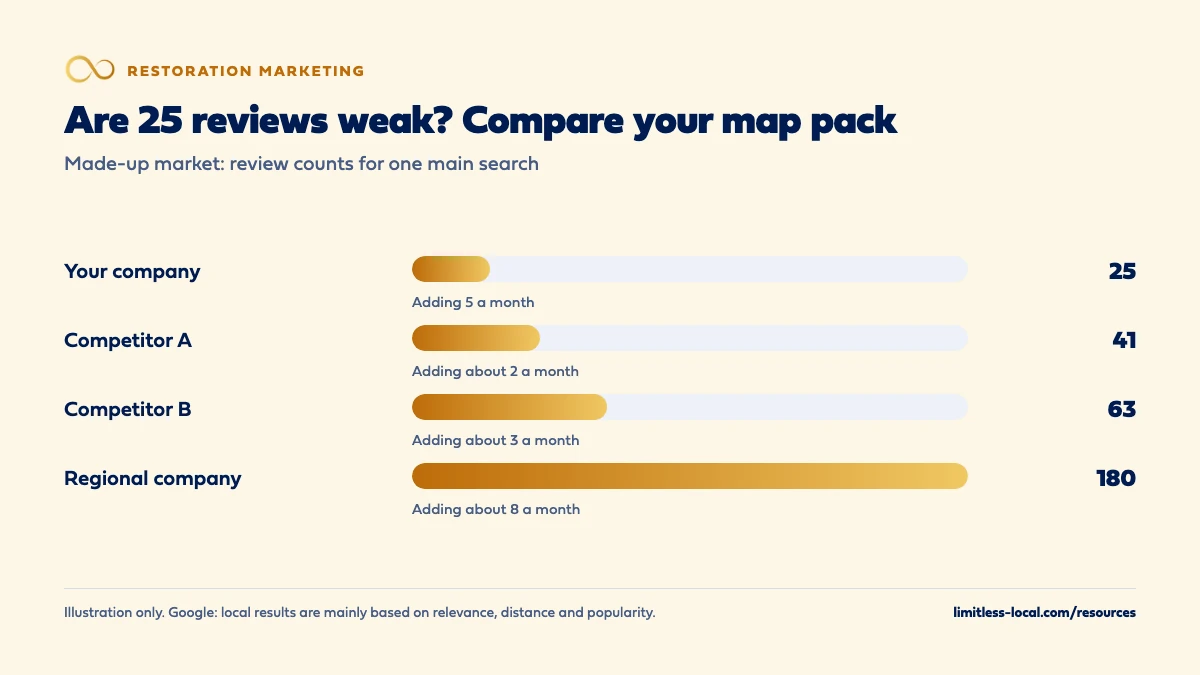
These numbers are made up to show the math, not a benchmark for your market. You have 25 reviews and a 4.8 rating. For your main search, the map pack shows companies with 41, 63 and 180 reviews. The first two are within reach; the third is a big regional company you won’t catch soon.
Counting recent dates, the first company adds about 2 reviews a month, the second about 3 and the big one about 8. You finish about 20 jobs a month, and if one in four customers leaves a review, you add 5 a month.
After six months you’ve added 30, for 55 total. The first company is at 53, so you’ve passed it. The second is at 81, so you’re closer but still behind. That tells you the plan works against two of the three and that the gap to the second company closes by about 2 a month, so the next step is to raise the share of customers who leave a review rather than wait.
Frequently asked questions
Does Google count reviews from other sites for the map pack?
Google’s ranking help mentions how many reviews you have and how many websites link to your business, without naming other review sites. Reviews elsewhere still help homeowners decide, but Google reviews are the ones shown on your profile, so start there.
Will replying to reviews help me rank with only 25?
Replying shows you value customers’ feedback, and positive reviews and helpful replies can help your business stand out. It’s worth doing whatever the count.
Should I ask past customers from last year for reviews?
Yes, if they had a genuine experience with your company. A short, personal text with your review link is enough. Don’t offer anything in return for the review.
Do photos in reviews matter?
They help homeowners trust the review, especially before-and-after shots of a dried-out room. Encourage customers to add one if they’re happy to, but never make it a condition.
Can an agency get me more reviews quickly?
An agency can set up the requests, links and reminders so every customer is asked, which speeds things up. Anyone offering to post reviews for you, or to buy them, is putting your profile at risk.
Key takeaways
- Google sets no review minimum for the map pack; reviews feed popularity alongside relevance and distance.
- 25 reviews is only weak next to competitors with several times as many, or when new reviews have stopped.
- Check the three companies Google actually shows for your main searches, from several towns.
- Reviews count more directly in Local Services Ads, where review count and rating feed profile quality.
- Ask every customer at the right moment, and never buy or incentivize reviews.
Not sure what's working right now?
Start with a free visibility audit: rankings, Google profile, reviews and tracking, checked against your service area.
More in this section
- How do I get my restoration company back into the Map Pack?
- How does a restoration company recover when its reviews drop?
- What is the map pack and how does it bring restoration calls?
- How do I hold my Map Pack spot against a new restoration competitor?
- Do reviews, response time and GBP affect restoration Maps and LSAs?
Sources
- Tips to improve your local ranking on Google — Google Business Profile Help
- Tips to get more reviews — Google Business Profile Help
- About ad rankings — Google Local Services Help
- Reviews and Ratings on Local Services Ads — Google Local Services Help
- About missing or delayed reviews — Google Business Profile Help
- The Consumer Reviews and Testimonials Rule: Questions and Answers — Federal Trade Commission