
How do I hold my Map Pack spot against a new restoration competitor?

- How do I protect my Google Maps position when a new restoration company opens nearby?
- Will a new restoration competitor push me out of the Map Pack?
- What should I check first when a new competitor opens nearby?
- Where does a new competitor actually threaten my calls?
- How do I keep my profile more relevant than a newcomer's?
- How do reviews help me hold my spot?
- What if the new competitor seems to be breaking Google's rules?
- What changes when the new competitor is a franchise?
- Should I widen my service area or open a second location to fight back?
- Do posts and job photos help defend my position?
- Should I turn on ads to protect my calls?
- How do I know if I'm actually losing ground?
- What's different when a new restoration competitor opens nearby
- A worked example: a franchise opens across town
- Frequently asked questions
- Key takeaways
- More in this section
- Sources
The short version
- A closer competitor may win searches near them; distance isn't yours to change.
- Your defense is relevance and popularity: a complete profile and steady reviews.
- Check the map from the neighborhoods your jobs come from, not just your office.
- Report real guideline violations through Google Maps; never copy them.
- Measure by calls and booked jobs over time, not by one search on one day.
For restoration owners who already show up in the map pack and have just watched a new independent or franchise restorer open in their area.
Get a free visibility audit · Book a growth call
How do I protect my Google Maps position when a new restoration company opens nearby?
You can’t stop a new competitor from showing up for searches near them, because Google says local results are mainly based on relevance, distance and popularity, and distance is out of your hands. What you can do is widen your lead on the other two: keep your profile complete and accurate, keep genuine reviews coming after every job, show real work in photos and updates, and make sure your website backs up what your profile says. Then watch calls and booked jobs by area, report the competitor only if they’re actually breaking Google’s rules, and don’t answer a new rival with shortcuts that could get your own profile suspended.
Defending a map pack position is ongoing profile and review work, which is part of our local SEO for restoration companies, measured by calls and booked jobs rather than a ranking screenshot. The restoration marketing guide explains why the map pack matters so much in an emergency trade, and the restoration marketing questions library goes one question at a time.
Will a new restoration competitor push me out of the Map Pack?
In some searches, possibly. Google says local results are mainly based on three things. Relevance is how well a profile matches the search. Distance is how far each business is from the person searching. Popularity is how well-known a business is, based partly on links to it from other websites and how many reviews it has; Google says more reviews and positive ratings can help.
A new company that sets up closer to some of your customers has a distance edge with those searchers on day one, and nothing you do changes that. But a new profile usually starts with few reviews and little on the web pointing to it, in our judgement, so on relevance and popularity you begin ahead. Holding your spot means keeping that lead. Google is also clear that there’s no way to request or pay for a better local ranking, so that isn’t an option for either of you. Source: Tips to improve your local ranking on Google.
What should I check first when a new competitor opens nearby?
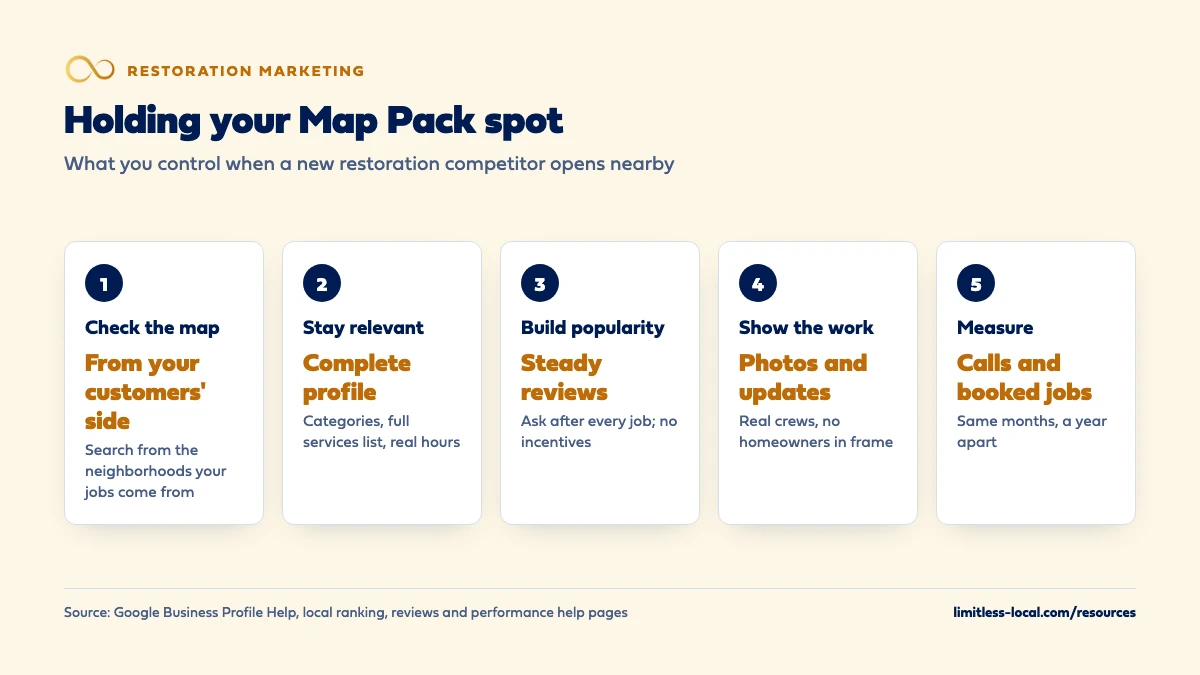
Before changing anything, get a clear picture. In our judgement, these four checks take an hour and tell you most of what you need:
- Where they are. Is their address a real shop or warehouse, or is the address hidden with a service area? That tells you which neighborhoods they’ll be closest to.
- What they claim. Look at their name, categories and services. Are they after the same water, fire and mold work, or a slice of it?
- What you see from your customers’ side. Search “water damage restoration” on a phone from the neighborhoods your jobs come from, not only from your office. The map pack changes with the searcher’s location.
- Your own baseline. Download your profile’s performance data now, so you have a before picture to compare against.
The checks after this depend on what you find. If you’ve already dropped out entirely, that’s a different problem with its own checklist: getting back into the Map Pack.
Where does a new competitor actually threaten my calls?
Mostly at the edges. Because distance is measured from the searcher, a competitor based across town is most likely to beat you for searches from their side of town, and less likely in the neighborhoods around you. Google says that if a customer doesn’t share where they are, it uses what it knows about their location.
In our judgement, that means the real question isn’t “am I still number one” but “am I still showing up in the neighborhoods where my best jobs come from”. If most of your water jobs come from the older housing stock on the east side and the new competitor opened on the east side, that’s where to focus. If they opened somewhere you rarely work, you may lose very little. Source: Tips to improve your local ranking on Google.
How do I keep my profile more relevant than a newcomer's?
Google says businesses with complete and accurate information are more likely to show up in local results, and that relevance comes from complete, detailed business info. A newcomer’s profile is often thin at first. Keep yours full:
- Categories that describe the business, not every service. Picking your Google categories covers the restoration choices.
- A full services list. Google says when a local customer searches for a service you offer, that service may be highlighted on your profile. List water extraction, structural drying, sewage cleanup, mold remediation, fire and smoke cleanup, contents and rebuild, whatever you really do, each with a plain description.
- Accurate hours and phone, so a homeowner who finds you at night can reach a person.
None of this is new work if your profile was already in good shape. The point is to keep it that way while a competitor fills theirs in. Sources: Tips to improve your local ranking on Google and Manage your services on your Business Profile.
How do reviews help me hold my spot?
Reviews are the part of popularity you control most directly. Google says more reviews and positive ratings can help local ranking, and that your review score is the average of all ratings published on Google, shown alongside the total number of reviews. After a new review, it may take up to 2 weeks for the score to update.
An established company’s advantage here is history, in our judgement, but history fades if reviews stop. A profile whose newest review is a year old looks quiet next to a newcomer collecting fresh ones. Ask after every job, with Google’s review link or QR code, and reply to reviews; Google says replies show customers their feedback matters. The hard line: offering anything in exchange for a review, change or removal is fake and misleading content under Google’s policy, and it can bring restrictions on your profile. Getting reviews that actually describe the job is covered in detailed reviews after water jobs. Sources: Tips to get more reviews, Understand review scores for local places & businesses and Tips to improve your local ranking on Google.
Curious what your marketing is actually booking?
Get a free visibility audit — no obligation, no sales pitch.
What if the new competitor seems to be breaking Google's rules?
Report it through Google, with facts, and leave it there. Google Maps lets anyone report a business. Its options include:
- Suggest an edit for inaccurate information that isn’t about conduct or policy.
- Offensive, harmful or misleading under “Place is closed or not here”, for a listing that makes you believe the business may not exist at that location.
- The Business Redressal Complaint form, for misleading business names, phone numbers or website addresses that raise suspicion of fraud.
- Report business conduct in the Maps app, for a business that offers incentives for reviews or pressures people to leave them.
What counts as a violation comes from Google’s guidelines: a name stuffed with service words or city names, an address at a rented mailbox or unstaffed virtual office, or more than one profile for the same business. Our advice: report what you can document, don’t report a business just for being new, and never answer a rule-breaker by breaking the same rules. Sources: Report a business on Google Maps and Guidelines for representing your business on Google.
What changes when the new competitor is a franchise?
The rules don’t. A franchise location gets a profile for a real location with its own staff and service area, under the same guidelines as you. What may be different, in our judgement, is that a national brand can start with name recognition and a larger web presence, which feeds popularity, and sometimes a marketing budget for ads from the first week.
Your edge is the opposite of theirs: a long local track record, reviews that name your crew and your towns, and an owner who answers the phone. Make those visible. Reviews and photos from real local jobs, a website with your own crews on it, and fast answering at night are things a new location has to build from zero. Source: Guidelines for representing your business on Google.
Should I widen my service area or open a second location to fight back?
Be careful with both. Google says a service-area business gets one profile for its central office with a designated service area, and that the overall area shouldn’t extend farther than about 2 hours of driving time from where you’re based, though larger areas may be appropriate for some businesses. A separate profile is allowed only for a location with its own staff and its own service area, and a rented mailbox or virtual office isn’t eligible.
So a “second office” on the competitor’s side of town only helps if it’s a real, staffed location. A mailbox there risks your main profile. Widening the service area doesn’t move your location either; in our judgement it’s better to list the towns your crew can honestly reach fast at night. Source: Guidelines for representing your business on Google.

Do posts and job photos help defend my position?
They help homeowners choose you once they see you, which matters as much as the position itself when two restoration companies sit side by side on the map. Google says posts let you share updates with photos or video on Search and Maps, and that posts older than 6 months are archived unless a date range is set. A profile with recent crew photos and an update from last week looks active next to a newcomer’s empty one.
Google lists photos and videos among its tips to improve local ranking but doesn’t name them as a ranking factor, so treat them as part of winning the call. What to shoot, and how to keep homeowners’ private details out of frame, is in whether job photos help you rank. Sources: Create & manage posts on your Business Profile and Tips to improve your local ranking on Google.
Should I turn on ads to protect my calls?
Ads don’t defend your map pack position; they’re a separate placement. But if a competitor is taking calls in a part of town you care about, a paid placement there can keep emergency calls coming while the profile work catches up, and ads can bring calls within days of launch while SEO is a slower ramp. That’s our view of how they fit, not a promise of results.
Which paid option fits a restoration company, and when to run both, is covered in Google Ads, LSAs or both.
How do I know if I'm actually losing ground?
Use your profile’s Performance report, not one search on one afternoon. Google says it shows how people find your profile and what they do, including Calls (taps on your call button) and Searches (the terms people used to find you), and that you can download the data. It also notes that performance data includes activity from both organic results and Google Ads.
In our judgement, compare the same months a year apart, because storms and freezes swing restoration demand more than any competitor does. Then match calls to booked jobs in your job software. If profile calls hold steady and bookings hold, the newcomer isn’t hurting you yet, whatever a single search shows. Setting up that tracking is covered in tracking which marketing books jobs. Source: Understand your Business Profile performance & insights.
Not sure which of these is costing you jobs?
A free visibility audit checks the Google profile, reviews, site and tracking, and shows what to fix first.
What's different when a new restoration competitor opens nearby
Emergency searches favor whoever looks ready now. A homeowner with water on the floor compares a few profiles in seconds. Recent reviews, real crew photos and hours that say someone is answering carry more weight in that moment than how long you’ve been in business, in our view.
New competitors often arrive after storms. A surge of work draws new companies into a market. Some stay; some leave when the work dries up. Don’t overreact with changes you’ll regret in a quiet month.
Your referral relationships aren’t on the map. Plumbers, property managers and agents who already send you work don’t care who ranks third this week. Keep those relationships warm while you defend the profile.
A worked example: a franchise opens across town
This is an illustration with made-up details, not a real client. Say an independent restoration company has been in the map pack across its city for years, based on the west side. A franchise location opens on the east side. The owner checks the map from a phone in three east-side neighborhoods and finds the newcomer in the top three there, while the west side is unchanged. Profile calls for the month are about the same as last year; east-side calls are a little lower.
The response: no new profile, no mailbox office, no change to the name. The owner fills out the services list with descriptions, has project managers ask for a review at every final walk-through, starts a weekly crew-photo routine, and adds east-side job descriptions to the website. The east side gets a paid placement while that work builds up.
The check: compare profile calls and booked jobs, by area, with the same months a year earlier. That’s the measure, not a promise of getting the east side back. Google Business Profile management with a weekly post, review response and basic review generation is part of our Essentials package at $3,500 a month.
Frequently asked questions
Can I report a competitor's fake reviews?
Yes. Google Maps has a Report business conduct option for businesses that offer incentives for reviews or pressure people to leave them, and you can flag individual reviews that break policy. Source: Report a business on Google Maps.
Should I leave a bad review on the new competitor's profile?
No. Google’s Maps content policy prohibits posting content on a competitor’s place or business to undermine its reputation, and says reviews must reflect a genuine experience. It also puts your own profile at risk for no gain. Source: Prohibited & restricted content.
Will a newcomer's profile outrank me just because it's new?
Google doesn’t list newness as a factor. It names relevance, distance and popularity. A new profile can win searches near its location, but it starts without your review history. Source: Tips to improve your local ranking on Google.
Should I add the competitor's town to my business name?
No. Google says the name should match your real-world name, and adding unnecessary information to it isn’t permitted and could get your profile suspended. Source: Guidelines for representing your business on Google.
How often should I check where I rank?
In our judgement, look at the Performance report monthly and compare it with the same month last year. Daily rank checks from one location mostly measure where you were standing.
Key takeaways
- A closer competitor can win nearby searches; distance isn’t something you can change.
- Hold your lead on relevance and popularity: complete profile, steady genuine reviews.
- Check the map from the neighborhoods your jobs come from before reacting.
- Report documented guideline violations through Google Maps, and never copy them.
- Judge the threat by calls and booked jobs compared year over year, not one search.
Want a second set of eyes on your setup?
We'll look at how you show up locally and where calls are leaking, then send you a plain-English breakdown.
More in this section
- How do I get my restoration company back into the Map Pack?
- How do I win recurring restoration work from facility managers?
- How does a restoration company recover when its reviews drop?
- How do I keep marketing steady while hiring restoration techs?
- How do I keep restoration work coming in between storms?
Sources
- Tips to improve your local ranking on Google — Google Business Profile Help
- Guidelines for representing your business on Google — Google Business Profile Help
- Tips to get more reviews — Google Business Profile Help
- Understand review scores for local places & businesses — Google Business Profile Help
- Report a business on Google Maps — Google Maps Help
- Manage your services on your Business Profile — Google Business Profile Help
- Understand your Business Profile performance & insights — Google Business Profile Help
- Create & manage posts on your Business Profile — Google Business Profile Help