
Does an electrical contractor need a digital marketing team?

- Do I need a digital marketing team for SEO and Google Ads at my electrical business?
- What does running SEO and Google Ads actually involve?
- Can one person handle SEO and Google Ads for an electrical shop?
- What would an in-house marketing hire cost?
- What does a one-truck electrician actually need?
- What about a shop with three to eight trucks?
- When does a larger electrical contractor need marketing staff?
- Agency, freelancers or an in-house hire: what's the trade-off?
- If I can't cover all five areas yet, which comes first?
- Who in my shop should own marketing, whoever does the work?
- What's the risk of leaning on one person for everything?
- How do I know my current setup has stopped working?
- What's different for electrical contractors
- A worked example: an in-house hire versus an outside team
- Frequently asked questions
- Key takeaways
- More in this section
- Sources
The short version
- SEO plus Google Ads is really five skills, not one job.
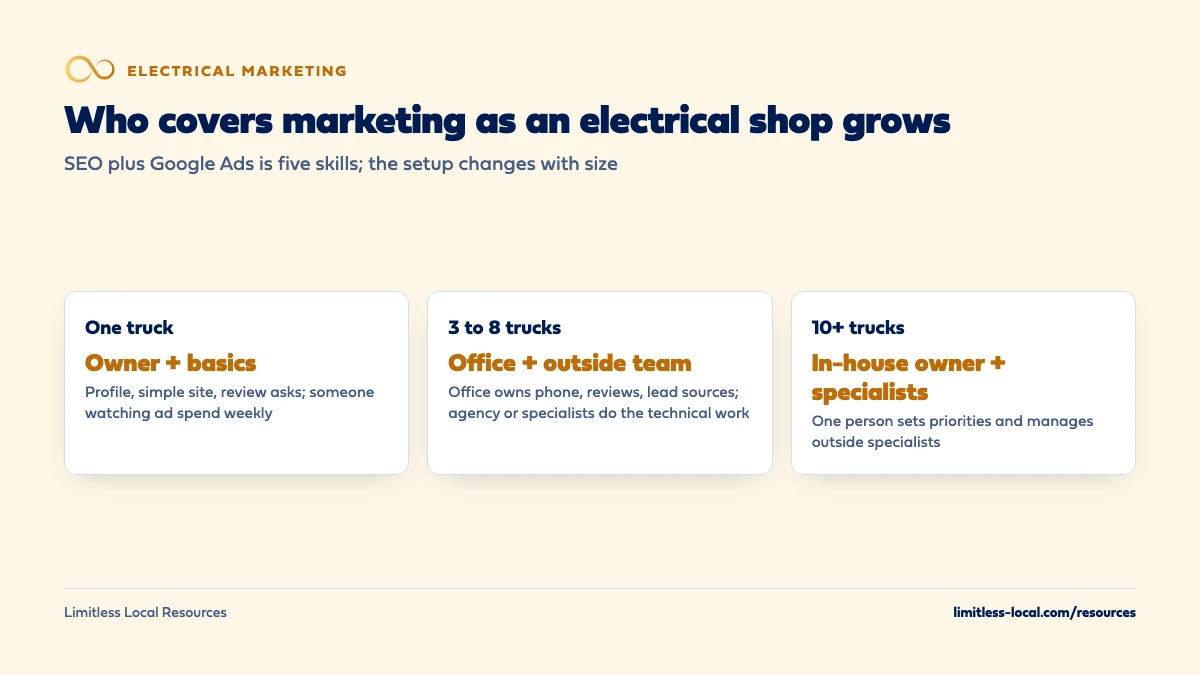
- One-truck shops need the basics and someone watching ad spend, not a team.
- Three to eight trucks: office handles phone, reviews and lead sources; outside help does the technical work.
- Ten-plus trucks or multiple locations: one in-house owner of marketing, still backed by specialists.
For electrical contractors deciding whether SEO and Google Ads call for hiring a team, one person or outside help, and how the answer changes from one truck to ten.
Get a free visibility audit · Book a growth call
Do I need a digital marketing team for SEO and Google Ads at my electrical business?
Most electrical contractors don’t need an in-house digital marketing team. They need five skills covered: Google Ads management, SEO and content, website work, Google profile and reviews, and tracking that ties calls to booked jobs. A small shop usually covers them with the owner or office handling the business-side tasks and an agency or specialist doing the technical work. An in-house marketing person starts to make sense around ten or more trucks or several locations, mostly to own priorities and manage outside specialists rather than do every task.
Our model is the outside team: specialists for ads, SEO and tracking, with delivery run by the team so it takes little of your time. Our packages show what each level covers, our electrical contractor marketing page explains how we work with electrical shops, and the rest of the electrical marketing questions library goes question by question.
What does running SEO and Google Ads actually involve?
It sounds like one job. It’s closer to five:
- Google Ads management. Search terms, negative keywords, bids, budgets and ad tests, checked every week because money moves every day.
- SEO and content. Service pages, town pages, site fixes, links and steady new content.
- Website work. Speed, mobile layout, forms and landing pages for the ads.
- Google profile and reviews. Posts, photos, accurate services and hours, review requests and replies.
- Tracking and reporting. Call tracking, form tracking, lead sources in your field software, and a monthly view of cost per booked job.
Each of those is a real skill. That’s why the question isn’t really “do I need a team?” It’s “how do I get each of those skills covered at a cost my shop can carry?”
Can one person handle SEO and Google Ads for an electrical shop?
One capable person can cover a small shop’s marketing reasonably well, especially if the ads account is simple and the website is already in decent shape. Google’s guide Do you need an SEO? says a small local business can probably do much of its SEO work itself.
Where one person struggles is depth across all five areas at once. Someone great at Google Ads is rarely also great at website development and call tracking setup. A generalist tends to keep everything ticking over without pushing any one channel hard, which is fine for holding steady and limiting for growing. If you hire one person, hire for the channel that brings most of your jobs, and buy help for the rest.
What would an in-house marketing hire cost?
More than the salary. The Bureau of Labor Statistics’ profile of advertising, promotions and marketing managers puts the median annual wage for marketing managers at $166,790 in May 2025, across all industries nationally. That’s the person who runs a company’s marketing, not someone for a small shop, but it shows what senior marketing talent costs on the open market.
Then add benefits. In BLS’s employer costs for employee compensation release, benefits made up 30.0% of private-industry employer compensation costs in June 2026, on average across all private-industry workers. On top of pay and benefits come the tools (call tracking, SEO software, design apps), training, management time, and the ad spend itself. And when that one person is out sick or leaves, the marketing stops.
What does a one-truck electrician actually need?
Not a team. A one-truck shop needs a verified Google Business Profile, a simple website with a page for each main service, a review request after every job, and someone answering the phone. The owner can usually keep those going in a couple of hours a week.
The moment you start paying for Google Ads or Local Services Ads, add one thing: someone who watches the spend weekly and can tell you what each booked job cost. That can be you, a specialist or an agency. How many leads per month before an electrician hires an agency works through when outside help starts to pay for itself.
What about a shop with three to eight trucks?
This is where most electrical contractors feel the squeeze. The owner is estimating, managing crews and still trying to run the marketing, and it shows: posts stop, review requests slip, the ads account goes weeks without a look.
The setup that usually works at this size is an office manager or customer service rep who owns the business-side tasks (answering calls, entering the lead source on every job, sending review requests, collecting job photos), plus an outside team for ads, SEO, the website and tracking. Nobody new on payroll for marketing, but every one of the five areas is covered.
Curious what your marketing is actually booking?
Get a free visibility audit — no obligation, no sales pitch.
When does a larger electrical contractor need marketing staff?
Once you have ten or more trucks, more than one location, or both residential and commercial divisions, there’s usually enough coordination work for one in-house person. Their job is less doing the work and more owning it: setting priorities, managing outside specialists or an agency, keeping the numbers honest, and making sure the field and office feed marketing what it needs.
Even at that size, most of the hands-on ads, SEO and development work tends to stay outside, because one hire can’t match a full bench of specialists. How an electrical contractor scales past one or two crews covers the growth side.
Agency, freelancers or an in-house hire: what's the trade-off?
- An agency gives you several specialists for one monthly fee, with one point of contact and one report. The trade-off is less of their attention than a full-time employee would give, so pick one whose reports show booked jobs.
- Freelancers or single specialists can be cheaper and very good at one channel. The trade-off is that you become the coordinator, and nobody owns how the pieces fit together.
- An in-house hire knows your business and is always around. The trade-off is cost, a narrower skill set, and everything stopping when they’re gone.
Whether an electrician should hire a full-service agency or one specialist goes deeper on the first two.
If I can't cover all five areas yet, which comes first?
Cover them in the order that protects your money:
- Tracking. Without a lead source on every job, you can’t judge anything else, so this comes before any new spend.
- Paid ads, if you run them. They spend every day, so they need someone checking them every week.
- Google profile and reviews. Cheap to keep up and close to the phone ringing.
- Website fixes. A slow site or a broken form wastes everything that sends people to it.
- SEO and content. The slowest to pay off and the one that compounds longest, so start it once the rest is steady.
The first three are often enough for a small shop to grow on before anything else is added.

Who in my shop should own marketing, whoever does the work?
Someone inside the business should, even if every task is handed off. That person:
- Reads the monthly report and asks what changed and why.
- Tells the marketing side about new services, price changes, busy and slow seasons, and crews joining or leaving.
- Makes sure the office records a lead source on every job.
- Gets job photos and review requests flowing from the field.
In a small shop that’s the owner. In a bigger one it’s often the office manager or general manager. Without someone in that seat, even a good outside team ends up guessing.
What's the risk of leaning on one person for everything?
Access and continuity. If one employee or one freelancer set up your ads account, website and tracking under their own logins, losing them can mean losing the keys. Google Ads lets you set access levels for each user, and Google notes that an account with only one administrator may lose access to its tags if that person becomes unavailable, recommending at least one more admin.
Keep every account in the business’s name, with the owner as an admin, and give everyone else only the access they need. That holds whether the work is done by a hire, a freelancer or an agency.
How do I know my current setup has stopped working?
- Ad spend has grown past what anyone checks weekly.
- You can’t say what a booked job cost from each channel last month.
- Profile posts, review requests or site updates stop during busy season.
- You’ve added a location, a commercial division or a new service, and the marketing hasn’t changed.
- The owner is spending evenings on marketing instead of estimates.
Any one of those says some part of the five isn’t covered. It doesn’t automatically mean hiring; it means deciding who covers it. What a marketing agency does for an electrician that’s hard to do alone breaks down the outside option.
Want to see where your company stands?
A free visibility audit shows where you show up on Google, Maps and AI answers, and what it's costing you in calls.
What's different for electrical contractors
The owner is often the estimator. In many electrical shops the license holder prices the bigger jobs. Every evening spent on marketing is an evening not spent closing panel upgrades and generator installs, which makes owner time unusually expensive.
Demand comes in waves. Storm season drives generator interest, new EV purchases drive charger installs, and summer heat drives service calls. Whoever runs the marketing has to move budgets and pages ahead of those waves, which is hard for an owner in the middle of one.
Commercial work isn’t a digital marketing job. General contractor relationships, bid lists and estimating drive commercial work. A digital team grows the residential side; don’t expect it to fill a commercial pipeline.
A worked example: an in-house hire versus an outside team
These numbers are made up to show the math, not a salary benchmark for your area. Say you’re thinking of hiring one marketing coordinator at $65,000 a year. If benefits run about 30% of total compensation, close to the private-industry average above, total pay and benefits come to about $92,860 a year (the $65,000 salary being the other 70%). That’s one person, before tools, training and ad spend.
Our Essentials package is $3,500 a month, or $42,000 a year, covering one location with Google Ads management up to $2,500 a month in spend, SEO content, Google Business Profile management, review response and basic review generation, and call, web and form tracking. Growth is $4,500 a month, or $54,000 a year, and adds Local Services Ads, Meta remarketing, SEO for up to two locations, advanced attribution and a dedicated account manager. Ad spend is paid to Google separately in every case.
The cheaper option isn’t automatically right. A ten-truck, multi-location shop may want both: one coordinator inside, an outside team doing the work. The useful comparison is which setup covers all five areas and shows you cost per booked job every month. What a marketing agency costs an electrician goes further into pricing.
Frequently asked questions
Can my office manager run our Google Ads?
They can keep an eye on it, but weekly ad management is a specialist skill. A better split is the office owning lead sources and review requests while someone experienced runs the ads.
Is a part-time marketer enough?
For a small shop with simple needs it can be, especially for posts, photos and review requests. Paid ads and tracking still need someone who checks them every week.
Do I need a separate person for social media?
Rarely. For most electrical shops, social posts are a small extra, not a job. Your Google profile and reviews usually do more for calls.
Should I hire family or a friend to run marketing?
Only if they have the skills or time to learn them, and only with the accounts in the business’s name. The same five areas still need covering.
How long before an outside team pays off?
Ads can bring leads within days of launch, while SEO typically takes three to six months to show meaningful organic growth. Judge it on cost per booked job once the ramp is behind you.
Key takeaways
- SEO plus Google Ads covers five skills: ads, SEO and content, website, profile and reviews, and tracking.
- Most electrical shops need those skills covered, not an in-house team.
- An in-house hire costs well beyond salary once benefits, tools and continuity risk are counted.
- Someone inside the business should still own marketing and read the monthly numbers.
- Keep every account in the business’s name, with the owner as an admin.
Not sure what's working right now?
Start with a free visibility audit: rankings, Google profile, reviews and tracking, checked against your service area.
More in this section
- What tools and software does an electrician need to DIY marketing?
- How much should an electrical contractor spend on marketing?
- Should I hire an agency or DIY my electrical marketing?
- Will a marketing agency understand the electrical trade?
- Can an electrical owner do DIY marketing first, then hire an agency?
Sources
- Advertising, Promotions, and Marketing Managers: Occupational Outlook Handbook — U.S. Bureau of Labor Statistics
- Employer Costs for Employee Compensation Summary — U.S. Bureau of Labor Statistics
- Do You Need an SEO? Tips for Hiring an SEO — Google Search Central
- About access levels in your Google Ads account — Google Ads Help