
Why is electrician SEO taking longer than expected?

- What are the most common reasons electrician SEO takes longer than expected?
- How slow is too slow for electrician SEO?
- Am I checking the right searches?
- Is my Google Business Profile pulling its weight?
- Do I have enough recent reviews compared with who's ranking?
- Does every job I want have its own page?
- Is something technical holding the site back?
- Did a redesign, move or shortcut set things back?
- Is my market just harder than I was told?
- Could SEO be working while my tracking hides it?
- Are the calls coming in but not turning into jobs?
- What should I fix first?
- Should I run ads while SEO catches up?
- What's different when electrician SEO is slow
- A worked example: slow or stuck?
- Frequently asked questions
- Key takeaways
- More in this section
- Sources
The short version
- SEO typically takes 3-6 months to show meaningful organic growth; early months show direction, not results.
- The usual causes: a thin Google profile, too few recent reviews, missing service pages, a crowded market or broken tracking.
- Check tracking and the Google profile first; they're quick and often the biggest win.
- Ads can bring calls while SEO builds, but they don't move your organic rankings.
For electrical contractors a few months into SEO who aren’t seeing the calls they expected, and want to know what to check before spending more.
Get a free visibility audit · Book a growth call
What are the most common reasons electrician SEO takes longer than expected?
Electrician SEO usually takes longer than expected for a handful of fixable reasons: a thin Google Business Profile, too few recent reviews compared with the shops already ranking, no dedicated page for each job you want, a crowded market, or tracking that can’t show the calls search is already bringing in. SEO typically takes 3-6 months to show meaningful organic growth, so early on you’re judging direction, not the finish line. If you’re past that and the calls still haven’t moved, find the cause and fix it before adding more of the same work.
Finding the cause before adding more work is how we run local SEO for electrical contractors: tracking first, then the Google profile, reviews and service pages, with reporting on calls and booked jobs so you can see the ramp for yourself. Our local SEO page explains the work, our electrical contractor marketing page covers how it fits with ads, and the rest of the electrical marketing questions library goes question by question.
How slow is too slow for electrician SEO?
SEO typically takes 3-6 months to show meaningful organic growth. Google’s own SEO Starter Guide says some changes take effect in a few hours and others could take several months, and that you’ll usually want to wait a few weeks before judging whether a change helped. So a quiet first month or two isn’t a red flag on its own.
What you’re looking for is the difference between slow and stuck:
- Slow: calls from Google search and your Google profile creep up month over month, the service pages start showing for searches in your towns, and new reviews keep landing. That’s a ramp. Keep going.
- Stuck: the same handful of calls in month five as in month one, pages that don’t show up anywhere, and no new reviews. That’s a problem with a cause, and adding more of the same work won’t fix it.
If you’re past the ramp and still stuck, the rest of this page walks through the usual causes in the order worth checking them.
Am I checking the right searches?
A lot of owners judge SEO by typing “electrician” into Google from the shop and seeing who comes up. That’s the hardest search there is, and the result you see from your own desk isn’t what a homeowner across town sees.
Specific jobs move first. “Panel upgrade” or “EV charger installation” plus your town has fewer pages competing for it, and one strong service page can show up for it. Broad searches like “electrician near me” are mostly decided in the map pack, where the searcher’s location carries a lot of weight, so they build slowly and are hard to win across a whole service area. If your SEO plan only tracks the broad terms, it’ll feel slow even when the job-specific searches are already bringing calls. How long it takes to rank for near-me versus specific services breaks down both timelines.
Is my Google Business Profile pulling its weight?
Google says local results are mainly based on “relevance, distance, and popularity” (Google Business Profile Help). You can’t change distance. You can change the other two.
- Relevance: the right primary category, secondary categories for the work you actually do, and a services list that names panel upgrades, EV chargers, generators, rewiring and lighting instead of just “electrical services”.
- Popularity: reviews, rating and links to your business from around the web.
A thin profile is the single most common reason a local SEO plan lags. If the website gets new pages every month but the profile still has one category, three photos and a blank services list, the work is going into the slower channel. Optimizing an electrician Google Business Profile goes through every field.
Do I have enough recent reviews compared with who's ranking?
More reviews and positive ratings can help your local ranking. What matters is the comparison: look at the three businesses showing in the map pack for your main job in your main town, and count their reviews and how recent the last few are.
If they have years of steady reviews and you have a burst from two years ago and nothing since, that gap is why the map pack isn’t moving, and nothing on the website will close it. The fix is boring and it works: ask every happy customer, the same day the job’s done, with a direct link. How many Google reviews an electrician needs covers the count, and a review request that goes out automatically after every job keeps you from falling behind again.
Does every job I want have its own page?
Google matches pages to searches. If your site has one “Services” page with a bulleted list, Google has nothing specific to show for “generator installation” or “whole home rewiring” in your town, so you won’t show up for those searches no matter how long you wait.
Give each job you want more of its own page: what the job involves, who it’s for, the towns you do it in, real photos, and a clear way to call. Thin pages that swap a city name into the same paragraph usually don’t do much. Start with the two or three jobs that are worth the most to you and that you want more of.
Curious what your marketing is actually booking?
Get a free visibility audit — no obligation, no sales pitch.
Is something technical holding the site back?
Sometimes the pages exist but Google isn’t showing them. Free tools in Google Search Console tell you quickly:
- URL Inspection shows whether a page is in Google’s index and whether it can be indexed. Paste in your panel upgrade page and see.
- Manual actions tells you whether Google has taken action against the site. If a site has one, some or all of it won’t be shown in search results. It’s rare for an honest electrician’s site, but it takes a minute to rule out.
- The Performance report shows clicks, impressions and average position over time, which is the cleanest way to see whether search visibility is moving at all.
Also check the site on your own phone. Slow pages, a phone number you can’t tap and pop-ups that cover the screen all cost you calls even after you rank. What to fix on an electrical website before investing in SEO has the full checklist.
Did a redesign, move or shortcut set things back?
Ask what changed around the time things went flat. A few common culprits:
- A new website or new domain without redirects. Google’s guidance on site moves says to expect ranking fluctuations while it recrawls the site, that it can take a few weeks or more for a medium-sized site, and to keep redirects from old URLs to new ones for at least a year. If the old panel upgrade page now goes to an error, whatever it had earned is gone.
- A business name, phone or address change that never got updated on your Google profile and the directories that list you.
- Shortcuts like bought links, keyword-stuffed pages or fake reviews. They can hold a site back for a long time, and cleaning them up takes longer than doing it right in the first place.
Is my market just harder than I was told?
A one-truck shop in a small town and a shop in a big, crowded metro aren’t on the same clock. Where a dozen established electricians all have hundreds of reviews, years of links and pages for every job, getting into the map pack for “electrician” across the whole city can take far longer than the usual ramp, and it may never be the right target.
That doesn’t mean SEO can’t work there. It means aiming narrower: the jobs with fewer competitors, the towns closest to your shop, and the services the big shops don’t push. A good SEO plan in a hard market says which searches it’s going after first and why, instead of promising the broad ones.
Could SEO be working while my tracking hides it?
Sometimes SEO isn’t slow at all. The calls just aren’t being counted. Common gaps:
- Calls from the Google profile go straight to your cell and never get tagged as coming from search.
- The website shows one number everywhere, so a call from a service page looks the same as a call from a truck wrap.
- Whoever answers the phone doesn’t ask, or doesn’t record, how the customer found you.
Google’s Business Profile Performance report shows calls from the call button on your profile, but its numbers include activity from both organic results and Google Ads, so it can’t separate the two on its own (Google Business Profile Help). Call tracking with a separate number for each source fixes that. What an electrician should check weekly to see if SEO is working lists the numbers worth watching.
Are the calls coming in but not turning into jobs?
Sometimes the complaint is “SEO isn’t working” and the real problem is after the phone rings. If search is bringing calls but they go to voicemail while you’re on a job, or callbacks happen the next day, the work is getting lost at the last step. Pull a month of calls and see how many were answered live, how many got a callback the same day, and how many booked. If that’s where the jobs go missing, stopping your electrical company from missing calls will do more for you right now than another month of SEO.
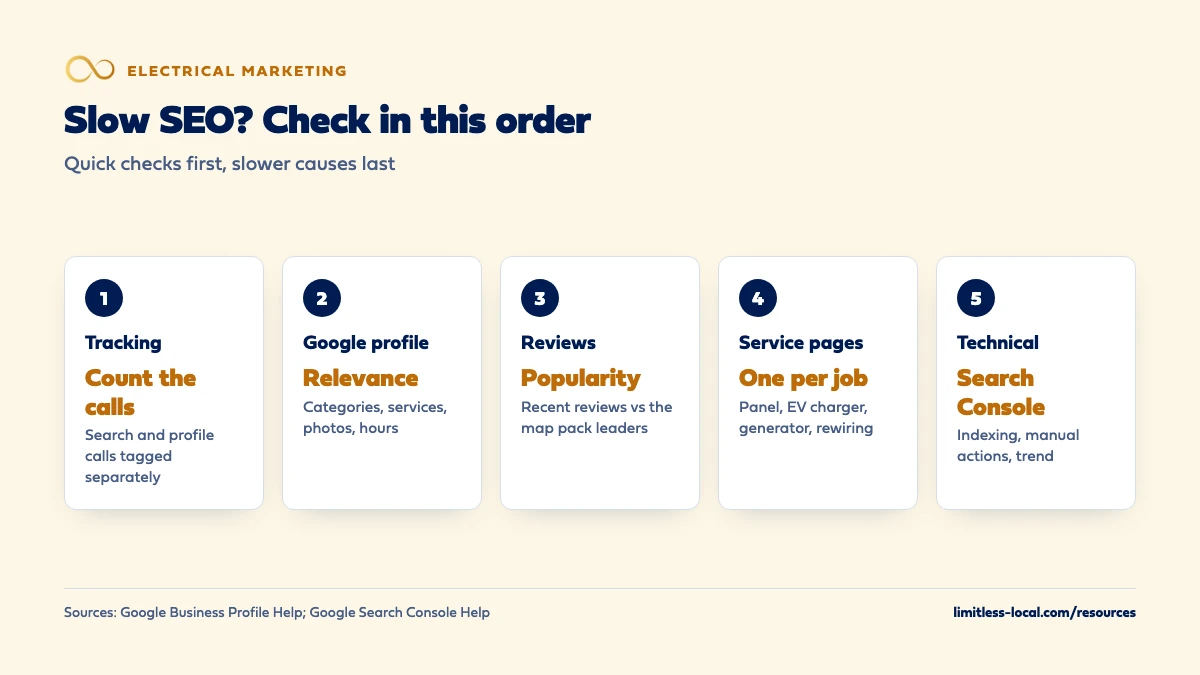
What should I fix first?
- Tracking. Make sure you can see calls and form requests from search and your profile, separately from everything else. Otherwise you can’t tell whether anything below helped.
- The Google profile. Categories, services, photos and hours. It’s quick and often the biggest win.
- Reviews. Start the after-every-job ask this week.
- Service pages for the two or three jobs you want most.
- Technical checks in Search Console: indexing, manual actions, the Performance trend.
- Targets. If the market’s crowded, narrow the searches and towns you’re going after.
Change one or two things at a time and give each a few weeks. If you change everything at once, you won’t know what worked.
Should I run ads while SEO catches up?
If the phone has gone quiet and you need calls this month, yes, it’s worth considering. Ads can generate leads within days of launch, while SEO builds. Google’s advice on hiring an SEO is clear that advertising has no effect on where you show up in its regular search results, so ads won’t speed up your rankings. They just bring calls in the meantime.
Keep the ads tight: the jobs you want, the towns you serve, and a page that matches the ad. And track them separately, so you can see what search is producing on its own as it ramps up.
Not sure which of these is costing you jobs?
A free visibility audit checks the Google profile, reviews, site and tracking, and shows what to fix first.
What's different when electrician SEO is slow
Your job mix splits the timeline. A service call, a panel upgrade, an EV charger and a whole-home generator are different searches with different competition. It’s normal for one to move fast while another hasn’t budged, so judge each job you care about on its own.
You’re probably a service-area business. Most electricians don’t have a storefront, and the map pack leans on how far you are from the person searching. Showing up near your shop long before you show up 40 minutes away is normal, not a sign that SEO is broken.
Storm season can skew the numbers. A run of outages can flood the phone with generator and repair calls one month and drop off the next. Compare the same months year over year, or the trend will mislead you in either direction.
A worked example: slow or stuck?
These numbers are made up to show the math, not a benchmark for your market. Say two electrical shops started SEO at the same time and track calls from search and their Google profile each month.
- Shop A: 4 calls in month one, then 5, 7, 9 and 12 by month five. That’s a ramp. It’s slower than the owner hoped, but it’s working, and the job is to keep going and fix what’s lagging.
- Shop B: 4 calls in month one and 4 or 5 every month after. That’s stuck. Something on the list above is blocking it.
Now put a dollar figure on Shop A’s month five. If 12 calls lead to four booked jobs at a made-up $600 average, that’s $2,400 of work from search that month, and it’ll keep growing if the trend holds. Shop B’s flat line is the one that needs a diagnosis, not more patience.
On our side, Essentials ($3,500 a month) includes Google Business Profile management, a content sprint of up to 10 pages, review response and basic review generation, and call, web and form tracking, so the usual causes of a slow ramp are covered in one plan.
Frequently asked questions
How long should I give SEO before I call it a failure?
Give it at least the 3-6 month ramp, judged on the trend in calls from search and your profile, not on where you rank for one broad search. If calls are still flat after that, look for the cause before deciding SEO doesn’t work for you.
Can I speed SEO up by paying Google?
No. Google doesn’t accept money to include or rank sites in its regular search results. Ads can bring calls in the meantime, but they’re a separate channel.
Why do I rank at my shop but not across town?
Distance from the person searching is one of the main things Google weighs in local results. It’s normal to show up near your shop first and farther out later, if at all.
Will posting on my Google profile every week fix slow SEO?
Posts keep your profile active and can help customers, but they won’t make up for missing categories, a thin services list or a review gap. Fix those first.
Should I switch SEO companies if it's slow?
First check whether it’s slow or stuck, and whether the cause is on their side or yours, like missed calls or no review requests. If the work isn’t getting done or they can’t explain what they’re targeting and why, that’s a different conversation.
Does a new website reset my SEO?
It can if old pages aren’t redirected to the new ones. Google says to expect ranking fluctuations during a site move and to keep redirects in place for at least a year.
Key takeaways
- SEO typically takes 3-6 months to show meaningful organic growth; judge the trend, not one search.
- Slow means calls are creeping up; stuck means they’re flat, and stuck has a cause.
- Check tracking and the Google profile first, then reviews, service pages and technical issues.
- In a crowded market, aim at specific jobs and nearby towns before broad searches.
- Ads can bring calls while SEO builds, but they don’t change your organic rankings.
Want a second set of eyes on your setup?
We'll look at how you show up locally and where calls are leaking, then send you a plain-English breakdown.
More in this section
- Why does SEO take longer than Google Ads for electricians?
- What happens to electrician calls if I stop paying for SEO?
- What should I fix on my electrical website before investing in SEO?
- Will cheap backlinks or fake reviews speed up electrician SEO?
- What should an electrician check weekly to see if SEO is working?
Sources
- SEO Starter Guide: The Basics — Google Search Central
- Tips to improve your local ranking on Google — Google Business Profile Help
- Understand your Business Profile performance & insights — Google Business Profile Help
- URL Inspection tool — Search Console Help
- Manual actions report — Search Console Help
- Performance report (Search results): Overview and basic setup — Search Console Help
- Site Moves and Migrations — Google Search Central
- Do You Need an SEO? — Google Search Central