
What is a good cost per lead for roofing Google Ads?
- What's a reasonable cost per lead on Google Ads for a roofing company?
- Why isn't there one good cost per lead for every roofer?
- What counts as a lead in my roofing Google Ads account?
- How do I work out a cost per lead my roofing company can afford?
- Should repair and replacement leads have different cost-per-lead targets?
- Why is a cheap roofing lead sometimes the most expensive one?
- What pushes roofing cost per lead up or down?
- How do I check which searches I'm paying for?
- Can I tell Google Ads what I want to pay per lead?
- Should I compare my Google Ads cost per lead with Facebook or lead sites?
- What should I do if my roofing cost per lead is too high?
- What's different about cost per lead for roofing companies
- A worked example: the cheap lead that cost more per roof
- Frequently asked questions
- Key takeaways
- More in this section
- Sources
The short version
- There's no honest national number: what a lead can cost depends on your job value and close rate.
- Set separate cost-per-lead limits for repair and replacement campaigns.
- Clean your tracking first: short calls, spam forms and out-of-area clicks shrink the number falsely.
- Judge leads by what each signed roof cost, not by the cheapest lead.
For roofing owners looking at the cost-per-lead number in their Google Ads account and wondering whether it’s good, bad or lying to them.
Get a free visibility audit · Book a growth call
What's a reasonable cost per lead on Google Ads for a roofing company?
A good cost per lead for roofing Google Ads is one your close rate and job value can carry, so it’s different for every roofer, and different for repairs and replacements. A replacement lead can be worth paying several times more for than a repair lead, as long as enough of those leads become signed roofs. Before you judge the number at all, make sure your account counts only real calls and form requests from your towns, because junk leads make a cheap cost per lead look better than it is.
Cost per lead is one line in the report we hand every roofer; the line we care about most sits under it, cost per signed roof. Google Ads management is part of our local ads work and of every package on our roofing marketing page. If you’re still deciding whether Google Ads makes sense at all, is Google Ads worth it for roofing walks through that decision, and the roofing marketing questions library takes the follow-ups one at a time.
Why isn't there one good cost per lead for every roofer?
Because a lead is only worth what it turns into. Two roofers can pay exactly the same for a lead and get very different deals: one signs a full replacement from every handful of calls, the other mostly books small leak repairs. The same price per lead is a bargain for the first and a slow loss for the second.
Your market moves the price too. What you pay for each click comes from an auction. Google says your actual cost per click depends on your ad quality, your bid, the competitiveness of the auction and the context of the search, and that ads shown above the search results usually cost more per click than ads below them (Actual cost-per-click (CPC): Definition). A metro full of roofers bidding on the same searches costs more than a small town with two or three of you.
A national “average roofing cost per lead” is somebody else’s market and somebody else’s close rate. Yours comes from your own books.
What counts as a lead in my roofing Google Ads account?
Whatever you’ve told Google to count. In Google Ads, a lead is a conversion, and conversions are the actions you set up: calls from the ad, calls to the tracking number on your site, form fills, maybe chat messages. Your cost per lead is simply your spend divided by those conversions, shown in the Cost / conv. column.
That means the number is only as good as the setup behind it. Common problems in roofing accounts:
- Every call counts, however short. For calls from ads and calls to your website number, you choose a minimum call length, and every call that lasts at least that long is counted as a conversion. Set it too low and hang-ups and wrong numbers count as leads.
- Page views counted as leads. Someone who reached the thank-you page by accident, or a button click with no form sent, can show up as a conversion if the tracking is set up loosely.
- The same homeowner counted twice. A call and a form from one person can show as two leads.
- Calls nobody tracks. If homeowners call the number printed on your site and it isn’t a tracking number, real leads go missing and your cost per lead looks worse than it is.
Google lists the call conversion options and how the minimum call length works (About phone call conversion tracking). If you aren’t sure your calls and forms are being counted properly, how a roofer tracks calls and forms from Google walks through the setup.
How do I work out a cost per lead my roofing company can afford?
Start from the signed roof and work backwards. You need two numbers from your own books:
- The most you’ll spend to win one signed job. That’s your ceiling. It comes from the job’s gross profit and how much of it you’re willing to hand to marketing.
- How many leads it takes to sign one job. Count your Google Ads leads from the last few months and the signed jobs that came from them.
Divide the first by the second, and that’s the most a lead can cost before the campaign stops paying. If you’ll spend up to a certain amount on a signed replacement and it takes eight leads to sign one, a lead can cost up to an eighth of that amount.
Working out the ceiling itself, from your average job price and gross margin, is covered step by step in what cost per booked job a roofing company should aim for. This page picks up from there: once you have a ceiling, is the cost per lead in your account actually good?
Should repair and replacement leads have different cost-per-lead targets?
Yes, and this is the most common reason a roofer’s cost per lead looks fine while the business doesn’t feel it. A leak repair and a full tear-off are different jobs with different profit, and the homeowner searching for each one is in a different spot.
Repair searches tend to be urgent and cheap to close, but the job is small. Replacement searches take longer to close, because there’s an inspection, an estimate, often a second opinion and sometimes an insurance claim, but one signed job can carry a much higher lead cost.
If both kinds of search land in one campaign, the account averages them into one cost per lead that tells you nothing. Split them into separate campaigns or ad groups, give each its own limit, and judge them separately. When repair leads eat the budget, replacement searches can go unanswered, and the account still looks cheap. Whether to market repairs or replacements goes deeper into that choice.
Curious what your marketing is actually booking?
Get a free visibility audit — no obligation, no sales pitch.
Why is a cheap roofing lead sometimes the most expensive one?
Because cheap leads often come from the wrong searches. A campaign that’s wide open will happily buy clicks from people looking for roofing jobs, DIY shingle prices, a supply house, or a roofer three counties away. Those leads cost little, sign rarely, and eat your office’s time on the phone.
Any time someone says they cut your cost per lead in half, ask what happened to signed jobs in the same period. The worked example below shows why.
The reverse is true too. A cost per lead that looks high can be a great deal if it comes from homeowners searching for a roof replacement in the towns you want, and a good share of them sign.
What pushes roofing cost per lead up or down?
Most of what moves your number is in your settings, not in Google’s prices:
- Which searches you show for. Google offers three keyword match types. Broad match can show your ad on searches related to your keyword, even ones that don’t contain its direct meaning; phrase match shows on searches that include the meaning of your keyword; exact match gives you the most steering over who sees your ad, but reaches fewer searches (About keyword matching options). Looser matching usually means cheaper leads and more junk.
- Where your ads show. By default, location targeting reaches people in your targeted area and people who have only shown interest in it. The Presence option limits ads to people who are, or regularly are, in your target locations (About advanced location options). For a roofer who has to drive to the house, that setting matters.
- Your ad and landing page. Ad quality is part of how Google prices each click, so a roof replacement ad that lands on a page about roof replacement, in your towns, tends to do better than one that lands on your homepage.
- Competition and season. More roofers bidding, after a storm or in spring, pushes click prices up.
- What you count. Every tracking problem from the section above changes the number without changing a single real lead.
How do I check which searches I'm paying for?
Open the search terms report. Google describes it as a way to see how your ads performed when triggered by actual searches, which is different from the keyword list you set up (About the search terms report).
Read it once a week while a campaign is new, and look for searches no roofing customer would type:
- Jobs and careers: roofer jobs, roofing apprentice, roofing salary.
- Do-it-yourself and supplies: how to patch a roof, shingle prices, roofing nails.
- Work you don’t do: metal buildings, flat commercial roofs, gutters, if those aren’t yours.
- Towns you don’t serve.
Add the junk as negative keywords. Google says negative keywords let you exclude search terms from your campaigns and focus on the keywords that matter to your customers (About negative keywords). A ready-made starting list is in which negative keywords a roofer should add to Google Ads.
Can I tell Google Ads what I want to pay per lead?
Yes. With the Target CPA bid strategy, you set the average cost per conversion you want, and Google sets bids to get as many conversions as it can at that average. Some leads will cost more than your target and some less. Google is clear that your actual cost per conversion also depends on things outside its control, like changes to your website or ads and competition in the auction (About Target CPA bidding). Before you can use it, you need conversion tracking set up.
Two cautions specific to roofing. First, a target cost per lead only helps if your conversions are real leads; set it on a messy account and Google will chase whatever is cheapest to count. Second, if repairs and replacements share a campaign, one target can’t fit both. Set targets per campaign, using the affordable cost per lead you worked out from your books.
Should I compare my Google Ads cost per lead with Facebook or lead sites?
Not head to head. A Google Ads lead is usually a homeowner who searched for a roofer and called you. A Facebook lead is often someone who tapped a form while scrolling, and a lead from a lead site may be sent to several roofers at once. Each one costs a different amount and signs at a different rate, so the cost per lead alone can’t tell you which is better.
Compare them on cost per signed roof instead. Tag every lead with where it came from, follow it through to signed or lost, and divide each channel’s spend by its signed jobs.
What should I do if my roofing cost per lead is too high?
Work through it in this order, cheapest fix first:
- Check the count. Are real calls missing from tracking? Missing leads make cost per lead look worse than it is.
- Check the searches. Junk in the search terms report means you’re paying for clicks that never call.
- Check the map. Location set to the towns you serve, with the Presence option if out-of-area clicks are a problem.
- Check the page. Does the page match the ad, load fast on a phone, and show a phone number you can tap?
- Check the phone. Leads that ring out or wait a day for a callback don’t become jobs, and that shows up as a high cost per signed roof.
Only then think about bids and budget, and give any change a few weeks of leads before you judge it; how long to run roofing Google Ads before judging them covers when it’s fair to decide. If clicks are coming in but the phone isn’t ringing, roofing ads getting clicks but no calls goes through each cause.
Want to see where your company stands?
A free visibility audit shows where you show up on Google, Maps and AI answers, and what it's costing you in calls.
What's different about cost per lead for roofing companies
Storms change the price overnight. After hail or high wind, more roofers bid on the same searches, and click prices jump with them. Don’t compare storm week with a quiet month.
A lead isn’t a job yet. Most roofing leads go through an inspection and an estimate before anyone signs, and insurance work can take longer still. That gap is why roofers need a cost per inspection as an early check and a cost per signed roof as the final one.
One replacement pays for a lot of leads. High-ticket work gives roofers room that a service-call trade doesn’t have, but only if those leads really are replacement leads. That’s why the repair and replacement split matters more in roofing than almost anywhere else.
A worked example: the cheap lead that cost more per roof
These numbers are made up to show the math, not a benchmark for your market. A roofer runs two replacement campaigns for a month.
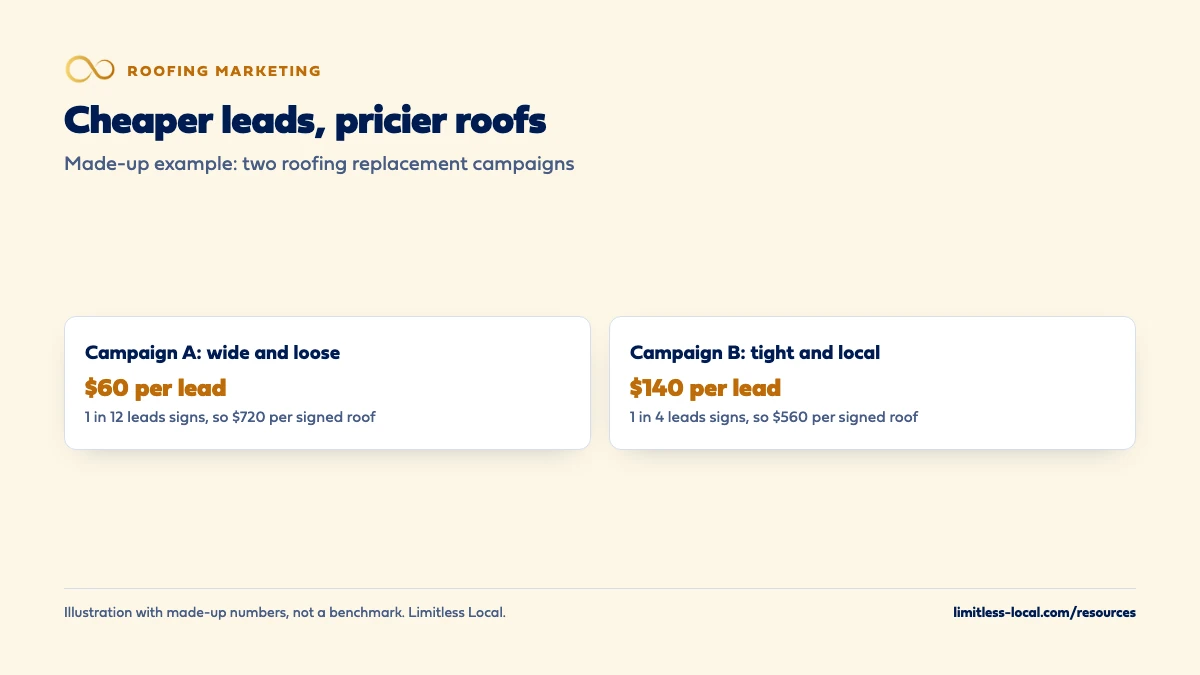
- Campaign A uses broad match across a wide area. It costs $60 per lead, and about 1 in 12 leads becomes a signed roof. Cost per signed roof: $60 x 12 = $720.
- Campaign B uses tighter keywords, the Presence location option and a dedicated replacement page. It costs $140 per lead, and about 1 in 4 leads signs. Cost per signed roof: $140 x 4 = $560.
Campaign A has the better-looking cost per lead. Campaign B wins the signed roofs, at $160 less each, and the office spends far less time on calls that go nowhere.
Management is a separate line from ad spend. Our Essentials package, $3,500 a month, includes Google Ads management for up to $2,500 a month in ad spend, and ad spend is always paid to Google directly. Whether that pencils out comes down to the same cost-per-signed-roof math, which is what a free visibility audit checks for your service area.
Frequently asked questions
Is cost per lead the same as cost per click?
No. Cost per click is what you pay each time someone clicks your ad. Cost per lead divides your spend by the calls and forms you actually got, so it includes all the clicks that never called.
Should a roofing lead from Google Ads cost more than a Local Services Ads lead?
It can go either way, depending on your market and settings. Local Services Ads charge per lead, while search ads charge per click, so compare the two on cost per signed roof once both have run for a while.
Do storm-damage searches give cheaper leads?
Usually the opposite while the storm is fresh, because more roofers bid on the same searches. Track storm campaigns separately so they don’t distort your normal numbers.
Can Google Ads charge me for a lead from a town I don't serve?
You pay for the click, wherever it came from. Use location targeting with the Presence option, exclude areas you won’t drive to, and check the location report so out-of-area clicks don’t eat the budget.
What's a sign my cost per lead is being reported wrong?
Leads in Google Ads that don’t match the calls and forms your office actually got. If the account shows many more leads than your team remembers, the tracking is counting things that aren’t leads.
Key takeaways
- A good cost per lead is one your own close rate and job value can carry, not a national average.
- Give repair and replacement campaigns separate cost-per-lead limits.
- Fix call length, spam forms and duplicates before trusting the number.
- Match types, location settings and the landing page move cost per lead more than anything else you control.
- Judge every campaign by cost per signed roof; the cheapest lead often isn’t the cheapest roof.
Not sure what's working right now?
Start with a free visibility audit: rankings, Google profile, reviews and tracking, checked against your service area.
More in this section
- How do I get commercial roofing leads with Google Ads?
- How long should I run roofing Google Ads before judging them?
- What should a roofing Google ad actually say?
- Are Google Local Services Ads worth it for a roofing company?
- Do Facebook ads work for getting roofing leads?
Sources
- Actual cost-per-click (CPC): Definition — Google Ads Help
- About phone call conversion tracking — Google Ads Help
- About keyword matching options — Google Ads Help
- About advanced location options — Google Ads Help
- About the search terms report — Google Ads Help
- About negative keywords — Google Ads Help
- About Target CPA bidding — Google Ads Help