
How long does it take to improve roofing ad lead quality?
- How long until better targeting and landing pages bring better roofing leads from ads?
- What does bad lead quality look like for a roofer?
- Which lead quality fixes work within days?
- How often should I check search terms while fixing lead quality?
- How long do landing page changes take to improve leads?
- How long does cleaning up my conversion tracking take?
- What happens to my ads right after I change what counts as a lead?
- How long until bidding learns which leads become roofs?
- How long does it take to improve Local Services Ads lead quality?
- What makes lead quality improve faster or slower?
- How do I know lead quality is actually getting better?
- What's different for roofers
- A worked example: a roofer's lead-quality timeline
- Frequently asked questions
- Key takeaways
- More in this section
- Sources
The short version
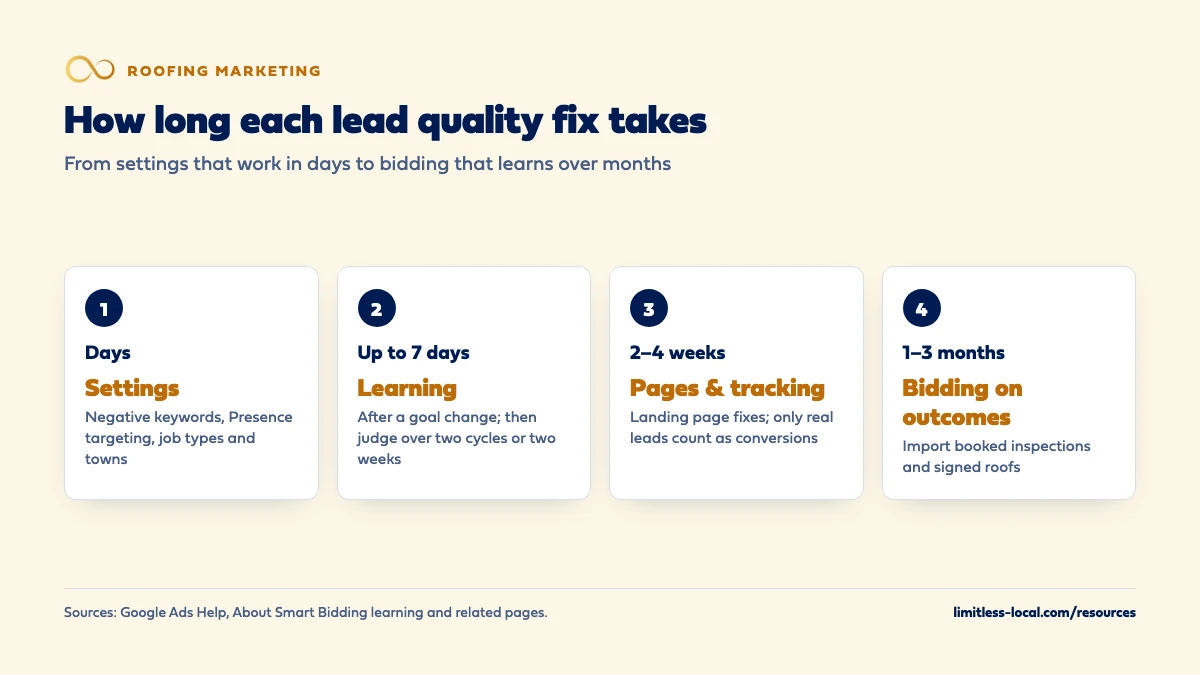
- Days: negative keywords, location settings and job types.
- Two to four weeks: landing page changes and cleaner tracking show in the lead mix.
- One to three months: bidding that learns from booked inspections and signed roofs.
- Change one thing at a time and track lead quality weekly.
For roofing company owners getting calls from their ads, just not the right ones, and wondering how long the fixes take to show.
Get a free visibility audit · Book a growth call
How long until better targeting and landing pages bring better roofing leads from ads?
The quickest fixes to roofing ad lead quality, like blocking junk searches, tightening location settings and turning off wrong job types, work in days, because Google applies them from the next auction. Landing page and tracking fixes usually show within two to four weeks, once enough new leads have come in to compare. Teaching Google’s bidding to chase signed roofs instead of any call takes longest: a couple of months, because the system needs time after a goal change and roofing leads take weeks to become jobs.
Lead quality work is the weekly grind of our local ads management: search terms, negative keywords, location settings, landing pages and tracking that tells Google which leads became jobs. It’s part of every roofing marketing package, with Local Services Ads on Growth and Scale. If you’re still deciding whether ads are right for you at all, read whether Google Ads are worth it for roofing, and the roofing marketing questions library has the follow-ups.
What does bad lead quality look like for a roofer?
Before you fix it, name it. Pull your last month of ad leads and sort the bad ones into piles:
- Wrong searches: job seekers, DIY questions, people shopping for shingles.
- Wrong places: homeowners two counties past where your crews drive.
- Wrong jobs: gutter cleaning, commercial flat roofs you don’t do, a quote for a shed.
- Wrong people: renters, “just getting prices”, sales calls.
- Not really leads: hang-ups, duplicate forms, clicks on your phone number that never became a call.
Each pile has a different fix and a different timeline. The biggest pile is where to start. If you can’t sort your leads because nobody logged them, that’s the first fix, and the rest of this page depends on it.
If the problem is fewer calls rather than worse ones, why roofing ads get clicks but no calls is the better starting point.
Which lead quality fixes work within days?
Settings that decide who sees your ads take effect quickly. Google’s page on Smart Bidding learning says updates to budgets, targets and targeting settings take effect in the next auction and don’t trigger a “Learning” status. So within days you can:
- Block junk searches. Google’s guide to negative keywords explains that they exclude search terms from your campaigns. Negatives don’t cover close variants, so add both singular and plural versions, like job and jobs.
- Tighten locations. By default, Google reaches people in your towns and people who’ve shown interest in them. Google recommends that broader default for most advertisers, but its page on advanced location options says to consider the “Presence” setting when you only want to reach people in specific locations. For a roofer whose crews only drive to certain towns, that’s usually the right call.
- Fix ad schedule and call hours so calls don’t ring out at night.
- Narrow Local Services Ads job types and towns to the work you want.
You’ll see fewer junk leads within the first week. What you won’t see yet is whether the leads that remain sign more often. That takes longer.
How often should I check search terms while fixing lead quality?
Weekly at first. The search terms report shows the actual searches that triggered your ads, and it’s where most roofing junk shows up: “roofing jobs near me”, “how to patch a roof”, “shingle prices”, competitor names you don’t want to pay for.
The first two or three weeks usually catch the bulk of it. After that, new junk slows to a trickle, and every two weeks is enough for most roofers, with an extra check after any storm, when search behavior in your area changes overnight.
Don’t block words homeowners use when they’re ready to hire, like cost, price, estimate, inspection or storm damage. Blocking “cost” to dodge price shoppers can cut out real replacement leads. Which negative keywords a roofer should add has a starter list.
How long do landing page changes take to improve leads?
The change is live the moment you publish it, but you need enough new leads to tell whether it worked. For most roofers that’s two to four weeks of normal demand.
Google rates each keyword’s landing page experience as above average, average or below average, and describes better pages as well organized, with text that relates to what people searched. For lead quality, the page also does a screening job. Changes that tend to filter out the wrong leads:
- Name the jobs you do, and the ones you don’t.
- List your towns. An out-of-area homeowner who sees the list often doesn’t call.
- Ask one or two qualifying questions on the form, such as address and type of job. A shorter form gets more leads; a slightly longer one gets better ones.
- Match the ad. An ad for replacements should land on a replacement page.
Whether roofing ads should go to your homepage or a landing page covers building that page.
Curious what your marketing is actually booking?
Get a free visibility audit — no obligation, no sales pitch.
How long does cleaning up my conversion tracking take?
The setup takes a day or two. The effect on lead quality builds over a few weeks, because your bidding has been chasing whatever you told it to count.
If your account counts phone-number clicks, short calls and every form fill as conversions, Google’s automated bidding is working to get you more of exactly those, including the junk. Google’s page on primary and secondary conversion actions explains that primary actions are used for bidding, while secondary ones are for observation only. So the fix is to make real leads primary and move the rest to secondary:
- Calls from ads and your website above a sensible minimum length: primary.
- Completed estimate forms: primary.
- Clicks on your phone number, page views, chat opens: secondary.
Expect your reported conversions to drop after this. That’s not the campaign getting worse; it’s your numbers getting honest.
What happens to my ads right after I change what counts as a lead?
Changing which conversions you optimize to is a goal change, and that’s one of the few changes that puts a Smart Bidding strategy into “Learning” status. That status never lasts more than 7 days, and ads keep running normally during it. The system then takes one to two conversion cycles to settle on the new goal, and performance is best judged over the next two conversion cycles or two weeks, whichever is longer.
In practice, for a roofer:
- Week one: some wobble in leads and spend. Leave it alone.
- Weeks two to four: the bidding settles on the new goal. Start comparing lead quality to the month before.
- After that: judge it.
The worst thing you can do here is change the goal again in week one because the numbers moved. How long to run roofing Google Ads before judging them covers the waiting game in more detail.
How long until bidding learns which leads become roofs?
This is the slowest fix and the most powerful. Instead of telling Google “this was a call”, you tell it “this call booked an inspection” or “this one signed”. Google’s page on offline conversion imports explains that you can import what happens after the click, such as a sale over the phone or at your office, so you measure the outcome, not just the lead. Google now recommends enhanced conversions for leads as the easier version of this.
For roofing, the timeline stretches because roofs sign slowly. A lead that comes in today may book an inspection this week and sign three weeks later. So:
- Month one: set up the import and start sending booked inspections, which happen fastest.
- Months two and three: enough outcomes pile up for the bidding to start favoring the searches and towns that book.
- After that: add signed roofs once you have a steady flow of them.
It only works if your office marks every outcome. How to track which roofing leads turn into signed jobs covers the habit.
How long does it take to improve Local Services Ads lead quality?
Local Services Ads have fewer levers, and the timeline is mostly about settings and credits. Google’s page on how leads work says leads judged invalid or low quality aren’t charged, and that charged leads are reassessed over a 30-day period and may be credited. You can also rate a lead in the feedback survey, and Google will do its best to send more of the leads you want and fewer of those you don’t.
So the rhythm is:
- Days: narrow job types and service areas to the work you actually want.
- Ongoing: give honest feedback on bad leads as they come in.
- Weeks: credits on low-quality leads show up within that 30-day window.
Answering fast matters here too. A missed call during business hours can still be a charged lead, and a homeowner you call back an hour later is often already talking to someone else.
What makes lead quality improve faster or slower?
Faster:
- More leads per week, so changes show up in the numbers sooner.
- Fixing the biggest pile of bad leads first.
- One change at a time, so you know what worked.
- An office that logs every lead and its outcome.
Slower:
- Small budgets or small towns, with only a handful of leads a week.
- A storm in the middle of your test, which floods the account with different searches.
- Changing the goal, the landing page and the budget in the same week.
- No outcome tracking, so nobody knows which leads signed.
A roofer with steady volume and good tracking can see most of the improvement within a couple of months. A low-volume account in a quiet season may need a full quarter.
How do I know lead quality is actually getting better?
Track three numbers every week, from your own records, not the ad platform’s:
- Share of leads that are real: right town, right job, a homeowner, a real conversation.
- Share of real leads that book an inspection.
- Cost per booked inspection, and later, cost per signed roof.
If the first number climbs while total leads drop a little, that’s often a good trade. Fewer, better leads cost your office less time and close more often. If total leads drop sharply and the share of real leads doesn’t move, you’ve cut too much. Loosen the last change and try again.
Price shoppers are a separate problem from junk: they’re real homeowners who aren’t ready to pay for quality. How to stop price shoppers calling your roofing company covers that.
Talk it through with someone who runs this every day
A 15-minute growth call: your market, your numbers, and what a realistic budget looks like. No pressure.
What's different for roofers
Storms reset the clock. After hail or high winds, search terms in your area change overnight, out-of-town crews start bidding, and junk leads spike. Pause non-urgent tests during a storm and restart the comparison once things settle.
Slow signing stretches every timeline. A roofer can’t judge lead quality by signed roofs after one week, because good leads may not sign for a month. Use booked inspections as the earlier signal.
Repair and replacement leads look different. Many repair calls are small or one-off; replacement leads are fewer and worth more. If you want replacements, separate campaigns for each let you judge quality without one hiding the other.
A worked example: a roofer's lead-quality timeline
These numbers are made up to show the timeline, not a benchmark. A roofer’s ads bring 42 leads a month, but only 16 are real, about 38%.
- Week one: they add negatives for jobs, DIY and supplies, switch locations to Presence, and drop two towns. Leads fall to a pace of 32 a month, with 17 real: about 53%.
- Weeks two to five: a replacement landing page with a town list and an address field. The pace settles around 31 a month with 19 real: about 61%.
- Months two and three: booked inspections are imported and set as the bidding goal. Leads hold near 31, but more of them book inspections.
Total leads dropped by a quarter. Real leads went up, and the office spent far less time on junk calls. The first week’s settings did the most, fastest; the bidding work paid off last.
Our Essentials package, at $3,500 a month, includes Google Ads management up to $2,500 in spend and a landing page; Growth, at $4,500 a month, adds Local Services Ads management and Google Ads up to $5,000 in spend. Ad spend is paid to Google separately.
Frequently asked questions
Will fixing lead quality lower the number of leads I get?
Usually a little, at first. That’s fine if the share of real leads rises. If total leads fall sharply and quality doesn’t improve, undo the last change.
Should I pause my ads while I fix lead quality?
Usually not. Most fixes work on a live campaign, and pausing takes away the new leads you need to see whether the fixes worked.
Can I make my roofing ads only show for replacement searches?
You can lean them that way with replacement keywords, a replacement landing page and negatives for repair-only searches, but some repair calls will still come through. Separate campaigns make it easier to judge each.
Does a longer form really improve roofing lead quality?
Often, if the added fields are ones a serious homeowner will answer, such as address and job type. Test it against your current form for a few weeks and compare real leads, not total leads.
Why did my reported conversions drop after I fixed tracking?
Because you stopped counting things that were never leads, like phone-number clicks and short calls. The real leads didn’t change; the count got honest.
Key takeaways
- Negative keywords, location settings and job types improve lead quality within days.
- Landing page and tracking fixes need two to four weeks of new leads to judge.
- Changing the bidding goal brings up to a week of learning, then a settling period.
- Teaching bidding to chase booked inspections and signed roofs takes one to three months.
- Change one thing at a time and track real leads and booked inspections weekly.
Ready to compare options?
Book a short growth call and we'll walk through the math for your service area, including when we're not the right fit.
More in this section
- How quickly can each roofing marketing channel produce leads?
- How much do roofing leads cost?
- How fast should a roofing company call back a new lead?
- How does a roofer keep up with leads coming in fast?
- What makes roofing marketing work faster or slower?
Sources
- About Smart Bidding learning — Google Ads Help
- About negative keywords — Google Ads Help
- About advanced location options — Google Ads Help
- About the search terms report — Google Ads Help
- Landing page experience: Definition — Google Ads Help
- About primary and secondary conversion actions — Google Ads Help
- About offline conversion imports — Google Ads Help
- How leads work — Google Local Services Help