
How long until a new pool builder website ranks in Google?
- How long does a brand-new pool builder website take to start ranking in Google?
- Why does a brand-new website start from zero in Google?
- Stage 1: How long until Google finds and indexes my new site?
- Stage 2: What will a new pool website rank for first?
- Stage 3: When will it rank for pool builder searches in my towns?
- Does a new site rank faster if it replaces my old one?
- What can I do in the first month to help Google find the site?
- What slows a new pool website down?
- Can my Google profile bring calls before the website ranks?
- Should I run Google Ads while the new site ramps up?
- How do I tell whether my new pool website is on track?
- What's different about a new website for a pool builder
- A worked example: a new pool website's first months
- Frequently asked questions
- Key takeaways
- More in this section
- Sources
The short version
- Found and indexed: a few days to a few weeks, per Google, though it isn't guaranteed.
- Your company name usually comes first; service and town searches take months.
- SEO typically takes 3-6 months to show meaningful organic growth.
- Your Google profile and ads can bring calls while the new site ramps up.
For pool builders launching a new website, on a new domain or replacing an old one, who want to know what to expect in the first weeks and months.
Get a free visibility audit · Book a growth call
How long does a brand-new pool builder website take to start ranking in Google?
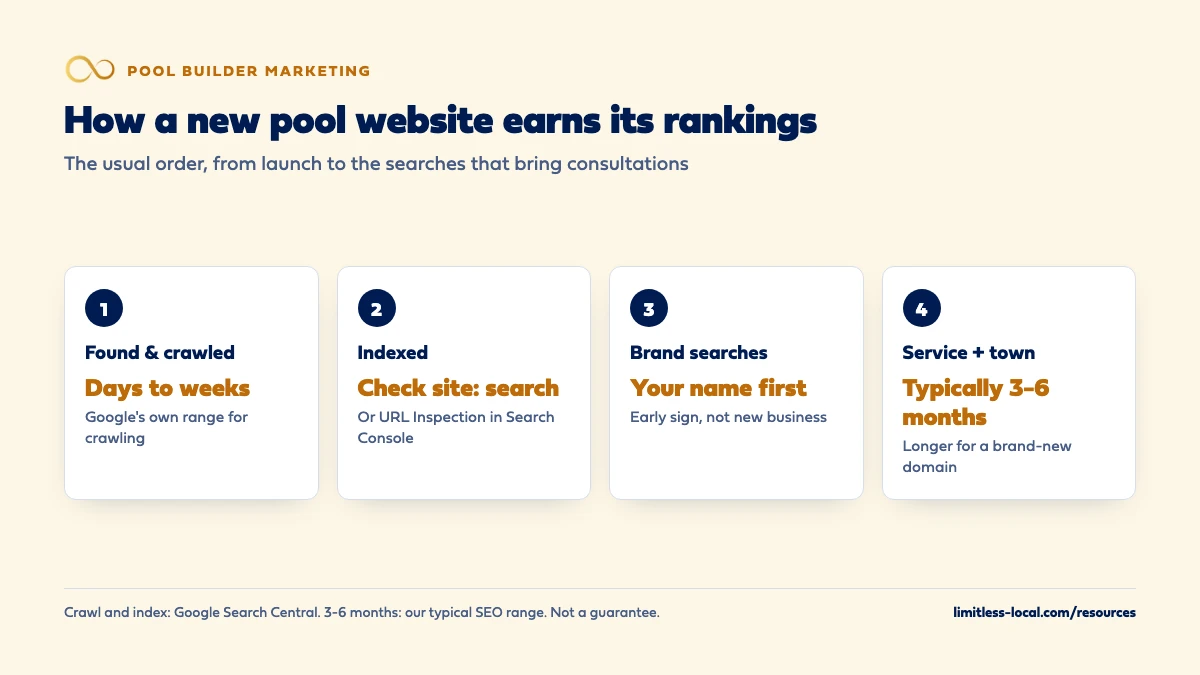
Google says crawling can take anywhere from a few days to a few weeks, so a new pool builder website is usually found and indexed within that window, and in our judgement it will show up for your own company name before anything else. Ranking for the searches that bring consultations, such as a pool type plus a town, takes longer: SEO typically takes 3-6 months to show meaningful organic growth, and a brand-new domain with few links pointing to it tends to sit at the slower end. Google doesn’t guarantee it will crawl or index any page, so check your progress in Search Console instead of waiting.
We plan new sites around that ramp, because the ranking clock only starts at launch: our website builds run from concept to launch in 100 days or less, about 60 days for a themed site. The pool builder marketing page shows how the site fits with a pool company’s Google profile and ads, and the pool builder marketing questions library covers the rest of the timeline questions.
Why does a brand-new website start from zero in Google?
Because Google has to find it first, and nothing points to it yet. Google’s guide to how Search works says there isn’t a central registry of all web pages, so Google must constantly look for new pages. Some pages are discovered when Google follows a link from a page it already knows, and others when you submit a list of pages, called a sitemap.
Google describes three stages, and says not all pages make it through each one:
- Crawling: Google downloads the text, images and videos from the page.
- Indexing: Google analyzes the page and stores it in its index.
- Serving: Google returns the page in results when it’s relevant to a search.
The same page says Google doesn’t guarantee it will crawl, index or serve your page, and doesn’t accept payment to crawl a site more often or rank it higher. A new pool website has to earn each stage in turn. This page covers that early stretch for a new site; for how long SEO takes to bring in leads overall, see how long pool builder SEO takes to bring in leads.
Stage 1: How long until Google finds and indexes my new site?
Google’s page on asking Google to recrawl says crawling can take anywhere from a few days to a few weeks, and to be patient and monitor progress. Two ways to check:
- A site: search. Google’s SEO starter guide suggests searching Google for your site with the site: operator, such as site:yourpoolcompany.com. If results show up, you’re in the index.
- The URL Inspection tool in Search Console, which shows whether a specific page is indexed. Source: URL Inspection tool.
You can ask Google to crawl a handful of important pages through URL Inspection, but Google says there’s a quota for individual requests, and that requesting a recrawl multiple times for the same page won’t get it crawled any faster.
Stage 2: What will a new pool website rank for first?
In our judgement, almost always your own company name. Someone who already knows you and types your name is the easiest search to match, and there’s little competition for it. That’s a good early sign the site is indexed and working, but it isn’t new business; those people would have found you anyway.
Next, usually, come long, specific searches that few other sites answer well, such as a particular pool type with your town, or a question about your build process. Short, crowded searches like “pool builder” plus your city come last.
Google’s starter guide puts timing this way: some changes might take effect in a few hours, others could take several months, and in general you’ll likely want to wait a few weeks to assess whether your work had beneficial effects. It also says not every change will make a noticeable difference.
Stage 3: When will it rank for pool builder searches in my towns?
This is where the usual SEO timeline applies. SEO typically takes 3-6 months to show meaningful organic growth. For a brand-new domain, in our judgement, expect the later half of that range or longer in a crowded market, because the site has no history and few or no other websites linking to it yet. Google’s starter guide says Google primarily finds pages through links from pages it already crawled, often other websites, and that those links happen naturally over time.
Searches with a town in them also show local results, the map listings, alongside the regular results. Those are mainly driven by your Google Business Profile, not your website, which is why the profile matters so much in the first months (more below).
Even once the site ranks, a pool builder’s signed contracts come later still, because homeowners take time to compare designs, builders and financing. How a long pool sales cycle changes when SEO pays off covers that lag.
Curious what your marketing is actually booking?
Get a free visibility audit — no obligation, no sales pitch.
Does a new site rank faster if it replaces my old one?
Often, yes, if the move is done carefully, because the old site’s history can carry over. If it isn’t, the new site can lose ground for a while. Google’s site move guide says to expect temporary fluctuation in ranking during a move, that for medium-sized websites it can take a few weeks or more for Google to start showing the new URLs instead of the old ones, and that a small to medium-sized site can take a few weeks for most pages to move. Submitting a sitemap can help make discovery quicker.
The work that protects you, in our judgement: keep the same domain if you can, keep page addresses that already bring traffic, and redirect every old address that changes to its closest new page. Whether a pool website needs a redesign before marketing covers what a rebuild can break.
What can I do in the first month to help Google find the site?
- Set up Search Console. Google calls it a free service that helps you monitor and troubleshoot your site’s presence in Search; you don’t need it to be included, but you can’t see what’s happening without it. Source: About Search Console.
- Submit a sitemap. Google’s recrawl page says a sitemap can be very helpful if you just launched your site, and its sitemap guide names a site that’s new and has few external links as one that may need it, because Googlebot might not discover pages no other sites link to. Many website platforms build one for you.
- Link your important pages from the menu. Google says that if your pages are properly linked, it can usually discover most of your site.
- Point the links you control at the new site. Your Google Business Profile, social profiles, directory listings and, where they exist, equipment and supplier dealer pages.
- Request indexing for the few pages that matter most, such as the home page and your main pool-type pages.
What slows a new pool website down?
Google’s how-Search-works guide lists common reasons pages don’t get crawled or indexed, including server problems, robots.txt rules blocking Google, robots meta rules that disallow indexing, low-quality content and site designs that make indexing difficult. For a new pool builder site, in our judgement, the usual culprits are:
- A “don’t index” setting left over from building the site. Many website platforms have a switch that hides a site from search engines while it’s being built, and it’s easy to forget to turn it off at launch.
- Content hidden behind scripts or images. Google’s starter guide says Google needs to see the page the way a visitor does; text inside images or loaded in ways Google can’t render may be missed.
- Thin, copied town pages. Dozens of near-identical pages that swap only the town name. Whether a pool builder should make a page for every city covers a better approach.
- Gallery pages with no words. Photos of finished pools with no captions, pool types or locations give Google little to index.
Can my Google profile bring calls before the website ranks?
Yes, and for a new site it’s often the faster route. Google says local results on Maps and Search are mainly based on relevance, distance and popularity: how well your Business Profile matches the search, how far you are from the person searching, and how well known your business is, including reviews. Source: Tips to improve your local ranking on Google.
The same page says how well known a business is, which it calls prominence, is also based on information like how many websites link to your business, so the website and the profile help each other over time. If your profile isn’t live yet, how a pool company sets up and verifies a Google profile walks through it, and it’s worth finishing before the site launches.
Should I run Google Ads while the new site ramps up?
If you need consultations before organic search arrives, it’s the usual bridge. Ads can generate leads within days of launch, while SEO is still in its slow early months. The same new site can serve both, as long as the pages ads point to are clear about what you build, where, and how to book a design consultation.
Ads won’t lift the site’s regular rankings; Google says it doesn’t accept payment to rank a site higher. They buy time while the site earns its place. Whether you need a separate page for ads is covered in whether pool builders need a landing page for Google Ads.
How do I tell whether my new pool website is on track?
Watch for these milestones in Search Console, roughly in this order:
- Indexed: your main pages show as indexed in URL Inspection, and a site: search shows them.
- Brand impressions: the Performance report shows impressions for your company name.
- Service impressions: impressions start to appear for pool types, renovations and town names, even at low positions.
- Clicks and inquiries: organic visits turn into consultation requests you can trace to the site.
If the first milestone hasn’t happened within a few weeks of launch, check for a technical block before anything else. If the later ones are slow, that’s normal for a new domain; compare quarter with quarter, not week with week.
Talk it through with someone who runs this every day
A 15-minute growth call: your market, your numbers, and what a realistic budget looks like. No pressure.
What's different about a new website for a pool builder
Launch timing and the season. Homeowners plan pools ahead of summer. In our judgement, a site launched in the slow months has time to get indexed and start ranking before the spring rush; one launched in spring starts its ramp during the busiest stretch.
The gallery is the content. Finished pools are a pool builder’s best proof, but a gallery of unlabeled photos gives Google little to work with. Short captions with the pool type, features and town turn the gallery into pages Google can understand.
Wide service areas tempt thin pages. Pool builders often serve many towns. A few strong pages for your core towns beat dozens of copies.
The payoff is a contract. Even after the site ranks, judge it by design consultations and signed contracts, which arrive months after the first organic inquiry.
A worked example: a new pool website's first months
This is a made-up illustration of how the early months can unfold, not a forecast for your site. Every market and site is different.
- Launch week: the builder verifies the site in Search Console, submits the sitemap the platform generated, links the site from the Google profile, and requests indexing for the home page and the main pool-type pages.
- The next few weeks: a site: search starts showing the main pages, and the Performance report shows the first impressions, nearly all for the company name.
- Months two and three: impressions appear for longer searches, such as a pool type plus a town, mostly at low positions. A first organic consultation request arrives.
- Months four to six: more service searches move up, and organic inquiries become steady enough to count. That fits the typical 3-6 month range for meaningful organic growth.
Throughout, the Google profile and ads carry most of the consultation requests. The website’s share grows as it earns rankings, and the contracts from those inquiries land months later.
Frequently asked questions
Can I pay Google to index my new website faster?
No. Google says it doesn’t accept payment to crawl a site more frequently or rank it higher.
Does submitting a sitemap make my site rank sooner?
It can help Google discover your pages, which Google says is especially useful for a site that just launched. Discovery isn’t ranking, though; pages still have to earn their positions.
Should I buy an old domain to skip the new-site wait?
In our judgement, rarely for a pool builder. Your own name on your own domain is what homeowners, your trucks and your Google profile should all match, and a domain’s past history may not be what you want.
Why does my new site show up for my name but nothing else?
That’s the normal early pattern. Your name has little competition, while service and town searches are crowded and take months for a new domain.
Will a new website hurt my Google Maps ranking?
Not by itself. Local results are mainly based on your Business Profile’s relevance, distance and popularity. Keep the website link on your profile correct, and redirect old addresses if they change.
How often should I request indexing in Search Console?
Only for new or changed pages that matter. Google says there’s a quota, and requesting a recrawl multiple times for the same page won’t get it crawled any faster.
Key takeaways
- Google says crawling can take from a few days to a few weeks, and it doesn’t guarantee crawling or indexing.
- A new pool website usually shows up for the company name first; service and town searches take months.
- SEO typically takes 3-6 months to show meaningful organic growth, and a brand-new domain tends toward the slower end.
- Search Console, a sitemap, clear menus and links from your Google profile help Google find a new site.
- Your Google profile and ads can bring consultations while the website earns its rankings.
Ready to compare options?
Book a short growth call and we'll walk through the math for your service area, including when we're not the right fit.
More in this section
- How long does pool builder SEO take to bring in leads?
- How long do Google Ads take to bring a pool builder calls?
- How does proximity affect a pool builder's Google Maps ranking?
- Which online listings should a pool builder have besides Google?
- How do I get my pool company to rank in Google Maps?
Sources
- In-depth guide to how Google Search works — Google Search Central
- Ask Google to recrawl your URLs — Google Search Central
- SEO Starter Guide — Google Search Central
- What is a sitemap — Google Search Central
- Site moves with URL changes — Google Search Central
- URL Inspection tool — Search Console Help
- About Search Console — Search Console Help
- Tips to improve your local ranking on Google — Google Business Profile Help