
How many plumbing leads before marketing shows booked jobs?

- How many plumbing leads do I need before booked jobs from marketing are a number I can trust?
- Why can't I judge my plumbing marketing on the first few leads?
- How many leads before my booking rate means something?
- How many booked jobs before cost per job means something?
- What counts as a real lead when I'm counting?
- How long does it take to get that many leads from each channel?
- Why do some booked jobs show up weeks after the lead?
- What if I get leads but no booked jobs at all?
- Should I count emergency and planned plumbing work separately?
- How do I track leads to booked jobs without a big system?
- When is it fair to call a channel a dud?
- What's different about counting leads for plumbing companies
- A worked example: the same channel at week one and week four
- Frequently asked questions
- Key takeaways
- More in this section
- Sources
The short version
- Early leads can book right away, but small numbers swing wildly.
- Trust a booking rate after about 30 real leads.
- Trust a cost per booked job after about ten booked jobs.
- Zero bookings from 15 or more real leads is a signal to check now, not later.
For plumbing owners who just started a new channel or campaign and want to know when the booked jobs, or the lack of them, actually mean something.
Get a free visibility audit · Book a growth call
How many plumbing leads do I need before booked jobs from marketing are a number I can trust?
Booked jobs can show up from the first few real leads, but a handful of leads can’t tell you whether the marketing works. Wait for about 30 real leads before you trust a channel’s booking rate, and about ten booked jobs before you trust its cost per booked job, because below that one job more or less swings the numbers too far. For ads that often takes a few weeks; for SEO it takes months, so judge each channel on its own clock.
Counting leads and booked jobs by source is the part most shops skip, and it’s the part that decides whether you can trust any of this. Every Limitless Engine package includes call tracking with recording, source tagging and a monthly report with a cost-per-lead breakdown, so each channel’s leads can be matched to the jobs they booked. See how it works for plumbing companies, or browse more plumbing marketing questions.
Why can't I judge my plumbing marketing on the first few leads?
Because small numbers lie. With five real leads, one extra booked job moves your booking rate by twenty points. Two good calls in a row look like a great channel; two price shoppers in a row look like a waste of money. Neither tells you much about next month.
Early leads also aren’t typical. The first week of a new campaign often catches people who were already searching, a backlog of unhappy customers from a competitor, or a cold snap that sends every phone in town ringing. Some weeks will look better than the channel really is, and some worse.
So the first booked jobs are a good sign that the phone is connected and the setup works. They aren’t a verdict. The verdict needs volume.
How many leads before my booking rate means something?
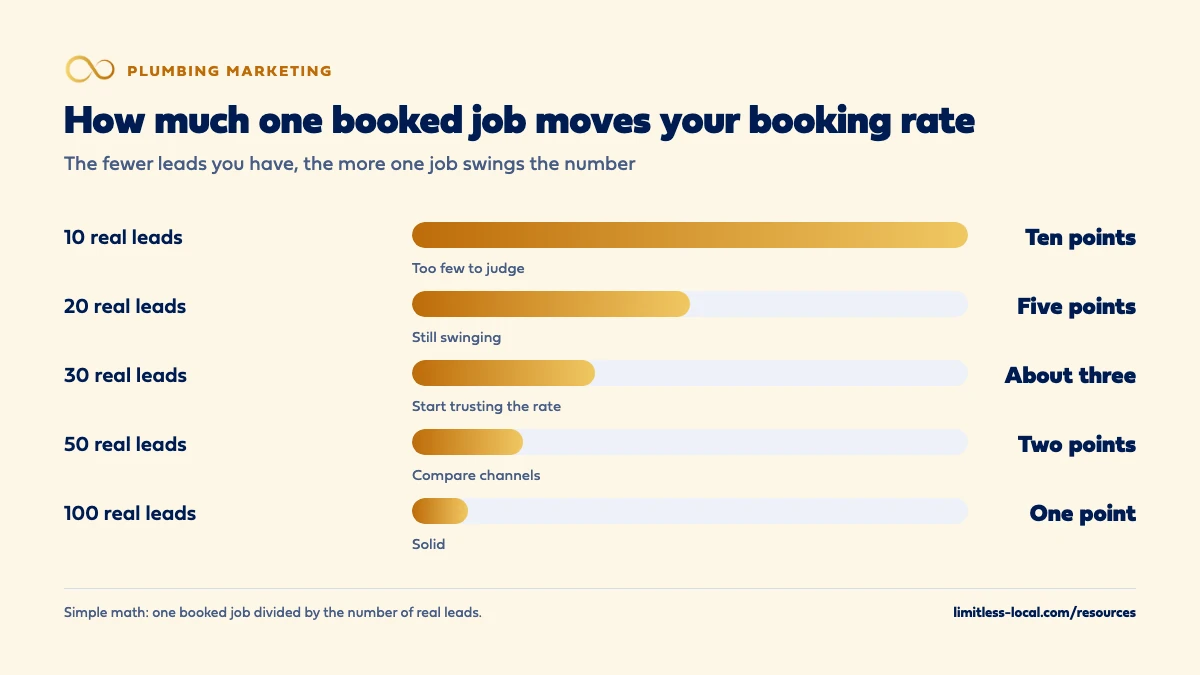
Look at how much one booked job moves the rate at each count:
- 10 real leads: one job moves the rate by ten points.
- 20 real leads: five points.
- 30 real leads: a little over three points.
- 50 real leads: two points.
- 100 real leads: one point.
Around 30 is where a single good or bad call stops changing the picture much. That’s a sensible point to start trusting a booking rate for a channel. At 50 or more you can compare channels side by side with some confidence.
If you’re not sure what a healthy rate looks like for your shop, what percentage of plumbing leads should turn into booked jobs covers it. This page is about when to trust the number, not what it should be.
How many booked jobs before cost per job means something?
Cost per booked job is spend divided by booked jobs, so it swings even harder at low counts. Say a channel cost $1,200. With three booked jobs that’s $400 a job; with four it’s $300. One job changed your cost per job by a quarter.
At ten booked jobs, one more or less moves it by about 10%. That’s the point where cost per job starts being useful for a decision. Before that, track it, but don’t cut or double a budget because of it.
Cost per job also has to include everything: ad spend, management fees, tracking and any software. A realistic cost per booked plumbing job by channel shows how to build that number for each one.
What counts as a real lead when I'm counting?
The count only works if you count the right things. A real lead is a new customer asking about work you do, in an area you serve. Leave out:
- Spam, robocalls and sales pitches.
- Existing customers calling about a job you’re already on, or to reschedule.
- Wrong numbers, job seekers and suppliers.
- Calls for work you don’t do, or from outside your area.
Software can help, but check how it decides. ServiceTitan’s guide to call classifications notes that until call reasons are set up, any call longer than 60 seconds is classified as a lead, which can skew both your lead count and your booking rate.
If lots of your contacts aren’t real leads, that’s its own problem. Whether you have a volume, quality or closing problem sorts it out.
Curious what your marketing is actually booking?
Get a free visibility audit — no obligation, no sales pitch.
How long does it take to get that many leads from each channel?
It depends on your market and budget, but the channels run on very different clocks:
- Google Ads and Local Services Ads can bring leads within days of launch. A shop getting a few real leads a day reaches 30 in two or three weeks; a small budget in a small town might take two months.
- SEO and your Google profile typically take 3 to 6 months to show meaningful growth. Expect few leads at first, so judge SEO on its trend over months, not on a lead count in month one.
- Referrals and repeat customers trickle in at their own pace. You can’t speed up the count, so look at them over a quarter.
- Direct mail and door hangers come in bursts after each drop. Count each drop separately.
If a channel will take more than three months to reach 30 real leads, the budget may be too small to judge it at all. That’s worth knowing before you spend.
Why do some booked jobs show up weeks after the lead?
Planned plumbing work doesn’t book on the first call. A water heater replacement, repipe or sewer line job usually goes through an estimate, a second opinion and a conversation with a spouse. The job might book two or three weeks after the lead came in.
That means a new channel’s booked jobs always lag its leads. In month one you see the emergency calls that booked the same day; the planned work shows up in month two. Judging the channel at day 30 undercounts it.
Google Ads has the same blind spot. Its help page on conversion lag explains that conversions are reported by the date of the search that led to the click, not the day the sale happened, so recent numbers can make cost per conversion look inflated until late conversions catch up. Give recent weeks time to settle before you read them.
What if I get leads but no booked jobs at all?
Zero is the exception to the wait-for-volume rule. If you’ve had 15 or more real leads from a channel and none booked, don’t wait for 30. Something is wrong now, and it’s usually not the channel.
Check, in this order:
- Are the calls being answered? Look at missed and abandoned calls for that tracking number.
- What happens on the answered calls? Listen to five recordings. Does anyone offer a time to come out?
- Are they really your kind of job? Wrong services or wrong towns mean the targeting needs fixing.
- Is the price the problem? If callers hang up after hearing a trip fee or estimate, that’s a pricing or wording question.
Fix what you find, then restart the count from zero.

Should I count emergency and planned plumbing work separately?
If you can, yes. Emergency calls book fast and at a high rate; planned work books slowly and needs estimates. Mixed together, a week full of burst pipes makes a channel look brilliant and a mild month makes it look broken.
The catch is that splitting slows down how fast you reach a trustworthy number. A practical middle ground: count all real leads together to reach 30, and also keep a note of which were emergency and which were planned. Once you have enough, compare the two.
For planned work, also count estimates given, not only jobs booked. If a channel sends plenty of estimate requests that don’t close, the problem may be in the sales visit, not the marketing.
How do I track leads to booked jobs without a big system?
You need two things: every lead tagged with where it came from, and every job tagged the same way. Most field software does this. Housecall Pro has a lead source field that can be tracked on customers, jobs and estimates. Jobber’s Lead Source Report shows the number of leads from each source and the first revenue tied to them.
If you don’t use field software, a simple shared spreadsheet works: date, name, source, real lead yes or no, booked yes or no, job value. The office fills it in as calls come in. Ask every caller how they found you, and use a separate tracking number for each channel so you don’t have to rely on memory.
If your Google Ads book jobs over the phone, you can also send booked jobs back into Google Ads. Google’s page on offline conversion imports covers measuring what happens offline, such as over the phone, after someone clicks your ad. If you’re setting this up for the first time, Google recommends starting with enhanced conversions for leads, its upgraded version.
When is it fair to call a channel a dud?
When all of these are true:
- It has had at least 30 real leads, or a full three months if it’s slower than that.
- Calls were answered, and you’ve listened to a sample.
- Planned jobs had time to book.
- Its cost per booked job, over at least ten booked jobs, stays above what an average job from it earns you.
If it passes all four and still doesn’t pay, cut it or fix the targeting. When a plumbing company should stop spending on a lead source covers that decision in detail.
Not sure which of these is costing you jobs?
A free visibility audit checks the Google profile, reviews, site and tracking, and shows what to fix first.
What's different about counting leads for plumbing companies
Weather skews the count. A hard freeze or a heavy storm can double a week’s emergency calls. If your first weeks with a new channel land on a weather event, keep counting past it before you judge.
Big tickets change the stakes. One sewer line or repipe can pay for a month of marketing on its own. That makes a single job look like proof. Count jobs, not dollars, to judge the channel, then look at dollars to judge whether it’s worth it.
Repeat callers blur the numbers. Past customers often Google your name and tap the first result, which may be your ad. Keep them out of the new-lead count, or the channel gets credit for work that was already yours.
A worked example: the same channel at week one and week four
These numbers are made up to show the math, not a benchmark for your market. A plumbing shop starts a new Google Ads campaign.
- Week one: 6 real leads, one booked. Booking rate 17%. The owner is ready to pull the plug.
- Week two: 14 real leads so far, 5 booked. Booking rate 36%. Now it looks great.
- Week four: 31 real leads, 12 booked, including two water heater jobs that booked from week-one estimates. Booking rate 39%.
Spend over the four weeks was $2,400, so cost per booked job is $2,400 ÷ 12 = $200. At week one there wasn’t even a cost per job to read, and the early booking rate was less than half the real one. Only the week-four numbers are worth acting on. If an average job from this campaign leaves more than $200 in gross profit, it’s paying its way. A free visibility audit can run the same check on your own channels.
Frequently asked questions
Can a channel book jobs in its first week?
Yes, especially ads and emergency calls. Early bookings tell you the setup works; they don’t tell you yet whether the channel pays.
Should I count form fills and texts as leads?
Yes, if they’re new customers asking about work you do. Count them with calls, and tag the source the same way.
What if my market is small and I'll never get 30 leads a month?
Count over a longer stretch, such as a quarter. The math doesn’t care how long it takes to reach the count.
Do Local Services Ads leads count the same way?
Yes. Count the real leads you were charged for and the jobs they booked. Leads Google later credits back can come out of both the cost and the count.
Should the count restart when I change the campaign?
After a big change, such as new towns, new services or a new landing page, yes. Small tweaks don’t need a fresh count.
Is booking rate or cost per job the better number to wait on?
Wait on both. Booking rate tells you how well calls are handled; cost per booked job tells you whether the channel pays.
Key takeaways
- A few early leads can’t tell you whether plumbing marketing works; one job swings the numbers too far.
- Wait for about 30 real leads to trust a booking rate, and about ten booked jobs to trust a cost per job.
- Count only real leads: new customers, work you do, towns you serve.
- Planned work books weeks after the lead, so a channel’s booked jobs always lag its leads.
- Zero bookings from 15 or more real leads means check answering and call handling now.
Want a second set of eyes on your setup?
We'll look at how you show up locally and where calls are leaking, then send you a plain-English breakdown.
More in this section
- What percentage of plumbing leads should turn into booked jobs?
- How do I get more plumbing leads?
- How long until plumbing marketing hits a profitable cost per job?
- What marketing gets a plumbing company to two jobs a day?
- How do I track which plumbing marketing books jobs?
Sources
- Understand call classifications — ServiceTitan Help
- About conversion lag reporting — Google Ads Help
- How to Use Lead Sources — Housecall Pro Help Center
- Lead Source Report — Jobber Help Center
- About offline conversion imports — Google Ads Help